La Princesa and the Pea by Susan Middleton Elya, illustrated by Juana Martinez-Neal

Published by G. P. Putnam’s Sons
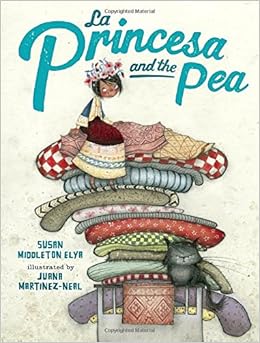
Summary:  The prince is longing for a wife, but no woman is perfect enough for his mother’s approval.  When a maiden happens by, the prince is hopeful, but Mom decides to test her with the old pebble under the mattress(es) trick.  Naturally, the young woman tosses and turns all night, convincing the mother that she’s the one for her son.  There’s a bit of a twist at the end, as it’s revealed that the prince stuck some pitchforks and stones in with the mattresses, but everyone lives happily ever after anyway.  Includes a glossary of Spanish words used in the text and an illustrator’s note explaining how she was inspired by textile arts of indigenous people of Peru in creating her art.  32 pages; ages 4-8.

Pros:  The catchy rhyming text and South American influences in both language and illustrations make this a perfect companion to the more traditional tale of the princess and the pea.

Cons:  Kids will find it helpful to have some background knowledge of the original story before reading this one.
The Princess and the Warrior: A Tale of Two Volcanoes by Duncan Tonatiuh

Published by Abrams Books for Young Readers 

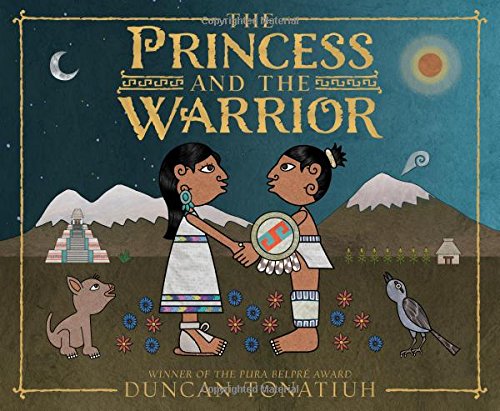
Summary:  Izta is a princess of the people, so when she falls in love, it isn’t with one of the wealthy suitors who travel from distant lands to court her.  The warrior Popoca can’t offer her riches, but he recognizes her kind heart and promises to always be faithful to her.  The king would prefer a more titled son-in-law, but he agrees to let the two marry if Popoca can defeat Jaguar Claw, a neighboring king who has caused trouble for years.  Popoca goes off to battle.  When Jaguar Claw realizes he is near defeat, he sends a messenger to tell Izta that her fiancé has been killed.  Grief-stricken, she drinks a potion that the messenger says will ease her sorrow.  Instead, it puts her into a deep sleep from which she never awakens.  When Popoca returns, he brings her outside to try to revive her, and there they stay, together, until they have turned into the two volcanoes, Iztaccihuatl and Popocatepetl.  An author’s note gives more history of this Aztec legend.  40 pages; grades 1-4.

Pros:  A captivating retelling of a Mexican legend that explains the existence of two volcanoes visible from Mexico City.  Award-winning author-illustrator Duncan Tonatiuh brings his distinctive style to the art done in the traditional Aztec style.

Cons:  Even with the glossary and pronunciation guide at the end, pronouncing the Aztec words is a challenge.

Juana & Lucas by Juana Medina

Published by Candlewick 

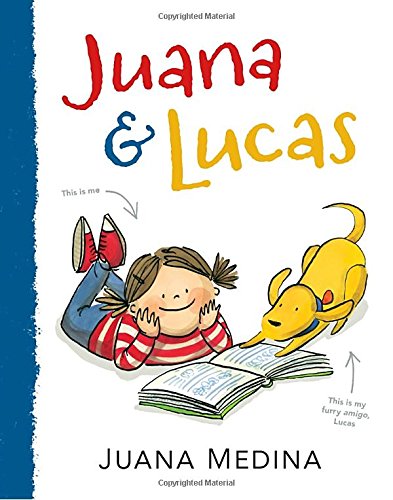
Summary:  Juana lives in Bogota, Colombia with her mother, Mami, and her dog Lucas.  She loves soccer, her best friend Juli, and Astroman.  She does not love learning “the English” at school.  It’s hard, and there doesn’t seem to be much point to it.  But then her beloved grandparents tell her they want to take her to Spaceworld in Orlando, Florida, where Juana will get to meet Astroman.  Her grandfather tells her that at Spaceworld, everyone speaks English, and Mami tells her that if her grades don’t improve, there will be no Spaceworld.  That’s all the inspiration she needs, and before long, the family has an amazing trip, and Juana gets to tell Astroman her whole life story.  96 pages; grades 2-4.

Pros:  Fans of Judy Moody and Junie B. Jones will enjoy the spunky Juana and her affectionate dog.  The Colombian setting and frequent Spanish words give this a nice international flavor.  Lots of colorful, cartoony illustrations throughout.

Cons:  It would have been nice to have a Spanish to English translation guide for all the Spanish words in the text.

Funny Bones: Posada and his Day of the Dead Calaveras by Duncan Tonatiuh

Published by Abrams Books for Young Readers 

Summary: In late nineteenth century Mexico, Jose Guadalupe Posada (Lupe) was a prolific artist who owned his own print shop. He became well-known, first for his satirical political illustrations, and later for his prints of Calaveras, or skeletons, that were extremely popular around Dia de los Muertos (Day of the Dead) celebrations. This book tells the story of Posada’s life, and also details the steps of his various printmaking techniques and looks at possible meanings behind some of his more enigmatic works. Back matter includes a lengthy author’s note about Posada and the history of Dia de los Muertos celebrations; a glossary and bibliography; and a list of U.S. locations where Posada’s works can be viewed. Grades 1-5.

Pros: This book could be used for many subjects: history, art, and Mexican culture. The illustrations are done in a Mexican folk art style and include several of Posada’s works.

Cons: Some may find the Calaveras a bit creepy.