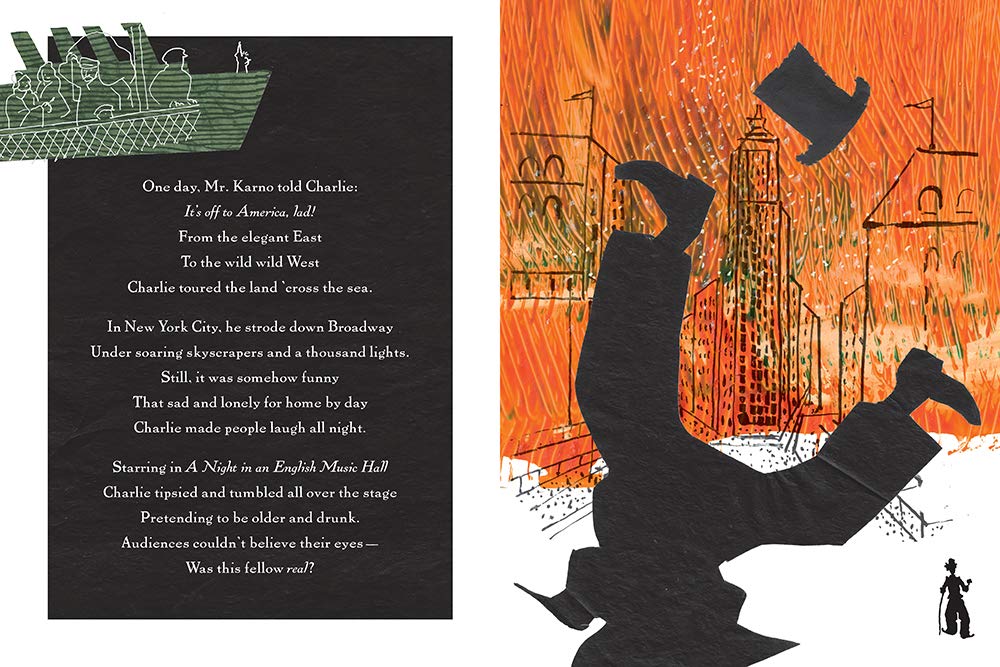
Smile: How Young Charlie Chaplin Taught the World to Laugh (And Cry) by Gary Golio, illustrated by Ed Young

Published by Candlewick

Image result for smile charlie chaplin ed young amazon

Image result for smile charlie chaplin ed young golio

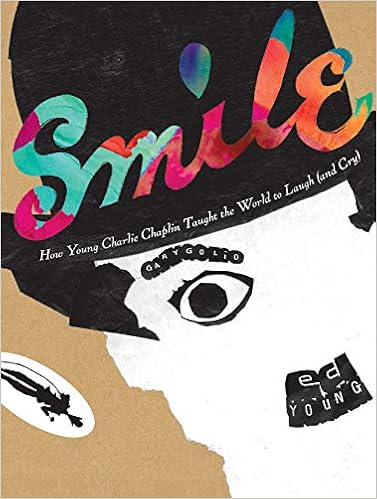
Summary: Charlie Chaplin’s life is chronicled from his impoverished childhood in London up to his creation of his iconic Little Tramp character in the early days of his movie career.  In spare text, Golio tells how the young Charlie enjoyed his mother’s stories and sometimes earned a few pennies singing and dancing in the city streets. An illness forced his mother and her two young sons into the poorhouse.  When they got out, Charlie was able to help his family when he joined a theater troupe at the age of nine. His stage career continued into adulthood, when he was spotted by Hollywood filmmaker Mack Sennett. Charlie made a movie with Sennett…it was funny, but the director wanted something even funnier.  Rummaging through the prop room, the actor found baggy pants, a small topcoat, and a bowler hat, and the Little Tramp was born. Includes an afterword, additional facts about Chaplin, and resources for further information. 48 pages; grades 2-6.

Pros:  Caldecott Medalist Ed Young has created intriguing collage illustrations that complement the brief, poetic narrative of Charlie Chaplin’s life.  Readers will enjoy the flip animation of the Little Tramp that appears in the lower right corners of the pages.

Cons:  Kids may not know who Charlie Chaplin is.

If you would like to buy this book on Amazon, click here.
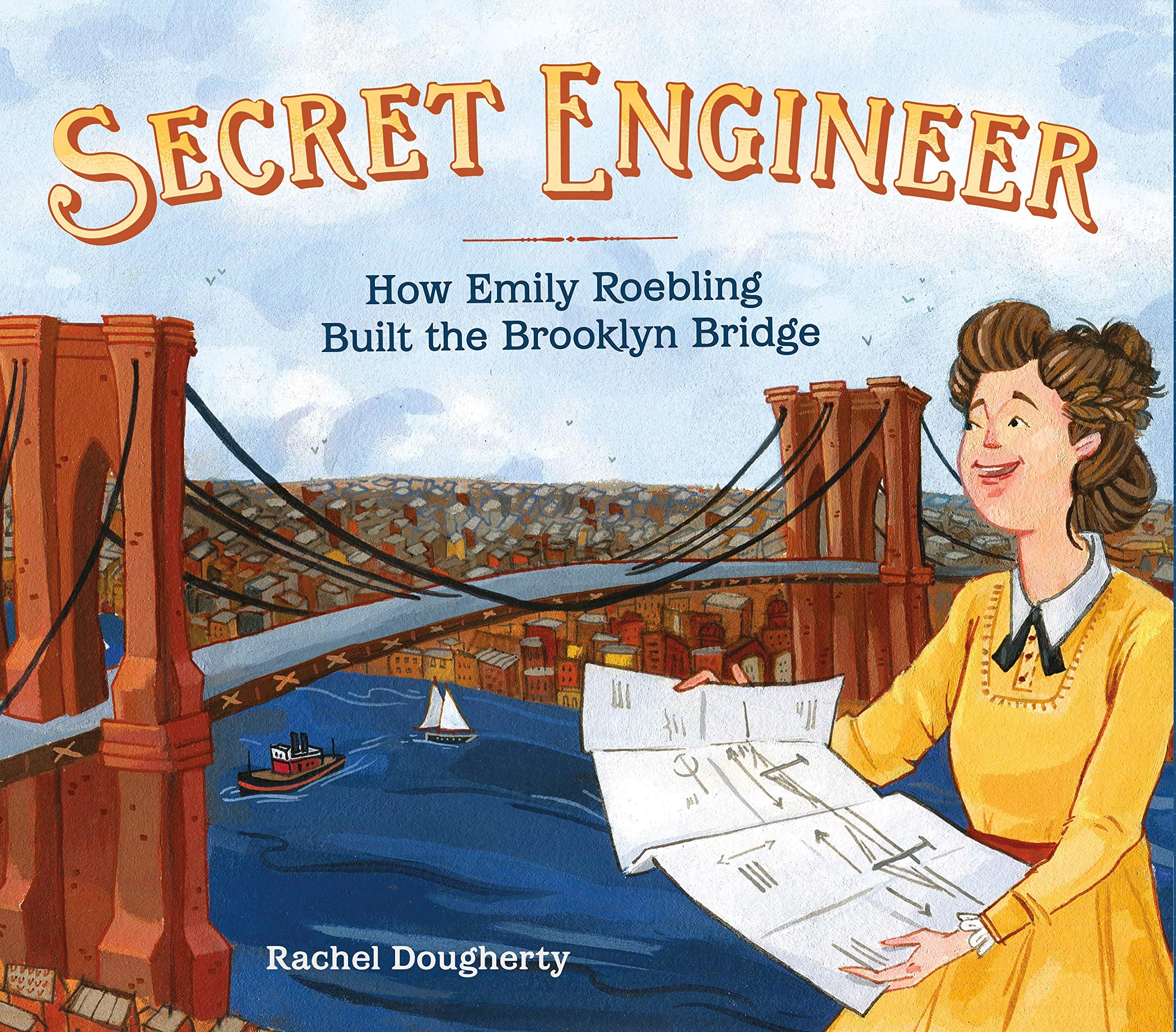
Secret Engineer: How Emily Roebling Built the Brooklyn Bridge by Rachel Dougherty

Published by Roaring Brook Press

Image result for secret engineer amazon

Image result for secret engineer emily roebling

Summary:  Unlike many girls of her time, Emily Warren enjoyed studying math and science.  When she married Washington Roebling, she insisted on joining him on his travels through Europe as he sought ideas to build a bridge from Brooklyn to Manhattan.  Construction began in 1870, with caissons being sunk into the river bottom. Many workers got sick with “caisson fever” from working inside the hot, damp structure, and Washington was afflicted in 1872.  Unable to return to work, he began to rely on Emily to communicate his ideas to the construction workers at the bridge. Eventually, Emily taught herself bridge engineering and began to feel confident enough to add her own ideas.  A week before the opening of the Brooklyn Bridge in 1883, Emily assuaged people’s concerns about its stability by taking the first trip across in an open carriage. Crowds on both sides of the river celebrated the opening on May 24, “never even knowing about the contributions of an insistent woman named Emily Roebling.”  Includes additional information about Emily, a glossary, and a list of additional resources. Photos of the Brooklyn Bridge appear on the endpapers. 40 pages; grades 2-5.

Pros: An inspiring story of a little-known woman who educated herself to be able to play a key role in one of the great engineering feats of her day.

Cons:  I was curious about caisson fever and Washington’s fate, but there was no information about that.

If you would like to buy this book on Amazon, click here.

The Crayon Man: The True Story of the Invention of Crayola Crayons by Natascha Biebow, illustrated by Steven Salerno

Published by HMH Books for Young Readers

Image result for crayon man amazon

Image result for crayon man salerno

Summary:  Consider the humble crayon.  Seems like it has always been with us, but prior to the 20th century, kids were limited to dull slate pencils.  Along came Edwin Binney, an inventor who loved color. Working with his cousin, C. Harold Smith, he created gray slate pencils, white chalk, and black crayons.  But colored crayons eluded him.  At his secret lab in Pennsylvania, he melted paraffin wax, ground rocks and minerals into powders, and mixed in clay to thicken the substance.  One evening in 1903, Edwin announced that he had successfully made colored crayons. His wife Alice combined the French words craie (stick of chalk) and ola (oily…an oily stick of chalk?  hmmm) to come up with the now ubiquitous Crayola brand.  Fortuitously, crayons were created around the same time that cheap paper became available, and the rest is colorful history.  Includes two pages of photos showing how Crayola crayons are made today (at the Binney-Smith factory in Easton, PA, where I did an internship while attending Lafayette College many moons ago); more information on Edwin Binney; and a bibliography of primary and secondary sources.  48 pages; grades 1-4.

Pros:  Kids will be fascinated to learn how their crayons were invented.  The illustrations of workers covered in color after laboring over pigments all day are fun, and Edwin Binney’s perseverance is a good lesson in not giving up.

Cons:  The origin of the “Burnt Sienna” color name is not revealed.

If you would like to buy this book on Amazon, click here.
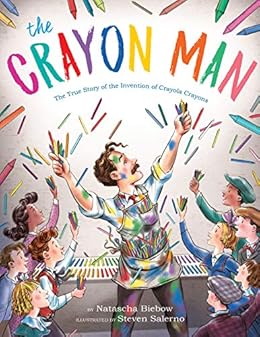
Image result for crayon man This also appears if you do a Google Images search for “Crayon Man”

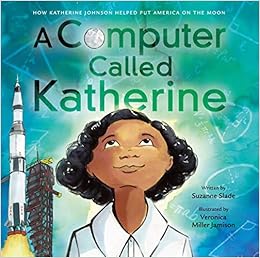
A Computer Called Katherine: How Katherine Johnson Helped Put America On the Moon by Suzanne Slade, illustrated by Veronica Miller Jamison

Published by Little, Brown Books for Young Readers

Image result for computer called katherine amazon

Image result for computer called suzanne slade

Summary:  Similar to last year’s Counting on Katherine, this picture book biography tells the story of Katherine Johnson’s life, beginning with her early fascination with math that eventually led her to a career at NASA.  Her brilliance was finally recognized there as she broke down the barriers that had kept women and blacks from the higher-level positions. This story focuses on her contributions to Apollo 11, the mission that included the first walk on the moon.  Katherine was instrumental in helping to calculate the flight plan that took the three astronauts to the moon and brought them safely back home again. Includes photos of Katherine and some of the documents she worked on at NASA, a time line, and author’s and illustrator’s notes.  40 pages; ages 4-8.

Pros:  Katherine Johnson’s story is brought to life in a way that is accessible for younger readers.  There’s an emphasis on her love of counting from an early age, and a fun incorporation of incorrect math facts (segregated schools seemed as wrong as 5+5=12; Katherine being excluded from NASA meetings was as wrong as 5×5=20).

Cons:  The story is light on dates and places, and there’s no list of further resources, so this wouldn’t be the best book for research or reports.

If you would like to buy this book on Amazon, click here.

Magic Ramen: The Story of Momofuko Ando by Andrea Wang, illustrated by Kana Urbanowicz

Published by little bee books

Image result for magic ramen

Image result for magic ramen urbanowicz

Summary:  Walking around postwar Japan in the late 1940’s, Momofuko Ando was saddened to see hungry people waiting in long lines to get a bowl of soup with noodles…if they were lucky enough to have money and not to be eating grass and bark or scrounging through the trash.  He believed that peace was only possible if people had enough to eat, and set out to make a cheap, easy, and nutritious food. After many, many failed attempts, he learned to make noodles in chicken soup that could be cooked by adding boiling water. He and his family started a business making and selling ramen, a passion he continued to work on into his 90’s.  Includes an afterword with more information about Ando and the Nissin Foods company. 40 pages; grades K-5.

Pros:  This beautifully illustrated picture book demonstrates Momofuko Ando’s perseverance through many failed attempts to create a food that has helped millions in all kinds of conditions throughout the world.  

Cons:  I’ve never actually eaten ramen.

Image result for magic ramen andrea wang

If you would like to buy this book on Amazon, click here.

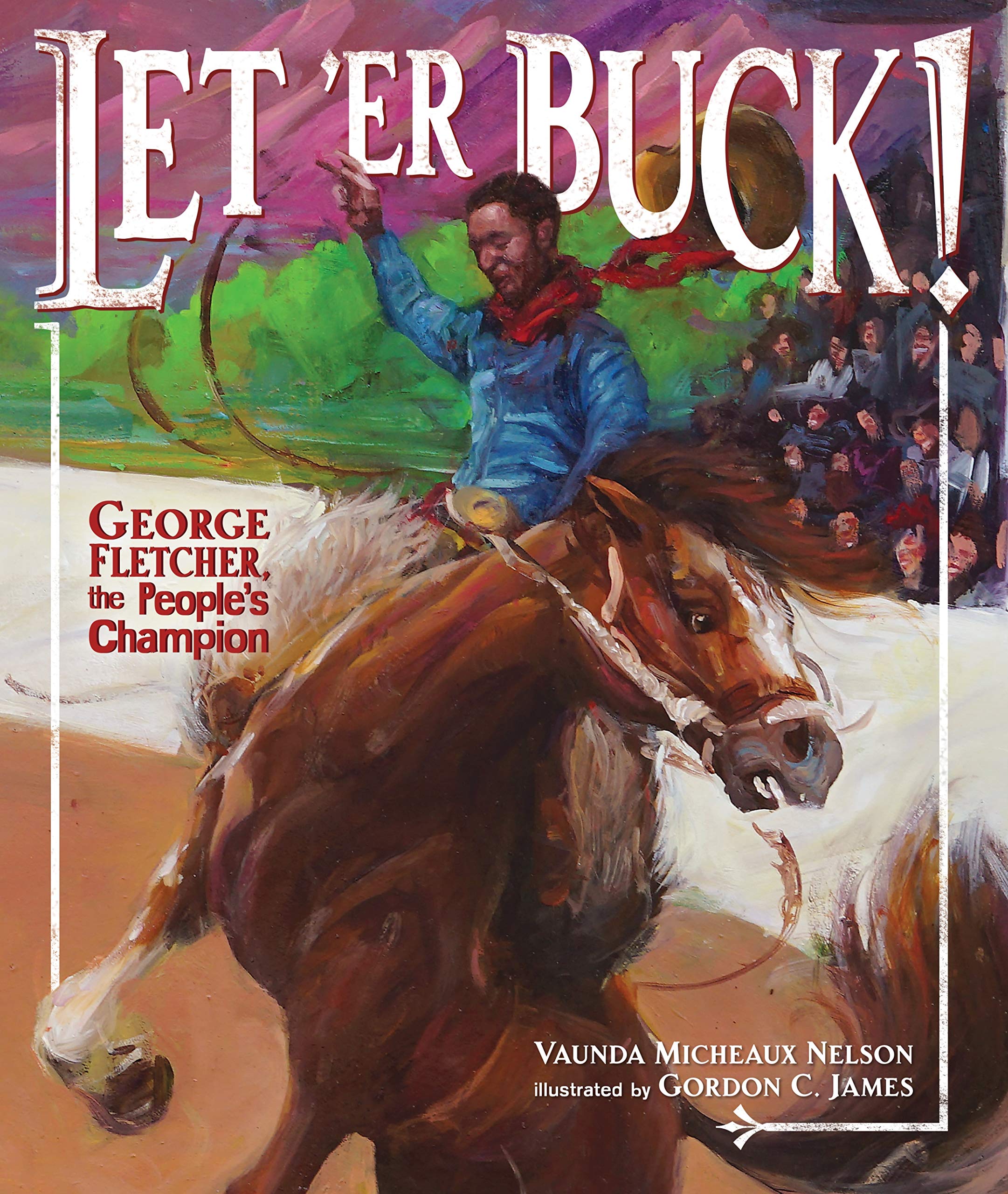
Let ‘Er Buck: George Fletcher, the People’s Champion by Vaunda Micheaux Nelson, illustrated by Gordon C. James

Published by Carolrhoda Books

Image result for let 'er buck george amazon

Image result for let 'er buck george gordon james

Summary:  Growing up in Oregon in the early 1900’s, George Fletcher was one of the only African-Americans in the town of Pendleton.  He spent a lot of time on the nearby Umatilla Indian Reservation, playing with the kids there and learning about horses. His riding skill led him to the rodeo, where he often experienced racism.  Sometimes black cowboys weren’t allowed to compete; other times they weren’t judged fairly against white competitors. This was demonstrated dramatically at the 1911 Pendleton Round-Up, the biggest rodeo in the Northwest.  George made it to the finals of the Saddle Bronc Championship, where he competed John Spain, a white rancher. It was clear to the audience that Fletcher did the best, but the judges chose Spain as the winner.  Sheriff Tillman Taylor grabbed George’s hat, cut it into pieces, then sold the pieces for $5.00 each, raising more money than the first prize saddle was worth. The audience declared George Fletcher the People’s Champion, parading him around the arena on their shoulders.  Includes a glossary of rodeo terms, additional information about and photos of George Fletcher, John Spain, and Tillman Taylor, and a bibliography. 40 pages; grades 2-5.

Pros:  Told with a Texas twang, this action-packed story brings to light a little-known but brave cowboy and his friends and supporters.

Cons:  Because little is known of George Fletcher, especially his early life, some of the details are more speculation than history (as described in the author’s note about the research).

If you would like to buy this book on Amazon, click here.


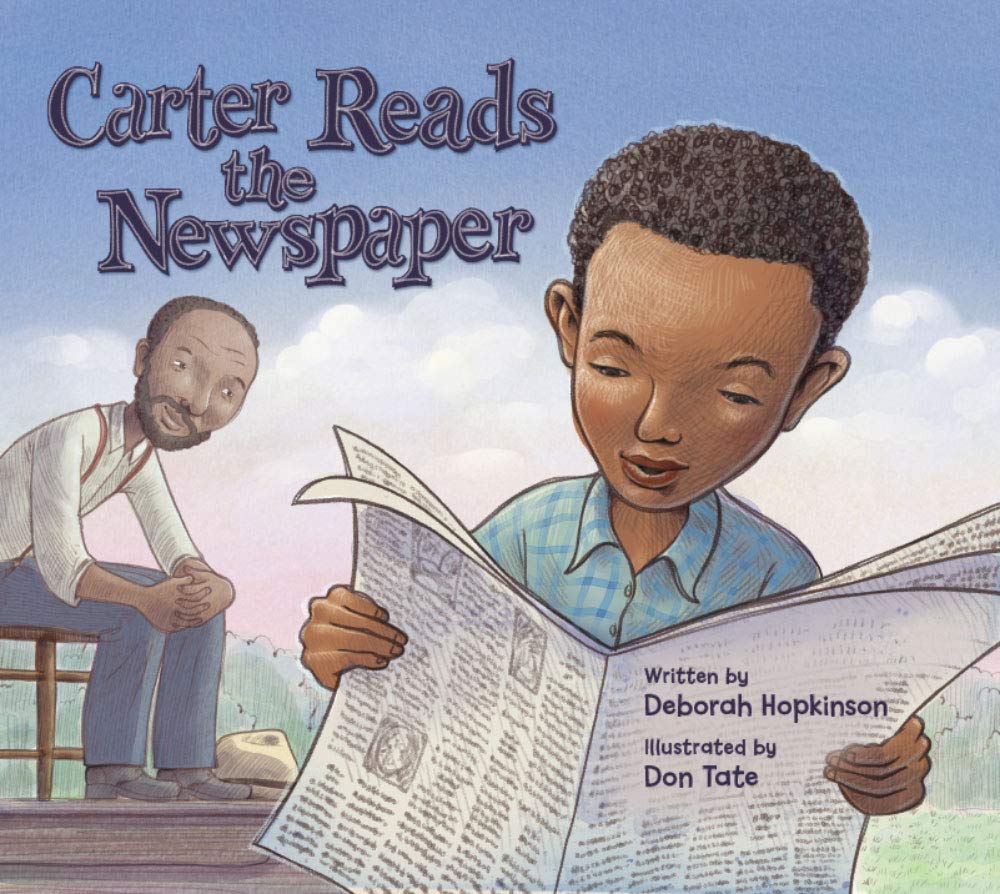
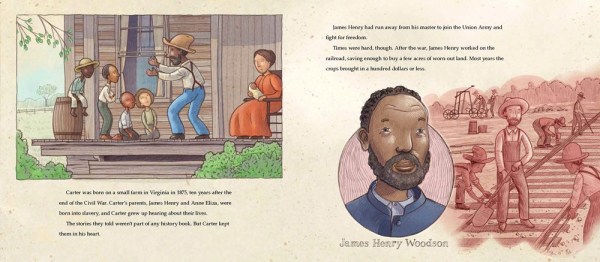
Carter Reads the Newspaper by Deborah Hopkinson, illustrated by Don Tate

Published by Peachtree Publishing Company

Image result for carter reads the newspaper amazon

Image result for carter reads the newspaper

Summary:  Carter Woodson grew up on a poor farm in Virginia, the son of two former slaves.  Although his father couldn’t read or write, he liked Carter to read the newspaper to him.  Later, working as a coal miner, he often met after work with friends for snacks and more newspaper reading.  After three years in the mines, Carter was able to continue his education, and eventually got a PhD in history from Harvard (the second African-American to do so, after W.E.B. Du Bois).  For the rest of his life he championed the cause of black history. In 1926, he started Negro History Week, choosing the second week of February to mark the birthdays of both Frederick Douglass and Abraham Lincoln.  Eventually that became Black History Month, still celebrated today during the month of February.  Includes author’s and illustrator’s notes; additional resources; a list of Black leaders pictured in the illustrations; and a timeline of Woodson’s life.  36 pages; grades K-4.

Pros:  An inspiring story of a little-known man whose influence continues today.  The list of leaders that are pictured in the book would make a good starting point for some research projects.

Cons:  Too bad this book wasn’t released on January 1, instead of February 1, to make it more available during Black History Month this year.

If you would like to buy this book on Amazon, click here.

Never Caught: The Story of Ona Judge by Erica Armstrong Dunbar and Kathleen Van Cleve

Published by Aladdin

Image result for never caught the story of ona judge amazon

Summary:  Ona Judge, one of Martha Washington’s favorite slaves, traveled north with the Washingtons when George became President.  In Philadelphia, she saw free blacks for the first time and began to consider what that life would be like. When Martha Washington decided to give Ona to her spoiled granddaughter as a wedding present, Ona escaped.  She traveled on a ship to New Hampshire, where she spent the rest of her life, despite determined efforts on the part of both the Washingtons to capture her and send her back to Mt. Vernon. Although Ona had a difficult life of poverty and hardship, she never looked back.  In an 1845 interview, when she was 72 years old, she was asked if she was sorry to have left the Washingtons. “No,” she replied. “I am free, and have, I trust, been made a child of God by the means.” Includes an epilogue describing how some of Ona’s younger relatives, inspired by her escape, were able to obtain their own freedom and make better lives for themselves.  Includes copies of her newspaper interviews and an 11-page bibliography. 272 pages; grades 5-8.

Pros:  This young reader’s edition of the 2017 National Book Award finalist for nonfiction is compelling reading that brings to light some of the less-than-heroic aspects of George and Martha Washington.  This would be interesting to read in conjunction with Kenneth Davis’s In the Shadow of Liberty for a different look at some of the founding fathers.  The story is impeccably researched, given the lack of historical record about Ona Judge.

Cons:  Because of that lack of records, the author frequently speculates about what Judge may have been thinking or feeling, which, while interesting, is not necessarily historically accurate.

If you would like to buy this book on Amazon, click here.

Hedy Lamarr’s Double Life: Hollywood Legend and Brilliant Inventor by Laurie Wallmark, illustrated by Katy Wu

Published by Sterling Children’s Books

Image result for hedy lamarr's double life amazonImage result for hedy lamarr's double life wu

Summary:  Most people know Hedy Lamarr as a film star, but she was also a dedicated inventor who spent her spare time coming up with ideas like a glow-in-the-dark dog collar and a flavor cube to turn plain water into soda.  Her biggest invention, working with composer George Antheil, was the “frequency hopping” guidance system, designed to prevent the enemy from jamming radio signals on torpedos. She and Antheil received a patent for their work in 1942, but unfortunately the system was never implemented by the Navy during the war.  Forty years later, the idea was declassified, and is used today to help keep cell phone calls and texts private. The two inventors never received recognition or money for their creation, but in 1997, they received the Pioneer Award from the Electronic Frontier Foundation. As Hedy commented, “It’s about time.” Includes a timeline, additional information about frequency hopping, a bibliography, a filmography of Lamarr’s works, and a reading list about other women in STEM.  48 pages; grades 2-5.

Pros:  Who knew Hedy Lamarr was a talented scientist and inventor as well as an actress?  This engaging biography includes information on her both her careers; the lively illustrations incorporate relevant quotes from Lamarr.  I was hoping to include a review of another book on this same topic, Hedy and Her Amazing Invention by Jan Wahl, published the same week, but no one in my library network has gotten a copy of this one.

Cons:  Some of the technical details may be a bit much for younger readers.

If you would like to buy this book on Amazon, click here.


Posted

Out of This World: The Surreal Art of Leonora Carrington by Michelle Markel, illustrated by Amanda Hall

Published by Balzer + Bray

Image result for out of this world the surreal art of leonora carrington amazon

Summary:  Growing up in England, Leonora Carrington never conformed to the expectations for a proper young lady.  Instead, she pursued art, creating fantastic pictures inspired by Irish legends her grandmother told her.  As an adult, she discovered surrealism, and became part of a group of artists in France. When World War II started, she fled to Mexico, where she eventually married and had children, but continued to paint.  She spent the rest of her life in Mexico, creating surreal paintings and sculptures until her death at the age of 94. Includes notes from both the author and the illustrator and a short bibliography. 40 pages; grades 1-5.

Pros:  An interesting biography of an artist who is probably unknown to most kids.  The illustrations, inspired by Leonora Carrington’s art, will spark young readers’ imaginations.

Cons:  None of Carrington’s actual artwork is included anywhere in the book.

If you would like to buy this book on Amazon, click here.