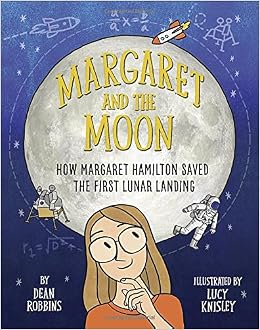
Margaret and the Moon: How Margaret Hamilton Saved the First Lunar Landing by Dean Robbins, illustrated by Lucy Knisley

Published by Knopf Books for Young Readers

Summary:  Margaret Hamilton loved solving problems.  Her ability to problem-solve led her to a career in computers, first at MIT, and then at NASA.  In 1964, she went to work for NASA, writing computer programs that took into account every problem a spacecraft could have as it traveled to the moon.  By the time the Apollo missions were underway, Margaret was the director of software programming.  Minutes before Apollo 11 was going to touch down on the moon, a computer problem set off an alarm.  Margaret was able to use her code to solve the problem, and the rest was a giant step into history.  An author’s note gives more biographical information about Margaret; there’s also a bibliography, and photos of Margaret on the endpapers.  40 pages; grades 1-4.

Pros:  A fun story about a woman who pioneered computer programming and played an important role in the space program. The text is engagingly conversational, and the graphic novel-style illustrations make it kid-friendly.

Cons:  The biographical details of Hamilton’s life are a little light.


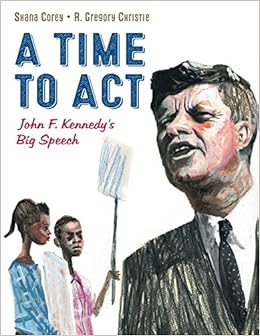
A Time to Act: John F. Kennedy’s Big Speech by Shana Corey, Illustrated by R. Gregory Christie

Published by NorthSouth Books

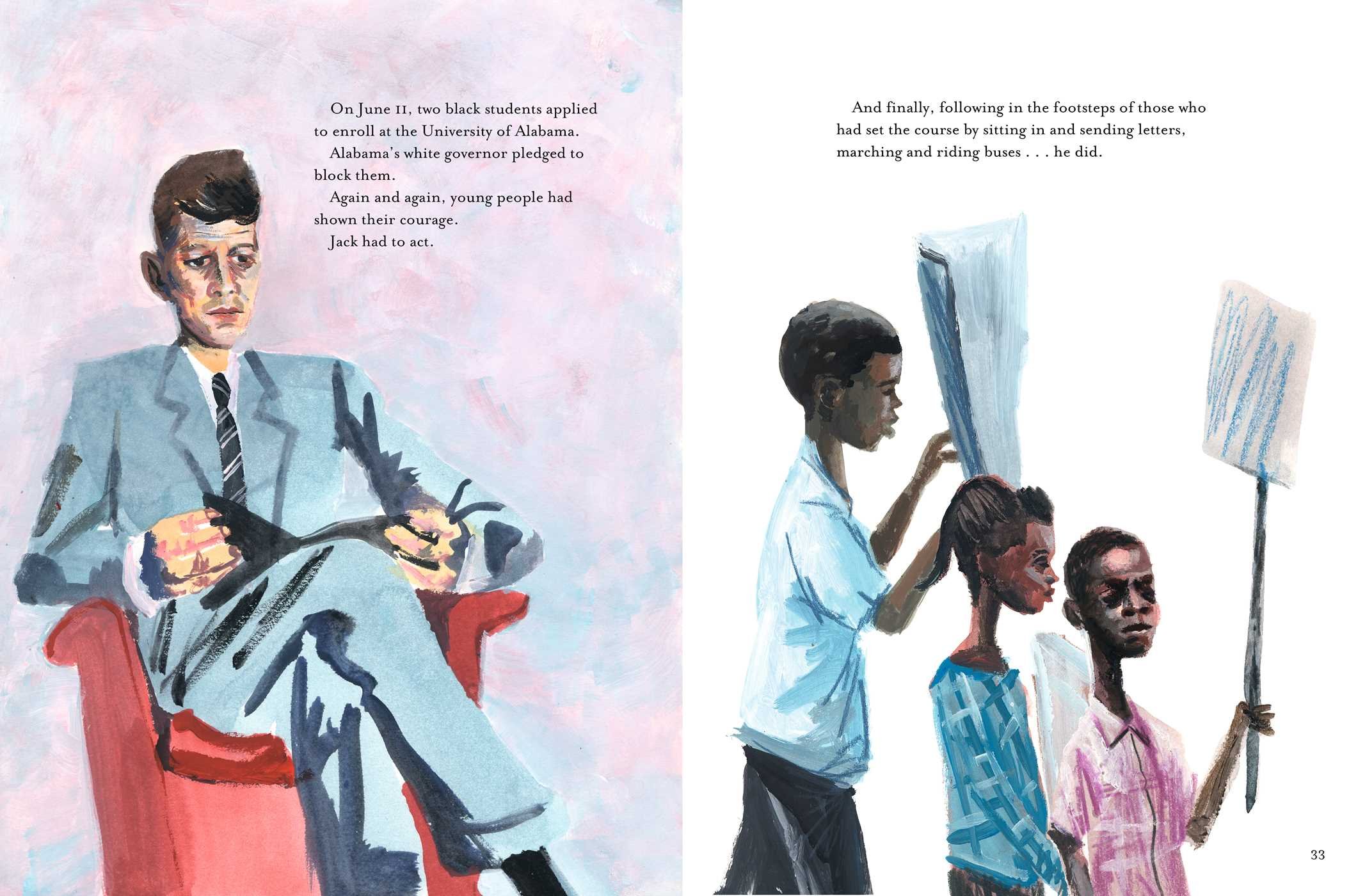
Summary:  Young John F. Kennedy didn’t always do well in school, and he was often sick.  But as he grew up and studied history, he became interested in the meaning of courage and how he could help others in the world. When his older brother Joe died in World War II, Jack became the focus of his family’s political ambitions.  When he was elected President, he quickly took action in a number of areas, like establishing the Peace Corps and starting the space race.  But he was less decisive on civil rights.  African-American leaders like Martin Luther King, Jr. and Jackie Robinson pressured him to act more forcefully, but it wasn’t until he saw young people around the country marching and going to jail that he found the courage to speak up.  The “big speech” of the title is his civil rights address, given June 11, 1963, that ultimately led to the 1964 Civil Rights Act.  Readers are encouraged at the end of the book to take action like those who inspired JFK to make this famous speech.  An author’s note gives more background; there are also thumbnail profiles of other famous people in the book and additional resources.  56 pages; grades 3-6.

Pros:  An inspirational story of the many accomplishments of John F. Kennedy, as well as a look at an area he where he was slow to act, and how others’ deeds finally led him to do the right thing.  The bold paintings complement the bold actions of the narrative.

Cons:  For a picture book, there’s a lot of content for readers to understand.

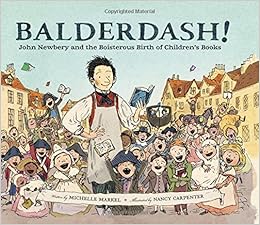
Balderdash! John Newbery and the Boisterous Birth of Children’s Books by Michelle Markel, illustrated by Nancy Carpenter

Published by Chronicle Books

Summary:  Pity the poor children growing up in early eighteenth century England.  Although there were plenty of books around for adults, kids only got preachy poems, sermons, and books of rules about manners and such.  Fortunately for them, a young printer named John Newbery thought they deserved better.  The fact that his books were entitled A Little Pretty Pocket-Book and The History of Little Goody Two-Shoes and became overnight bestsellers demonstrates what a deplorable condition children’s literature was in at that time.  John continued to work throughout his career to produce popular books for kids, and we remember him every January when the Newbery Medal is awarded to the book that has made “the most distinguished contribution to American literature for children”.  An author’s note gives additional biographical information.  44 pages; grades K-4.

Pros:  A lighthearted look at the life of a man whose name many librarians and teachers know, but whose life we are less familiar with.  Readers will appreciate the wealth of children’s literature that has grown since Mr. Newbery’s time.

Cons:  The subject may be of greater interest to adults than to kids.

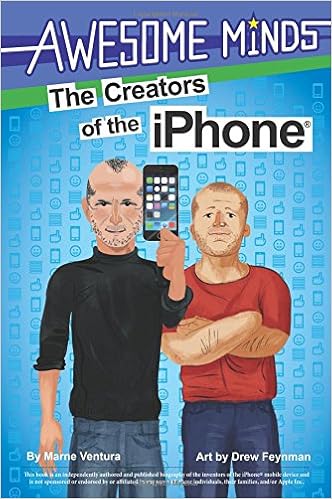
Awesome Minds: The Creators of the iPhone by Marne Ventura, art by Drew Feynman

Published by duopress

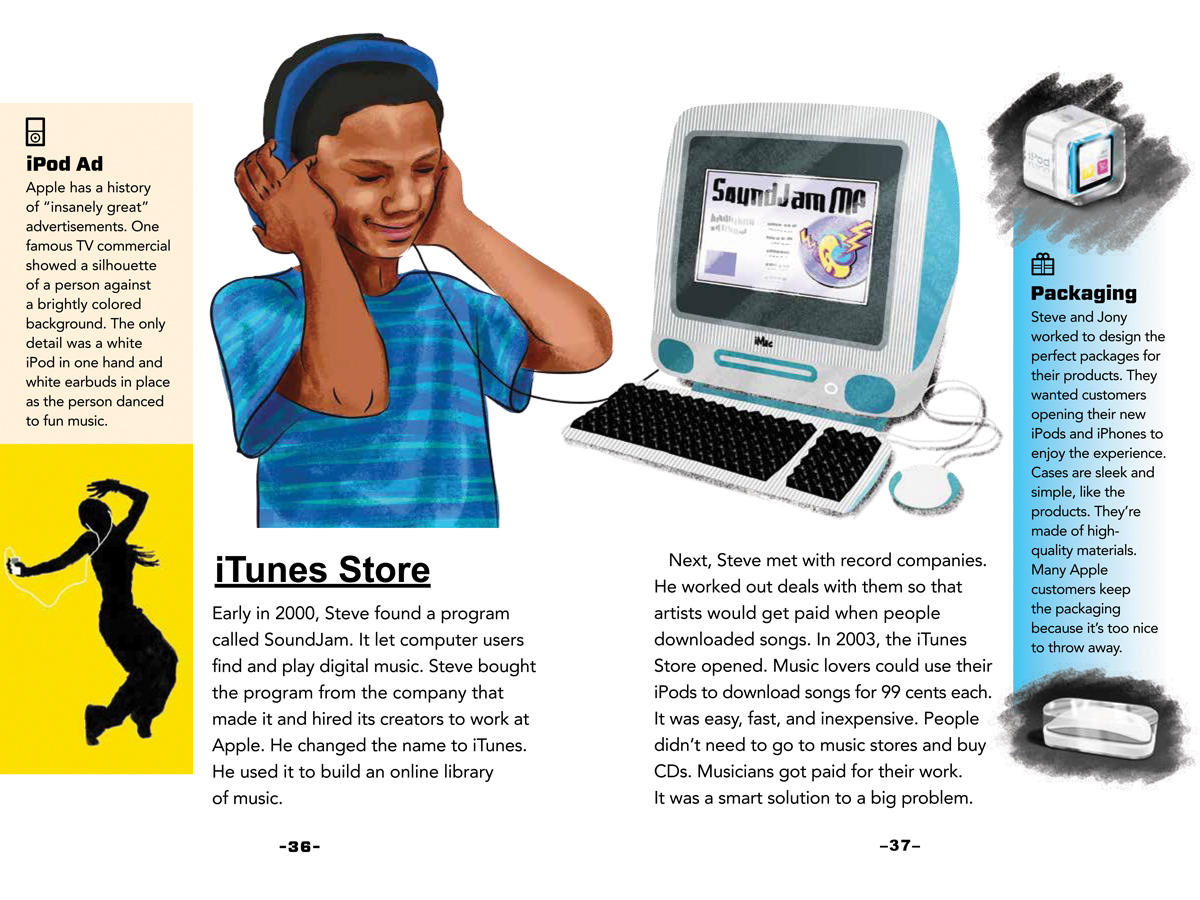
Summary:  We all take our smartphones for granted these days, but it wasn’t so long ago that portable phones were roughly the size and weight of a brick (at least it doesn’t seem that long ago to me).  It was the genius of Steve Jobs and industrial designer Jony Ive that created the first iPhone.  It was a long road to get there, though, beginning with the creation of the Apple company, and continuing with the many machines and software that came before the iPhone: personal computers in a variety of shapes and sizes, the iPod, iTunes, and more.  This book takes a brief look at the whole history, starting with the creators’ early lives, and concluding with Steve Jobs’ death and the iPhone today.  Includes a glossary, list of books and websites, and index. 56 pages; grades 2-5.

Pros:  A fast-paced, colorful look at a topic that’s sure to be of interest to kids.  The design is appealing, with plenty of sidebars and graphics .

Cons:  So much material is covered in such a short book that it sometimes seems disjointed and choppy.

Becoming Bach by Tom Leonard

Published by Roaring Brook Press

Summary:  From the time he was born, Johann Sebastian Bach was surrounded by music (and also, apparently, by people named Johann).  His whole family–many of whom, incidentally, were named Johann–made music, so much so that in his part of Germany, musicians were called bachs.  His parents died when he was young, and he went to live with his oldest brother, Johann Christoph (traveling with another brother, Johann Jacob).  There, he learned by copying music and playing a great variety of instruments, until he was able to express his many deep emotions through his own compositions.  The final two pages of the book show the music coming from his organ as beautifully colored floating designs, traveling through time to contemporary listeners.  An author’s note gives additional biographical information.  40 pages; grades 1-5.

Pros:  Spare text, told in Bach’s voice, is gorgeously accompanied by illustrations which also convey information about his life.

Cons:  Too many characters named Johann.

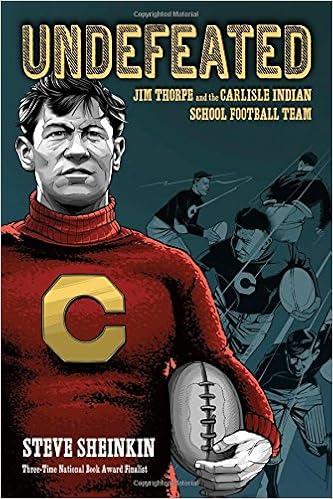
Undefeated: Jim Thorpe and the Carlisle Indian School Football Team by Steve Sheinkin

Published by Roaring Brook Press

Summary:  Which American sporting event drew the biggest crowd in 1911?  The World Series?  An Olympic event? (Wait, there weren’t even any Olympic games in 1911).  The Harvard-Yale football game?  Well, you’re half right; it was the football match between Harvard and the Carlisle Indian School football team, starring Olympian Jim Thorpe.  Final score: 18-15, Carlisle.  You might know Carlisle Indian School as a place where Native American children were sent, often unwillingly, to be taught to assimilate into white culture.  But it also had an amazing football team, coached by Pop Warner, that pretty much reinvented the modern game of college football.  You might know Jim Thorpe as the Olympian who had to return his medals when he was discovered to have played professional baseball.  But there is much, much more to his story, including an amazing football career at Carlisle that spanned seven years, and was capped by a win at West Point, playing against a team that included Dwight D. Eisenhower and Omar Bradley.  The symbolism of the soldiers versus the Indians was not lost on anyone, and the story of Thorpe and the Carlisle school is also the tragic story of racism that Native Americans are still experiencing today.  Includes 33 pages of source notes and works cited.  288 pages; grades 5-10.

Pros: The stories of Thorpe, the Carlisle School, Pop Warner, and the game of football are all told in an engaging style that captures the reader’s attention from beginning to end.  I bet we’ll see this book on the Sibert Award list, if not the Newbery.

Cons:  Although I attended every football game through high school and college as a member of the marching band, I am still too clueless to understand even the simplest schematic illustrating some of the plays described in the book.

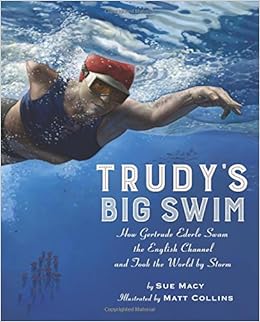
Trudy’s Big Swim: How Gertrude Ederle Swam the English Channel and Took the World by Storm by Sue Macy, illustrated by Matt Collins

Published by Holiday House

Summary:  When Gertrude “Trudy” Ederle emerged from the water on August 6, 1926, she became both the first woman to swim the English Channel and the fastest person, shaving almost two hours off the previous record.  Admittedly, she was a superstar swimmer, having won three Olympic medals and set 29 records in events ranging from 50 yards to half a mile.  But she was also a product of her time, riding the wave of women’s increased participation in sports and freedom that allowed her to wear a two-piece bathing suit very different from the head-to-toe coverage women swimmers had to put up with just a generation earlier.  Trudy’s swim made her a celebrity, and the final illustration shows her resting on her hotel bed, surrounded by the four ham sandwiches she ate after her swim, with newspapers carrying her story pressed against the windows.  An afterword gives more details about the swim and Trudy’s life afterward (she completely lost her hearing by age 22, taught swimming to deaf children for many years, and lived to the age of 98), and there are plenty of additional resources listed.  40 pages; grades 1-5.

Pros:  As someone who has read America’s Champion Swimmer by David S. Adler to many classes, I thought there was little need for another picture book biography of Gertrude Ederle.  But veteran sportswriter Sue Macy has brought the story to life magnificently, placing it in the historical context of American women, propelled by getting the right to vote, enjoying greater freedoms and opportunities.  The illustrations have a you-are-there boldness that add a lot to the text.

Cons:  Endpapers giving a timeline of 1920’s sports history will be covered by the taped-down dust jacket of library books.

Mickey Mantle: The Commerce Comet by Jonah Winter, illustrated by C. F. Payne

Published by Schwartz and Wade

Summary:  Right from the author’s note before the title page, it is clear that Mickey Mantle was a flawed character.  The note mentions the poverty and abuse that marred his childhood, as well as the alcoholism that led to his death at the age of 63.  But it is equally clear that Mantle was an amazing baseball player, chosen to replace the legendary Joe DiMaggio on the New York Yankees, and a winner of baseball’s Triple Crown in 1956 (league leader in batting average, home runs, and RBI’s), a feat not achieved by DiMaggio, Willie Mays, Babe Ruth, or Hank Aaron.  He could belt powerful home runs from either the left or the right, and could run from home plate to first base in 2.9 seconds…until a debilitating knee injury raised his time to 3.1.  Plagued by injuries, he still led his team to the World Series 12 times, and, although fans knew he wasn’t perfect, they cheered him on for 17 years.  40 pages; grades 2-5.

Pros:  The large full-color illustrations bring Mantle’s story to life, told in a conversational voice with a slight Oklahoma (Mantle’s home state) twang.

Cons:  I could have enjoyed a seeing a photo or two.

Fancy Party Gowns: The Story of Fashion Designer Ann Cole Lowe by Deborah Blumenthal, illustrated by Laura Freeman


Published by Bonnier Publishing

Summary:  Growing up in Alabama, Ann Cole Lowe loved to watch her mother sew beautiful dresses for women to wear to fancy parties.  When Ann was 16, her mother died, and Ann took over the business.  A few years later, a customer from Florida sent her to design school, where Ann had to study in a separate classroom, due to segregation.  After graduation, she moved to New York and opened her own shop.  Although she never made a lot of money, her gowns became well-known.  Her most famous design was Jacqueline Kennedy’s wedding dress and bridesmaid gowns.  Less than two weeks before the wedding, a pipe in Ann’s shop burst, and ten of the sixteen dresses were ruined.  She rallied, hired extra help, and got the job done, even though she lost any profit.  She continued designing and sewing well into her 70’s, her primary motivation, “to prove that a Negro can become a major dress designer.”  40 pages; grades 1-4.

Pros:  An inspiring story of a little-known woman.  The repeating refrain of the story is, “Ann thought about what she could do, not what she couldn’t change.”  Beautifully illustrated, with some of Ann’s designs gracing the endpapers.

Cons:  My constant search to find Tim Gunn and Heidi Klum lurking in the illustrations indicates I have been watching too much “Project Runway”.

Muhammad Ali: A Champion is Born by Gene Barretta, illustrated by Frank Morrison

Published by Katherine Tegen Books

Summary:  If 12-year-old Cassius Clay hadn’t had his bicycle stolen in 1954, there might never have been a heavyweight champion named Muhammad Ali.  When Cassius went to the police station to report the theft, Officer Joe Martin suggested he try out his boxing gym.  The boy fell in love with boxing right away, and pushed himself to become the greatest.  He would run alongside the school bus to build his endurance, and have his brother throw stones at him to improve his reflexes.  His dream came true, first at the 1960 Olympics, where he earned a gold medal, and in the years after that, when he won 56 of 61 professional fights, was 3-time heavyweight champ, and defended his title 19 times.  Out of the ring, he fought for the rights of those who were treated unfairly because of race or religion.  Two pages at the end give additional information, including photos of Ali in 1954 and 1966.  There’s also a bibliography and a list of additional resources.  40 pages; grades 1-5.

Pros:  Kids will enjoy the action-packed writing and illustrations, and be inspired by Muhammad Ali’s hard work and compassion.

Cons:  Ali’s biggest fights are described at the beginning, with the story then flashing back to his childhood; the ending seems a little abrupt, since the fights aren’t covered at that point.