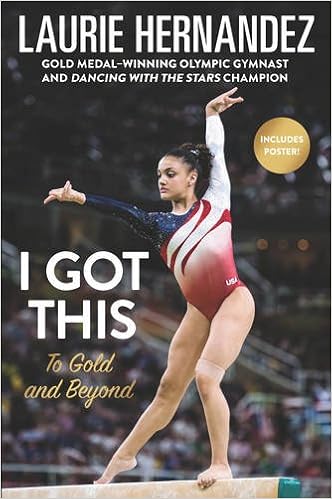
I Got This: To Gold and Beyond by Laurie Hernandez

Published by HarperCollins

Summary:  16-year-old Laurie Hernandez is living the dream, having won a gymnastics team gold medal and a silver for balance beam, at the 2016 Summer Olympics.  Upon her return, she traveled with the Kellogg’s Tour of Gymnastics Champions, while simultaneously competing in (and winning) Dancing with the Stars.  This autobiography tells about growing up in New Jersey as part of a loving and supporting family, overcoming a serious injury, and what it takes to become a champion.  Includes 8 pages of color photos, a list of Laurie’s gymnastics records, a glossary of gymnastics terms, and several pages for readers to record their own goals and dreams.  240 pages; grades 3-7.

Pros:  An upbeat, inspiring memoir.  Laurie was the first U.S. Latina gymnast to win at the Olympics, and clearly takes being a role model seriously.  Gymnasts and Olympics fans will find this a quick and enjoyable read.

Cons:  There’s not a lot of deep insight here.

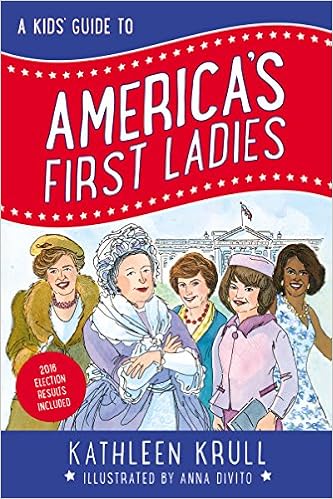
A Kids’ Guide to America’s First Ladies by Kathleen Krull, illustrated by Anna DiVito


Published by HarperCollins

Summary:  Which First Lady raised silkworms in the White House?  Who crocheted 3,500 pairs of slippers while her husband was President?  Kathleen Krull profiles each U.S. President’s wife, including Melania Trump, in 20 chapters.  Some, like Martha Washington, Jackie Kennedy, and Michelle Obama, get their own chapters, while others are put in groups of two to five.  Biographical information is given, along with each woman’s contributions to her husband’s administration.  There are boxes of interesting informational tidbits through each chapter, as well as a “Women Break Through” section that shows what was going on for women at the time.  Two drawings of each First Lady are given, one a portrait-style head shot and the other showing her in the White House.  A final chapter summarizes the role of the First Lady and how it has changed over time.  Includes a list of selected resources and an pretty extensive index. 256 pages; grades 3-7.

Pros:  I read this fascinating book in a single day.  The chapters about lesser-known First Ladies are particularly interesting.  Krull’s writing style is so engaging, the pages just fly by.

Cons:  It seemed odd that there was no mention of Hillary Clinton running for President, given that Melania Trump was profiled.  

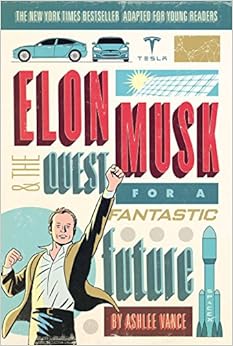
Elon Musk and the Quest for a Fantastic Future (Young readers’ edition) by Ashlee Vance

Published by HarperCollins

Summary:  If you haven’t heard of Elon Musk, maybe you’re familiar with the Tesla electric car.  Or SpaceX, the company that’s sending reusable rockets to the International Space Station at a fraction of NASA’s cost, and is planning how to colonize Mars.  Or maybe you’ve leased some solar panels from SolarCity.  All of these companies have Elon Musk as the driving force behind them.  A brilliant visionary who grew up in South Africa, Musk emigrated to the U.S as a young man, and made his way to Silicon Valley just in time for the dotcom boom.  He got in on the ground floor of PayPal and made a fortune, which he then proceeded to plow back into his companies, determined to create a better, less oil-dependent world.  It’s been a roller coaster ride from multimillion dollar fortune to near bankruptcy and back again as Elon Musk dreams of the impossible…and then proceeds to make those dreams come true.  274 pages; grades 5-8.

Pros:  Musk’s story will inspire technology-loving readers who will be excited to learn it’s possible to save the world and make a lot of money in the process.

Cons:  I glazed over a bit on some of the more technical descriptions.

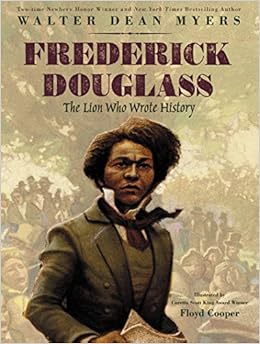
Frederick Douglass: The Lion Who Wrote History by Walter Dean Myers, illustrated by Floyd Cooper

Published by HarperCollins

Summary:  Frederick Douglass was born into slavery in 1818.  Through hard work, determination, and perseverance, he taught himself to read, stood up to a cruel master, and ultimately made a daring escape to the north.  There, he became a noted speaker and writer, publishing his autobiography when he was only 27, and speaking out against slavery and in favor of women’s rights.  As differences between the north and south grew, Douglass was recruited by John Brown to participate in the raid on Harper’s Ferry; he correctly predicted that Brown would fail and chose not to join him.  After the Civil War started, Douglass convinced Lincoln to integrate the Union army.  He continued to serve the government after the war, helping to write American history in many ways.  Includes a timeline and brief bibliography.  40 pages; grades 1-5.

Pros:  An engaging story of Frederick Douglass’s life written by the late award-winning author Walter Dean Myers, and illustrated by Coretta Scott King winner Cooper.

Cons:  Contrary to what President Trump seems to believe, Frederick Douglass is actually dead.

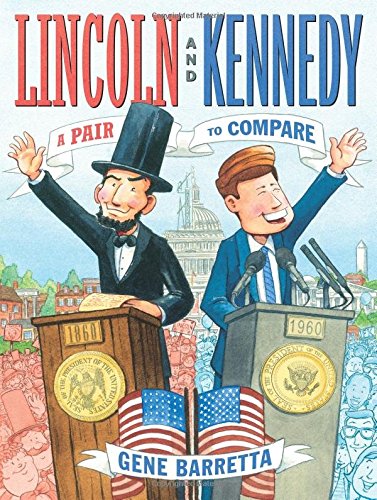
Lincoln and Kennedy: A Pair to Compare by Gene Barretta

Published by Henry Holt


Summary:  They were born 108 years apart, one growing up in poverty and the other with great wealth and privilege.  Yet Abraham Lincoln and John F. Kennedy had a remarkable number of things in common.  Both were named for their grandfathers and had seven letters in their last names.  Both served in the House of Representatives, elected exactly 100 years apart (1846 and 1946), and both lost the race for Vice President before being elected President in 1860 and 1960.  The two men had somewhat tragic private lives, each losing a child before being elected President and another when he was in the White House.  Lincoln was determined to end slavery while Kennedy worked for civil rights legislation.  And, of course, both had their presidencies and their lives cut short by an assassin: each one sitting next to his wife who wasn’t injured; by a man who used three names and was killed before his trial; and succeeded by a President named Johnson.  Back matter includes presidential accomplishments, trivia, and quotes from each man, a glossary, and sources.  40 pages; grades 1-5.

Pros:  Biographical information is presented in a fascinating manner; this book could be the inspiration for students to research and compare two other presidents.

Cons:  This book only presents the tip of the iceberg for similarities between Lincoln and Kennedy.  Search the Internet if you really want to go crazy with this comparison.  http://surftofind.com/coincidence

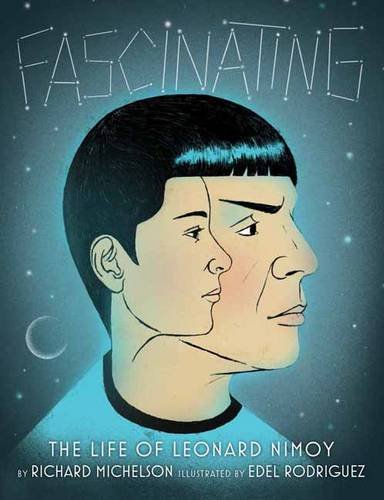
Fascinating: The Life of Leonard Nimoy by Richard Michelson, illustrated by Edel Rodriguez

Published by Alfred A. Knopf

Summary:  Leonard Nimoy grew up in a four-room apartment in Boston’s West End, the son of Russian immigrants.  He got his first taste of acting at a Jewish settlement house.  By the time he was 17, he knew he wanted to be an actor.  Heading to Hollywood where he drove a taxi (he once gave John F. Kennedy a lift), Leonard built a moderately successful career in movies and television.  His life changed in 1965 when he got a call from Gene Rodenberry, asking him to play the alien Spock in his new series Star Trek.  Initially concerned that the pointy ears and weird haircut might ruin his career, Leonard made the fortuitous decision to take the part, and the rest is science-fiction history.  A final note (“The Rest Is History”) gives more information about Nimoy, including his lesser-known careers as a photographer, writer, and musician.  An author’s note tells of Michelson’s close friendship with Leonard Nimoy.  40 pages; grades 1-5.

Pros:  An engagingly-written biography of a man who, in fact, lived long and prospered, rising from a poor immigrant childhood to success in many arenas.  The stories about Nimoy flow together well to tell his story, and the illustrations do a good job of portraying Leonard/Spock.  Readers will enjoy learning the origin of Spock’s famous four-finger salute.

Cons:  The pallette for the illustrations is kind of drab.

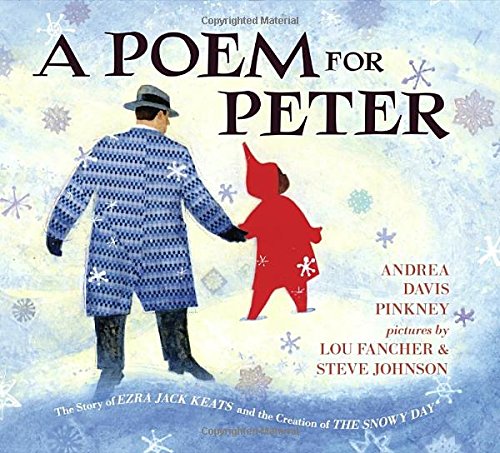
A Poem for Peter: The Story of Ezra Jack Keats and the Creation of The Snowy Day by Andrea Davis Pinkney, pictures by Lou Fancher & Steve Johnson

Published by Viking

Summary:  Andrea Davis Pinkney’s poetic homage weaves together biographical information about Keats with the story of the creation of his most famous book.  Born Jacob Ezra Katz, the son of Polish immigrants, the artist grew up in a poor Brooklyn neighborhood with a father who faced job discrimination and a mother whose secret dreams of becoming an artist never came to fruition.  Young Ezra loved art and won an art school scholarship, but when his father died of a heart attack the day before his high school graduation, his school days were over.  He was helped by the New Deal’s WPA, and went on to become a comic book artist before moving to children’s book illustration.  When he was asked to write and illustrate his own book, he thought of a little African-American boy whose picture in Life magazine had hung on Keats’s wall for many years.  This boy became Peter and the book was The Snowy Day.  Back matter includes “Ezra’s Legacy” with more information about the books that celebrated city life and the people from different cultures who lived there, and “Keats, the Collage Poet”, explaining how the verse narrative used for this book reflects Keats’ collage style of art.  60 pages; grades 2-5.

Pros:  A beautiful celebration of a life and a book, illuminated with illustrations inspired by Ezra Jack Keats’s art.

Cons:  I find the poetic biographies are a hard sell with the elementary crowd.


Are You an Echo? The Lost Poetry of Misuzu Kaneko narrative and translation by David Jacobson, Sally Ito, and Michiko Tsuboi; illustrated by Toshikado Hajiri

Published by Chin Music Press 

Summary:  Born in a Japanese fishing village in 1903, Misuzu Kaneko was fortunate enough to receive more education than most of her female contemporaries.  She worked in her mother’s bookstore and published her poems in magazines.  Then she made the unfortunate decision of marrying one of the bookstore clerks who was abusive, unfaithful, and passed on a devastating disease to Misuzu.  She divorced him, but when he insisted on full custody of their daughter (a right given to fathers only at that time in Japan), Misuzu committed suicide.  The first half of the book tells the story of her life, and the second half is a collection of her poems, written in both Japanese and English.  An author’s note and translators’ note explain the careful work and research that went into creating this book.  64 pages; grades 2-7.

Pros:  This might be the most moving book I have read in 2016.  Misuzu Kaneko’s life was ultimately tragic, but her poetry reveals a beautiful spirit who saw life and hope in ordinary objects around her.  Her poems are accessible to kids, yet infused with deeper meaning.  The gorgeous illustrations should receive Caldecott consideration.

Cons:  I was unprepared for the shock of reading about Misuzu’s suicide.

Radiant Child: The Story of Young Artist Jean-Michel Basquiat by Javaka Steptoe

Published by Little, Brown, and Company 

Summary:  Jean-Michel Basquiat grew up in Brooklyn with a mother from Puerto Rico and a father from Haiti.  His childhood was filled with art, both his own works and what he saw around him.  His mother was artistic and regularly took him to art museums.  There were also difficult times for Jean-Michel.  He was in a serious car accident at the age of eight, and spent months recovering.  During that time, his mother brought him a copy of Gray’s Anatomy, which helped him learn to draw the human figure.  A few years later, his mother’s mental illness drove her to leave the family.  Jean-Michel left school and moved to New York City, where he continued to pursue his art in a number of unconventional mediums, including graffiti.  He lived his dream of being a famous artist until his tragic death in 1988 at the age of 27 from a heroin overdose. An author’s note gives more biographical information. 40 pages; grades 1-5. 

Pros:  The story of Basquiat’s life is told in brief, lyrical text, illustrated with beautiful collages inspired by the artist’s work.  The artwork is sure to receive some Caldecott consideration.

Cons:  There are some pretty adult topics covered in this book targeted for elementary students.  Also Basquiat’s work isn’t included anywhere in the book.

Six Dots: A Story of Young Louis Braille by Jen Bryant, illustrations by Boris Kulikov

Published by Knopf Books for Young Readers 

Summary:  Louis Braille tells the story of his life, beginning with his early childhood, a bright, curious boy growing up in a loving family.  At a young age, he injured his eye with one of his father’s leatherworking tools.  The eye got an infection that spread to the other eye, and he became blind.  Fortunately, his family continued to support and educate him, eventually sending him to the Royal School for the Blind in Paris when he was 10.  Louis loved to learn, and his most fervent wish was to read.  But books at his school were rare, and they only had a few words on each page.  One day, his teacher told the class about a military code that could be read by touch.  Inspired, Louis decided to come up with his own code.  After a few years of hard work, he was ready to demonstrate his invention to the school’s headmaster.  The man read Louis a page from a book, while Louis copied it down, then read it back to him.  He had created the Braille alphabet, still used today to allow blind people to read and write.  The final pages include an author’s note about how she came to write the book, questions and answers about Louis Braille and his invention, and additional resources about both.  The Braille alphabet appears on both the front and back endpapers.  40 pages; grades 1-4.

Pros:  The inspiring story of Louis Braille is told in his own voice in a way that is accessible for young readers.

Cons:  The way Louis loses his eyesight is horrible.