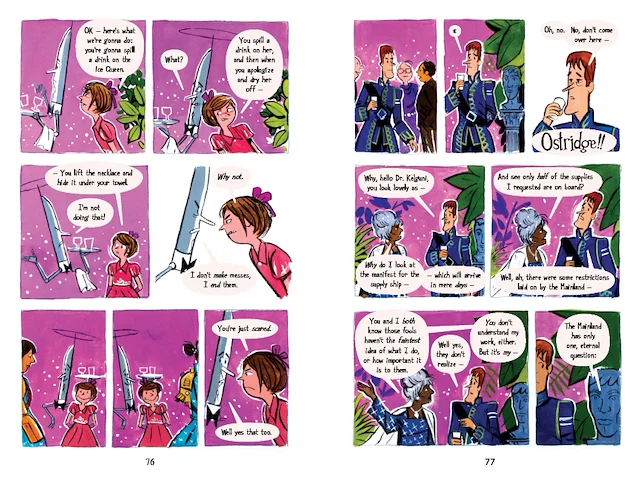
Lumberjackula by Mat Heagerty, illustrated by Sam Owen

Published by Simon and Schuster Books for Young Readers

Summary:  Jack’s ready to pick a secondary school, but he’s torn between following in his lumberjack mom’s bootsteps or choosing the eerier path of his vampire dad.  He tries out both of their alma maters, but neither feels like a great fit.  When he accidentally stumbles upon a school for dancers, it seems perfect for his talents, but he’s afraid he’ll disappoint his parents.  Finally, a wise teenage manatee rescues Jack from a near-drowning and gives him some good advice about being himself.  He finally gets up the courage to tell his parents what he wants, and they proudly cheer him on to become a great dancer.  152 pages; grades 3-6.

Pros:  Elementary kids will happily snap up this quirky graphic novel with lots of fun characters and a good “be yourself” message.

Cons:  There wasn’t a lot of suspense since it was pretty evident early on what Jack’s decision was going to be.

Fibbed by Elizabeth Agyemang

Published by Razorbill

Summary:  Nana’s in trouble again for lying, even though she swears her story about how her teacher’s toupee disappeared is true.  Her parents have had enough, however, and they decide to send her to stay with family in Ghana for the summer.  There she meets relatives and learns about the trickster spider Ananse who exchanges favors and magic for stories.  When Nana, her cousin, and a classmate discover men who are destroying a local forest by stripping it of magic, they end up working with Ananse to defeat the villains and save the forest.  As a reward, Nana gets a wish granted and is happy that her stories are finally believed by family members in both Ghana and the U.S.  Includes four pages of additional information about Ananse.  256 pages; grades 4-7.

Pros:  This graphic novel cleverly weaves together a realistic family story and folklore. The artwork is gorgeous, particularly the wordless pages that show the Ghanian countryside.

Cons:  There’s a lot going on in the story, and I was a little confused about some of the details.

Smaller Sister by Maggie Edkins Willis

Published by Roaring Brook Press

Summary:  Lucy and her older sister Olivia have always been close, but when they switch schools right before fifth and sixth grades, things start to unravel.  Olivia develops an eating disorder, and Lucy struggles to try to understand the unhappy person her sister has become and the difficult changes her whole family is going through.  Just as Olivia is starting to recover, the family moves from Indiana to Massachusetts, a transition that proves difficult for both of the girls.  As Lucy faces peer pressure and mean girls, she begins to doubt herself and to adopt some of Olivia’s techniques for losing weight.  Fortunately, Olivia and their parents have learned a lot in the last couple of years and are able to intervene.  Two weeks at a theater camp between sixth and seventh grade give Lucy a huge boost in confidence, helping her to start seventh grade on a much more positive note.  Includes an author’s note telling of her experiences that inspired this book.  320 pages; grades 4-7.

Pros:  Another middle school girl graphic memoir that will undoubtedly be popular with the many readers who love this genre.  The topics of eating disorders and girls’ struggles with body image are addressed sensitively and in an appropriate manner for upper elementary and middle school readers.  I’d love to see how seventh grade goes for Lucy, so I’m hoping for a sequel.

Cons:  The parents, who were sensitive in other ways, seemed kind of oblivious about how tough it was for the girls to change schools twice in two years.

Crab & Snail: The Invisible Whale (Crab & Snail book 1) by Beth Ferry, illustrated by Jared Chapman

Published by HarperAlley

Summary:  Crab and Snail are BBF’s (best beach friends), who hang out with a couple of barnacle sidekicks named Drip and Grip.  When a mysterious rain shower starts following Crab and Snail around, they can’t figure out what’s happening until a know-it-all gull tells them an invisible whale is following them around.  They send their friendliest smiles out to the ocean and are rewarded with a new friendship with Isabel who is, in fact, an invisible whale.  She ends the book by serenading them with a lullaby as the sun goes down.  Look for book 2 in November.  64 pages; grades 1-3.

Pros:  There are plenty of laughs and celebrations of friendships in this graphic series starter that will definitely be a hit with Narwhal and Jelly fans and other beginning readers. 

Cons:  I would have preferred the structure of a chapter book.

Apple Crush by Lucy Knisley (Peapod Farm, book 2)

Published by Random House Graphic

Summary:  Jen and her family continue the story started in Stepping Stones.  She and her mom have settled into the routine of life on Peapod Farm with her mother’s boyfriend Walter.  Walter’s daughters Andy and Reese visit on the weekends.  Fall brings the beginning of middle school and a job for Andy and Jen helping to set up a haunted hayride at a neighboring farm.  The owner’s nephew Eddie is also working there, and even though he and Jen have a lot of common interests, Andy has a crush on him.  Jen doesn’t understand all the fuss made about romance and runs into even more issues with this when she becomes friends at school with a boy named Ollie.  Like it or not, romance is part of middle school life, and Jen has to learn to both deal with it and to speak up for herself and what she wants in her own life.  Includes several pages at the end in which Lucy shares incidents from her childhood that influenced this book.  208 pages; grades 3-7.

Pros:  Another fun graphic novel about a middle school girl that does a great job capturing family and friendship dynamics.  The fall setting makes this a perfect back-to-school book.

Cons:  While I would no longer describe Walter as verbally abusive (as I did in my review of book 1), he still presents as an insensitive dunderhead.  

The Stonewall Riots: Making a Stand for LGBTQ Rights by Archie Bongiovanni, illustrated by A. Andrews and The National Parks: Preserving America’s Wild Places by Falynn Koch

Published by First Second

Summary: These two entries into the History Comics series tell the story of the 1969 Stonewall Riots that helped bring gay rights into the national spotlight and the history of the National Parks System that helped preserve natural wonders and historical artifacts in the United States.  In The Stonewall Riots, Natalia’s abuela takes teen Natalia and her friends Jax and Rashad back in time to the night of the first protest.  Abuela had a girlfriend at the time, and the three kids, all part of the LGBTQIA+ community, get some lessons about the people and events of that time.  The National Parks features two narrators, a bigfoot and an eagle, who look at the patchwork history of the National Parks System, going all the way back to the early 19th century.  Each book starts with a foreword and includes an author’s note with additional information and resources at the end.  128 pages; grades 4-8.

Pros:  Both books make history accessible through the graphic format and the fun narrators (abuela and Bigfoot).  The additional resources at the end make these a good introduction that could lead to further research.

Cons:  I thought this format worked better for a specific incident (Stonewall Riots) than a longer period of time (National Parks).  I could see kids losing interest in such a sprawling history that included so many different people and places.

Miss Quinces by Kat Fajardo

Published by Graphix

Summary:  Sue (or Suyapa to her family) just wants to draw, go to camp, and hang out with her friends all summer, but her family has other plans: the annual trip to visit relatives back in Honduras.  When they get there, Sue is horrified to learn that her mother has been secretly planning her quinceañera, an event Sue has made clear she does not want.  She reluctantly agrees if her mother lets her go to camp when they get back in the US.  Sue’s abuela encourages Sue by telling her how she kept her sense of style for her own quinceañera.  When Sue finds out her mother forgot to sign her up for camp, the deal is off.  But then abuela passes away, and Sue begins to realize how important her extended family is to her and decides to respect her grandmother by having the quinceañera after all.  She manages to pull off an event that honors her grandmother, keeps the family traditions, and includes her own special flair.  Includes a four-page note with photos about quinceañeras.  252 pages; grades 4-8.

Pros:  Here’s another great graphic novel for Raina fans that shows a loving Latine family with a girl struggling to figure out exactly where she belongs. 

Cons:  I would definitely get this for an elementary library, but a 15-year-old protagonist seems a little old for that audience.

The First Cat In Space Ate Pizza by Mac Barnett, illustrated by Shawn Harris

Published by Katherine Tegen Books

Summary:  When scientists on Earth discover that a pack of evil rats is eating away at the moon, they realize they only have three days to fix the problem.  The solution?  Send a microchipped cat to the moon to devour the rats.  Thus begins a series of adventures that involve the Moon Queen, a toenail-clipping robot, and a lot of pizza.  This story started out as a collaboration between former high school classmates Barnett and Harris during the 2020 lockdown, and their original videos can be seen on YouTube.  By the end of the book, the rats seem to have been eliminated, but there is sure to be at least one sequel.  316 pages; grades 3-5.

Pros:  As I’ve shown again and again, I have pretty lowbrow literary tastes, so this was a lot of fun for me, and I laughed out loud more than once.  Definitely plan to buy multiple copies for any elementary school library. Dog Man fans, rejoice.

Cons:  Don’t forget to fasten your seatbelt. It’s a wild ride.

Growing Pangs by Kathryn Ormsbee, illustrated by Molly Brooks

Published by Random House Books for Young Readers

Summary:  Kathryn Ormsbee’s memoir begins the summer before sixth grade when Katie and her best friend Kacey are going off to camp for a week.  Katie feels like a bit of an oddball as a homeschooled kid with red hair, crooked teeth, and a secret about the obsessive thoughts she sometimes has when she’s feeling anxious.  Camp turns out to be good, though, except that Kacey starts acting cold when Katie makes a new friend.  Katie hopes that things will get better when their homeschool co-op starts up again, but the two friends seem to be moving in different directions.  On top of that, Katie learns she has to have dental surgery and her obsessive thoughts are getting worse.  A chance to act in a local theater production and a couple of new friends help the situation, but things really start to improve when she’s forced to tell her parents about her anxiety.  The last page sees Katie about to walk into a therapist’s office where she feels hopeful that she can get some help.  Includes an author’s notes with photos from her childhood and an artist’s note showing how she developed the art.  250 pages; grades 3-6.

Pros:  Another one for Raina fans that even deals with some similar topics (dental difficulties, anxiety).  Katie is a character many kids will relate to as she navigates the ups and downs of friendships and the beginnings of puberty.  I loved how the artist portrayed Katie’s OCD thoughts with buzzing bees, and I also loved the support that Katie’s parents showed when they finally found out what was going on with her.

Cons:  I was so curious to know how the therapist appointment went.  I hope we get a sequel.

Swim Team by Johnnie Christmas

Published by HarperAlley

Summary:  Bree’s nervous about her big move with her dad from New York to Florida, but things seem to be going well until she finds out that her sixth-grade elective is Swim 101.  Surrounded by kids who have grown up around pools and the ocean, Bree is embarrassed that she doesn’t know how to swim.  All that changes one day when she accidentally falls into her apartment complex’s pool and is rescued by her neighbor, Miss Etta.  It turns out that Etta was a swimming champion, and she takes Bree under her wing and, step by step, teaches her how to swim.  To raise her Swim 101 grade, Bree agrees to try out for the swim team and to everyone’s surprise–including her own–she’s a natural.  The girls on the team have their ups and downs as they prepare for the big state championship.  When Etta sees their struggles, she decides to reunite with her old swim team, including one woman with whom she hasn’t spoken for decades.  The older women coach the girls to a nail-biting but ultimately entirely satisfying state championship win.  256 pages; grades 3-7.

Pros:  Fans of Raina Telgemeier and Jerry Craft will definitely want to dive into this graphic novel.  The excellent art (I especially love the swimming scenes) and compelling story will have them clamoring for a sequel.  The difficult history Black people in America have had with swimming and racism is seamlessly woven into the present-day narrative.

Cons:  Bree’s journey from non-swimmer to champion seemed a bit unrealistically short.