Compass South by Hope Larson, illustrated by Rebecca Mock

Published by Farrar, Straus, and Giroux

 Summary:  12-year-old twins Alexander and Cleopatra are on their own in 1860’s New York City after their father disappears.  They join a gang, but a robbery gone wrong leads their arrest.  When they tell the police where the gang leader is hiding, they need to leave town in a hurry.  On their way to New Orleans, they see a newspaper article offering a reward for information about a pair of red-haired twin boys from San Francisco.  The two redheads see a chance to make some money, so Cleo cuts their hair, and they change their destination.  On their way, they meet up with another pair of redheaded twins who have the same idea.  Fate intervenes once again, and each set of twins is split up, with one from each pair ending up on two different boats.  Alex and Edwin are put to work on board their ship, while Cleo (traveling under the name of Patrick) and Silas are stowaways on theirs.  The book alternates between the two, with non-stop adventures all the way.  There are vicious pirates, a hungry puma, an angry gang leader out for revenge, and even a couple of ill-fated romances.  Alex and Cleo discover they have the tools to look for hidden treasure, but the actual search will have to wait for the sequel, Knife’s Edge.  224 pages; grades 4-8.

Pros:  Newcomer Rebecca Mock has created a graphic masterpiece with a roller-coaster ride adventure story from Hope Larson.  Kids will find it hard to put this down, but will want to take their time to study the detailed illustrations.

Cons:  Having two pairs of identical twins in a graphic novel led to occasional confusion about whose story was being told.

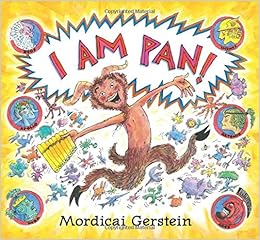
I Am Pan by Mordicai Gerstein

Published by Roaring Brook Press 

Summary: Which Greek god has the most kid appeal? Pan, of course, the fun-loving god of noise, confusion, sheep, shepherds, goats, goatherds, bees, and beekeepers. Mordicai Gerstein combed through Greek myths to find all the ones he could in which Pan played a role. So after recounting his own birth, Pan then goes on to tell different stories about himself, including his marriage to Echo (who knew?), how he invented his famous pipes, and his pivotal role in helping the Greeks at the Battle of Marathon. The ending suggests that Pan and his deity comrades are still living among us today, a “fact” Rick Riordan fans will appreciate. A brief author’s note explains how and why Gerstein came to write this book; a list of the mythology books he used for his research is included. 80 pages; grades 1-5.

Pros: Written in comic book form with illustrations by Caldecott Medalist Gerstein, this is a perfect introduction to mythology for elementary age kids. Those already familiar with the Greek pantheon will enjoy expanding on their knowledge.

Cons: Reading a book with a goofy goat-man on the cover, emblazoned with the large words, “I Am Pan!” may open you up to scorn and derision from offspring over the age of 10.

Hippopotamister by John Patrick Green

Published by First Second

Summary:  Hippo and Red Panda spend their days in a run-down zoo, until Red Panda decides he’s had enough, and leaves to find a job. Whenever he comes back for a visit, he tells Hippo that he has the best job ever, although his changing hats suggest that it’s always a different job. Finally, Hippo decides to join him. Red Panda tells Hippo that he’s now Hippopotamister, and he has to act like a human. The two friends try cooking, hair dressing, banking, and a host of other positions. In each one, Hippopotamister is a bit unsure of himself, but does his work well; Red Panda, on the other hand, is completely confident, but makes a mess of things and gets them both fired. Finally, discouraged, Hippo returns to the zoo, where he finds everything just as bad as he left it. In one night, he uses his new job skills to fix it all. The animals elect him zookeeper, and Red Panda, with his ebullient personality, is hired on as head of customer relations. 96 pages; grades K-3.

Pros: This graphic novel has cute illustrations and lots of gentle humor, with a satisfying ending. Kids will enjoy learning how to draw Hippopotamister and Red Panda on the last page.

Cons: The lengthy job search got a bit repetitious.

Poptropica: Mystery of the Map by Jack Chabert, illustrated by Kory Merritt

Summary: A hot-air balloon ride gone wrong lands Oliver, Mya, and Jorge on a mysterious island inhabited by dodo birds and Vikings. The dodos are entertaining and companionable, the Vikings, not so much. Not only are Erik the Red and his band after the kids, but Octavian, the balloon’s pilot, wants the magic map they took from him. After a daring prison break and a series of exciting chase scenes, the three children manage to outwit them all and sail off in a Viking vessel. The trip home promises an exciting sequel. 112 pages; grades 1-4.

Pros: This graphic novel is based on the Poptropica website, a gaming site co-founded by Diary of a Wimpy Kid creator Jeff Kinney. All the kid-friendly elements are in place to make this a surefire hit with even reluctant elementary readers.

Cons: Is it really okay to have a positive Jeff Kinney blurb on the front cover a book based on a website he helped create?

Little Dee and the Penguin by Christopher Baldwin

Published by Dial Books for Young Readers


Summary: Little Dee is getting tucked in for the night when her park ranger father gets an emergency call. The next time we see her is at her father’s funeral, when she is spotted by animal friends Ted (bear), Blake (dog), and Vachel (vulture). At about the same time, they’re joined by a penguin named Paisley, who has wandered away from his family in Antarctica and is being chased by two polar bears who want him for lunch. Reluctantly, the three friends agree to both save Little Dee from the cold, cruel orphanage and take Paisley back to Antarctica. Their journey takes them to Mexico, Ecuador, and Chile, with plenty of adventures and a few more interesting characters along the way. 128 pages; grades 3-6.

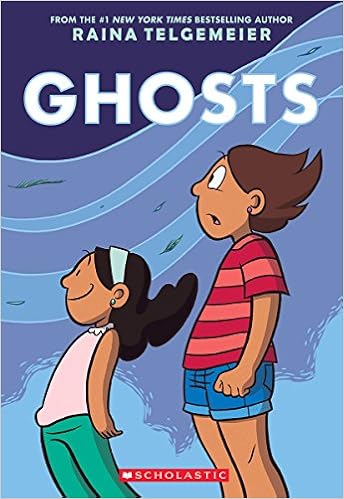
Pros: Originally a webcomic, Little Dee is great fun. Although she herself doesn’t talk, her animal friends more than make up for her silence with their nonstop banter. There’s plenty of snark and sarcasm, but also a good deal of friendship and caring. The illustrations are bright and colorful and will appeal to fans of Bone and Raina Telgemeier.

Cons: Some of the funnier sarcasm may go over the heads of younger readers.

Fluffy Strikes Back by Ashley Spires

Published by Kids Can Press 

Summary: Fluffy is the lead cat of P.U.R.S.T. (Pets of the Universe Ready for Space Travel). Although he used to work out in the field, he now spends his days behind a desk five stories underground, protecting the humans and pets of the world from aliens. But one day, those aliens (insects) invade P.U.R.S.T. headquarters, and Fluffy has to spring back into action to defeat them. It’s a tough job, but with the help of his right-hand cat and chief engineer guinea pig (hamster?), Fluffy is able to get the job done. 72 pages; grades 1-4.

Pros: A fun beginning graphic novel; not too much text, but plenty of cat action.

Cons: A bit of bathroom—or rather, litter box–humor.


The Wrong Wrights (Secret Smithsonian Adventures) by Steve Hockensmith and Chris Kientz, illustrated by Lee Nielsen

Published by Smithsonian Books 

Summary:  Four kids are awarded a trip to the Smithsonian’s Air and Space Museum for winning the district science fair.  When they get there, they discover that, instead of airplanes, the exhibit halls are filled with hot air balloons and dirigibles.  They’ve accidentally stumbled into an alternate reality, and before you can say “Kitty Hawk”, they are whisked back in time to a crucial point in aviation history.  On a windy day in 1909, the Wright brothers, Glenn Curtiss, and Thomas Scott Baldwin demonstrated their flying machines.  Only the Wright brothers were successful, and this led to greater financial support for the airplane, and less for the other types of aircraft.  The kids, with the help of Katherine Wright (Orville and Wilbur’s sister) are able to defeat other time travelers who are trying to help Curtiss and Baldwin, and secure the Wrights’ place in history.  When they return to the present, the airplanes are back in place at the Air and Space Museum.  64 pages; grades 3-6

Pros:  History, time travel, and science are pleasantly mingled in this graphic novel, which is apparently the first in a series published by the Smithsonian.

Cons:  Some of the time travel seemed a little too “Scooby Doo” and not particularly well thought-out.

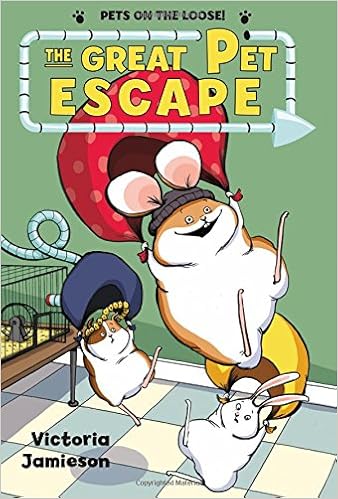
The Great Pet Escape by Victoria Jamieson

Published by Henry Holt and Company 

Summary:  GW (real name, George Washington) has been stuck in his hamster cage for three months, two weeks, and one day.  He and his friends, Barry the bunny and Biter the ferocious guinea pig used to be the Furry Fiends until they were captured and turned into classroom pets.  As the story opens, GW has just figure out a way to unlock the cage.  At the end of the school day, he makes his break and goes off in search of his companions.  To his dismay, Barry seems pretty happy in first grade, and Biter has completely gone over to the dark side of kindergarten, calling herself Sunflower and practicing yoga to handle her anger issues.  GW finally convinces them to return to their previous life, but their plans are interrupted by Harriet, the fourth grade mouse, leading an army that includes the fifth grade snake and ten more mice (or wait, is it nine and a well-fed snake?).  War breaks out in the halls and cafeteria of the school, and a single food fight could change the course of class pet history forever.  64 pages; ages 6-10.

Pros:  Victoria Jamieson is a genius. Roller Girl was a Newbery winner and one of my favorite graphic novels of 2015.  Now she’s gone in a totally new direction with a hilarious new graphic.  Unlike some “humorous” kids’ books that just seem silly, this one had me laughing out loud on every page.

Cons:  I can’t decide which sequel I want to see first…Roller Girl 2 or another installment of Pets on the Loose.

Study Hall of Justice (Secret Hero Society series) by Derek Fridolfs, illustrated by Dustin Nguyen

Published by Scholastic 

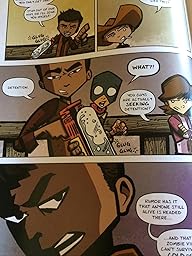
Summary:  Young Bruce Wayne is looking forward to starting school at the prestigious Ducard Academy, but right from the first day, everyone seems incredibly mean, even the teachers.  He does manage to befriend two kids who are having similar struggles, a boy named Clark Kent and a girl named Diana Prince.  Together, they try to investigate the dark secrets of their new school and who is behind them.  The story is told through comics, letters, journal entries, school forms, and texts.  With the school mystery solved by the end, Bruce’s mention of an upcoming camp visit hints at a sequel.  176  pages; ages 8-12.

Pros:  Reluctant readers will flock to this book about the young Batman, Superman, and Wonder Woman.  The variety of formats (graphic novel, letters, texts, etc.) makes it an interesting and fast-paced read.

Cons:  The story was a little more complex than I was expecting, and the different types of text could make it a bit confusing.

Five Favorite Graphic Novels

Each year brings a larger group of graphic novels for a wider range of readers.  Here are some that I particularly enjoyed this year:

Awkward by Svetlana Chmakova.  Published by Yen Press.

Awkward (Berrybrook Middle School, 1): CHMAKOVA, SVETLANA: 9780316381307:  Amazon.com: Books

Peppi treats another kid badly on her first day of middle school…then spends a good portion of the rest of the book beating herself up about it and trying to make amends.  Perfectly captures middle school angst.

Sunny Side Up by Jennifer Holm, illustrated by Matthew Holm.  Published by Scholastic.  Book trailer: https://www.youtube.com/watch?v=vOC_Vjc2wRg

The month of August in a Florida retirement community?  Sunny struggles to adapt to her sudden visit to Grandpa’s.  Flashback scenes help the reader figure out the family difficulties that have precipitated the need to have Sunny out of the house for a month.  Based on the authors’ own childhood, Sunny Side Up is a story of family love and resilience.

Roller Girl by Victoria Jamieson.  Published by Dial Books.

Another middle school story…Astrid and her best friend Nicole pursue different interests, and the possibility of the end of their friendship, during the summer before sixth grade.  While Nicole follows her passion for dance, Astrid decides to try roller derby camp.  Amidst the bumps, bruises, and falls, she discovers something she loves and maybe, just maybe, can learn to be good at.

Lost in NYC: A Subway Adventure by Nadja Spiegelman, illustrated by Sergio Garcia Sanchez.  Published by Toon Graphics.

Part friendship story, part engineering manual, Lost in NYC recounts a comedy of errors school field trip on the New York City subway that results in a new friendship and a lesson in NYC’s subterranean maze.

Secret Coders by Gene Luen Yang, illustrated by Mike Holmes.  Published by First Second.  Hopper’s first day in her new school is anything but ordinary, as she and a new friend discover binary coding, some unusual owls, and an underground network run by a pretty creepy custodian.