The Bird Book by Steve Jenkins and Robin Page

Published by Clarion Books

Summary:  The husband-and-wife team of Jenkins and Page have created a picture book jam-packed with information about birds.  From their anatomy and physiology to their evolution from dinosaurs to record-holders in the avian world, readers will learn fascinating facts about birds, accompanied by Steve Jenkins’s trademark cut-paper illustrations.  Includes a four-page table listing every bird mentioned in the book, with its size, diet, range, and the page where it can be found; also, a list of books and websites with more information.  48 pages; grades 1-5.

Pros:  Another beautiful offering by Robin Page and the late Steve Jenkins, with a ton of information offered in an appealing format with stunning illustrations.

Cons:  Another childhood bubble was burst when I learned that the oldest bird on record is a pink cockatoo that lived to the age of 83, not Dr. Dolittle’s 199-year-old parrot Polynesia.

Mae Makes A Way: The True Story of Mae Reeves, Hat & History Maker by Olugbemisola Rhuday-Perkovich, illustrated by Andrea Pippins

Published by Crown Books for Young Readers

Summary:  Published in collaboration with the Smithsonian National Museum of African American History and Culture, this book traces the story of Mae Reeves, a Black woman who left Georgia in the 1930’s to become a milliner.  She eventually opened her own shop in Philadelphia, creating hats for celebrities like Marian Anderson, Lena Horne, and Ella Fitzgerald.  She kept her business going while raising three children and being active in her community, helping other Black businesses.  Mae lived to be 104, long enough to see artifacts from her shop included in the Smithsonian’s National Museum of African American History and Culture.  Includes interviews with Mae’s daughter Donna and with Dr. Reneé Anderson, Head of Collections at NMAAHC, as well as information about the museum and a list of sources.  48 pages; grades 2-5.

Pros:  A fascinating biography of a woman who never became famous but who lived a full life, following her own dreams and helping others.  Readers will be inspired to head to Washington, D.C. to see Mae’s hats in the museum.

Cons:  It’s a long picture book for reading aloud.

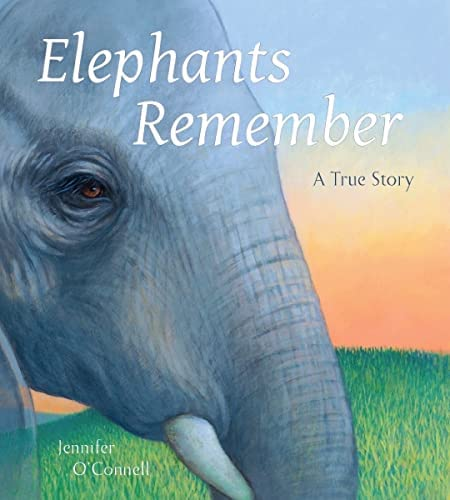
Elephants Remember: A True Story by Jennifer O’Connell

Published by Tilbury House Publishers

Summary:  When Lawrence Anthony gets a call saying that a herd of elephants will be shot if he can’t rescue them, he quickly sets up his wildlife reserve to accommodate them.  The animals have been traumatized after having members of their herd killed by poachers, including the matriarch and her baby.  Lawrence names the new matriarch Nana, and after the elephants trample the reserve’s electric fence and escape the first night, he sets out to earn Nana’s trust.  Slowly, she begins to let down her guard and allow Lawrence to come closer to her.  Over the years, Lawrence distances himself from the growing herd to help them remain wild, but he always keeps a connection with Nana.  When Lawrence dies of a heart attack, Nana leads the herd to his house and does so again on the same day for the next two years.  Includes an author’s note and three pages of additional information about elephants and Lawrence Anthony.  48 pages; grades 1-5.

Pros:  An incredibly moving story of a man dedicated to helping African wildlife and the amazing connection he made with elephants.  

Cons:  Some photos would have been a nice addition.

The Universe in You: A Microscopic Journey by Jason Chin

Published by Neal Porter Books

Summary:  In Your Place in the Universe, Jason Chin starts with a group of kids, then gradually moves out into the farthest reaches of the universe.  In this book, he goes in the opposite direction, beginning with the smallest bird–a Calliope Hummingbird–landing on a girl’s hand, then moving to the hair on her skin, then to cells, DNA, atoms, and eventually to elementary particles.  From there, the journey continues back outward, inviting a sense of wonder that everything in the universe is made of the same molecules, yet combines in a way to make a unique human.  Includes additional information on the building blocks of matter, as well as an author’s note and a note about the illustrations.  40 pages; grades 3-7.

Pros:  Another mind-blowing offering from last year’s Caldecott medalist, Jason Chin, with amazingly detailed illustrations, some of things that are too small to be seen with the human eye.  A contender for a Caldecott or Sibert, both of which Chin has already won.

Cons:  I’m more wowed by the larger universe than the subatomic one.

Polar Bear by Candace Fleming, illustrated by Eric Rohmann

Published by Neal Porter Books

Summary:  The award-winning team behind Giant Squid, Honeybee, and Strongheart has created a new book that explores the world of a mother polar bear and her two cubs.  Emerging from five months in the den, during which time she gave birth and nursed her offspring, the mother bear emerges emaciated and hungry.  She heads for the ice where she knows she can hunt seals.  The narrative follows the bears through the year, showing how climate change affects their ability to hunt and perilously strands them on some floating ice.  They survive the dangers, and the final pages show them back on the ice in the 24-hour darkness of an Arctic winter.  Includes a two-page labeled diagram of a polar bear, additional facts about polar bears and the effects of warming in the Arctic, and a list of resources.  32 pages; grades K-5.

Pros:  Another breathtaking science book with poetic informative text and detailed realistic paintings of the polar bears and their environment.  With a Sibert Medal and Honor on their resumé, this team can expect awards consideration again for this book.

Cons:  As always, I found it stressful to read about the effects of climate change.

Luminous: Living Things That Light Up the Night by Julia Kuo

Published by Greystone Kids

Summary:  A mother and child travel through the night, walking, boating, and swimming to observe bioluminescence in many different forms.  The pages are all in black, making the colors glow brightly.  Each page has a single phrase or sentence in a larger font, then a few sentences in smaller print that give additional information.  A sense of wonder is conveyed in the last few pages, sharing the information that many life forms have yet to be discovered, and encouraging readers to look closely at the world around them.  44 pages; ages 4-10.

Pros:  A beautiful introduction to bioluminescence that will encourage kids to look for other wonders in the world as well.  The illustrations are striking and there is plenty of interesting information.

Cons:  No back matter.

Only the Best: The Exceptional Life and Fashion of Ann Lowe by Kate Messner and Margaret E. Powell, illustrated by Erin K. Robinson

Published by Chronicle Books

Summary:  Ann Lowe learned her first lessons about sewing and design from her grandmother, who had been an enslaved seamstress, and her mother, who owned a dress shop.  Ann’s work ethic showed itself early; when her mother died, young Ann put aside her grief and finished the dresses that had been ordered for New Year’s Eve.  A year later, she got a job in Tampa, Florida, sewing for a wealthy family.  Her ambitions took her to New York City, where she found success despite the racism she encountered there.  Jacqueline Bouvier hired Ann and her assistants to design and sew her gown and bridesmaid’s dresses for her wedding to Senator John F. Kennedy.  When a leaky ceiling flooded Ann’s workroom and destroyed all the dresses ten days before the wedding, she and her seamstresses recreated every one.  Ann capped her career by opening her own store with her own label on Madison Avenue.  Includes an author’s note with two photos, quotations, and a bibliography.  56 pages; grades 1-5.

Pros:  I loved Fancy Party Gowns by Deborah Blumenthal (2017), but I love this book at least as much.  There’s a bit more detail about Ann’s career, the writing style is engaging, and the illustrations are stunning.

Cons:  At 56 pages, it’s a bit long for a picture book.

Strong by Rob Kearney and Eric Rosswood, illustrated by Nidhi Chanani

Published by Little, Brown Books for Young Readers

Summary:  Rob Kearney was a strong kid who excelled at football and cheerleading, but his favorite sport was weightlifting.  It made him feel like a superhero.  At the age of 17, Rob learned about the Strongman competition and decided to become a weightlifting champion.  Competition events involved lifting heavy logs, stones, and tires, so Rob got to work, running, swimming, and lifting the heaviest weights he could.  Rob loved wearing bright, colorful clothing, but other competitors wore plain, dark colors, so Rob did, too.  When he came in last at his first competition, he felt as dark and gloomy as his clothes.  Falling in love with Joey, a fellow weightlifter, encouraged Rob to be himself, and before long he was dressing exactly the way he wanted to.  Joey’s support and encouragement helped Rob in other ways, and he eventually won the North American Strongman championship.  Includes a letter to readers from Rob, additional resources, and descriptions of all the Strongman events.  40 pages; ages 4-8.

Pros:  The empowering be-yourself message will especially speak to LGBQT+ readers, as Rob defies stereotypes with his rainbow mohawk and unconventional clothing in a sport that is often associated with more traditional masculinity.  The colorful illustrations bring the weightlifting events to life.

Cons:  Although Joey offers to wear the same colorful clothes as Rob, he’s shown on the last page in blue pants and a plain white t-shirt.

Yuck, You Suck! Poems About Animals That Sip, Slurp Suck by Jane Yolen and Heidi E. Y. Stemple, illustrated by Eugenia Nobati

Published by Millbrook Press

Summary:  Thirteen animals are profiled in this poetry collection, from the tiny mosquito to the elephant.  Some animals, like the vampire bat, have a reputation for sucking but actually lap up blood from the animals they bite (is that better?).  The first poem introduces the concept of sucking, and the final one connects the animals to humans, who start their lives sucking milk.  Includes additional information about animals that suck, a list of additional resources, anatomical terms for body parts that suck, a glossary, and a bit more information on each animal.  32 pages; grades 2-5.

Pros:  From the team that brought you Eek, You Reek! (about stinky animals) comes a book that is sure to catch the eye of many elementary students.  Most of the poems have catchy rhymes (although there’s a haiku thrown in, for the honeybee), and kids will get a kick out of the bug-eyed creatures in the illustrations.

Cons:  There’s a certain bloody gross-out factor inherent in the subject matter. You may not want to read this book before sitting down to Thanksgiving dinner and perhaps not too soon after either.

A Journey Under the Sea by Craig Foster and Ross Frylinck

Published by Clarion Books

Summary:  The narrator takes readers on a dive into the ocean at the tip of South Africa.  Underwater, they observe all kinds of animals including a seal, an octopus, a cuttlefish, and a couple of different sharks.  On the way back, they see tiny snail eggs and a whale, which likes to snack on the sea snails, an example of how ocean animals are all connected.  Includes a note from the authors and additional information about each photo in the book.  56 pages; grades K-5.

Pros:  A gorgeous picture book from the creators of The Octopus Teacher, now streaming on Netflix. Their joy and enthusiasm for diving and exploring the ocean really shines through in both the photos and the text.  From the eye-catching cover to the farewell from the dolphins, kids will be captivated by this journey.

Cons:  There’s just a little bit of information about each animal, so some additional resources would have been nice.