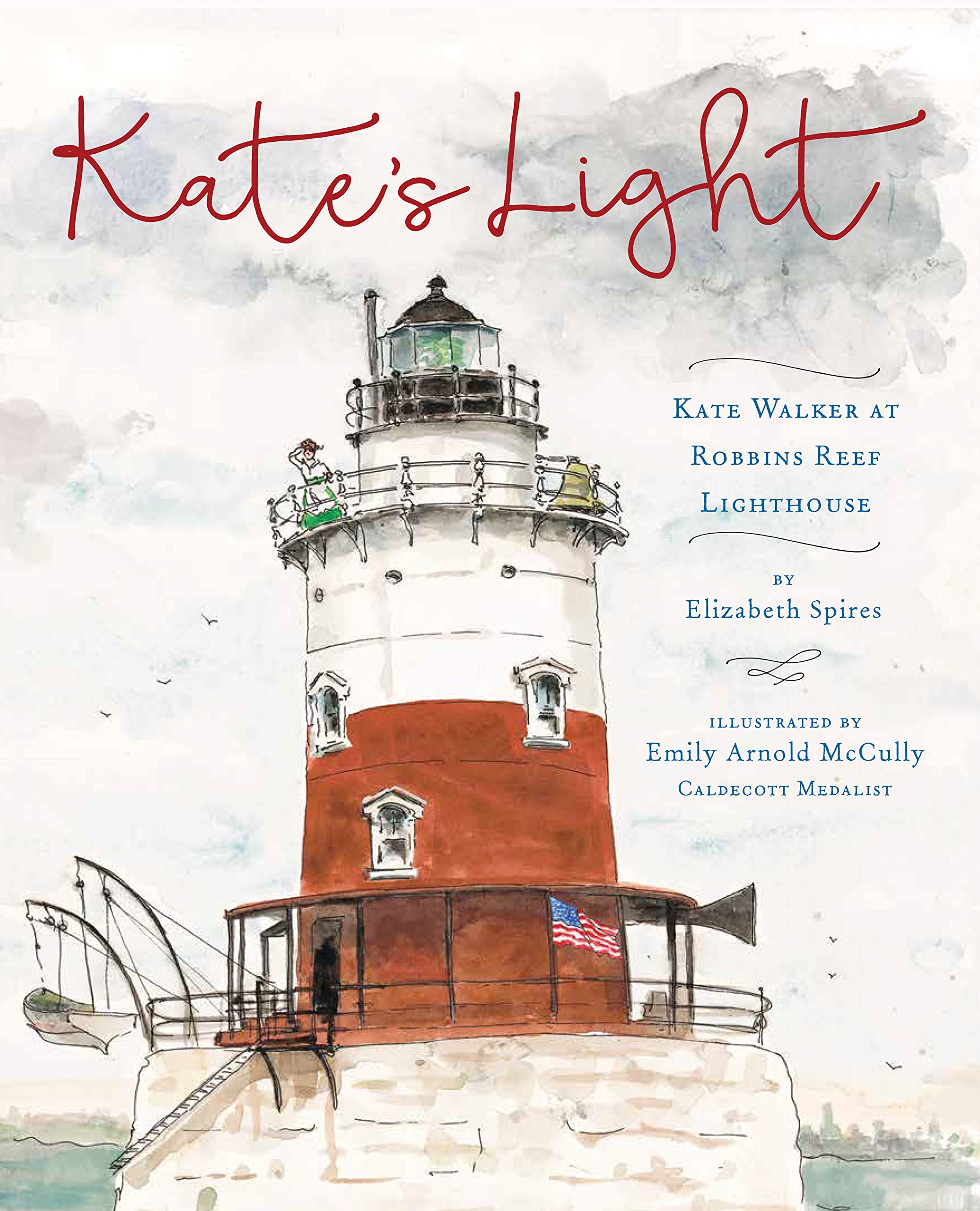
Kate’s Light: Kate Walker at Robbins Reef Lighthouse by Elizabeth Spires, illustrated by Emily Arnold McCully

Published by Margaret Ferguson Books

Kate's Light: Kate Walker at Robbins Reef Lighthouse: Spires, Elizabeth,  McCully, Emily Arnold: 9780823443482: Amazon.com: Books

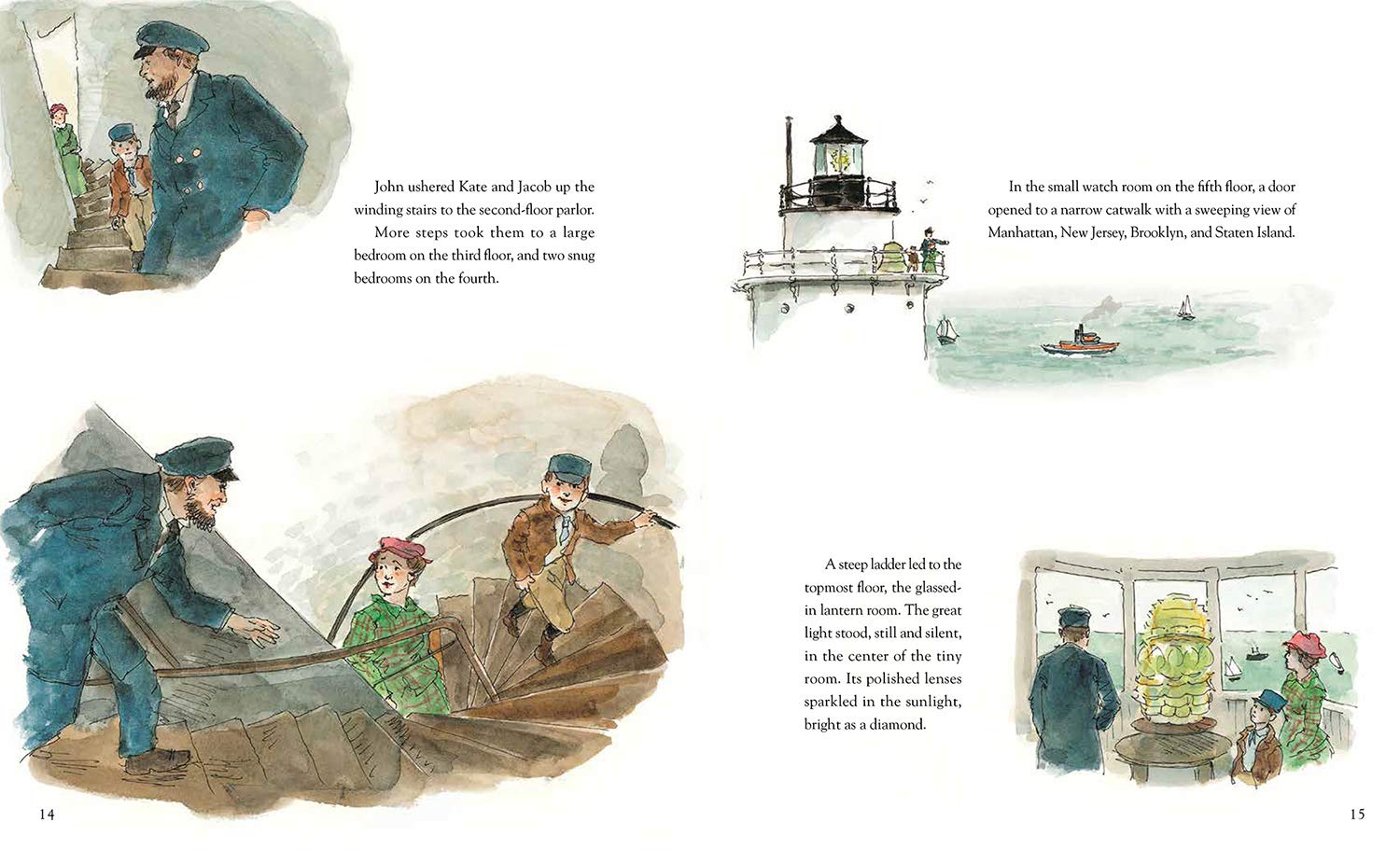
Summary:  When Kate Kaird left Germany for America with her young son Jacob, she couldn’t have imagined what lay in store for her.  She soon married John Walker, the keeper of the Sandy Hook Lighthouse, and within a year they moved into the lighthouse to live.  She spent the next 33 years there, taking over all the duties after John died when their daughter was only three years old.  It took four years for her to get the title and salary of permanent lighthouse keeper, securing the job after two men passed it up as being too lonely.  Kate kept the light clean and polished, rowed back and forth to Staten Island for visits and supplies, and rescued more than fifty people during her long career.  Includes additional information with a photo and a list of sources; endpapers include a map of the lighthouse and the surrounding area.  40 pages; grades 1-5.

Pros:  Another great choice for Women’s History Month, this would also pair well with Sophie Blackall’s Hello, Lighthouse!  The lengthy story gives plenty of details which are supplemented further with the author’s note.  As always, Emily Arnold McCully’s illustrations are excellent and really capture the different seasons and types of weather experienced by the lighthouse dwellers.

Cons:  The story is long enough that younger readers might get antsy during a read-aloud.

A Plan for the People: Nelson Mandela’s Hope for His Nation by Lindsey McDivitt, illustrated by Charly Palmer (Released March 30)

Published by Eerdman’s Books for Young Readers

A Plan for the People - Lindsey G Mcdivitt, Charly Palmer : Eerdmans

Summary:  This biography of Nelson Mandela covers his early life in the first few pages, focusing primarily on his imprisonment from 1963 until 1990.  Mandela studied and taught others while in prison, reaching out to both white guards and black prisoners.  His isolation gradually decreased as reforms slowly came to South Africa, and on February 2, 1991, he was released from prison.  Three years later, he voted for the first time in his life–and was elected president of South Africa.  Includes extensive back matter:  lengthy author’s and illustrator’s notes; additional information on apartheid, the ANC, and Mandela’s imprisonment; a timeline of Mandela’s life and South Africa’s journey to democracy; and lists of books, videos, and websites with additional information (but, surprisingly, no photos).  48 pages; grades 3-6.

Pros:  An inspiring look at Nelson Mandela’s life, with beautiful, brilliant acrylic paintings to illustrate it, and lots of material to support further research.

Cons:  I wish this book had been edited more; the text is lengthy, and some of Mandela’s story could have been more effectively shown rather than told. 

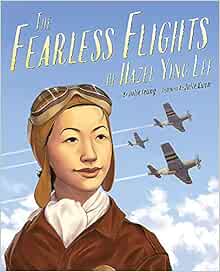
The Fearless Flights of Hazel Ying Lee by Julie Leung, illustrated by Julie Kwon

Published by Little, Brown Books for Young Readers

The Fearless Flights of Hazel Ying Lee: Leung, Julie, Kwon, Julie:  9780759554955: Amazon.com: Books

Summary:  Growing up in Portland, Oregon, Hazel Ying Lee was a fearless girl who loved running races with her brothers.  She fell in love with flying as a teenager, taking a job as an elevator operator (one of the few jobs open to Chinese Americans) to fund her flying lessons.  When World War II began, she signed up for the Women Airforce Service Pilots (WASPs), and became one of the few women to fly high-powered fighter jets.  In 1944, a radio tower miscommunication resulted in a collision between Hazel’s plane and another, and she died two days later from her injuries.  Her family had to appeal all the way to the White House for permission to bury her in the whites-only cemetery of their choice.  An author’s note gives additional information, including the facts that WASPs finally received veteran status from Jimmy Carter in 1977 and Barack Obama awarded them the Congressional Gold Medal in 2009; also includes a list of additional resources.  48 pages; grades 1-5.

Pros:  Just in time for Women’s History Month (or at least the last ten days of it), this excellent picture book biography tells the story of a courageous young woman who overcame many obstacles to pursue her dream.  The additional resources make it a great starting point for more research.

Cons:  No photos in the book, so here you go.

Meet Hazel Ying Lee, The First Chinese American Woman to Be a Pilot in the  U.S. Military During WWII

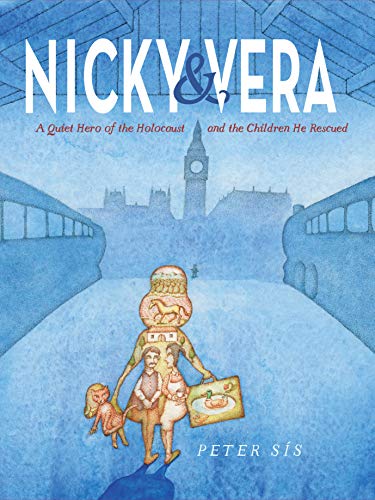
Nicky & Vera: A Quiet Hero of the Holocaust by Peter Sis

Published by Norton Young Readers

Nicky & Vera: A Quiet Hero of the Holocaust and the Children He Rescued -  Kindle edition by Sís, Peter. Children Kindle eBooks @ Amazon.com.
Illustrator Peter Sís shares hard stories with children – The Forward

Summary:  Nicholas Winton was a young man living in England when Germany invaded Czechoslovakia in 1938, and a friend asked him to come to Prague to help.  England was accepting refugees under the age of 17 if they had families to take them in.  Nicky set up an office in Prague and began collecting names and photos of children.  One of those children was Vera, a 10-year-old girl whose Czech parents wanted to send her to England.  A few months later, Nicky returned to London to recruit families to take the children.  He eventually got almost 700 children (including Vera) on eight trains out of Czechoslovakia.  A ninth train with 250 children never made it out after the borders were closed, and only two children on that train survived the war.  After the war, Vera returned home, but her entire family had perished, so she moved permanently to England.  Nicky never told anyone what he had done until his wife discovered his lists in 1989 and arranged a TV reunion with many of the people he rescued.  Nicky never thought of himself as a hero.  “I only saw what needed to be done.”  Includes a long author’s note with additional information and a photo of a young Nicholas Winton.  64 pages; grades 2-6.

Pros:  Peter Sis uses spare, understated text and folk art-style illustrations to tell this amazing story of a quiet hero and the girl whose life he saved (among many others).  Keep a Kleenex handy as you read this compelling story which is sure to engage readers well into middle school and may be considered for a few awards next year. And while you have the tissues out, watch this YouTube clip of Nicholas and Vera’s 1988 reunion on British television.

Cons:  I wish there had been a few more photos.

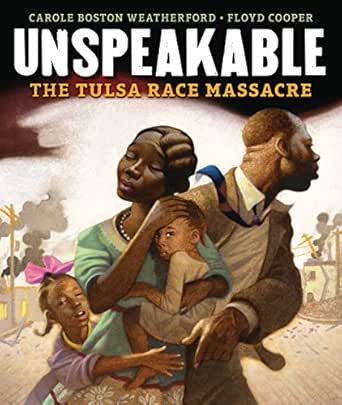
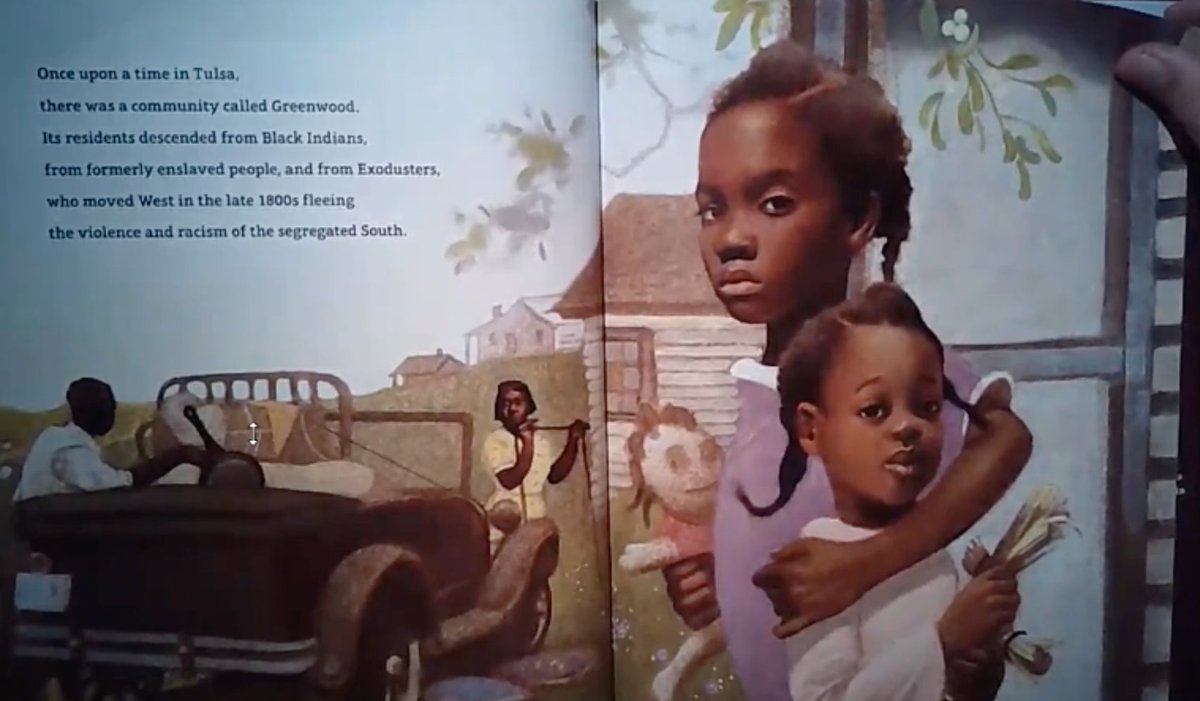
Unspeakable: The Tulsa Race Massacre by Carole Boston Weatherford, illustrated by Floyd Cooper

Published by Carolrhoda Books

Unspeakable: The Tulsa Race Massacre - Kindle edition by Weatherford, Carole  Boston, Cooper, Floyd. Children Kindle eBooks @ Amazon.com.
Debbie Reese (tribally enrolled, Nambé Pueblo) on Twitter: "Did you click  thru? Did you watch Floyd Cooper's video embedded in the article, of him  reading from UNSPEAKABLE: THE TULSA RACE MASSACRE? Here's

Summary:  “Once upon a time in Tulsa, there was a community called Greenwood.”  Although this was a segregated community, the Black part of town thrived, with excellent schools, libraries, medical facilities, and enough businesses to call Greenwood Avenue “Black Wall Street”.  But in 1921, accusations by a young white woman that a black teenager had assaulted her ignited a series of events that ultimately left up to 300 Black people dead, hundreds more injured, and more than 8,000 homeless when their community was burned to the ground.  The town was rebuilt, but the massacre was covered up; it was 75 years before an investigation took place that revealed that police and city officials plotted with the white mob to destroy the Black community.  Includes notes from both the author and illustrator describing their connections to this event, as well as photos of Greenwood burning and the Tower of Reconciliation that stands in Tulsa’s Reconciliation Park.  32 pages; grades 3-6.

Pros:  With six starred reviews, this book will surely be considered for multiple awards next January.  The structure of the story is perfect, describing the amazing community of Greenwood before the massacre as a place where Black people demonstrated that they could build thriving businesses and community services.  The massacre is described in a few heartbreaking pages, and Weatherford and Cooper don’t shy away from laying the blame squarely on the white community.  Their ending notes are fascinating, particularly Floyd Cooper’s story about his grandfather who survived the massacre.

Cons:  The endpapers are before and after pictures of Greenwood.  I wish the front endpaper was a photo like the back one is, but maybe there isn’t a photo in existence of what Greenwood looked like as a flourishing community.

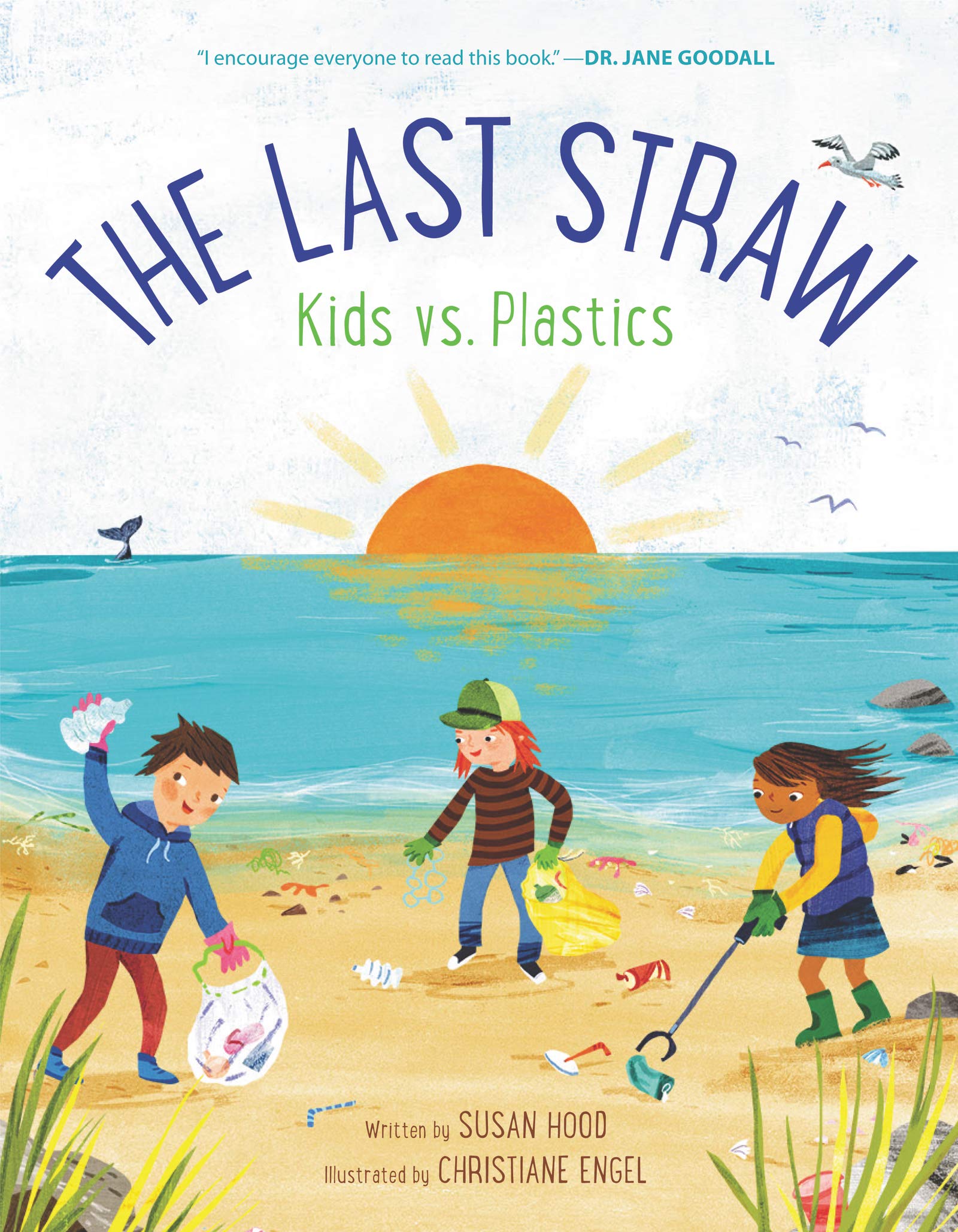
The Last Straw: Kids vs. Plastics by Susan Hood, illustrated by Christiane Engel

Published by HarperCollins

The Last Straw: Kids vs. Plastics: Hood, Susan, Engel, Christiane:  9780062981394: Amazon.com: Books

Summary:  Following an introduction by 9-year-old Milo Cress, founder of Be Straw Free, this poetry collection looks at different aspects of plastic, from its undeniable usefulness in many areas to the damage it is wreaking on the environment (especially the oceans) to different ways kids and teens are figuring out to recycle and find alternatives to plastic.  Includes a two-page author’s note; a timeline of the history of plastic from 1839; alternatives to single-use plastic items; top ten plastic ocean polluters; sources, websites, and additional notes for each poem; poetry notes for each poem; three books for further reading; and additional websites for news about plastics.  48 pages; grades K-5.

Pros:  The poetry is just the beginning in this book that is jam-packed with information and inspiring stories about kids working to make a difference in the world by recycling or eliminating plastics.  The colorful illustrators add a lot to the poems, and the 13 pages of back matter, enough to satisfy even me, would make this an excellent resource for older kids.

Cons:  I was feeling so bummed after reading the first few poems that I almost didn’t make it to the more inspirational section.

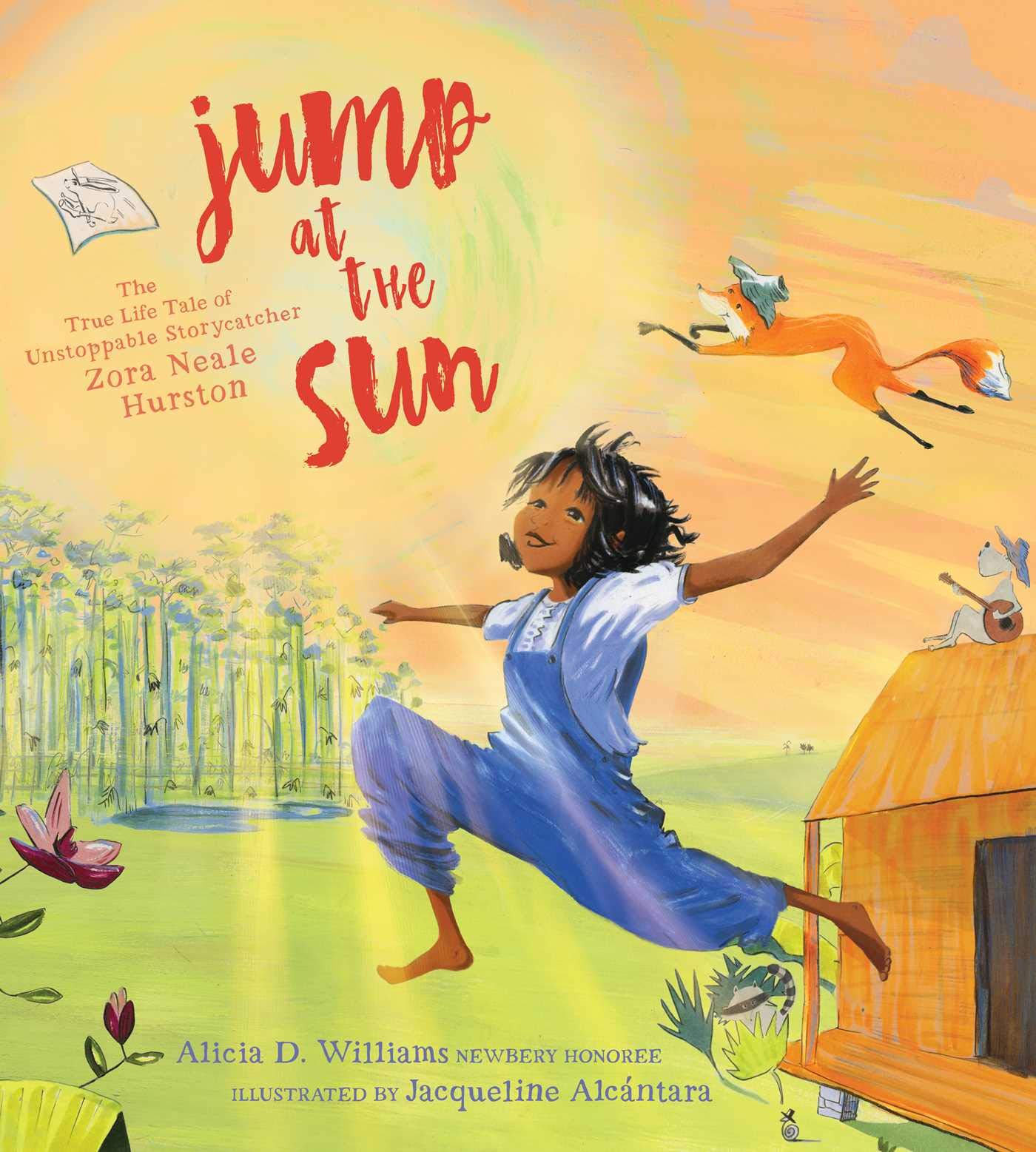
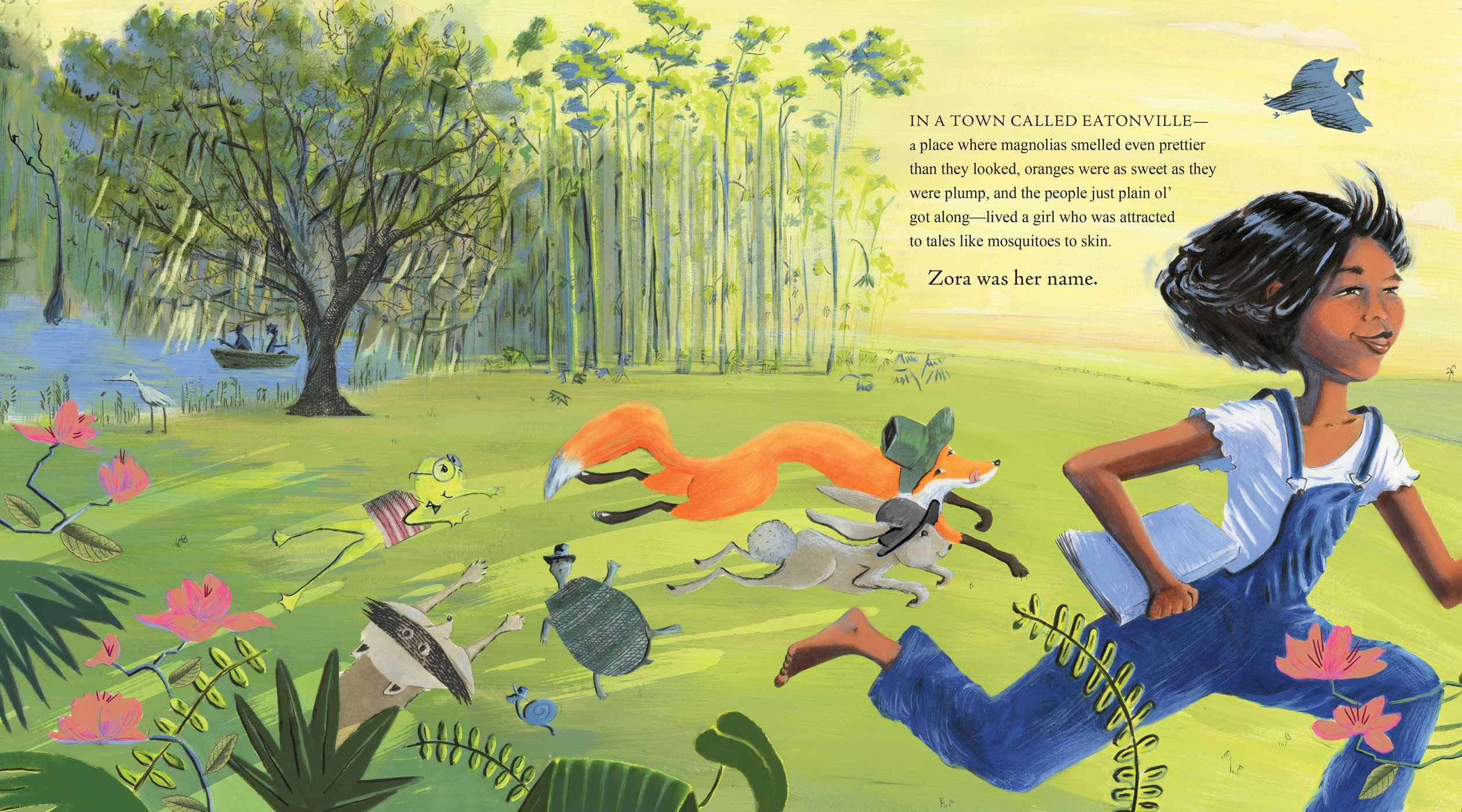
Jump at the Sun: The True Life Tale of Unstoppable Storycatcher Zora Neale Hurston by Alicia D. Williams, illustrated by Jacqueline Alcántara

Published by Atheneum/Caitlyn Dlouhy Books

Jump at the Sun: The True Life Tale of Unstoppable Storycatcher Zora Neale  Hurston: Williams, Alicia D., Alcántara, Jacqueline: 9781534419131:  Amazon.com: Books

Summary:  Growing up in Eatonville, Florida, Zora loved any kind of storytelling, and would hang around the general store to hear the townsfolk swapping stories.  Her father and grandmother didn’t approve, but her mother encouraged her to “jump at de sun.  You might not land on de sun, but at least you’ll get off de ground.”  Sadly, Zora’s mother died when she was 13 years old, and her stepmother didn’t encourage her dreams.  Zora was on her own at the age of 14, and she went to school as much as she could, graduating high school in her late 20’s.  A college anthropology professor encouraged her to collect Negro folklore.  She started the project in Eatonville, then moved on to other states, Haiti, and the Bahamas.  Zora spent the rest of her life back in Eatonville, typing up those stories and writing her own as well.  Includes an author’s note with additional information; a few Hurston stories recommended for children; and a list of sources.  48 pages; grades 1-5.

Pros:  The story of Zora Neale Hurston is told with plenty of energy in the voice of the stories she loved by Newbery honoree Alicia D. Williams.  The illustrations complement the story, with cartoon bubbles that includes snippets of those stories.  

Cons:  For such a long picture book biography, which would make a great starting point for research, there was surprisingly little back matter.

Gone to the Woods: Surviving a Lost Childhood by Gary Paulsen

Published by Farrar Straus Giroux

Gone to the Woods: Surviving a Lost Childhood: Paulsen, Gary:  9780374314156: Amazon.com: Books

Summary:  Beloved author Gary Paulsen writes of his “lost childhood” in five sections, beginning in 1944 when, at the age of 5, his grandmother took him from his alcoholic mother and sent him to live on a remote farm with his aunt and uncle.  Although the work there was hard, he felt happy and secure until his mother unexpectedly showed up and took him to the Philippines to live with his father for the first time.  The horrific ship ride there and his time in Manila make up the second and third parts of the book, then he moves on to age 13, back in the U.S.  His parents drank and fought constantly, and he was pretty much on his own, running away regularly to work on farms and at a carnival.  The final chapter tells of his time in the army, winding up with his decision to make more of himself than the other men he saw there.  On the last page, at the age of 80, he finds a notebook that a beloved librarian gave him, and thinks, “What the hell.  Might as well write something down.”  368 pages; grades 5-8.

Pros:  I zipped through this compelling memoir in just a couple of days, both mesmerized and horrified by Paulsen’s stories of his incredibly difficult childhood and adolescence.  Written in third person (he refers to himself as “the boy”), this story will be appreciated by fans of other Paulsen books, and will help readers understand the experiences that have influenced his work (although you might want to preview it before handing to some wide-eyed fourth-grade Hatchet fan).

Cons:  This is more of a memoir than an autobiography, and readers will only learn certain episodes from Paulsen’s youth rather than all that happened to him in those years. 

Butterfly for a King by Susan L. Roth and Cindy Trumbore

Published by Lee and Low Books

Image result for butterfly for a king amazon
Image result for butterfly for a king susan roth

Summary:  The isolation of the islands that make up Hawai’i means that they are home to plant and animal species that exist nowhere else on Earth.  One of these is the Kamehameha butterfly, named for the king who united all of the islands.  In 2009, a group of fifth grade students led a successful campaign to make this butterfly the state insect, hoping to bring attention to the endangered butterfly.  Soon scientists from the state and the University of Hawai’i started working together to help save the Kamehameha.  Citizen scientists helped collect data and photos.  Since then, thousands of butterflies have been raised in captivity and released all around Hawai’i.  Includes an afterword with a map and many photos; an illustrator’s note; and a list of sources.  48 pages; grades 2-5.

Pros:  Another excellent nonfiction book by the Sibert Medal winning team of Susan Roth and Cindy Trumbore.  Kids will be inspired by the way elementary students made a real difference in helping with an environmental issue.  The collage illustrations enhance the text, which includes information on the formation of the Hawaiian islands, the butterfly’s life cycle, King Kamehameha, and how the scientists carried out their project.

Cons:  Even with the pronunciation guides, I struggle with how to say some of the Hawaiian words.

Pearl Harbor (History Smashers) by Kate Messner, illustrated by Dylan Meconis

Published by Random House Books for Young Readers

Image result for history smashers pearl harbor

Summary:  When Pearl Harbor was “suddenly and deliberately attacked” by Japan on December 7, 1941, it seemed as though it had come with no warning.  But Kate Messner shows that there were those who predicted an attack as far back as the 1920’s.  The declaration of war brought out the best and worst of America, as people came together to win, but also showed cruel racism against Japanese Americans and in the segregated military.  The narrative goes through Hiroshima and Nagasaki, all the way up to the 2016 visits of President Barack Obama to Hiroshima and Japanese Prime Minister Shinzo Abe to Pearl Harbor. Includes a timeline; author’s note; bibliography; index; and lists of books, websites, and museums to visit.  224 pages; grades 3-7.

Pros:  Somehow I missed this series’ debut in 2020, but I’m glad I caught up with this latest volume.  The premise is to show some of the history that hasn’t always been taught, presumably because it doesn’t portray the U.S. in the best way.  Filled with personal narratives, photos, and pages of comic panels in every chapter, the fast pace and human interest focus are sure to entice both history buffs and reluctant readers. Perfect for fans of Nathan Hale’s Hazardous Tales.

Cons:  The focus is mostly on the war with Japan, so the European side of World War II gets a bit of a short shrift, with the Holocaust receiving a mere four sentences.