Works of art

Time to Make Art by Jeff Mack (Henry Holt and Co., 48 pages, grades K-5). A girl poses a variety of questions about art to artist. “Does it have to be perfect?” she asks Michelangelo, as he puts the finishing touches on the Sistine Chapel. “You can make your art any way you want,” he replies. “What if I can only draw stick figures?” she wants to know, to which a Paleolithic cave artist answers, “Then draw stick figures!” Colors, feelings, art materials, and subjects are all covered in a way that opens up art to everyone, with reinforcement from famous artists. Those artists all get thumbnail descriptions in the back, listed in the order they appear in the book.

This is both an excellent introduction to art history and an inspiring invitation to create art. The illustrations are cute, and it’s fun to try to identify the artists and their works. A few more resources for further exploration would have made a nice addition.

The Sunflowers: Vincent van Gogh’s Search for Beauty by Zahra Marwan (Feiwel and Friends, 40 pages, grades K-4). Vincent van Gogh’s favorite things to paint are sunflowers, which seem like happy spots of color in the gray city of Paris, even if they’re considered an inelegant subject for art. When he meets fellow artist Paul Gauguin, the two bond over the vibrant colors of each other’s paintings. Vincent moves from the city to a little yellow house in Arles, France, where he finds happiness that’s reflected in brighter, more colorful art. Some of his art finds its way onto the walls of his house, as he prepares for a joyful reunion with his friend Paul. When Paul arrives, he feels welcomed by the powerful paintings of sunflowers, and “He could feel the way it is to have a real friend.” Includes an author’s note with some additional information about Vincent and some thoughts about how art can be a powerful bond in creating friendships. This is a lovely celebration of art, friendship, and following your own heart, illuminated with van Gogh-inspired illustrations. It’s definitely not a biography, and I was sorry there wasn’t more biographical information in the back matter.

I heard about this book at the same time I learned of another biography about Vincent van Gogh, The Vincent van Gogh Atlas by Nienke Denekamp and René van Blerk, illustrated by Geert Gratama, Thames and Hudson, 160 pages, grades 5-8). I don’t know if it’s because this book was originally published in Europe, but I have struggled (unsuccessfully so far) to get it through interlibrary loan. From what I’ve read about it, it sounds like a real work of art filled with maps, letters, and reproductions of van Gogh paintings. I hope you will have greater success obtaining it than I have!

Persistence, resistance, and a fight for existence

Ernö Rubik and His Magic Cube by Kerry Aradhya, illustrated by Kara Kramer (Peachtree, 32 pages, grades K-4). Ernö Rubik was a solitary kid who enjoyed reading and solving puzzles in his Budapest home. He grew up to be a teacher who would build models to teach his students about three-dimensional objects. His curiosity about cubes led him to try making a big cube out of small ones that could move around but stay connected. His first attempts failed, but he finally found the secret: 26 cubes in three rows, with a round mechanical core. And the rest is history as Ernö’s invention, the Rubik’s Cube, went on to become one of the most popular puzzles of all time. Includes additional information about Rubik and his cube, an author’s note, and a list of three books about the cube.

Although there are some details about Ernö Rubik’s life, the focus is on the Rubik’s cube and the perseverance needed to solve a difficult problem. If kids haven’t tried the cube, they will definitely get their hands on one and start searching YouTube for various solutions.

They Call Me Teach: Lessons in Freedom by Lesa Cline-Ransome, illustrated by James E. Ransome (Candlewick, 40 pages, grades 1-5). A young enslaved man is known as Teach, due to his abilities to read and write that he learned growing up with the master’s son. By day he works as a clerk in the master’s store, but at night he teaches other enslaved people to read. He secretly helps people by reading their letters and, in one case, writing a receipt to help a woman escape. Just looking at a newspaper in public results in punishment, leaving readers to infer that there could be much more serious consequences for teaching literacy to other Black people. An author’s note gives more information about Black people’s quest for education throughout history. Includes a list entitled “More Books on Resistance.”

This husband and wife team has created a fascinating story that focuses on the large majority of enslaved people for whom escape was impossible and who tried to resist and improve themselves in the ways that were available to them, despite the risk of cruel punishments. Sure to be a Coretta Scott King award contender.

Wild Places: The Life of Naturalist David Attenborough by Hayley Rocco, illustrated by John Rocco (G. P. Putnam’s Sons Books for Young Readers, 48 pages, grades K-3). The story of David Attenborough’s life is told by another husband and wife team. Young David loved exploring the natural world around his English home, and he continued those studies as a university student. When he graduated, television was just becoming popular, and he got a job introducing viewers to the world of nature. Before long, he was traveling all over the world to show people plants and animals of different ecosystems. His travels made him more aware of the ways that wild places were shrinking and living creatures were losing their habitats. David shifted his focus to helping people understand what was happening and giving them information to help them make better choices for the planet, work that he continues today in at the age of 98. Includes an author’s note with additional information about David Attenborough and rewilding, a couple of photos, and a bibliography.

Like the Ernö Rubik biography, this is an engaging read that’s a little light on biographical information. Most pages only contain a sentence or two of text, along with award-winning illustrator’s John Rocco’s beautiful depictions of the natural world. Quotes from David Attenborough are scattered throughout the book, and the end matter fleshes out his life a bit more.

National treasures

Golden Gate: Building the Mighty Bridge by Elizabeth Partridge, illustrated by Ellen Heck (Chronicle Books, 60 pages, grades 2-5). The two children of a lighthouse keeper observe the creation of the Golden Gate Bridge from their house. Told in second person narration (“You leap out of bed–how did you forget? Today’s the day work begins on the Golden Gate Bridge”), the text includes plenty of construction details and emphasizes the seemingly impossible nature of the project. As the kids grow older, the foreman gets to know them and sometimes includes them in some aspects of construction, like the day they get to ride the elevator to a height of 700 feet above the water. Finally, on May 27, 1937, the Golden Gate Bridge is open to the public, and crowds of people, including the two children, walk across the bridge, where “the word impossible seems like nothing at all.” Includes an afterword with additional information.

Great Lakes: Our Freshwater Treasure by Barb Rosenstock, illustrated by Jamey Christoph (Knopf Books for Young Readers, 40 pages, grades 2-5). Beginning with the history of the five Great Lakes, formed by the melting of a huge glacier that covered more than half of North America, the narrative shifts to the present importance of the lakes. Not only are they home to many species of plants and animals, but they contain almost all of the surface freshwater in North America. Although they are essential in supporting humans, we’ve done our best to poison and pollute them. In recent years, work has been done to protect them, and readers are invited to investigate how they can help preserve these national treasures. Includes messages from the author and Kathleen Smith, an indigenous woman from the Great Lakes Indian Fish and Wildlife Commission, information about the Center for Great Lakes Literacy, and a list of sources.

Both of these books are chock full of fascinating information, well supplemented by beautiful, detailed illustrations, that will help readers better understand two famous American landmarks. Although they are both picture books, each one contains quite a bit of text and somewhat technical information, making them better choices for older elementary and middle school readers.

Master storytellers

As Edward Imagined: A Story of Edward Gorey in Three Acts by Matthew Burgess, illustrated by Marc Majewski (Knopf Books for Young Readers, 48 pages, grades 2-5). In Act 1, we meet a young Edward Gorey, who learned to read when he was 3 and devoured books, including Dracula at the age of six. This led him to create his own spooky stories, something that he continued to do when he moved to New York City as an adult (Act 2). Not only did he write his own stories, but he illustrated other writers’ books and gained his greatest fame designing the sets for the Broadway adaptation of Dracula and creating introductions to PBS’s Mystery! series. With money earned from those projects, Gorey headed to Act 3, purchasing a house on Cape Cod where he continued to write, draw, and work with local theaters. Edward always led life on his own terms, whether that was wearing green toenail polish as a child, attending nearly every performance of the NYC Ballet for twenty years, or keeping six cats at Elephant House on the Cape. Includes an author’s note, additional resources, and chronology.

Kids may need to be introduced to Edward Gorey’s work, but they will undoubtedly embrace his spooky illustrations and books, and perhaps be inspired to live life to the beat of their own drummer, as Edward Gorey most definitely did. I first learned of Gorey through John Bellairs’ books, which were only briefly mentioned both in this book and when I visited the Edward Gorey Museum on the Cape; this seems like an unfortunate oversight.

The Mythmakers: The Remarkable Fellowship of C.S. Lewis and J.R.R. Tolkien by John Hendrix (Harry N. Abrams, 224 pages, grades 7-12). C.S. Lewis and J.R.R. Tolkien both suffered early childhood losses but also had mystical experiences of joy as children, often associated with reading myths and fairy tales. After horrific experiences fighting in the trenches of World War I, they both became Oxford dons, where they developed a delightful friendship based on their mutual love of myths and interest in religion. A lifelong Catholic, Tolkien encouraged the agnostic Lewis to follow his spiritual longings, eventually leading Lewis to a dramatic conversion to Christianity. Each supported the other in his writing, and it’s pretty clear that neither the Chronicles of Narnia and especially The Lord of the Rings would have existed without the influence of their friendship and the literary group The Inklings which grew out of that relationship. The main chapters are interspersed with comics featuring a lion and a wizard traveling through the landscapes of Tolkien’s and Lewis’s life, and a poignant final chapter imagines the two men, who sadly had a falling out in the last decades of their lives, reuniting for one last conversation before moving into the great beyond. Includes extensive additional information about mythology, as well as an author’s note about his research, notes, a bibliography, and an index.

As someone who is both a John Hendrix fan and was an obsessive enough fan of C.S. Lewis to actually write a biography of him, I was excited to see this new book. Although it bills itself as a graphic novel, the amount of information far exceeds most of that genre. The lion and wizard segments are in comic format, while the rest of the book is more like an illustrated text. The emphasis is on the friendship between the two men and how their common love of mythology influenced their literary masterpieces. I was a bit disappointed that Lewis’s relationship with Janie Moore, which lasted for decades and had a huge impact on his life, was pretty much left out of the story. Additionally, some of the information about mythology got a bit too dense for me, and I imagine many young adults will have the same experience. Nevertheless, this is a rich story of an extraordinary friendship between two men who changed the landscape of fantasy literature and left behind books that are still beloved today.

A final pair of books about voting before the big day

Show Up and Vote by Ani DiFranco, illustrated by Rachelle Baker (Rise x Penguin Workshop, 48 pages, ages 4-8). A young girl looks back at the end of Election Day, recalling how she was reluctant to go out on a rainy November morning, but her mother told her that they were on a mission. At the polling station, the girl recognizes friends and neighbors, realizing that voting is a community event. In the voting booth, she watches her mom make her selections, and as they finish, the two of them imagine people across the country doing the same thing. Proudly wearing their “I voted” stickers, they walk home, and the girl sees her neighborhood with new eyes, as a place where people work together to create a community, and “showing up to vote is how it all starts.”

Singer and songwriter Ani DiFranco has created an accessible introduction to voting and Election Day with rhyming text (and no capital letters) that reads kind of like a folk song and colorful illustrations that resemble retro posters. Readers will learn a bit about voting and be empowered to get involved in their communities.

Represent: The Unfinished Fight for the Vote by Michael Eric Dyson and Marc Favreau (Little, Brown Books for Young Readers, 256 pages, ages 12 and up). Dyson and Favreau continue their exploration of American history that they began in Unequal with this story of voting rights from the founding of the United States to the present. There are inspiring narratives about Black, female, Latinx, and Native activists who worked to get the vote for their communities, alongside less inspiring ones such as how white women largely refused to help Black and Native women once they had secured their own right to vote. And there are downright depressing ones that continue to this day like the Citizens United Supreme Court decision that has encouraged huge amounts of spending across the political spectrum and the gerrymandering of districts for political gain. The list of “People-Power Ideas” at the end (get rid of the electoral college, expand the House of Representatives, introduce ranked-choice voting, among others) seem commonsensical yet depressingly unlikely to happen. There are also ideas for student activism, a voting rights timeline, additional resources, and an index.

I found this book both extremely depressing and surprisingly hopeful, seeing that our current threats to democracy are actually part of a centuries-long plot to keep voting and power concentrated in the hands of a few. The struggles that have ensued to give more people the right to vote have resulted in torture, imprisonment, and murder, yet ordinary people have persevered and often ultimately met with success. Seeing ourselves as part of this long history rather than poised at some do-or-die moment gives me a glimmer of hope to continue the struggle.

Reminder: I have an Election Day and Voting Rights book list if you’re looking for more. I haven’t had a chance to add these two books yet!

Space travel

Almost Underwear: How a Piece of Cloth Traveled from Kitty Hawk to the Moon and Mars by Jonathan Roth (Christy Ottaviano Books, 40 pages, grades 1-5). Back in 1903, unbleached muslin was most commonly used to make ladies’ underwear. But one bolt of fabric was purchased by Wilbur and Orville Wright and used for a completely different purpose: to help make the wings of their new flying machine. Although they succeeded, and the muslin went airborne, the machine ultimately was wrecked and went into storage for many years. Shortly before his death, Orville donated swatches of fabric to the new Carillon Historical Park museum in Dayton, Ohio, where it stayed until 1969, when Neil Armstrong carried a piece of it into space. The cloth made it all the way to the Moon, where Armstrong carried it on his moonwalk. The cloth’s final adventures took place in 2020, when it traveled all the way to Mars on board the rover Perseverance. Not only that, but the cloth was attached to Ingenuity, a four-pound helicopter that became the first machine to fly on a different planet. Not bad…for something that could have been some underwear. Includes an author’s note, a glossary of the Perseverance instruments, and a bibliography.

The title reveals the clever hook used to look at three different milestones in air and space travel history, illustrated with combinations of historical photographs and cartoons, including a fun cartoon rendering of the happy piece of cloth. The author does a great job of making STEM history accessible to elementary readers. Pro tip: be very specific when doing a Google images search for Almost Underwear.

Mae Jemison: A Graphic Novel (It’s Her Story) by Lesley Williams, illustrated by Brooke O’Neill (Sunbird Books, 48 pages, grades 2-5). This short graphic biography tells the amazing life of Mae Jemison, who graduated from high school at age 16, attended Stanford, became an M.D., then transitioned to a career as an astronaut, becoming the first Black woman to go into space. She also loved music and was an accomplished dancer, as well as working for civil rights as a college student and advocating for STEM education as an adult. The last page invites readers to share their dreams, remembering that Mae’s hard work and persistence made hers come true.

This is the first volume of this series I’ve seen, but it looks like there are several others about famous women. The short page count and graphic format will make it appealing to many different types of readers, and it brings Mae Jemison to life in a way that kids will relate to, showing her as a child who had many interests in addition to science. Some additional resources at the end would have been a nice addition.

Graphic memoirs

Uprooted: A Memoir About What Happens When Your Family Moves Back by Ruth Chan (Roaring Brook Press, 288 pages, grades 4-7). Having spent her whole life in Toronto, Ruth’s not excited about moving back to Hong Kong to be closer to her mother’s family. Her brother, a senior in high school, stays behind at a Canadian boarding school, and her dad is in China much of the week at his job there. Ruth finds Hong Kong exciting but challenging, with different school subjects than what she’s used to and a language (Cantonese) that she understands but doesn’t feel comfortable speaking. Her mom is enjoying reconnecting with family and friends, leaving Ruth feeling pretty much on her own–except when her parents find out about her grades and nag her to do better at school. Finally, she explodes and tells her parents about all the difficulties she’s dealing with. They’re surprisingly understanding, having believed that Ruth was capable of making all the adjustments, but offering to make some changes to try to help. Her dad’s story of his birth and early days during a difficult time in Chinese history, is woven through the contemporary story, and Ruth draws on it for courage and perseverance during her own difficult times. By the time her brother comes for a visit, Ruth is confident enough to show him all around the city, even trying out her Cantonese on the natives. Includes an author’s note and photos that give more details about her story.

Unlike many immigration graphic novels, like Parachute Kids or Measuring Up, this one is about going back to a country of origin when North America (in this case, Canada) has started to feel like home. Ruth Chan writes in the author’s note that in Canada people saw her only as Chinese, but in Hong Kong, she wasn’t Chinese enough. It’s an interesting perspective, and her father’s stories add an extra dimension that I wish had been developed a bit more. All in all, Ruth comes across as a resilient girl, able to make friends easily and to communicate (in her 13-year-old way) with her parents when things get tough.

Dear Dad: Growing Up With a Parent in Prison–and How We Stayed Connected by Jay Jay Patton with Kiara Valdez and Markia Jenai (Scholastic Graphix, 128 pages, grades 4-8). Jay Jay Patton’s spent her early life without her dad, who was incarcerated. Her parents did their best to keep the family connected, but phone calls were difficult and expensive, and visits were extremely rare. They relied on letters to keep in touch, with Jay Jay especially liking the math problems and puzzles her father created and sent to her. When Jay Jay was ten, Dad was released from prison, and the family relocated to Florida. Jay Jay struggled with a new school, a new family structure, and the uncertainty of how to tell new friends about her family’s history. Her father had a new job in the tech industry, and the two of them bonded over coding, eventually working together to create the Photo Patch app that helps parents and kids stay in touch when a family member is in prison. Today, at the age of 18, Jay Jay and her dad run the Photo Patch Foundation as well as events to teach kids coding. Includes several pages of photos and additional information about Photo Patch.

This is a fascinating story about a topic (incarcerated parents) that’s not written about much in children’s books. Jay Jay is an amazing role model, and I’m grateful that she’s shared her story, as well as her dad’s. The story itself is only 110 pages without a lot of text, so it felt like some pretty complex issues were given only the briefest coverage.

A ballplayer who dared, a poet who cared, and a sanitation worker who repaired

Call Me Roberto! Roberto Clemente Goes to Bat for Latinos by Nathalie Alonso, illustrated by Rudy Gutierrez (Calkins Creek, 40 pages, grades 2-5). Roberto Clemente loved playing baseball as a boy in Puerto Rico and was thrilled to be scouted by the MLB. After a disappointing season in Montreal, he joined the Pittsburgh Pirates, where he became an All-Star and helped lead his team to the World Series in 1960 and 1971. He won twelve Gold Gloves, was the 1966 National League MVP, and the 1971 World Series MVP. Despite his success, Roberto often faced racism and discrimination. He corrected those who tried to call him Bob and spoke out against the segregation he endured during spring training in Florida. On September 30, 1972, Roberto became the 11th MLB player and the first Latino one to reach 3,000 hits. Includes notes from the author and illustrator, glossary, photos, bibliography, and timeline that tells about Roberto’s death in a plane crash on his way to deliver humanitarian aid to Nicaragua in December of 1972.

I’m ashamed to say that I thought Roberto Clemente was Dominican and that the only thing I knew about him was his death in a plane crash. This biography emphasizes his greatness in baseball, making clear the discrimination he faced and how he fought for justice for himself and other Black and Latino players. The illustrations by Caldecott honoree Rudy Gutierrez are beautiful and deserve a look from this year’s Caldecott committee. The author’s note adds a personal story, since she is a Cuban American sportswriter who has faced some of the same issues Roberto Clemente did.

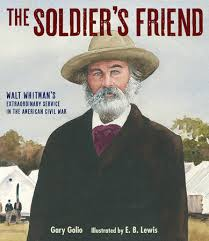
The Soldier’s Friend: Walt Whitman’s Extraordinary Service in the American Civil War by Gary Golio, illustrated by E. B. Lewis (Calkins Creek, 40 pages, grades 2-5). A look at a lesser-known part of Walt Whitman’s life, when he served as a volunteer nurse in the Civil War. After his brother was wounded, Walt traveled from New York to Virginia to visit him in the hospital. He was so moved by the soldiers he saw that he decided to move to Washington, DC to devote himself to caring for them. Most of what he did was simple: bringing treats, helping men write letters, talking with them, or just listening. Although he was a fervent supporter of the Union cause, he cared equally for soldiers from both sides. Lines from Whitman’s “Leaves of Grass” are woven into the story. Includes photos and additional information about Walt Whitman and his Civil War experiences, along with a list of resources.

This touching story of Walt Whitman’s kindness and caring seems particularly relevant in today’s world when it’s easy to feel like it’s necessary to take sides or that one person can’t make a difference. The author notes at the end that Whitman may have visited as many as 25,000 soldiers, and while he couldn’t influence the outcome of the war, he found a way to express caring and kindness. Except for the lines from “Leaves of Grass,” there’s almost no mention of Walt Whitman’s poetry; it would have been nice to acknowledge his literary contributions in the story or back matter.

Gifts from the Garbage Truck: A True Story About the Things We (Don’t) Throw Away by Andrew Larsen, foreword by Nelson Molina, illustrated by Oriol Vidal (Sourcebooks Explorer, 40 pages, grades 1-4). Nelson Molina was always a collector. His mostly Puerto Rican neighborhood in East Harlem yielded all kinds of treasures. His mom showed him how to turn scrap wood into birdhouses, and Nelson enjoyed fixing up cast-off toys for his younger siblings. As an adult, Nelson became a New York City Sanitation Worker, where he continued to find and fix up things that he found in the trash. He started displaying them in the locker room of the sanitation garage, eventually expanding into other parts of the building. Since retirement, Nelson has opened a museum where he can display his treasures, showing the huge amount of stuff that we put into the trash. Includes tips for reducing, reusing, recycling, and rethinking, as well as photos of Nelson with some of the exhibits from his museum.

Kids will be inspired to look at trash differently, maybe thinking twice before they throw something away. I loved the scene at Christmas where young Nelson happily gives his siblings the toys he’s fixed up for them. Being something of a minimalist, though, the photos of his cluttered museum convinced me that his way of life is not for me.

Election Day, part two

We Shall Not Be Denied: A Timeline of Voting Rights and Suppression in America by Cayla Bellanger DeGroat and Cicely Lewis (Lerner Publications, 48 pages, grades 4-8). Beginning with a present-day example of laws being passed to limit voting by mail, the authors trace the history of groups of Americans whose right to vote has been suppressed. A timeline at the bottom of each page keeps track of important years in voting rights history, while the text and illustrations give more details about those events. Although there have been backwards steps, the trajectory has slowly inched forward to give women, Indigenous people, Asian Americans, and Black citizens voting rights, and voting has become more accessible through absentee ballots and the repeal of poll taxes and other discriminatory practices. There is still work to do, and the final pages suggest actions readers can take, as well as offering reflection questions, a glossary, and index, and a reading list.

Readers will learn that voting, which should be a right, has too often been a privilege reserved for certain groups based on race, gender, and class. Although it contains a fairly brief, straightforward narrative, the book offers a lot of food for thought and discussion and would make an excellent resource to begin an investigation into the history of voting rights and the state of those rights today.

With Election Day just weeks away, teachers and librarians will undoubtedly be looking for resources to share with students. Here’s an Election Day and voting rights book list to help you out.

Indigenous history

Stealing Little Moon: The Legacy of the American Indian Boarding Schools by Dan SaSuWeh Jones (Scholastic Focus, 304 Pages, grades 5-8). Dan SaSuWeh Jones tells the story of his family’s history with the Chilocco Indian Agricultural (boarding) School, beginning with the forcible capture of his grandmother Little Moon There Are No Stars from the Ponca reservation in 1885 at the age of four. The Chilocco school, run by Quakers, did not condone the physical abuse found at other Indian boarding schools, but it did use strict, military-inspired practices to force the students to assimilate to white culture. Little Moon There Are No Stars, renamed Elizabeth, stayed on for several years after her graduation to work as a school matron, and sent her own daughter there as well. By the time the author’s sister attended the school in the 1950’s, there had been many changes, becoming a vocational school that provided a positive experience for many (although certainly not all) of the students. The 1960’s and 1970’s saw political movements that helped the school and its students embrace their various cultures and languages. While the author didn’t attend the school, he worked there after it closed in 1985 as part of a maintenance crew trying to preserve the buildings and grounds. In his final chapter, he writes of the appropriateness that those buildings have crumbled, leaving the land to its natural state, a metaphor for the enduring nature of Indigenous cultures that have survived so much trauma yet still continue to live on. Includes an introduction by Denise K. Lajimodiere (Turtle Mountain Band, Chippewa), photos throughout the text, and a long list of additional resources.

Reading this book caused me to reflect on how much this blog has educated me and changed my views on American history. I’m not sure I knew anything about Indian boarding schools ten years ago, but I’ve learned from children’s books over the years, and this one added a lot to that knowledge. It’s masterfully written, weaving together a personal family memoir and the history of boarding schools in North America. The author writes unflinchingly about a multitude of abuses and deaths of children at many different schools, while at the same time acknowledging that some students had positive experiences and learned to embrace their heritage, particularly in the later years of the schools’ histories. The final chapters give hope that some of the many, many crimes and trauma committed against indigenous people are finally being at least brought to light and possibly, in some cases, addressed and healed. There are some horrific descriptions of child abuse, so be aware of that element when sharing this book with kids. I hope this book will be considered for awards, especially by the Sibert committee.

This Land: A History of the Land We’re On by Ashley Fairbanks, illustrated by Bridget George (Crown Books for Young Readers, 40 pages, ages 4-8). “This is my house. I live here with my family,” the narrator begins. “Before us, another family lived here.” Other families lived there, too, but further back in time, a whole community lived on the land before they were forced off by Europeans, something that happened all across the country. The narrator has a friend who is Anishinaabe (like the author and illustrator), and he and his grandma remind the boy of the Indigenous people who once lived there: their food, their songs, and mostly, the way they considered the land to be sacred. Now, as he travels around the U.S. with his family, the boy learns about different Indigenous groups who lived in those places and remembers how they once honored the land they were on. Includes additional information about land acknowledgement, discussion questions, and ideas for learning more about local Native people.

This straightforward story reminds readers to learn about the history of the land they now call home and recall that it once belonged to people who were forced to leave their homes. I really liked how the book acknowledges those who lived on the land of well-known sites like Mount Rushmore and New York City. I read in a review that the title calls to mind the controversy around the song “This Land Is Your Land,” a song that is considered problematic by many Indigenous people. I wasn’t aware of this and was reminded once again of how much I have learned from reading books for this blog.