The Quest for Z: The True Story of Percy Fawcett and a Lost City in the Amazon by Greg Pizzoli

Published by Viking

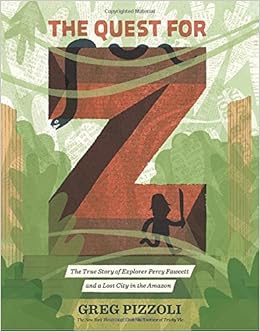
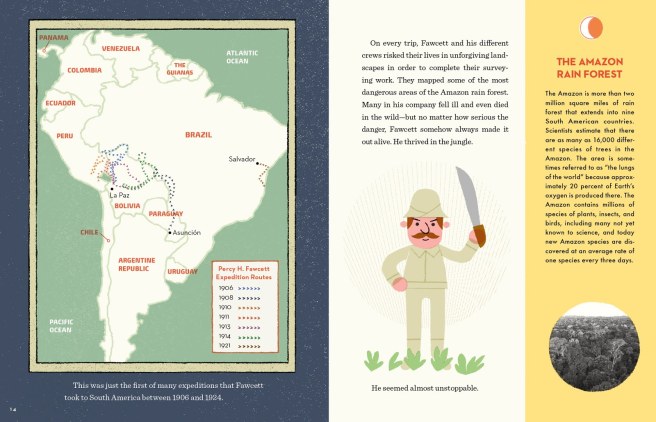
Summary:  British explorer Percy Fawcett was fascinated by stories of a mythical city that had thrived in the Amazon rain forest, then mysteriously disappeared.  He called the city “Z”, and he was determined to find it.  For many years, he worked as a member of the Royal Geographic Society, surveying areas in Bolivia, Brazil, and Peru. He had many dangerous adventures on these expeditions, including a close encounter with a huge anaconda and the discovery of a missing member of his party with 42 arrows in his body (he was dead).  He heard more stories from the locals about the lost city of Z, and became obsessed with finding it.  The Royal Geographic Society wouldn’t support such a wild goose chase, so Fawcett organized a trip himself, taking only his son Jack and Jack’s friend Raleigh.  They set off for unknown territory in the Brazilian jungles, and (spoiler alert) were never seen again.  To this day, other explorers have tried to find out what happened to them, but their fate remains a mystery, and the city of Z has never been discovered.  Includes an author’s note, a page of “Fawcett hunters” describing other explorers who have tried to find out what happened to Percy Fawcett, a glossary, and a page of sources.  48 pages; grades 2-5.

Pros:  A perfect addition to a unit on explorers.  Fawcett’s story is compelling, but ultimately tragic, not unlike some of the better-known European explorers.  The cartoon-inspired illustrations add some fun, and sidebars provide context to the explorer’s life.

Cons:  Fawcett definitely seems to be a product of his time, with his stiff upper lip British Empire approach to exploration.
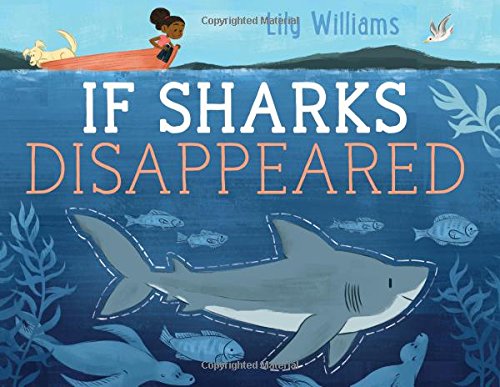
If Sharks Disappeared by Lily Williams

Published by Roaring Brook Press

Summary:  Sharks can seem scary, but a world without sharks is even scarier.  Because they’re at the top of the food chain, they keep the populations of their prey in balance.  By feeding on weaker animals, they allow the stronger ones to reproduce and survive.  Williams makes the case that removing sharks from the ecosystem could ultimately destroy the oceans and all the animals that depend on it for life–including humans.  The final two pages include additional information on why sharks are in trouble and what kids can do to help save them.  Also includes a glossary and bibliography; labeled drawings of a variety of shark species are included on the endpapers.  40 pages; ages 4-8.

Pros:  A simple yet scientific explanation of the interconnectedness of all species.  The focus on sharks will make this a popular choice for kids.

Cons:  The destruction of all life on earth is kind of a downer.

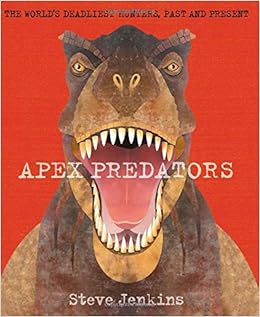
Apex Predators by Steve Jenkins

Published by Houghton Mifflin Harcourt

Summary:  After a one-page explanation of what an apex predator is (animals at the top of their food chain), Jenkins launches into his trademark cut-paper illustrations with facts about various apex predators, past and present.  He starts with several modern-day animals, then works his way backward through time, from the giant short-faced bear (extinct 11,000 years ago) to the Anomalacaris (strange shrimp) that’s been extinct for 500 million years.  On the last two pages, he shows a couple imagined face-offs between living and extinct animals.  Who would win–the Siberian tiger or the Utahraptor?  The great white shark or the Dunkleasteus?  There’s also a sidebar about the deadliest predator of all times; bet you can guess what that is.  Includes a brief bibliography and a list of websites.  32 pages; grades 1-5.

Pros:  Jenkins has produced another collection of amazing illustrations and kid-friendly facts.  Readers will wish for more of the “Who would win?” scenarios…maybe they could learn about some of the apex predators and create their own.

Cons:  After reading many Steve Jenkins books, some of his facts sound familiar.

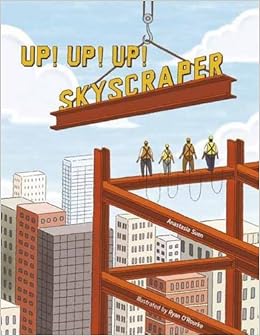
Up, Up, Up, Skyscraper! by Anastasia Suen, illustrated by Ryan O’Rourke

Published by Charlesbridge

Summary:  What’s going on behind that fence?  A group of kids gets to put on hard hats and take a look at every step of the construction of a skyscraper. Each two-page spread has four lines of rhyming text, supplemented with a few sentences explaining the process.  The illustrations have labels to identify machines used, as well as different parts of the structure.  A small inset picture gives a macro view of what the building looks like at each step.  The last page unfolds upward to show the finished skyscraper.  32 pages; ages 3-8.

Pros:  A fun and accessible introduction to building a skyscraper.  Construction enthusiasts will love studying the pictures, while those less familiar with the process will learn a lot.

Cons:  The fold-out page seemed a little ill-fitting and was already starting to rip a bit when I unfolded it.

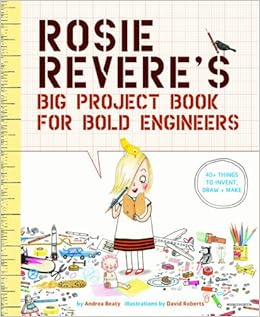
Rosie Revere’s Big Project Book for Bold Engineers by Andrea Beaty, illustrated by David Roberts

Published by Harry N. Abrams

Summary:  In this companion workbook to Rosie Revere, Engineer, Rosie advises kids about how to start being an engineer.  On the first few pages, Rosie introduces herself and the different types of engineering.  Much of the rest of the book is design challenges, including several “Real-World Problems”, such as thinking of ways to save water, and “Make-It” activities like building and testing a catapult for marshmallows.  There are several “Super-Duper Engineering Challenges”, like designing a cane for Great-Great-Aunt Rosie that will allow her to carry her tools; kids are encouraged to draw a design for these, rather than to build the actual item.  There are many blank pages for writing and drawing.  On the final page, young engineers can design a stamp to identify their work.  96 pages; grades 1-5.

Pros:  A good introduction to engineering with lots of activities to inspire creative thinking.

Cons:  Kids and teachers might be looking for less drawing and writing and more hands-on activities to build.

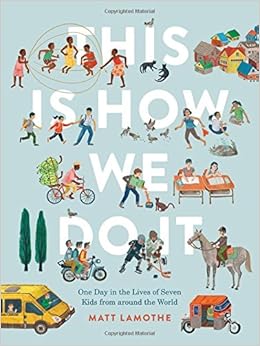
This Is How We Do It: One Day in the Lives of Seven Kids from Around the World by Matt Lamothe

Published by Chronicle Books

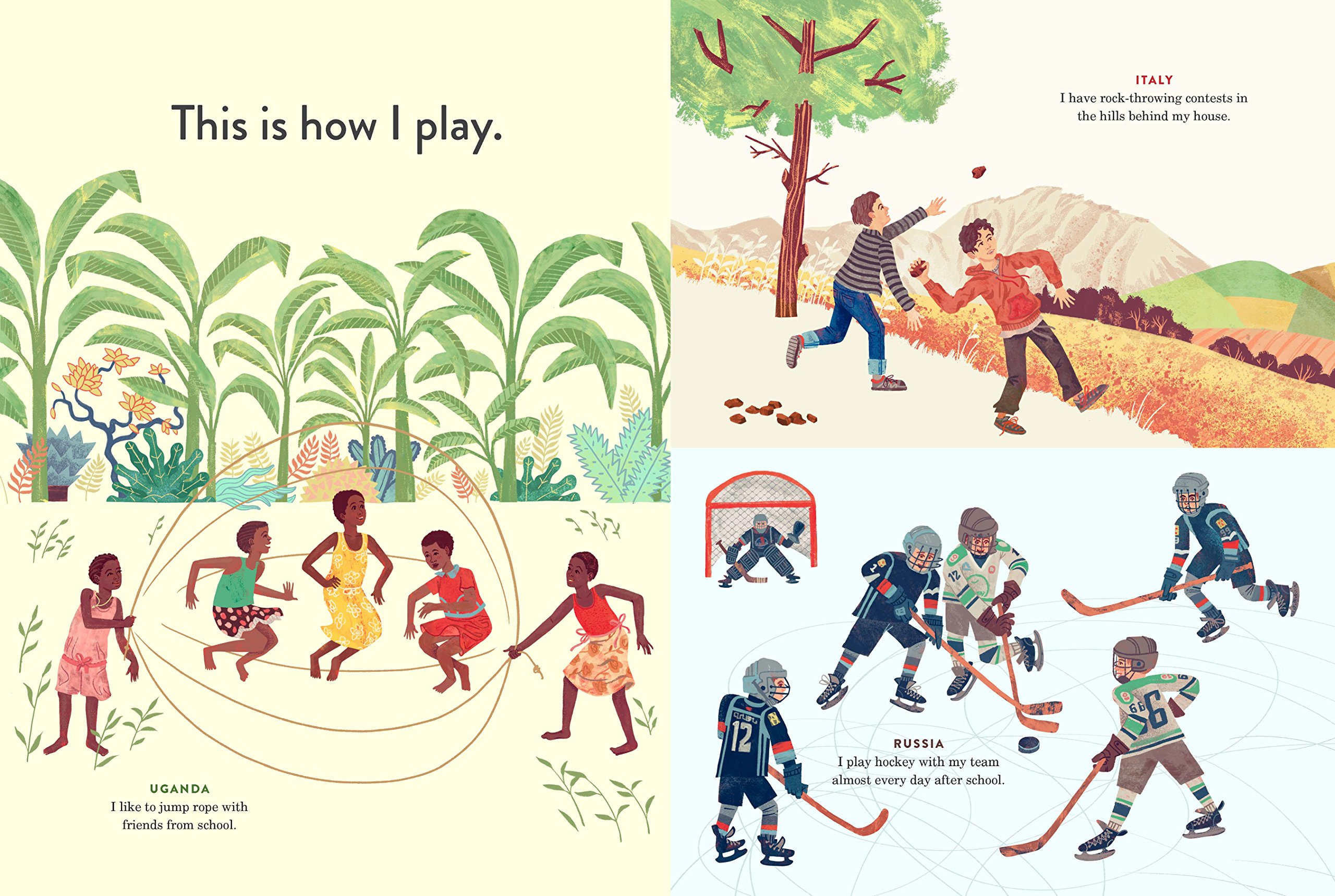
Summary:  Seven children, ages 7-11, from seven different countries (Japan, Peru, Iran, Russia, India, Italy, and Uganda) explain what they do throughout their day. Readers learn what they eat, who is in their family, how they get to school, what they learn there, and what they do after school.  The last page says, “This is my night sky,” indicating that children all over the world sleep under the same sky.  The last two pages show photos of the real families that the kids come from, and an author’s note explains how those families were chosen and that, while they represent their countries, not everyone in their country has the same tastes, interests, and experiences as those described in the book.  Includes a glossary and endpapers with a map of the world showing where each child lives.  52 pages; grades 1-4.

Pros:  The large, colorful pages are an engaging way for kids to learn about the lives of others their age around the world.  The focus on everyday activities will allow readers to make many connections with their own lives.

Cons:  The text was kind of stilted.

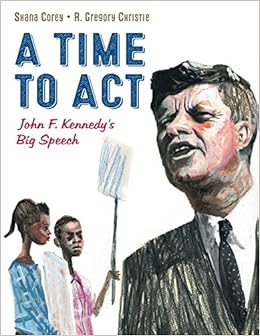
A Time to Act: John F. Kennedy’s Big Speech by Shana Corey, Illustrated by R. Gregory Christie

Published by NorthSouth Books

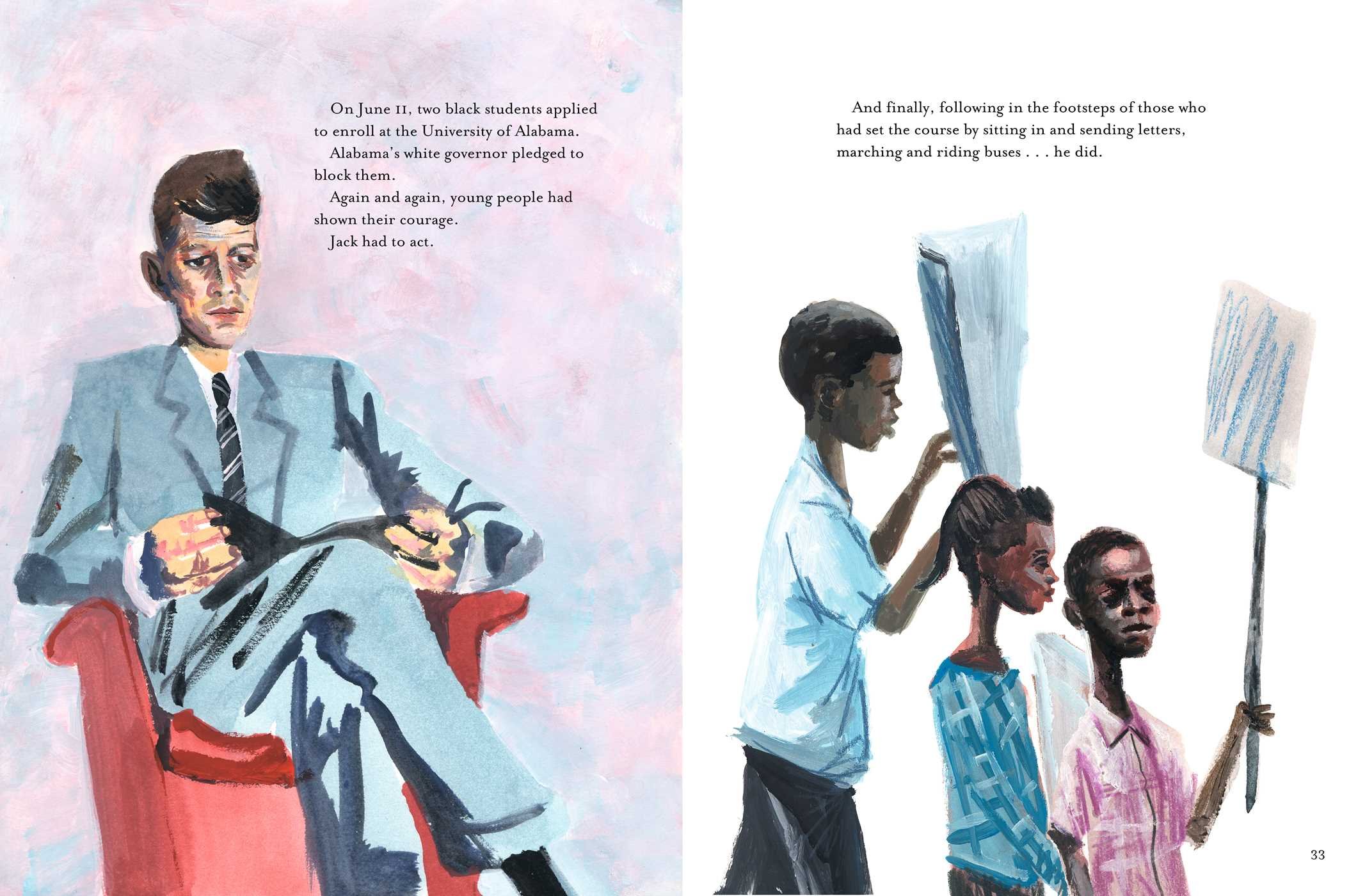
Summary:  Young John F. Kennedy didn’t always do well in school, and he was often sick.  But as he grew up and studied history, he became interested in the meaning of courage and how he could help others in the world. When his older brother Joe died in World War II, Jack became the focus of his family’s political ambitions.  When he was elected President, he quickly took action in a number of areas, like establishing the Peace Corps and starting the space race.  But he was less decisive on civil rights.  African-American leaders like Martin Luther King, Jr. and Jackie Robinson pressured him to act more forcefully, but it wasn’t until he saw young people around the country marching and going to jail that he found the courage to speak up.  The “big speech” of the title is his civil rights address, given June 11, 1963, that ultimately led to the 1964 Civil Rights Act.  Readers are encouraged at the end of the book to take action like those who inspired JFK to make this famous speech.  An author’s note gives more background; there are also thumbnail profiles of other famous people in the book and additional resources.  56 pages; grades 3-6.

Pros:  An inspirational story of the many accomplishments of John F. Kennedy, as well as a look at an area he where he was slow to act, and how others’ deeds finally led him to do the right thing.  The bold paintings complement the bold actions of the narrative.

Cons:  For a picture book, there’s a lot of content for readers to understand.

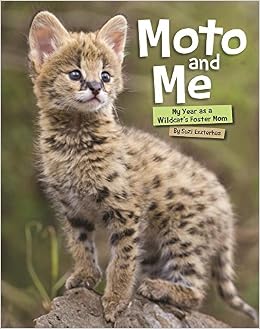
Moto and Me: My Year As a Wildcat’s Foster Mom by Suzi Eszterhas

Published by Owlkids

Summary:  While trying to rescue her kittens from a fire, Moto’s mother was scared by a truck and dropped one of them in the road.  The tourists on the truck didn’t see the mother.  Thinking they were rescuing the tiny serval, they took it to a ranger station.  By the time they got there, the ranger knew Moto’s mother would never take her kitten back, so he was given to Suzi Eszterhas, who was working as a wildlife photographer.  She became his foster mom, taking care of him, but also making sure that he followed his instincts and learned how to live in the wild.  As Moto grew up, he spent increasingly long periods of time in the wild until one day he didn’t return.  Eszterhas feared the worst, but a week later, she spotted him, and he came over to her jeep to greet her.  He was seen again several times by rangers, and Suzi knew she had succeeded as a serval foster mom.  Includes a page of facts about servals.  40 pages; grades K-5.

Pros:  An engaging nonfiction narrative that kids could read for either pleasure or research.  Eszterhas is a wildlife photographer, so the many photos are cute and captivating.

Cons:  I’m not really sure how to pronounce “serval”.

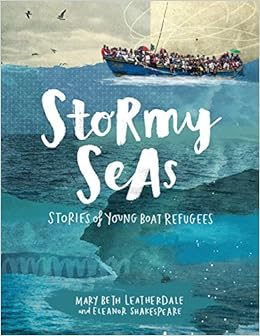
Stormy Seas: Stories of Young Boat Refugees by Mary Beth Leatherdale, illustrated by Eleanor Shakespeare

Published by Annick Press

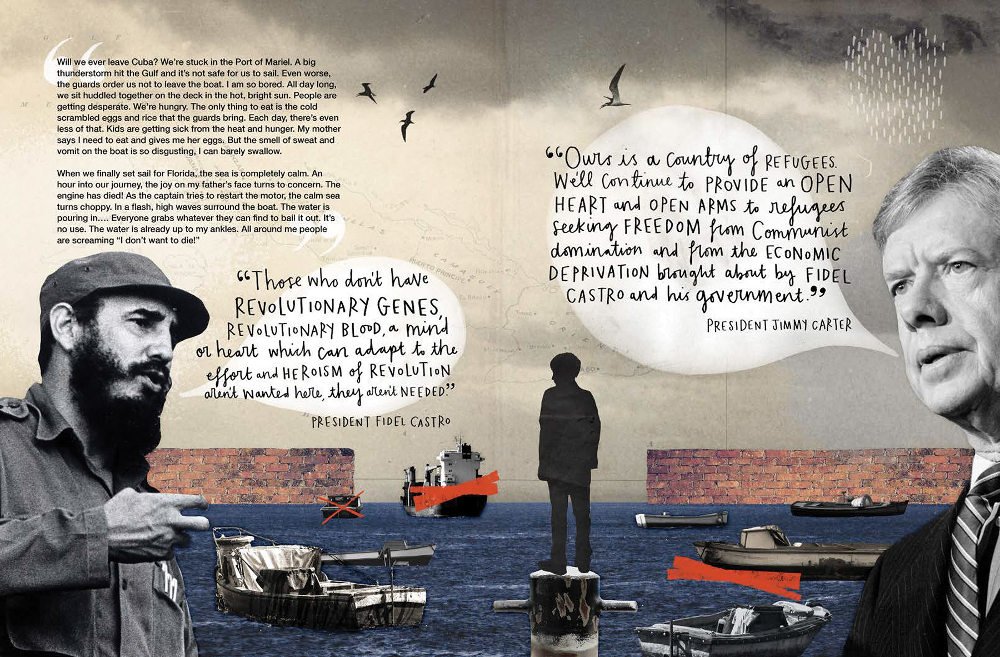
Summary:  Sixty five million people worldwide have been forced to leave their homes due to war, persecution, or natural disaster. Many of them, including a large number of children, are seeking refuge in countries in Europe and North America.  This book profiles five refugee kids from Germany, Vietnam, Cuba, Afghanistan, and Ivory Coast over the last 60 years.  They have undertaken dangerous journeys by boat, been attacked by pirates, been turned back from their original destinations, and have often arrived in an unknown place with little more than the clothes on their backs.  Yet each one has worked hard and become a productive citizen of his or her new country.  Each profile includes the narrative of the subject, much of it in his or her own words, a timeline of the journey, and a “What happened to?” section that tells the happy ending to each story.  Includes timelines and a list of resources.  64 pages; grades 4-7.

Pros:  Readers will empathize with the refugees’ stories, and by extension, the plight of refugees everywhere.  Fans of the “I Survived” series will find these suspenseful real-life survival tales riveting reading.  The collage illustrations add interest.

Cons:  There are some disturbing details, like the 14-year-old girls from Vietnam who are taken off the boat by marauding pirates.

Balderdash! John Newbery and the Boisterous Birth of Children’s Books by Michelle Markel, illustrated by Nancy Carpenter

Published by Chronicle Books

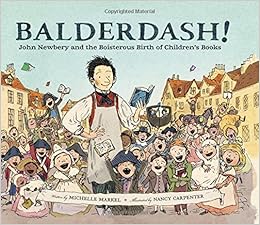
Summary:  Pity the poor children growing up in early eighteenth century England.  Although there were plenty of books around for adults, kids only got preachy poems, sermons, and books of rules about manners and such.  Fortunately for them, a young printer named John Newbery thought they deserved better.  The fact that his books were entitled A Little Pretty Pocket-Book and The History of Little Goody Two-Shoes and became overnight bestsellers demonstrates what a deplorable condition children’s literature was in at that time.  John continued to work throughout his career to produce popular books for kids, and we remember him every January when the Newbery Medal is awarded to the book that has made “the most distinguished contribution to American literature for children”.  An author’s note gives additional biographical information.  44 pages; grades K-4.

Pros:  A lighthearted look at the life of a man whose name many librarians and teachers know, but whose life we are less familiar with.  Readers will appreciate the wealth of children’s literature that has grown since Mr. Newbery’s time.

Cons:  The subject may be of greater interest to adults than to kids.