Clara: The (Mostly) True Story of the Rhinoceros Who Dazzled Kings, Inspired Artists, and Won the Hearts of Everyone…While She Ate Her Way Up and Down a Continent by Emily Arnold McCully

Published by Schwartz & Wade Books
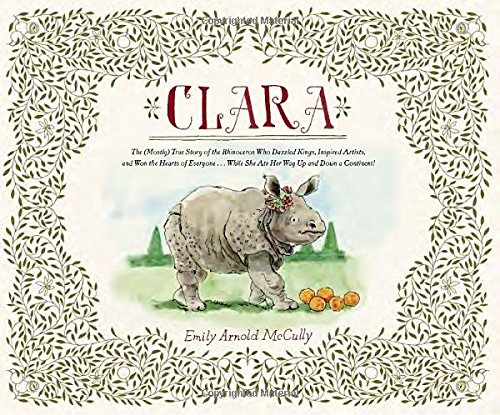
 

Summary:  In the early 1700’s, while visiting a friend in India, Captain Van der Meer was astonished to see a baby rhinoceros wandering about the house.  Thinking he could make a living showing her, the Captain adopted the rhino, named her Clara, and brought her back to his home in Holland.  Clara proved to be a good companion, but a voracious eater, and the Captain was hard-pressed to buy her food.  The two of them eventually traveled all over Europe, even getting an audience with Louis XV of France, who offered to house Clara with his menagerie (the Captain turned him down).  After 17 years of travel, Clara passed away, with the Captain at her side describing her as “the greatest trouper and the truest friend.”  An author’s note tells more about Captain Van der Meer and Clara, and which parts of the story have been fictionalized; endpapers show the routes the two friends traveled.  48 pages; ages 4-8.

Pros:  Readers will be captivated by Clara, who comes across as affectionate and docile as a large dog.  Caldecott Medalist McCully has illustrated her story with colorful, detailed paintings.

Cons:  Beer is mentioned several times as a staple of Clara’s diet.

Living in…Brazil by Chloe Perkins, illustrated by Tom Woolley

Published by Simon and Schuster 

Summary:  Kids will find out what it’s like to live in Brazil, courtesy of an enthusiastic narrator whose home is in Recife, on the coast.  He takes readers on a tour of Brazil, describing its geography, natural features, and some of the cities.  Then he focuses on his own home, giving kids a look at what his typical day is like.  Additional information about Brazil is conveyed through what the narrator learns about in school.  The last page has a picture of the Brazilian flag and some fast facts.  32 pages; grades K-3.

Pros:  Part of a new Living in… series, this book would be enjoyed by kids who like learning about other cultures.  The series would also work well for a classroom research project on different countries.

Cons:  A detailed map of Brazil and some photos would have been nice additions.

Grover Cleveland, Again! A Treasury of American Presidents by Ken Burns, illustrated by Gerald Kelley

Published by Alfred A. Knopf 

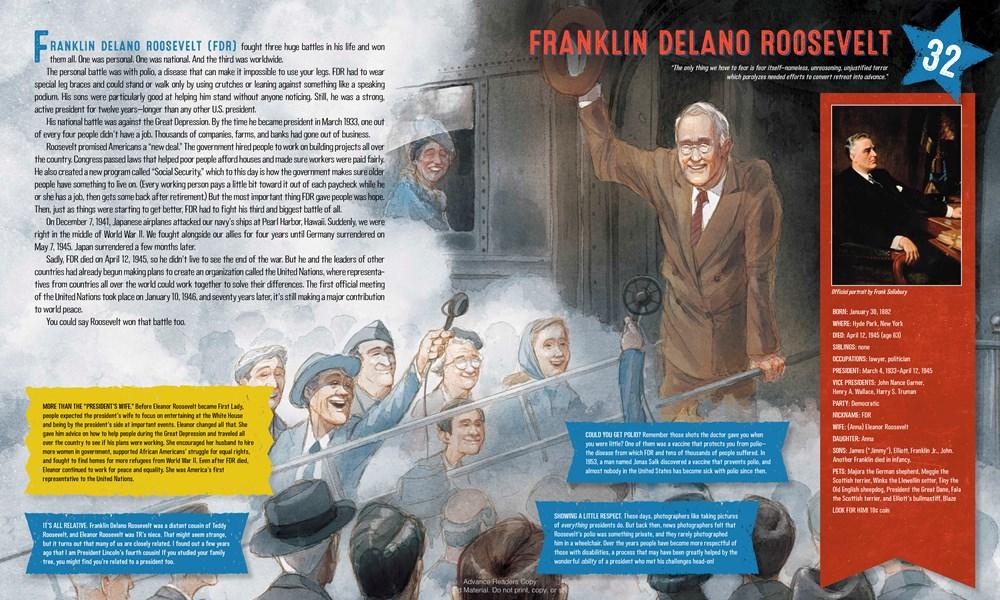
Summary:  Many years ago, Ken Burns used to recite the names of the U.S. presidents to his four daughters.  When he got to #24, the girls would say, “Grover Cleveland, again!”  He resolved then to write a book about the presidents for kids, and we now have the result of that.  Each two-page spread includes a chatty summary of that president’s term in office, a few highlighted facts, and a sidebar with fast facts such as family members, nickname, and pets.  There’s a large illustration covering both pages, plus a portrait at the top of the sidebar.  The last few pages include a glossary and a list of presidential birthplaces, libraries, museums, and historic sites arranged by state.  96 pages; grades 5 and up.

Pros:  This is a great book to browse or read cover to cover.  Burns uses his down-to-earth style to make each president’s history accessible to young readers.  The fast facts would be helpful for report writing.

Cons:  Burns doesn’t always write an unbiased account (Under Calvin Coolidge: “I believe that one of the best things the government can do is help people when their friends and neighbors can’t…”).  An astute reader will probably be able to guess who the author is hoping to write about for President #45.

Brave Like Me by Barbara Kerley

Published by National Geographic Society 

Summary:  What’s it like when your mom or dad has to go overseas to do their job?  Through text and photos, this book explores kids’ feelings and day-to-day lives when their parents are deployed to another country.  The book opens with kids playing with their parents, then sending them off.  There are pictures of children and parents going through their days when they are separated.  The last two pages show the happy hugs of returning soldiers reuniting with their kids.  Back matter includes a map showing where all the photos in the book take place; and information on dealing with separation, who serves overseas from the United States, quotes on being brave, a note for caregivers, and additional resources.  48 pages; ages 4-8.

Pros:  This would be an extremely helpful book for kids whose parents are traveling abroad in any capacity.  The large clear photos and simple text focus more on the kids’ day-to-day lives and their feelings about separation than on the activities their parents are engaged in.

Cons:  Although many overseas workers are mentioned in the section at the end, the photos included are only of military personnel.

Every Breath We Take: A Book About Air by Maya Ajmera and Dominique Browning, with a foreword by Julianne Moore

Published by Charlesbridge 

Summary:  Brightly colored photographs illustrate the simple text describing how air is all around us and necessary for all kinds of life.  The last several pages talk about how dirty air is unhealthy, and makes several kid-friendly suggestions (ride bikes and walk more, turn out the lights) to help clean up polluted air.  The final two pages have six questions, such as “What is air?” and “Why is clean air so important?” with a few paragraphs of information on each topic.  40 pages; ages 4-8.

Pros:  A simple and beautifully illustrated introduction to the importance of clean air in our lives.

Cons:  Trying to answer the question “What is climate change, and how is it connected to air pollution?” in two paragraphs seems overly ambitious.

Mountain Chef: How One Man Lost His Groceries, Changed His Plans, and Helped Cook Up the National Park Service by Annette Bay Pimentel, illustrated by Rich Lo

 Published by Charlesbridge


Summary:  In 1915, there were eleven national parks, but no service to administer them.  Assistant Secretary of the Interior Stephen Mather knew the country needed one, but couldn’t get through the Washington red tape to set it up.  To convince lawmakers, he organized a two-week camping trip through the mountains of California, and hired Tie Sing, a Chinese American trail cook reputed to be the best.  Tie Sing had his hands full, transporting and preparing such delicacies as frogs’ legs and Lyonnaise potatoes, and serving them on a table set with a tablecloth and fine china.  Along the way, he lost a couple of mules packed with supplies and food, and often had to improvise.  He succeeded in keeping the campers well-fed and happy, though, and the National Parks Service will celebrate its 100th birthday on August 25. Back matter includes more information about Tie Sing, the expedition, and several members of the party.  40 pages; grades 1-5.

Pros:  A fascinating story about a little-known man; Pimentel and Lo have succeeded admirably in bringing to life someone about whom very little is known.  There’s a lot of text, but the story is so engaging that this would make an excellent read-aloud.  As someone who has camped all over the U.S. and Canada, I appreciated Stephen Mather’s philosophy: “Give a man a poor breakfast after he has had a bad night’s sleep and he will not care how fine your scenery is.”

Cons:  It’s my opinion that any activity that involves English plum pudding with brandy sauce, peaches and cream, and a heavy linen tablecloth cannot really be described as “camping”.

The William Hoy Story by Nancy Churnin, pictures by Jez Tuya

Published by Albert Whitman and Company 

Summary:  When William Hoy graduated from high school in 1879, there wasn’t much chance of a deaf man making it in the world of professional baseball.  But Hoy was talented, hard-working, and determined, and he managed to snag a spot on a minor league team in Oshkosh, Wisconsin.  He loved the game, but often ran into trouble when he couldn’t hear the umpire make the calls.  After a humiliating incident in which he didn’t know he had struck out, Hoy came up with the idea of the ump using hand signals…the same signals that are used today.  Eventually, he went on to great success as a major league player with the Washington Senators, and lived a long and happy life, throwing out the first pitch of the World Series in 1961 at the age of 99.  Back matter includes author’s note and a timeline.  32 pages; grades K-3.

Pros:  A fun and inspirational baseball story about a little-known player who overcame difficulties and changed the game.

Cons:  Hoy’s nickname of “Dummy” (mentioned in the author’s note, not the main text) will need some explanation.


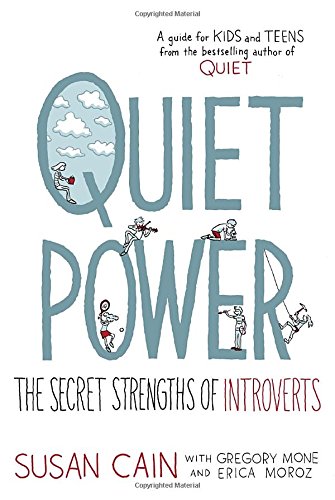
Quiet Power: The Secret Strengths of Introverts by Susan Cain with Gregory Mone and Erica Moroz

Published by Dial Books for Young Readers 

Summary:  Susan Cain wrote the best-selling book Quiet,  and delivered an extremely popular TED talk, both on the subject of people who are introverted.  Now she has written a book to help introverted kids and teens survive and thrive in a world that often favors extroverts.  Divided into four parts—school, socializing, hobbies, and home—Quiet assures introverts that being quiet and needing time alone are good things, and that they can bring unique qualities to the classroom, their friends, and organizations they are a part of.  Cain acknowledges the importance of making friends, getting along with family, and staying engaged in classroom discussions, but she also recognizes the value of the solitary time introverts need to recharge and how their quiet listening can add an important dimension to discussions.  Introverts have succeeded in many arenas, including unexpected ones such as the stage, screen, and at the helm of many corporations and nonprofits.  An afterword offers tips to teachers and parents on how to make sure the introverted kids in their classrooms and homes reach their full potential.  288 pages; grades 5 and up.

Pros:  As an introvert who was often told to participate more in class, let me say, “Thank you, Susan Cain!”  I wish I had had this book when I was in middle school and high school, busily comparing myself unfavorably to my more extroverted peers.  Put this book in the hands of those quiet kids who may tend to slip under the radar to let them know they have much to contribute to the world.

Cons:  As the mother of two introverted children, I can attest to the fact that many teachers are still nagging introverts to participate more in class.

Seven and a Half Tons of Steel by Janet Nolan, illustrated by Thomas Gonzalez

Published by Peachtree Publishers 

Summary:  The USS New York is a Navy ship weighing 25,000 tons.  Seven and a half of those tons are made of steel from a most unusual source—the World Trade Center.  After the September 11 destruction of the Twin Towers, work crews removed a steel beam and had it transported from New York to Louisiana.  There it was melted down and molded into a ship’s bow.  The work of building the ship was interrupted by Hurricane Katrina, but eventually, the ship was completed and brought back to New York.  There it was greeted with a twenty-one gun salute before sailing off to do its work at sea.  An author’s note gives more facts about the USS New York and the meaning of the different colors and symbols of its crest. 36 pages; grades 2-5.

Pros:  History buffs, particularly fans of military history, will enjoy learning about the construction of this special ship.  The large, vivid paintings offer plenty of visual details to the story.

Cons:  There are only a few sentences about September 11 and Hurricane Katrina, so kids may need more information on both of these events to truly appreciate this book.

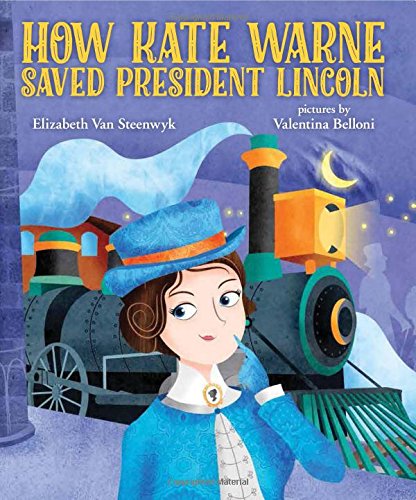
How Kate Warne Saved President Lincoln by Elizabeth Van Steenwyk, pictures by Valentina Belloni

Published by Albert Whitman and Company


Summary:  When Kate Warne walked into the Pinkerton Detective Agency in 1856, Allan Pinkerton had never considered hiring a woman to be a detective.  But Warne convinced him that women could go undercover in a variety of ways that men could not, and soon she was a valuable member of the world’s first detective agency.  She successfully worked on a number of cases, but her most famous was helping to thwart an assassination plot against Abraham Lincoln as Lincoln traveled from Illinois to Washington, D.C. to begin his term as President.  Kate infiltrated the group that was planning to kill the President, and learned that they had vowed to not let him leave Baltimore alive.  She and other detectives from the agency worked all night to make sure Lincoln got safely through the city, onto Philadelphia, and finally to Washington.  An author’s note tells a bit more about Kate Warne’s life, although little is known; a brief bibliography is also included.  32 pages; grades 1-4.

Pros:  Kate’s escapades make interesting and exciting reading, particularly given how difficult it was for women to have successful careers in her time.  The bright cartoon-like illustrations are appealing.  See last year’s The Detective’s Assistant by Kate Hannigan for an entertaining fictional account of Warne’s life.

Cons:  It’s frustrating that Kate Warne’s early life is a complete unknown.