Rapunzel by Bethan Woollvin

Published by Peachtree Publishers
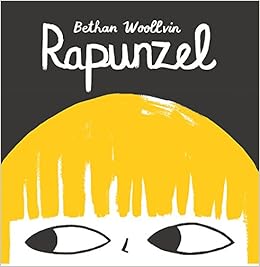
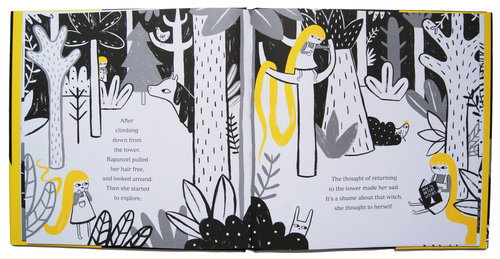
Summary:  Rapunzel lives in a tower, visited only by a witch who climbs up her long hair to visit, then steals some of Rapunzel’s golden locks to sell.  When the witch leaves, she tells Rapunzel that if she tries to escape, the witch will put a terrible curse on her.  “But was Rapunzel frightened? Oh no, not she!”  She makes a ladder from her hair, and goes out to explore.  Freedom is exhilarating, and she and a new (horse) friend make an escape plan.  One day, the witch tries to climb out of the tower using Rapunzel’s hair; the girl quickly cuts her hair, and the witch falls to the ground.  Rapunzel’s equine friend is waiting, and the two ride off in bandit costumes to become witch hunters.  32 pages; ages 4-8.

Pros:  A quick and funny retelling of Rapunzel, casting the heroine as an independent girl with no sign of a prince in sight.

Cons:  The style of art and the yellow and black palette aren’t really my cup of tea.
If you’d like to buy this book on Amazon, click here.

Red Again by Barbara Lehman

Published by HMH Books for Young Readers

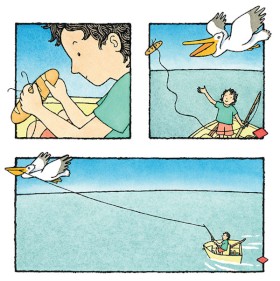
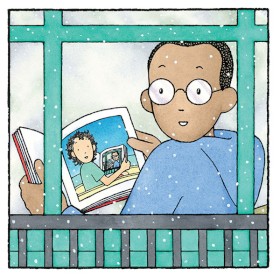
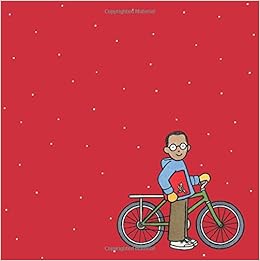
Summary:  A lot has changed since 2004, but the wordless Red Again picks up right where that year’s The Red Book left off.  A boy on a bicycle finds the magical book and takes it to a cupola at the top of his house to read it.  As he studies a map of some islands, the illustrations zoom in to a girl fishing from a rowboat, a red book floating behind her.  When she opens the book, she sees the boy’s house, and eventually, the two are face to face through their books.  With the help of a loaf of bread and a pelican, she zooms through the water to meet her new friend.  In his excited rush to greet her, he drops the book.  It ends up in a snowbank, where it is picked up by…well, I can’t tell you everything.  32 pages; ages 4-8.

Pros:  The Red Book won a Caldecott honor, and this sequel is a worthy successor.  There is a lot to look at in the deceptively simple illustrations that celebrate books and friendship.

Cons:  Some of the connections within the book and between the two books might blow your mind a little bit.

If you would like to order this book through Amazon, click here.

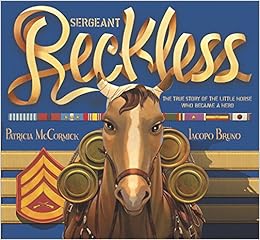
Sergeant Reckless: The True Story of the Little Horse Who Became a Hero by Patricia McCormick, illustrated by Iacopo Bruno

Published by Balzer + Bray

Summary:  When a group of U.S. Marines was looking for a pack animal to haul ammunition in the Korean War, they ended up buying a scrawny abandoned horse from a nearby racetrack.  She was given a military rank, and became known as Private Reckless.  The men trained her to duck incoming fire and to retreat, using her insatiable appetite for just about any kind of food to get her to do what they needed.  She learned to stay calm in battle, carrying heavy loads of ammunition on her back.  In one day-long battle, she made 51 trips, totaling 35 miles up and down hills, to carry 9,000 pounds of ammunition.  That earned her a promotion to sergeant, and her Marine friends started a campaign to send her to the United States.  They were successful, and she was able to retire with full military honors and two Purple Hearts, the only animal to ever hold military rank.  An author’s note tells more of Reckless’s story, including a photo and a brief bibliography.  40 pages; grades 1-5.

Pros:  Animal lovers and military history buffs will enjoy this story about a unique horse who won the hearts of the U.S. Marines with her humor, hard work, and bravery.

Cons:  Reckless’s diet of coffee, Coca-Cola, and chocolate.

If you would like to buy this book on Amazon, click here.


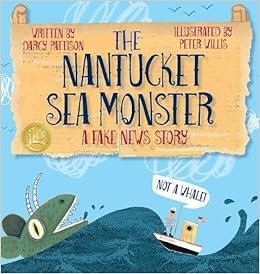
The Nantucket Sea Monster: A Fake News Story written by Darcy Pattison, illustrated by Peter Willis

Published by Mims House

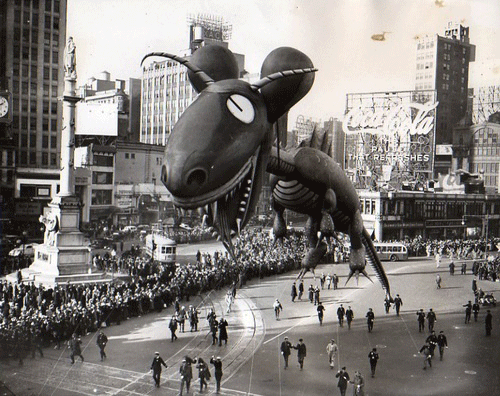
Summary:  August 4, 1937: Two men claim to have seen a sea monster off the coast of Nantucket.  The local newspaper reports the story, and before long, other witnesses come forward and describe a similar monster.  A few days later, five-foot long footprints are discovered on the beach.  Scientists at Harvard and the New England Aquarium study photos of the giant prints, while newspapers across the country pick up the story.  Two weeks later, word spreads that the monster has been caught.  When people rush to see it, they can’t believe their eyes.  The “monster” is a huge rubber balloon, designed by master puppeteer Tony Sarg for the Macy’s Thanksgiving parade.  It had all been a publicity stunt, with news reporters in on the hoax from the very beginning.  The float flew in the 1937 parade and was seen by millions more people; Nantucket got tons of free publicity.  Includes a timeline and two pages on the ethics of fake news.  32 pages; grades 2-5.

Pros:  A fun story that also has a timely message about the responsibilities of a free press; this would be a great catalyst for a discussion about today’s fake news.

Cons:  I was skeptical that the monster could be as goofy-looking as the illustrations showed.  As you can see from the photo, it actually was.  Hard to believe.

If you would like to buy this book on Amazon, click here.

Winter Dance by Marion Dane Bauer, illustrated by Richard Jones

Published by Houghton Mifflin Harcourt

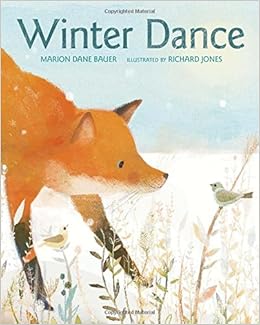
Summary:  When a single snowflake lands on a fox’s nose, the fox is unsure about how to handle the coming winter.  He gathers advice from other animals, but hibernation and migration options don’t work for him for one reason or another.  At last he meets another fox, and as snow begins to fall, whirling in the wind, the other fox shows him how they can dance together.  40 pages; ages 4-8.

Pros:  Muted illustrations perfectly capture the feeling of late fall and early winter.  The repeating text will help kids learn more about how animals survive the cold weather.

Cons:  It would have been nice to see some back matter explaining more about animal behavior, and especially about the foxes’ dance.

If you would like to buy this book on Amazon, click here.

Pizza Day by Melissa Iwai

Published by Henry Holt

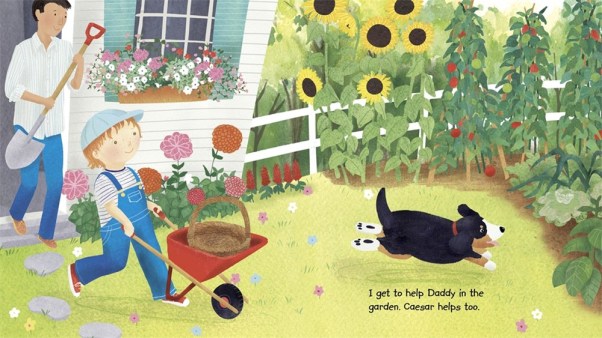
Summary:  A boy and his father spend a day at home making pizza.  They start in the garden, picking tomatoes, carrots, onions, basil, and a pepper.  Then it’s into the kitchen to make the dough and the sauce.  Both items have to rest awhile, so father and son head outside to play.  Later, the boy “wakes up” the pizza ingredients, and he and his dad put them together, add some toppings, and send their dinner to the oven to bake.  While they’re cleaning up, Mom gets home from work, and the day ends with a delicious dinner.  Includes recipes for dough and sauce, and instructions on how to assemble and bake your own pizza.  40 pages; ages 3-6.

Pros:  A companion to Melissa Iwai’s Soup Day (which may be more appropriate for this time of year), this simple story celebrates family and fresh food.  The acrylic illustrations have plenty of kid appeal, and will whet appetites to try the recipes at the end.

Cons:  That pizza definitely needed more cheese.

If you would like to buy this book on Amazon, click here.

Malala’s Magic Pencil by Malala Yousafzai, illustrated by Kerascoet

Published by Little, Brown Books for Young Readers

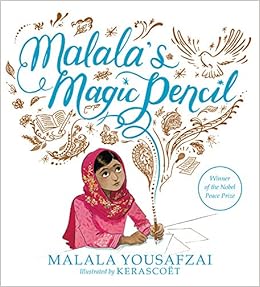
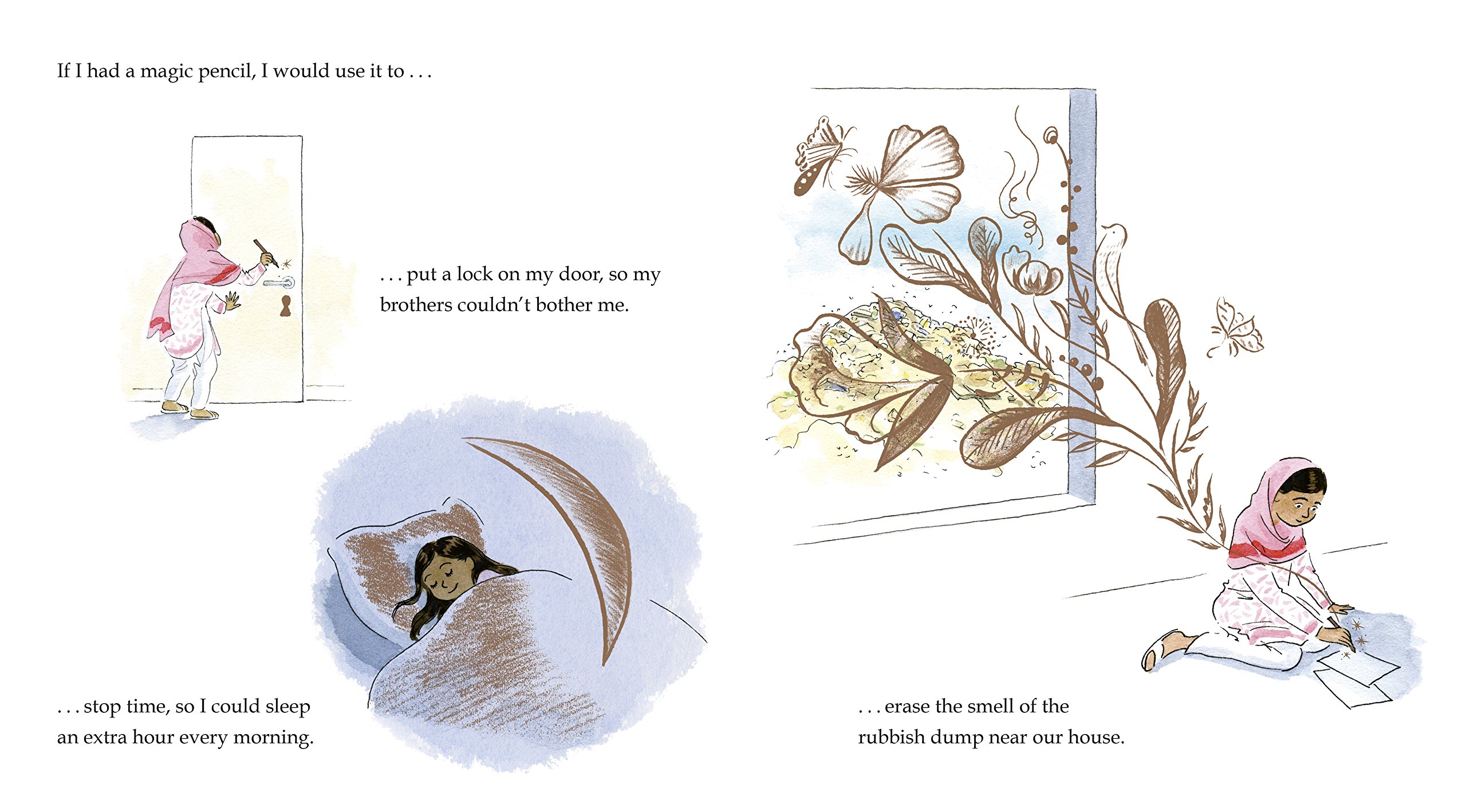
Summary:  Malala Yousafzai describes how she used to watch a TV show about a boy who had a magic pencil that could create whatever he drew.  She wished she could have one so she could draw a lock on her bedroom door, new dresses for her mother, and a soccer ball for her brothers.  As she grew older, her dreams grew too, and soon she wished she could use her magic pencil to erase the poverty she saw around her.  She worked hard at school, and when “powerful and dangerous men” took over her country, she started speaking out about the importance of letting girls attend school.  With white letters on a black page, Malala states, “My voice became so powerful that the dangerous men tried to silence me. But they failed.”  The accompanying illustration shows her looking out a hospital window.  The last few pages show her continuing her work today, writing, demonstrating, and speaking at the United Nations.  Back matter includes a letter from Malala, a page of biographical information, and three photos of her at different stages of her life.  48 pages; ages 5-8.

Pros:  A moving introduction to Malala Yousafzai’s courageous story, beautifully illustrated with ink and watercolor drawings.  Kids looking for more information can move on to the young reader’s edition of I Am Malala.

Cons:  You didn’t really think I was going to write something negative about a book by Malala on Thanksgiving Day, did you?

If you would like to buy this book on Amazon, click here.

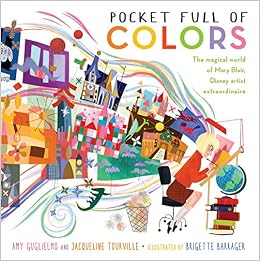
Pocket Full of Colors: The Magical World of Mary Blair, Disney Artist Extraordinaire by Amy Guglielmo and Jacqueline Tourville, illustrated by Brigitte Barrager

Published by Atheneum Books for Young Readers

Summary:  From the time she was a child, Mary Blair loved colors of all hues.  She used them at art school, and they led her to a job at Disney Studios, one of the first women to be hired by them.  Once there, though, a group of older men rejected her colorful drawings, preferring to stick with mostly black and white.  She did succeed in catching the attention of one man, Walt Disney himself, who invited her on a tour of South America to create art.  Upon her return, under the South American influence, her art grew even more eye-popping, and some of her ideas were finally accepted, including Cinderella’s pumpkin coach and Alice in Wonderland’s caterpillar.  But too many of her ideas were turned down, and Mary went off on her own, where she created children’s book illustrations and theater sets.  A few years later, Walt Disney approached her with a new plan, and Mary became the chief designer for his “It’s a Small World” ride.  At last, her colors could flow freely, and the world could finally see Mary’s world as she had always imagined it.  Includes an author’s note with biographical information.  48 pages; ages 4-8.

Pros:  A colorful biography of a little-known artist with a connection most kids will recognize and a “be yourself” message about creativity.

Cons:  Now we will all have “It’s a Small World” stuck in our heads for the rest of the day.

If you would like to purchase this book on Amazon, click here.

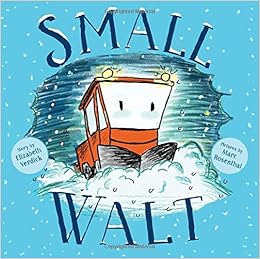
Small Walt by Elizabeth Verdick, pictures by Marc Rosenthal

Published by Simon and Schuster

Summary:  When a blizzard hits town, most of the snowplow drivers go for the big, tough plows.  But Gus agrees to drive Walt, the smallest one in the fleet, and Walt is determined not to let him down.  They plug along through town, and Walt keeps himself going with rhymes such as, “My name is Walt. I plow and I salt. I clear the snow so the cars can go!”  Finally, they reach a high hill with the biggest drifts Gus has ever seen.  “I don’t think we’re up to this,” he says, but Walt has different ideas.  With a bit of slipping and sliding, they make it to the top, then back down again, with mega snowplow Big Buck following close behind.  At dawn, they head back to the parking lot, and even Big Buck has grudging words of admiration for Walt.  As for Gus, he takes off his blue scarf and ties it around Walt’s rearview mirror, cementing their friendship for snowstorms yet to come.  40 pages; ages 4-8.

Pros:  A cross between Mike Mulligan and His Steam Shovel and The Little Engine That Could, this is a charming story of persistence and optimism with pleasantly retro illustrations.  A perfect read-aloud for the coming winter months.

Cons:  For the purpose of story hours and kids chanting along with a repeated refrain, Walt should have made up one rhyme and stuck with it.  Instead, he kept changing it.

If you would like to buy this book on Amazon, click here.

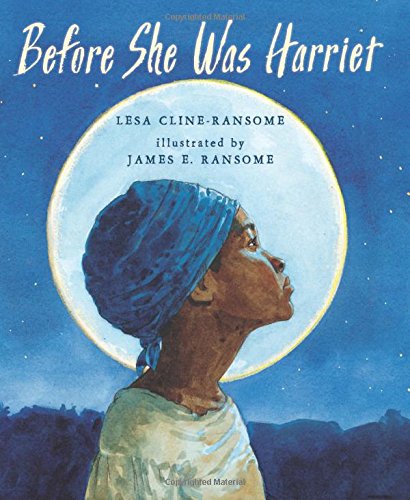
Before She Was Harriet by Lesa Cline-Ransome, illustrated by James E. Ransome

Published by Holiday House

Summary:  Harriet Tubman’s story is told in reverse, beginning when she is “an old woman/tired and worn/her legs stiff/her back achy”.  Before that, she was a suffragist, and before that, a Union spy.  The narrative continues back in time, showing Harriet as Moses, conducting slaves to freedom on the Underground Railroad, and finally, all the way back to a child named Araminta, “who dreamed/of living long enough/to one day/be old/stiff and achy/tired and worn and wrinkled/and free”.  32 pages; grades 1-4.

Pros: A brief, poetic look at Harriet Tubman’s life and many achievements, beautifully illustrated by Coretta Scott King medalist James Ransome.

Cons:  I was disappointed that there was no back matter giving more biographical information.

If you would like to buy this book on Amazon, click here.