Bloom by Doreen Cronin, illustrated by David Small

Published by Atheneum 

Summary:  “Once upon a time, in a beautiful glass kingdom, there lived an unusual fairy named Bloom.”  Bloom uses her magic to help keep the kingdom beautiful, but she’s muddy and heavy-handed (and footed), and eventually, through mutual agreement, the kingdom and fairy part ways.  Many years later, the glass all over the kingdom is breaking, and no one can fix it.  It’s decided that a messenger should go into the forest and convince Bloom to return.  The king tries and fails, the queen tries and fails; the last hope is an ordinary girl named Genevieve.  Unlike the king and queen, Genevieve isn’t afraid to get her hands dirty, and Bloom teachers her how to use the mud to make bricks and build things.  Delighted, Genevieve returns, teaches others her new-found skills, and saves the kingdom. 40 pages; ages 4-8.

Pros:  Award-winning author-illustrator team Cronin and Small contribute to make a magical tale that extols the virtues of hard work and girl power.

Cons:  “[T]here is no such thing as an ordinary girl,” said Bloom.  Just in case you missed the message of the story the first two or three times.

Emma and Julia Love Ballet by Barbara McClintock

 Published by Scholastic Press


Summary:  Emma and Julia both love ballet.  Emma goes to her beginners’ class, while Julia takes a class with the company she’s part of.  When Emma warms up and stretches, Julia is doing the same in her class.  Both work hard at the barre, then soar through their dance moves.  At the end of the day, Emma is excited to be going to a ballet performance.  Afterwards, she gets to go backstage, where she meets some of the dancers, including Julia.  Emma gets a big hug, and some words of encouragement that Julia was also once a little girl who loved ballet.  32 pages; ages 4-8.

Pros:  Young ballerinas will love seeing the dancers of all ages on these pages.  The illustrations are simple, yet detailed enough to give a real feel for the world of ballet.  Bringing the two ballet fans together creates a satisfying and inspiring ending.

Cons: How did Emma get to go backstage? Readers might think this is a standard part of every performance.


The Almost Terrible Playdate written and illustrated by Richard Torrey

Published by Doubleday Books for Young Readers 

Summary:  A boy and a girl ask each other, “What do you want to play?”  Unfortunately, neither one has an answer the other one likes.  The boy wants to a dinosaur or a dragon or a race car driver; the girl a magical wizard or a ballet instructor or queen of the universe.  As each one makes a suggestion, the other one’s imagined interpretation of the idea is shown in a crayon cartoon bubble, purple for the girl and green for the boy.  Finally, unable to agree on anything, they go their separate ways.  Each one starts creating with blocks, but is unable to keep from looking at what the other is doing.  Finally, they break down and tell what they’re making; this inspires them to make up a game that includes both creations, and by the end of the playdate, they’re ready to make plans to get together another time.  40 pages; ages 3-7.

Pros:  A good lesson on the art of compromise.  Kids will enjoy the illustrations of what the two characters are thinking.

Cons:  The ideas for games were a little gender stereotypical.

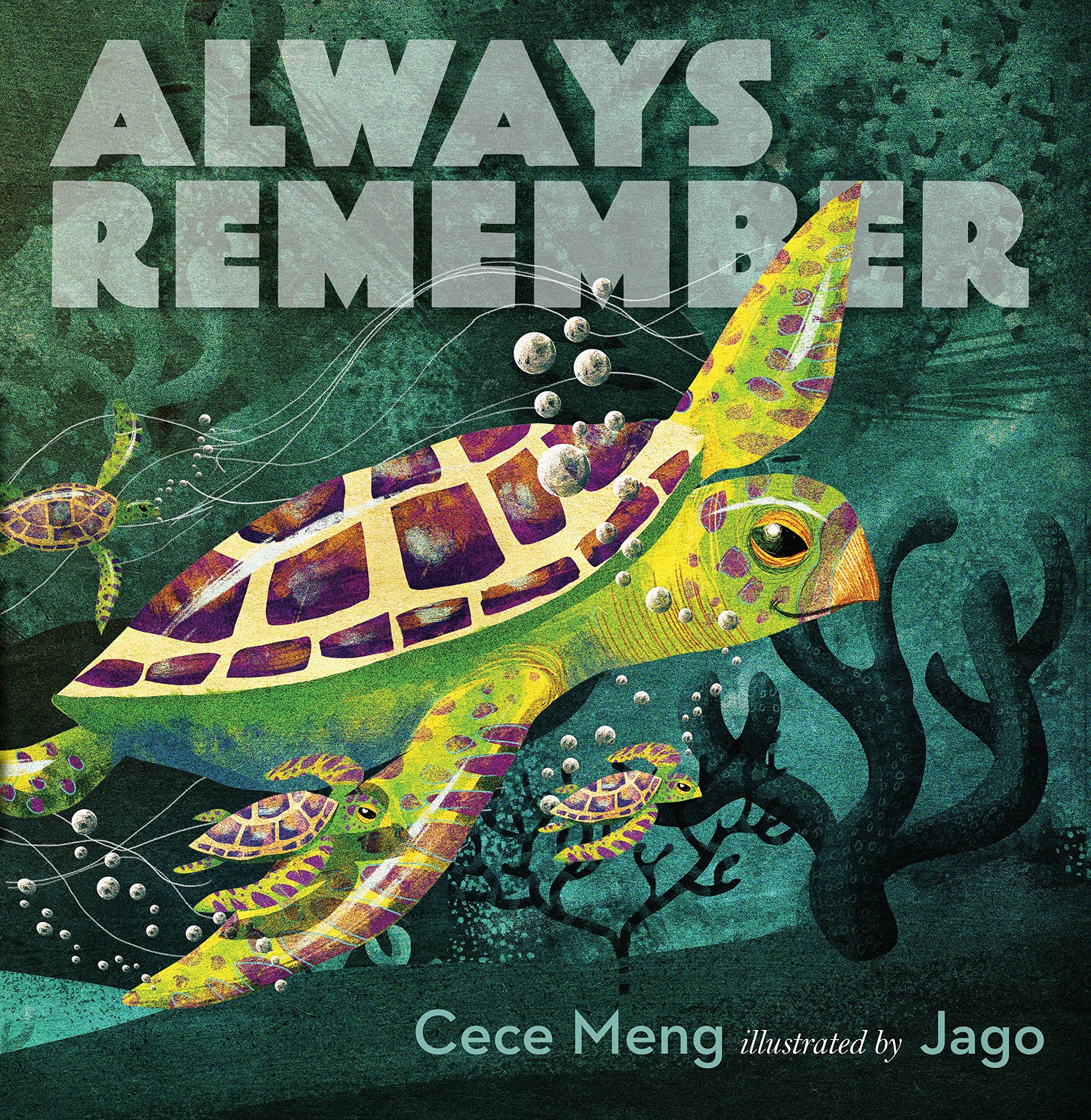
Always Remember by Cece Meng, illustrated by Jago

Published by Philomel Books

Always Remember: Meng, Cece, Jago: 9780399168093: Amazon.com: Books

Summary:  When Old Turtle takes his last breath and swims his last swim, the waves carry him away, and his friends remember him.  The young turtles remember how he taught them how to swim; the otters remember how he loved to play and have fun; the manatee remembers how he rescued him when he was tangled in a fishing net.  At the end, they conclude that Old Turtle lived a life filled with kindness, love, and helpfulness, and his legacy will live on through their own lives.  32 pages; ages 3-7.

Pros:  A beautifully illustrated simple story that celebrates a life well-lived and gives children a way to look at death as the completion of life.

Cons:  Another three-Kleenex read-aloud.

Before I Leave by Jessixa Bagley

Published by Roaring Brook Press 

Summary: A hedgehog learns she is moving to a new home, and is heartbroken to be leaving her anteater best friend. They decide to play together one last time just the way they always have.  The two friends are sad, and the hedgehog is scared about moving some place new, but they manage to have one more day of fun together before they have to go their separate ways.  When the hedgehog starts to unpack at her new house, she finds that her friend has snuck pictures and notes into her suitcase.  The last pages shows her sitting in her room, the papers clipped to a clothesline, beginning a letter to her friend.  40 pages; ages 4-7.

Pros:  This simple story would be a good way to help children express their feelings about a move or a friend who is moving.  The sweet illustrations show the fun the two friends have shared.

Cons:  The hedgehog’s face is so small sometimes it’s hard to see her expressions.


The Quickest Kid in Clarksville by Pat Zietlow Miller, illustrated by Frank Morrison

Published by Chronicle Books 

Summary:  Alta’s pretty sure she’s the fastest kid in Clarksville, Tennessee, until Charmaine comes along and challenges her to a couple of races.  Charmaine’s got new sneakers, and Alta’s toes are poking out of hers, but the contest ends in a draw.  Alta’s unhappy about the new girl, until the next day, when she’s racing to get herself and her banner to the parade in time to see Olympic medalist Wilma Rudolph go by.  The two girls work together, and end up with a curbside seat to the parade.  Wilma gives them a wave and a smile, and the two girls find themselves smiling at each other as well.  An author’s note gives a brief history of Wilma Rudolph and her victory parade, which she insisted be open to all races, making it the first major integrated event in Clarksville’s history.  40 pages; ages 5-8.

Pros:  A fun story of friendship, served up with a slice of history.  Frank Morrison occasionally channels Hilary Knight in his action-packed illustrations.

Cons:  Kids will need a little background on Wilma Rudolph before reading this book to fully appreciate the story.


Ida, Always by Caron Levis and Charles Santoso

Published by Atheneum Books for Young Readers 

Summary:  Gus and Ida are polar bears who live in a park in the middle of a huge city.  Every day the play, swim, and eat together.  Ida can’t see, but she tells Gus that she doesn’t have to see the city to feel it.  At night, each bear goes to his or her own cave to sleep.  Every day is the same until one morning when Ida doesn’t come out of her cave.  Sonya the zookeeper tells Gus that Ida is sick and she isn’t going to get better.  Gus and Ida still have some time together.  Some days Ida can play, but other days she has to rest.  Each night before sleeping, the two bears tell each other they will miss the other one.  Finally, one morning, with Gus at her side, Ida passes away.  Gus continues to enjoy each day, but never forgets his good friend. A brief author’s note tells of the real Ida and Gus who lived in New York City’s Central Park Zoo. 40 pages; ages 4-8.

Pros:  A beautiful story of love and loss, exploring terminal illness and death in a way that will be accessible to preschoolers and early elementary age readers.

Cons:  Good luck reading this one out loud.  Keep the Kleenexes handy.

Oops Pounce Quick Run! An Alphabet Caper by Mike Twohy

Published by Balzer + Bray 

Summary: An entire story is told with a single word per page, each word starting with a different letter of the alphabet. A mouse is Asleep when a Ball bounces into his hole, which he proceeds to Catch; the nose of a Dog pokes into the hole, soon followed by its Eye. You get the idea. The action is non-stop as the two animals pursue each other before the mouse finally has a clever idea to make peace. The word on the final page, not surprisingly, is Zzzzz. 32 pages; ages 3-7.

Pros: A clever concept for an alphabet book, with cute, action-packed illustrations. Younger kids will enjoy using this to learn the alphabet, while older ones could be challenged to make up an alphabetical story of their own.

Cons: A few pages (To Dog, Very Cool) don’t quite adhere to the one-word-per-page rule.


Whose Hands Are These? A Community Helper Guessing Book by Miranda Paul, illustrations by Luciana Navarro Powell

Published by Millbrook Press 

Summary: Each page shows a different worker and describes in rhyming text what his or her hands do; turn the page to see who that person is. The answers get a little more difficult through the book, starting with farmers and cooks and moving up to architects and physicians (which may not be a word preschoolers are as familiar with as doctors).  The book ends by asking the reader what your hands could do; the last four pages give thumbnail profiles of all the professions illustrated.  32 pages; ages 4-7.

Pros:  Having done a unit on community helpers, I know there aren’t a lot of good picture books that introduce many different kinds of jobs.  This one is particularly fun and interactive with bright, interesting illustrations.

Cons:  Those of us who hail from northern New Jersey do not believe that “water” rhymes with “potter”.


It’s Not Easy Being Number Three by Drew Dernavich

Publishd by Henry Holt and eCompany


Summary: When 3 decides there’s more to life than being a number, he goes off in search of a new career. He tries a great many options, including being the humps of a camel and the toes of an elephant.  Deciding  he prefers people to animals, he tries being a shoelace and the rim of some glasses.  An anchor?  A rake?  An airplane’s steering wheel?  3 tries them all before finally settling for getting bronzed and becoming a statue in the park.  At first, he is admired and appreciated, but gradually people stop coming to see him, and he realizes it’s time to move on.  In the spring he heads for the fair, but learns it’s not opening this year.  With no 3, there can be no triple scoops of ice cream, three-legged races, or music (“A one, and a two, and a….”).  3 finally realizes his rightful place is with the numbers, and 1, 2, 4, 5, 6, 7, 8, and 9 are all more than happy to welcome him back.  40 pages; ages 3-7.

Pros:  A fun introduction to the importance of numbers in everyday life, as well as a bit of an I Spy, as kids will enjoy seeing where 3 is hiding in many of the illustrations.

Cons:  Be prepared for giggles as both a pigeon and a dog cover the statue of number 3 with numbers 1 and 2.