Snappsy the Alligator (Did Not Ask to Be In This Book!) by Julie Falatko, illustrated by Tim Miller

Published by Viking Books for Young Readers


Summary:  It starts out sounding like an ordinary story: “Snappsy the alligator wasn’t feeling like himself.  His feet felt draggy.  His skin felt baggy.”  But then, Snappsy himself interrupts.  “This is terrible!  I’m just hungry!  Why is this rude narrator trying to make it seem like I need a nap?”  The book continues, with the narrator telling the story and Snappsy getting annoyed and correcting the narration.  Snappsy goes to the grocery store, goes home, and shuts himself into his house.  The narrator presses on, and Snappsy reveals that the story has made his day sound so boring, he’s decided to plan a party.  Sure enough, he cleans the house and ends up with quite the shindig, attended by all the neighbors.  At last, even the narrator shows up, turning out to be a pretty fun party guest, but badgering poor Snappsy right up to the very last page.  40 pages; ages 4-8.

Pros:  This would be a hilarious read-aloud.  The usual narrative structure is turned on its head.  The cartoon illustrations are fun, with the narrator’s text written like a regular story and Snappsy’s in cartoon bubbles.  Comparisons with Mo Willems are apt.

Cons:  Those people who kind of remind me of the narrator.

When Spring Comes by Kevin Henkes, illustrated by Laura Dronzek

Published by Greenwillow Books


Summary:  Waiting for spring can be hard.  There’s rain, mud, and sometimes, a brief return of winter.  But if you’re patient, you’ll see flowers blooming and eggs hatching, and you’ll feel the warm sun.  You’ll know it’s really spring when there are buds and bees and boots and bubbles; worms and wings and wind and wheels.  But you’re not done waiting, because then it’s time to wait for summer!  40 pages; ages 3-8.

Pros:  The husband and wife team of Kevin Henkes and Laura Dronzek has created a book that perfectly captures the slow unfolding of spring from winter. The soft, brightly-colored illustrations perfectly complement the brief, but descriptive, text. The spring endpapers at the beginning and summer ones at the end encapsulate the movement from one season to the next.

Cons:  Don’t read this book until at least late March, or you’ll be depressed when you look out your window.

Tooth by Tooth: Comparing Fangs, Tusks, and Chompers by Sara Levine, illustrations by T. S. Spookytooth

Published by Millbrook Press 

Summary:  How many teeth do you have?  What are the names and functions of different types of teeth?  What kind of an animal would you be if you had really long incisors?  Or teeth that were all the same? Tooth by Tooth draws readers right in with questions about something all of us are pretty familiar with—our teeth.  Kids will learn which types of teeth are used by carnivores, herbivores, and omnivores, and why only mammals have different types of teeth.  The last few pages include a glossary, additional resources, and more information about mammals and their teeth.  32 pages; grades K-4.

Pros:  The first book by this author/illustrator team, Bone by Bone is one of my favorite nonfiction read-alouds.  The questions make both books very interactive, and the illustrations are lots of fun, showing what you would look like with different types of bones or teeth.  Not only that, but there’s a ton of information packed into a short amount of text.

Cons:  I didn’t find teeth quite as varied and interesting as bones.

Don’t Call Me Grandma by Vaunda Micheaux Nelson, illustrated by Elizabeth Zunon

Published by Carolrhoda Books 

Summary: Great-Grandmother Nell is 96 years old, and prickly enough to be kind of scary. Yet clearly her great-granddaughter, who narrates this book, loves her and is fascinated by her.  Great Grandmother insists on being called Great Grandmother.  She may be old, but she is still stylish, occasionally inviting her great granddaughter into her room for a little practice applying lipstick and wearing perfume.  Great Grandmother claims to remember every day of her 96 years, including the day her heart was broken when her best friend said they couldn’t be friends anymore because of Nell’s brown skin.  A wordless two-page spread shows some of her other memories, like the March on Washington and a performance by the Alvin Ailey dance company.  At the end, the narrator sneaks into her great grandmother’s room for a good night kiss while Great Grandmother is sleeping.  32 pages; grades 1-3.

Pros:  This is a great mentor text for characterization.  So many interesting details about Great Grandmother Nell really make her come alive for the reader, and also reveal a bit about the narrator.  The bold, colorful illustrations help flesh out both characters as well.

Cons: Some adult readers may be offended by the “glass with something that looks like apple juice” that Nell sips during the day and once offers to her great granddaughter.

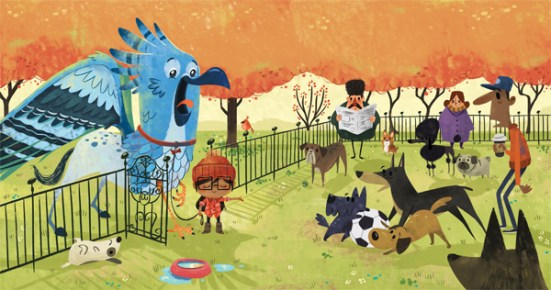
If I Had a Gryphon by Vikki VanSickle, illustrated by Cale Atkinson

Published by Tundra Books 

Summary: When the narrator of the story gets a pet hamster, she thinks it’s kind of boring—it only eats, sleeps, hides, and gets its shavings wet. Her imagination takes off as she starts to imagine the mythical creatures that might make really exciting pets.  The more she thinks about each one, though, the more she realizes it has a down side.  Unicorns are shy, a hippogriff could be disruptive at the dog park, a gryphon has to be flown every day without fail.  In the end, she concludes the hamster might not be so bad after all.  The final page clues the reader in that this may not be your ordinary hamster.  32 pages; ages 3-7.

Pros:  The rhyming text and colorful illustrations provide a fun introduction to a variety of mythical creatures.

Cons:  You might want to confirm the pronunciation of words like gryphon, kraken, and kirin before attempting this as a read-aloud.

Beatrix Potter & the Unfortunate Tale of a Borrowed Guinea Pig by Deborah Hopkinson, illustrated by Charlotte Voake

Published by Schwartz & Wade Books


Summary:  Told as a story letter (“My Dear Reader”) in a style similar to one Beatrix Potter used to use, this tale features a young Beatrix.  Not surprisingly, she enjoyed keeping numerous pets, and even borrowing others’ pets, mostly for the purpose of drawing and painting them.  She could be careless, though, and on one occasion, she forgot about a borrowed guinea pig, who proceeded to eat up most of her art supplies.  Unfortunately, these proved fatal for the cute little animal, and Beatrix was forced to go confess her mistake.  In an attempt at compensation, Miss Potter offered a watercolor drawing of the guinea pig, which was not received too graciously.  Although the story is about a young girl, the author’s note reveals that this incident happened when Beatrix Potter was 26 years old.

Pros:  This humorous tale includes quite a bit of historical information about Beatrix Potter’s life and how she got her start writing and illustrating her famous books.  The watercolor illustrations are clearly inspired by the Potter books.

Cons:  The whole killing the guinea pig thing is a little less of a chuckle when one finds out it was committed by a 26-year-old woman.


Shape Shift by Joyce Hesselberth

Published by Henry Holt and Company

Summary:  A boy and a girl introduce nine shapes: triangle, semicircle, crescent, trapezoid, rectangle, circle, oval, diamond, and square.  Then they start putting the shapes together to see what they look like.  A triangle on top of a semicircle can look like a ballerina or an elephant with a thousand balloons on his back.  A crescent on top of a trapezoid?  A bull ready to charge or a fish jumping in the sea.  The final two pages show twelve shape combinations and ask readers what they see.  32 pages; ages 2-6.

Pros:  A fun introduction to shapes that will have kids looking for geometry in their everyday lives.

Cons:  According to other reviews, the author has created two apps to explore shapes and colors, but they’re not mentioned anywhere in the book.

Bear is Not Tired by Ciara Gavin

Published by Knopf 

Summary: Bear is an enthusiastic member of a household of ducks. When the weather starts getting colder, Bear is determined to stay awake all winter so as not to miss out on anything.  But nature takes its course, and before long Bear is dozing off at meals and in the middle of games.  Mama Duck convinces him that he can’t fight who he is, and that, awake or asleep, he is still part of the family.  Finally, Bear settles into hibernation mode.  The ducks eat meals near him, and the baby duck snuggles up to sleep with Bear at naptime.  When spring comes, Bear awakens and enjoys sharing the pictures of what happened all winter long.  32 pages; ages 2-6.

Pros:  Cute watercolor illustrations enliven this gentle tale that would make a perfect bedtime story.

Cons:  There sure are a lot of picture books that feature cute bears hibernating.

Frankencrayon by Michael Hall

Published by Greenwillow Books 

Summary:  On the page before the title page, the reader is informed that this picture book has been cancelled.  A few pages in, a bunch of crayons are surprised that someone has persevered to the story.  The pencil takes over, relating how the crayons were all set to do a performance of “Frankencrayon” when the lights went out, and a huge red scribble appeared.  Crayon attempts to clean it only made it worse, and the production was cancelled.  Meanwhile, the three crayons slated to play the Frankencrayon monster were awaiting their entrance on page 22.  When the big moment arrived, everyone was gone except the scribble.  The three resourceful crayons fix things up; the last page reveals who was responsible for the scribble in the first place.  40 pages; ages 4-8.

Pros:  The story takes great liberties with the standard book format, including the reader in all the goings-on.  Michael Hall, creator of last year’s Red: A Crayon’s Story once again shows his skills at bringing crayons to life.

Cons:  Careful reading is required to understand the story.

Freedom in Congo Square by Carole Boston Weatherford and R. Gregory Christie

Published by little bee books

Summary:  Both slaves and free gathered each Sunday in Congo Square, the only place in New Orleans where slaves were allowed to meet.  After working all week, Sunday afternoons were a celebration, with music and dance that reflected the participants’ African heritage.  The story of Congo Square is told in rhyming couplets, illustrated with folk art style paintings.  A foreword by historian and Congo Square expert Freddi Williams Evans and an author’s note both explain the history behind this book.  40 pages; grades 1-3.

Pros:  The grueling work of slavery is depicted in both the text and the illustrations, with allusions to beatings and escape attempts.  In contrast, the Congo Square scenes radiate joy and celebration.

Cons:  The foreword and author’s note seem somewhat redundant.