Everybody Sleeps (But Not Fred) by Josh Schneider

Published by Clarion Books

Summary:  “Every kind of bird and beast/in the West and in the East/way up high and way down deep/everybody has to sleep.  But not Fred.  Fred has a to-do list you wouldn’t believe.”  On every page, animals are sleepily flossing, brushing, and getting ready to hit the sack.  Only Fred, blue-striped pj’s notwithstanding, is raring to go.  He breaks the world shouting record and tests his horn collection.  He practices karate chops and hunts the legendary Sasquatch.  He is, in other words, every parent’s worst bedtime nightmare.  Finally, however, Fred goes missing, and is found snuggled against a sheep, thumb in his mouth, asleep at last.  The last page warns the reader to close the book softly lest Fred wake up again.

Pros:  This is a great anti-bedtime story.  Kids will love the pictures of the animals as they get ready for bed and shake their heads at Fred’s antics.

Cons:  I experienced horrific flashbacks from earlier parenting days.


How to Draw a Dragon by Doug Florian

Published by Beach Lane Books

Summary:  “Drawing a dragon isn’t hard/Drag a dragon to your yard.”  So begins this rhyming treatise on how to draw every part of a dragon, from its bumpy head to its claws that also like to draw.  Each rhyming couplet is illustrated with what looks like a child’s drawing of a kid sketching a dragon, often with the dragon’s assistance.  Recommended for ages 4-8.

Pros:  The rhyme is catch and funny, but the pictures are what make this book such a winner.  Kids will want to try their hands at sketching a dragon after reading this.

Cons:  Upon reaching the last page, you may be unable to resist the urge to draw a dragon.

Meet the Dullards by Sara Pennypacker and Daniel Salmieri

Published by Balzer and Bray

Summary:  The Dullards enjoy such activities as staring at their unplugged TV and watching the paint dry (a mix of beige and gray).  When they catch their children reading books about the circus, they decide it’s time to move to a duller neighborhood.  But the new place has all kinds of pitfalls, like a neighbor who brings an applesauce cake made with chunky applesauce and uses sentences that end in exclamation marks.  When they discover their children playing circus outside, it’s time to pack up and move back again.  That night, the parents rest easy in their old boring house while the children run away to the circus that’s in town.

Pros:  The humor starts on the cover (“Extra boring edition!”) and continues on every page.  The cartoon-like illustrations perfectly render what the dullest family in the world would look like.

Cons:  Somehow, I was expecting more of a twist at the end.  It was, honestly, a bit dull.

Queen of the Diamond : the Lizzie Murphy Story by Emily Arnold McCully

Published by Farrar, Straus, and Giroux

Summary:  When Lizzie Murphy was growing up in turn-of-the-century Rhode Island, girls didn’t play baseball.  But Lizzie’s brothers played, her father had played, and she wanted to play, too.  She became batgirl for her brother’s team and carried her father’s old ball and glove everywhere.  At one game, both teams realized no one had brought a ball.  Lizzie had her ball, but refused to lend it unless they’d let her play.  After a star turn at first base and four hits, she was a member of the team.  She continued to play into adulthood, making a living on the Warren, Rhode Island semipro team, and was the first person of either gender to play on both the National and American Leagues’ all-star teams.  She even got a single off of legendary pitcher Satchel Paige while playing on a Negro League team.  She finally retired from baseball in 1935, at the age of 40.  Recommended for grades 1-3.

Pros:  An interesting and little-known story about a woman athlete who refused to give up her dream despite enormous obstacles.  Emily Arnold McCully doesn’t disappoint with either the story or the illustrations.

Cons:  Too bad Lizzie didn’t blaze a trail into MLB for other women.

Monty’s Magnificent Mane by Gemma O’Neill

Published by Templar

Summary: Monty the lion usually lets his meerkat friends play with his magnificent mane.  But one day they go too far with their braiding and decorating, and Monty has had enough.  He stomps off to the water hole, where a crocodile lures him closer by complimenting him on his mane.  The crocodile tries to take a bite, but only gets a mouthful of mane.  Monty runs away, the crocodile in hot pursuit, only to realize too late that he’s led the crocodile right to the meerkats.  With a tremendous “ROAR!”, Monty scares off the crocodile, and is happy to let his friends play in his mane once again.

Pros:  A nice story about friendship and loyalty, with magnificent illustrations.  The two-page spread of Monty’s roar is suitable for framing.

Cons:  I read this to several classes of kindergarteners and they seemed a bit lukewarm about it.  I liked the pictures better than the story.

Stick and Stone by Beth Ferry, illustrated by Tom Lichtenheld

Published by HMH Books for Young Readers

Summary:  Stick and Stone are all alone until one day when Stick sticks up for Stone against the bullying Pinecone.  They become best friends, exploring the world together, until one day a hurricane blows them apart.  Fortunately, Stone finds his friend, stuck head-down in a puddle, and is able to affect a rescue (“You rock, Stone,”).  Together, they make a perfect 10.  Recommended for preschool – grade 3.

Pros:  A delightful story of friendship.  The illustrations perfectly complement the rhyming text.

Cons:  I would have liked to see some redemption for Pinecone.  It is merely hinted at on the last page.

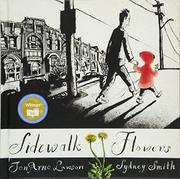
Sidewalk Flowers by JonArno Lawson, illustrated by Sydney Smith

Published by Groundwood Books

Summary:  In this wordless picture book, a little girl in a red coat is walking home from the grocery store with her busy, distracted (think cell phone) father.  As they walk, she finds flowers growing in sidewalk cracks.  Their trip through the city is drab and gray, with her coat and the flowers the only bits of color.  Halfway through, they enter a park, and she starts leaving the flowers as gifts—on a dead bird, with a man sleeping on a bench, tucked into a dog’s collar.  Arriving home, she distributes the rest to her family. As soon as she starts giving away the flowers, the pictures become filled with color.  On the last page, she tucks one final flower behind her ear as she watches a flock of birds overhead.

Pros:  More and more, I love wordless books.  This one has so much to look at, with multiple panels on many of the pages.  The message is simple but beautiful.

Cons:  I felt like there was some greater significance to the last page that I didn’t quite get.

The Grasshopper and the Ants by Jerry Pinkney

Published by Little, Brown Books for Young Readers

Summary:  Why do those ants work so hard?  The Grasshopper can’t understand it, and urges them to enjoy the spring, summer, and fall.  He’s a musician, traveling around with his banjo in his hands and a drum set on his back.  When winter comes, though, he’s out in the cold while the ants enjoy the cozy home they have made.  Finally, the Queen Ant ventures out into the snow to invite him in for a cup of tea.  A gracious guest, the Grasshopper repays her kindness by providing all the ants with music for a cold winter’s night.

Pros:  Jerry Pinkney doesn’t disappoint with another gorgeously illustrated fable that could be a Caldecott contender.  The story is simple, but the pictures are filled with details all rendered in beautiful watercolors. Kids will pore over all the activities in the ants’ winter home.

Cons:  Maybe it is the subject matter (grasshopper versus lion), but for me, this book is a notch below The Lion and the Mouse.

Drum Dream Girl : How One Girl’s Courage Changed Music by Margarita Engle, illustrated by Rafael Lopez

Published by HMH Books for Young Readers

Summary:  Millo Castro Zaldarriaga, a Chinese-African-Cuban girl growing up in 1930’s Cuba, dreamed of playing drums.  But only boys were allowed to be drummers.  She kept dreaming, though, and practicing any way she could, until finally her father allowed her to take drum lessons.  By the age of 15, she was good enough to play at President Franklin Roosevelt’s birthday celebration, and she went on to perform with many of the great jazz players of her time.

Pros: This is really a poem inspired by the story of Zaldarriaga.  It’s a celebration of following your dream, illustrated with eye-popping neon colors that perfectly capture the celebrations and street cafes where Millo hears the music she loves.

Cons: You’ll need to give some context for kids to understand what this book is about. The historical note at the end is a good place to start.

I Don’t Want to Be a Frog by Dev Petty, illustrated by Mike Boldt

Published by Doubleday Books for Young Readers

Summary:  A young frog wants to be another animal, maybe a cat, a rabbit, a pig, or an owl.  Frogs are too wet, slimy, and bug-eating.  His father argues that there is nothing wrong with being a frog, but his son remains unconvinced.  Along comes a hungry wolf, who tells the young frog that cats, rabbits, pigs, and owls are all on his menu, but that frogs are too wet, slimy, and bug-eating.  “I guess you can’t fight nature,” concludes the frog at last.  “We are what we are.”

Pros:  A lesson in self-acceptance, well-disguised in an entertaining story; with lots of funny dialogue related through cartoon bubbles, and vibrant comical illustrations.

Cons:  Wolves eat kitties and bunnies?