The Universe in You: A Microscopic Journey by Jason Chin

Published by Neal Porter Books
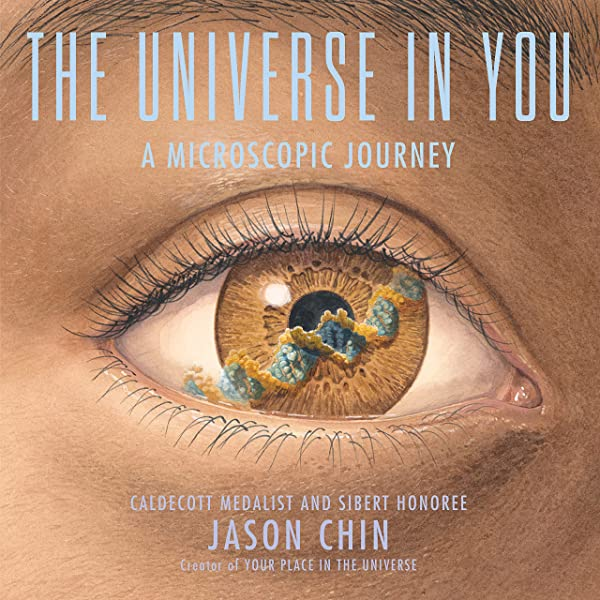
Summary:  In Your Place in the Universe, Jason Chin starts with a group of kids, then gradually moves out into the farthest reaches of the universe.  In this book, he goes in the opposite direction, beginning with the smallest bird–a Calliope Hummingbird–landing on a girl’s hand, then moving to the hair on her skin, then to cells, DNA, atoms, and eventually to elementary particles.  From there, the journey continues back outward, inviting a sense of wonder that everything in the universe is made of the same molecules, yet combines in a way to make a unique human.  Includes additional information on the building blocks of matter, as well as an author’s note and a note about the illustrations.  40 pages; grades 3-7.

Pros:  Another mind-blowing offering from last year’s Caldecott medalist, Jason Chin, with amazingly detailed illustrations, some of things that are too small to be seen with the human eye.  A contender for a Caldecott or Sibert, both of which Chin has already won.

Cons:  I’m more wowed by the larger universe than the subatomic one.
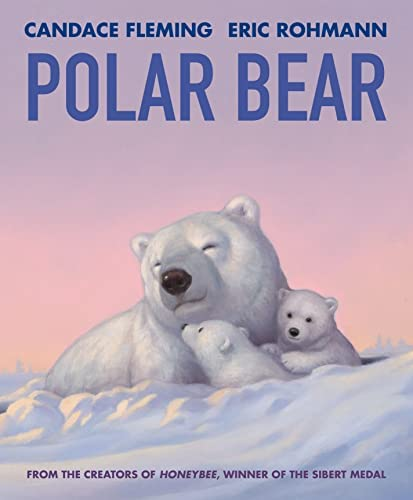
Polar Bear by Candace Fleming, illustrated by Eric Rohmann

Published by Neal Porter Books

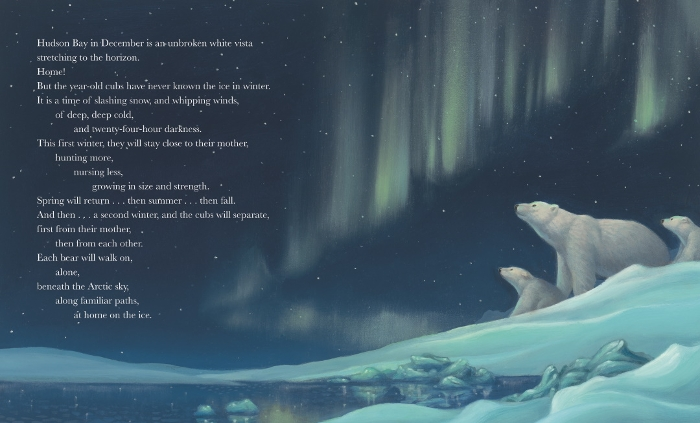
Summary:  The award-winning team behind Giant Squid, Honeybee, and Strongheart has created a new book that explores the world of a mother polar bear and her two cubs.  Emerging from five months in the den, during which time she gave birth and nursed her offspring, the mother bear emerges emaciated and hungry.  She heads for the ice where she knows she can hunt seals.  The narrative follows the bears through the year, showing how climate change affects their ability to hunt and perilously strands them on some floating ice.  They survive the dangers, and the final pages show them back on the ice in the 24-hour darkness of an Arctic winter.  Includes a two-page labeled diagram of a polar bear, additional facts about polar bears and the effects of warming in the Arctic, and a list of resources.  32 pages; grades K-5.

Pros:  Another breathtaking science book with poetic informative text and detailed realistic paintings of the polar bears and their environment.  With a Sibert Medal and Honor on their resumé, this team can expect awards consideration again for this book.

Cons:  As always, I found it stressful to read about the effects of climate change.

Wibble Wobble BOOM! by Mary Ann Rodman, illustrated by Holly Sterling

Published by Peachtree

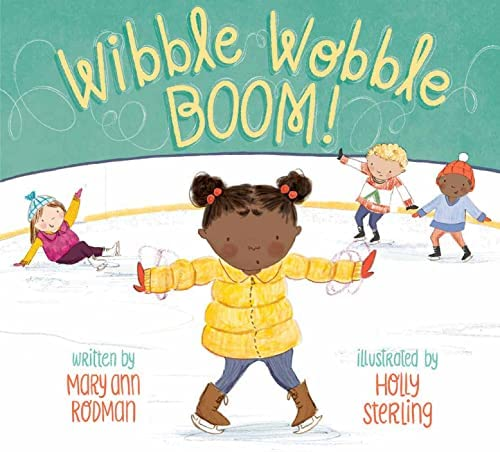
Summary:  Claire is excited about her first skating lesson, but reality rears its ugly head when she’s placed in the beginners’ group called the Snowplows and given brown rental skates.  The kids have to practice standing up off the bench before they’re even allowed onto the ice, and once they’re finally there, Claire is surprised at how hard it is to skate and how easy it is to fall.  She’s a keen observer, though, and noticing how the teacher pushes and glides across the ice leads to her being the first in the class to do some real skating.  Ultimately, Claire is glad to be a Snowplow, because snowplows work hard, and she’s excited for the next class and her dreams of being a real figure skater.  32 pages; ages 4-8.

Pros:  An engaging story that I am going to add to my list of books about persistence and grit, as Claire keeps going through some disappointing turns of events to ultimately find some success.  The cute illustrations portray a diverse cast of characters.

Cons:  The “hockey boy” in Claire’s class who keeps heckling her when she falls. “Know why you’re called a Snowplow? ‘Cause you clean the ice with your bottom!”  Let’s hope Claire checks him in the next class.

Stopping By Woods on a Snowy Evening by Robert Frost, illustrated by P. J. Lynch

Published by Candlewick

Summary:  in this illustrated version of Robert Frost’s poem, a young woman in a long dress is riding her horse through the dark woods on a snowy night.  Each page contains a line or phrase from the poem with a realistic illustration of the girl, who eventually dismounts and pauses to observe the snow.  The endpapers are part of the story, with the front cover showing her riding through a lighted village and the back depicting the sun rising on a snowy landscape.  32 pages; grades K-5.

Pros:  A beautiful introduction to a classic poem.  The female rider makes a nice new twist and spreading the text out one line at a time allows the reader to savor both the words and the gorgeous illustrations.

Cons:  Personally, if I got caught in a nighttime snowstorm in the woods while wearing a long dress, I would get on that horse and ride, not “stop by” for a lengthy meditation.

Too Early by Nora Ericson, illustrated by Elly MacKay

Published by Harry N. Abrams

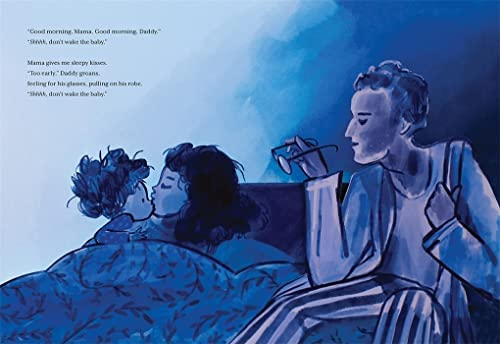
Summary:  “I wake up very early,” says the child narrator on the first page.  Mom gives a kiss and a warning not to wake up the baby.  Dad sleepily puts on his glasses and heads downstairs for coffee, grumbling, “You wake up too early.”  As dawn arrives, the two sit on the porch, looking at the moon and finding Venus.  Birds start to sing, the baby starts to cry, and the light starts to change.  As the sky turns from dark blue to bright yellow, the narrator says, “I wake up just in time.”  32 pages; ages 3-6.

Pros:  A lovely early morning book, kind of the antithesis of a bedtime story.  Kids and parents will find a lot to relate to, and the illustrations do a magnificent job of using color to show the changing time of day.

Cons: Flashbacks to early sleep-deprived days of child-rearing.

Luminous: Living Things That Light Up the Night by Julia Kuo

Published by Greystone Kids

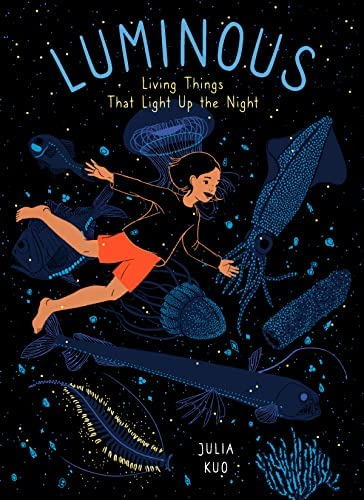
Summary:  A mother and child travel through the night, walking, boating, and swimming to observe bioluminescence in many different forms.  The pages are all in black, making the colors glow brightly.  Each page has a single phrase or sentence in a larger font, then a few sentences in smaller print that give additional information.  A sense of wonder is conveyed in the last few pages, sharing the information that many life forms have yet to be discovered, and encouraging readers to look closely at the world around them.  44 pages; ages 4-10.

Pros:  A beautiful introduction to bioluminescence that will encourage kids to look for other wonders in the world as well.  The illustrations are striking and there is plenty of interesting information.

Cons:  No back matter.

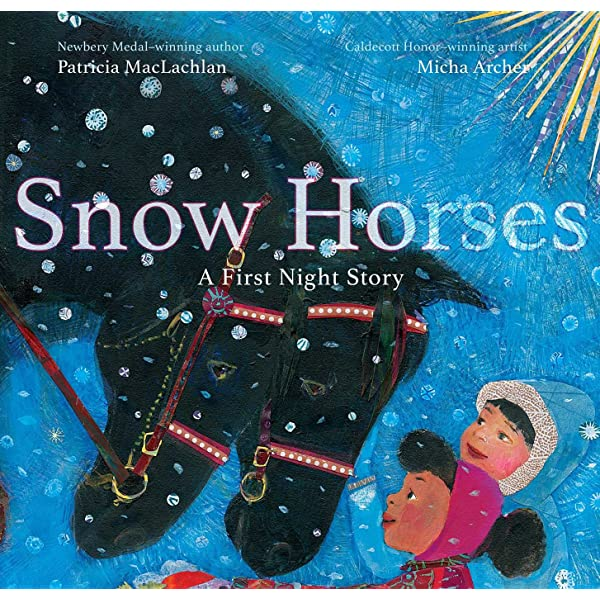
Snow Horses: A First Night Story by Patricia MacLachlan, illustrated by Micha Archer

Published by Margaret K. McElderry Books

Summary:  A young woman named Jenny guides her two horses, Tom and Tim, out into a snowy night for a New Year’s Eve celebration.  First, they pull a sleigh full of children around town before dropping them off at their houses to snuggle into bed.  They next go to the manor to pick up the older people, who enjoy reminiscing about their childhood days on their sleigh ride.  Finally, the two horses are led back into the barn where they are bedded down for the night.  Everyone falls asleep as New Year’s Eve turns into New Year’s Day.  40 pages; ages 4-8.

Pros:  The lyrical text and gorgeous collages capture a snowy night filled with celebration.  The colors and textures make for some amazing illustrations by Caldecott honoree Micha Archer.  A perfect addition to winter holiday collections.

Cons:  It’s a bit more slow-moving and contemplative than some other holiday stories.

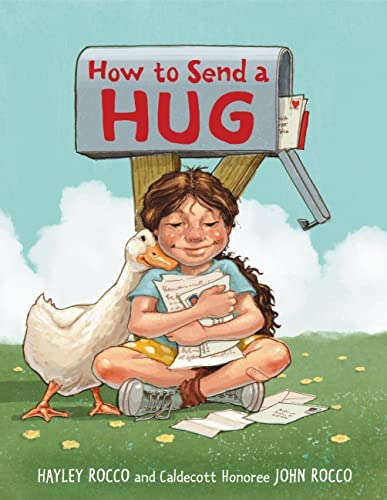
How to Send a Hug by Hayley Rocco, illustrated by John Rocco

Published by Little, Brown Books for Young Readers

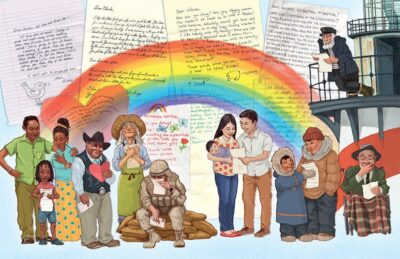
Summary:  A girl tells readers that she is known for being good at giving hugs, but she can’t hug her grandmother, who lives far away.  Talking on the phone or via computer isn’t quite good enough, so the girl explains how she sends a hug through the mail.  After writing a letter with her favorite marker, she puts it in a special jacket (envelope), addresses it, and sticks the ticket for its trip (stamp) on the front.  The Hug Delivery Specialist (mail carrier) takes it to the post office, and the wait begins.  While she’s waiting for Grandma’s answer, she thinks of others around the world receiving hugs, whether they’re delivered by donkey, jeep, bicycle, or boat.  Finally, she gets a hug back from her grandmother, complete with fragrant rose petals from her garden. Includes an author’s note about her own experiences with mail as a child.  40 pages; ages 4-8.

Pros:  Considering the somewhat imperiled state of the USPS, there certainly seem to be plenty of picture books serving as love letters to it.  This would make a great companion to The Lost Package, Letters from Space, or Sincerely, Emerson.  It’s also a good mentor text for procedural writing.  I always love John Rocco’s illustrations, and his wife’s debut picture book is excellent as well.

Cons:  Parts of Grandma’s letter are obscured by the illustration.

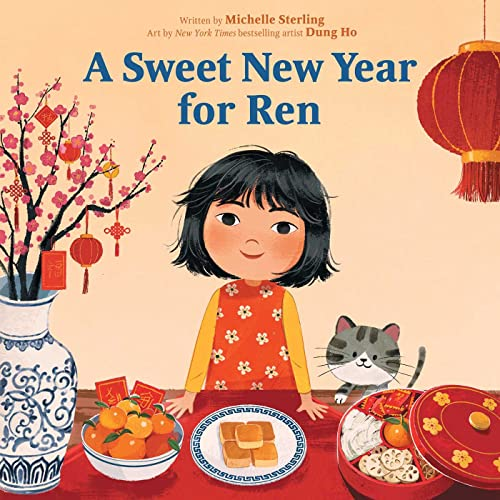
A Sweet New Year for Ren by Michelle Sterling, illustrated by Dung Ho

Published by Simon and Schuster/Paula Wiseman Books

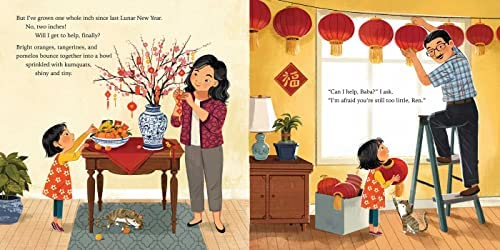
Summary:  Ren is excited to be getting ready for the Lunar New Year.  There’s plenty of food to prepare, but every time Ren asks to help, she’s told that she is too little (even though she has recently grown two inches!).  Finally, her big brother Charlie comes home, and he has the patience to gently guide Ren through making pineapple cakes.  She is happy when the family sits down to the holiday dinner that she has made something to contribute.  After dinner, everyone gathers outside to watch the fireworks.  Includes an author’s note at the beginning about her connection to Lunar New Year and a recipe for pineapple cakes at the end.  32 pages; ages 4-8.

Pros:  A happy introduction to Lunar New Year, narrated by an enthusiastic young girl who loves the holiday and her family.  The cheerful illustrations will help readers visualize the different foods and decorations.

Cons:  I thought there would be more of a plot resolution around Ren being repeatedly told that she was too little.

Only the Best: The Exceptional Life and Fashion of Ann Lowe by Kate Messner and Margaret E. Powell, illustrated by Erin K. Robinson

Published by Chronicle Books

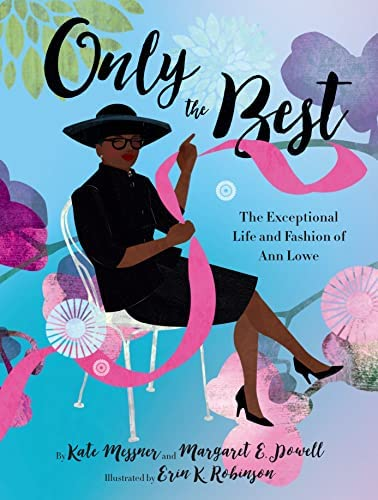
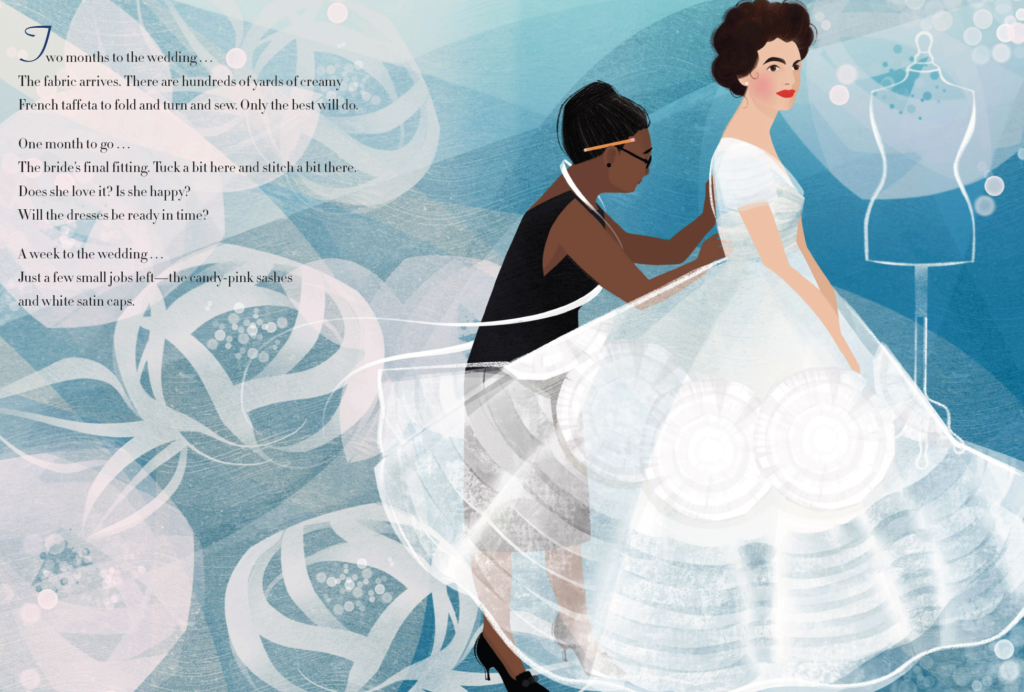
Summary:  Ann Lowe learned her first lessons about sewing and design from her grandmother, who had been an enslaved seamstress, and her mother, who owned a dress shop.  Ann’s work ethic showed itself early; when her mother died, young Ann put aside her grief and finished the dresses that had been ordered for New Year’s Eve.  A year later, she got a job in Tampa, Florida, sewing for a wealthy family.  Her ambitions took her to New York City, where she found success despite the racism she encountered there.  Jacqueline Bouvier hired Ann and her assistants to design and sew her gown and bridesmaid’s dresses for her wedding to Senator John F. Kennedy.  When a leaky ceiling flooded Ann’s workroom and destroyed all the dresses ten days before the wedding, she and her seamstresses recreated every one.  Ann capped her career by opening her own store with her own label on Madison Avenue.  Includes an author’s note with two photos, quotations, and a bibliography.  56 pages; grades 1-5.

Pros:  I loved Fancy Party Gowns by Deborah Blumenthal (2017), but I love this book at least as much.  There’s a bit more detail about Ann’s career, the writing style is engaging, and the illustrations are stunning.

Cons:  At 56 pages, it’s a bit long for a picture book.