Pretty Perfect Kitty-corn by Shannon Hale, illustrated by LeUyen Pham

Published by Harry N. Abrams

Summary:  “Unicorn is perfect.  Everybody thinks so.’’ His best friend Kitty-Corn agrees and decides to paint his picture.  Unicorn stands like a statue, “the way everyone thinks he should,” but Kitty-Corn feels like something is missing.  Unicorn tries a variety of poses, but nothing is quite right until finally, “That’s it! It’s perfect!” exclaims Kitty-Corn.  When Unicorn takes a look, he’s horrified to see that he has apparently sat in some paint and has been painted with paint bum.  Worried that Kitty-Corn won’t want to be his friend if he’s not perfect, Unicorn sits in a corner feeling like a big, ugly goof.  Kitty-Corn assures Unicorn that she likes him the way he is, then proceeds to sit in some paint herself, and the two friends enjoy a messy romp together.  48 pages; ages 4-8.

Pros:  With its purple, pink, and glitter cover portraying a unicorn and kitty, this book will sell itself, AND it has an excellent message about friendship and self-acceptance.

Cons:  I felt like the title should have been Pretty Perfect Unicorn.

Uncle John’s City Garden by Bernette G. Ford, illustrated by Frank Morrison

Published by Holiday House

Summary:  The narrator describes how she and her two older siblings spent a summer helping Uncle John in his garden, a plot of dirt in the middle of the city’s projects.  Each one chose their own vegetables to plant: okra for the narrator, tomatoes and onions for her sister, and corn and lima beans for her brother.  Their mother told them they were growing succotash, which they loved.  As the summer went on, the garden grew, and even a big thunderstorm couldn’t stop it from flourishing.  Right before school started again, Uncle John had a big barbecue, with the best succotash ever to go along with the ribs and burgers.  Each family member got to take home a bag of vegetables, and Uncle John and the kids looked forward to working in the garden again next summer.  Includes an author’s note telling about her childhood inspiration for the story and a recipe for succotash.  32 pages; ages 4-8.

Pros:  A simple story that shows how a garden–or a person–can thrive in even the most unlikely setting.  As always, Frank Morrison’s illustrations are delightful and should be considered for some sort of award.

Cons:  I was sorry to learn in the author’s note that she never actually got to spend the whole summer helping her Uncle John.

Big and Small and In-Between by Carter Higgins, illustrated by Daniel Miyares

Published by Chronicle Books

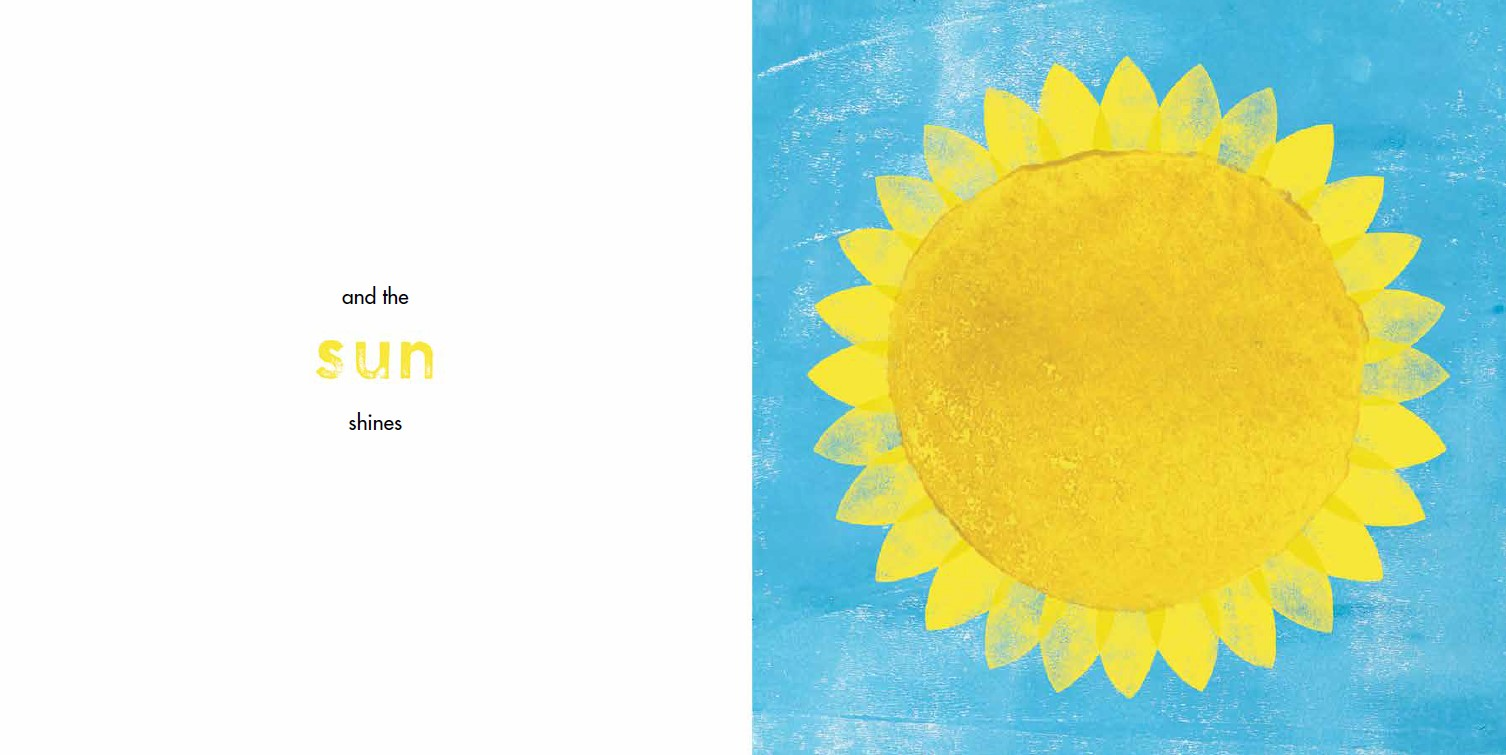
Summary:  The three sections of this book describe things that are big, small, and in-between, but they are not necessarily the first things you think about for each concept.  Big: “The SUN and its SHINE when it asks you to rise, the DONUT your brother got because you picked last and only got the hole.”  In-between things include “the TEETER-TOTTER not when it’s up or when it’s down but when two smiles meet in the middle,” and an example of small is “the PLIP of a raindrop and the PUDDLE where it falls for a butterfly to sip.”  Chapter 4 is “Everything”, and consists of a foldout page that reads, “the bluest SKY, the bittiest BUG, and you in the middle of it all.”  98 pages; ages 4-8.

Pros:  This beautifully illustrated concept book could serve as inspiration for kids to expand on what they think of as big, small, and in-between.

Cons:  The 3-D foldout papers that begin each chapter will likely not last long in a library book.

The World Belonged to Us by Jacqueline Woodson, illustrated by Leo Espinosa

Published by Nancy Paulsen Books

Summary: Jacqueline Woodson looks back on her childhood summers in Brooklyn where kids played freely on the streets all day long.  Children of all ages and races gathered for playground games, frolicking through the water from an open fire hydrant, and enjoying treats from the ice cream truck.  People were kind, the older kids helping younger ones who got hurt, and everyone pooling their money for ice cream.  When suppertime came, mothers called their children home in a variety of languages, and the kids made plans for the next day as they left.  Jacqueline ran home, already excited about tomorrow “and the many tomorrows to come.  Not just in Brooklyn, not just in the summer…but everywhere I’d ever go and always.”  32 pages; grades K-3.

Pros:  Turns out Jacqueline Woodson and I were born the same year, so I really grooved with the 1970’s vibe which is perfectly portrayed by Leo Espinosa.  This would make an excellent mentor text for memoir writing.  Anyone who has ever pondered the question, “Can you tell me how to get to Sesame Street?” will feel like they’ve arrived with the Brooklyn streets portrayed here.

Cons: Could lead readers to some unfortunate fashion choices like plaid bell bottoms and white tube socks.

Armadillo Antics by Bill Martin, Jr. and Michael Sampson, illustrated by Nathalie Beauvois

Published by Brown Books Kids

Summary:  As the sun goes down in the desert, the armadillo emerges.  “Armadillo, armadillo, armadillo, run.  Romp and play till the night is done.”  As the night goes on the armadillo, leaps, digs, eats, and finally returns to its burrow where it settles down to sleep as a new day begins.  Includes a page of armadillo facts.  32 pages; ages 2-6.

Pros:  Michael Sampson collaborated with the late Bill Martin, Jr. on many picture books including Chicka Chicka Boom Boom.  The beautiful illustrations of this one are reminiscent of Eric Carle and Lois Ehlert, who illustrated some of Martin’s best-loved books.

Cons:  In general, I find that books published posthumously aren’t quite the caliber of the ones published when the author was alive.

Luli and the Language of Tea by Andrea Wang, illustrated by Hyewon Yum

Published by Neal Porter Books

Summary:  While a group of parents attends ESL classes, their children stay in the playroom next door.  Since they speak different languages, the kids end up playing alone a lot.  But Luli has an idea.  Today she’s brought a thermos, a teapot, and a stack of cups.  She sets up a table, then calls “Chá!’ the Chinese word for tea.  The word is similar in many other languages (and other languages have a word that is similar to the English “tea”).  Each child is shown saying the word for tea in their own language, and soon, they’re gathered around the table.  Lili pulls out another box and practices a new English word, “Cookie?”  The playroom is no longer quiet.  Includes an author’s note about tea, and several pages about immigrants from each continent that include maps and information about how tea is served in different countries.  40 pages; ages 3-7.

Pros:  A perfect book to share for Asian American and Pacific Islander Heritage Month in May.  The kids are super cute, and it’s interesting to see how both the words and the customs for tea transcend different languages and cultures.

Cons:  Ten young children sharing tea in small cups (and even transferring some from one cup to another) without spilling a drop? Seems a tiny bit unrealistic.  

Mushroom Rain by Laura Zimmerman, illustrated by Jamie Green

Published by Sleeping Bear Press

Summary:  Mushrooms can suddenly pop up anywhere, especially after a rain.  With a wide variety of colors and scents, the mushrooms are often used as food, including by humans.  The mushrooms may seem to disappear, but they continue to grow underground, the largest stretching for miles after growing for thousands of years.  Mushrooms reproduce by spores, which can even seed clouds and produce the rain that encourages the growth of new mushrooms.  Includes four pages of information about mushrooms, including a craft and additional resources.  32 pages; grades K-3.

Pros:  A fascinating look at something many of us may take for granted, with gorgeous close-up illustrations of a wide variety of mushrooms.

Cons:  Is it just me, or are mushrooms just a little bit creepy?

Waiting for Mama by Gianna Marino

Published by Viking Books for Young Readers

Summary:  A penguin egg narrates what it hears as its mother goes for food and its father keeps it warm and safe, tucked between his feet.  Finally, the egg hatches, and the baby is able to see its dad.  When the mother penguins all return, the baby listens for its mother’s distinctive sounds.  Finally, it recognizes her, and the family is reunited.  Includes additional information about emperor penguins.  40 pages; ages 2-6.

Pros:  Beautiful illustrations depict penguin scenes both close-up and zoomed out, backed by gorgeous Antarctic sky.  Does double duty as a perfect read for Mother’s Day or Father’s Day.

Cons:  Cons for a book about animal parents on Mother’s Day? Not on my watch.  

Dress-Up Day by Blanca Gómez

Published by Harry N. Abrams

Summary:  The narrator is excited to wear her homemade rabbit costume for dress-up day at school.  But when the big day arrives, she’s home sick in bed.  She’s feeling better the next day, so her mom suggests she wear her costume.  She’s excited to get to school but feels self-conscious when she sees the other kids in their regular clothes.  Turns out that Hugo was out sick the day before, too, and a few minutes later, he shows up at school in his costume…a carrot!  “Be sad no more, little rabbit–your carrot is here!”  Before long, everyone is hopping around the playground, and Hugo is her new best friend.  The next day, the other kids come to school in costume, ready to play more imaginary games.  40 pages; ages 3-6

Pros:  Well, right off the bat, I love Hugo.  Any kid who dresses up like a carrot, then says the line above is someone I’d like to hang out with.  Overall, this is a cute story that will resonate with preschoolers and show them that it’s okay to do their own thing.

Cons:  Getting sick on dress-up day.

Kick Push by Frank Morrison

Published by Bloomsbury Children’s Books

Summary:  Ivan is a skateboard champ whose moves have earned him the nickname Epic from his friends.  When his family moves to a new neighborhood, he hits the streets with his skateboard, but he misses having friends around to cheer him on.  He tries to connect with kids through football, soccer, and basketball, but those sports prove not to be his thing.  To cheer him up, his mom gives him money to buy a treat at the bodega.  He travels there by skateboard, practicing his tricks as he zooms past groups of kids.  They’re impressed, and Epic discovers that being true to his skateboarding self has gotten him a new group of friends.  Includes an author’s note (at the beginning of the book) about his own less-than-stellar skateboarding attempts.  40 pages; ages 4-8.

Pros:  The be-yourself message combines lots of skateboarding language and some pretty epic illustrations.  Frank Morrison is overdue for a Caldecott, and hopefully that committee and/or Coretta Scott King will consider this book.

Cons:  Despite Epic’s expertise, I thought a helmet and some other protective gear would have been a nice addition to the illustrations.