Two books from Eerdmans

Long-time subscribers may recall that a few years ago I reviewed a book every week from an independent publisher. I haven’t kept up with it recently, but a few of those publishers still reach out to me from time to time. I recently received these two excellent books from Eerdmans Books for Young Readers. They are a great reminder of the unique and beautiful work being produced by smaller publishers. Both books will be released in September.

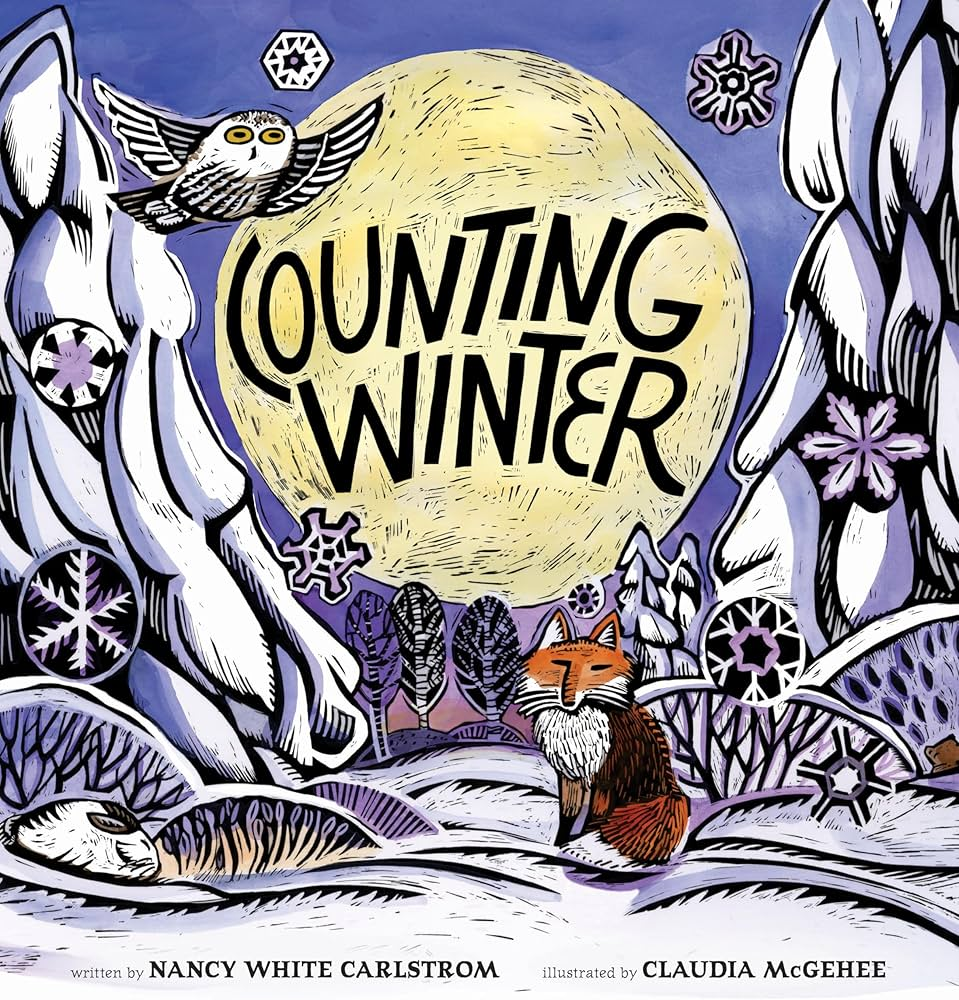
Counting Winter by Nancy White Carlstrom, illustrated by Claudia McGhee (44 pages, ages 4-8). Nancy White Carlstrom drew on her eighteen years in Alaska to create this counting book that includes eleven different animals, with verses written in similar fashion: “One red fox walks/across the white snow/quietly/stalking winter.” These could be used as models for kids to write their own four-line poems about animals with a similar combination of verbs, adverbs, and adjectives. The stunning scratch board and watercolor illustrations perfectly capture the animals and the snowy landscapes. When the counting reached eleven, I started to think it was going all the way to twenty, but the last page features twelve excited children, which was the perfect stopping place. Includes a wordless two page spread showing all the animals, two pages of animal profiles, and notes from the author and illustrator.

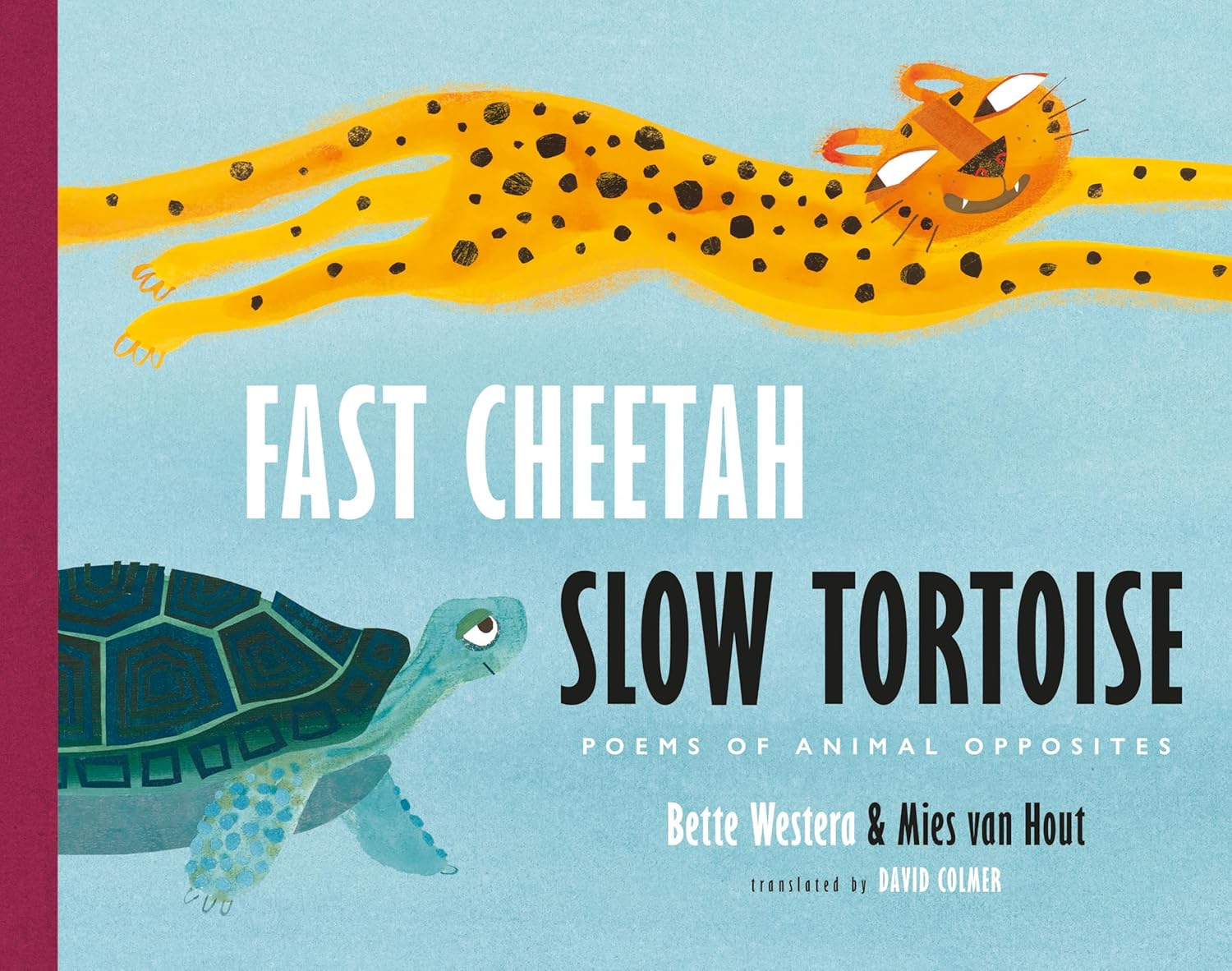
Fast Cheetah, Slow Tortoise: Poems of Animal Opposites by Bette Westera and Mies van Hout, illustrated by David Colmer. (40 pages, grades K-4). This Dutch import pairs animal poems that illustrate antonyms; a two-page spread features the tortoise in a poem entitled “Slow” with the cheetah, which is “Fast.” Others are noisy and quiet (cricket and pill bug), relaxed and busy (sloth and ant), and bossy and meek (gorilla and lesula). As this last example shows, there are some animals that may be new to kids. Each poem is accompanied by an illustration, which will help kids visualize those unfamiliar animals. This would be fun to share by reading a poem and having kids guess the animal and maybe the antonym as well. Unfortunately, there’s no back matter that could have offered more information on the animals.

Halloween is coming!

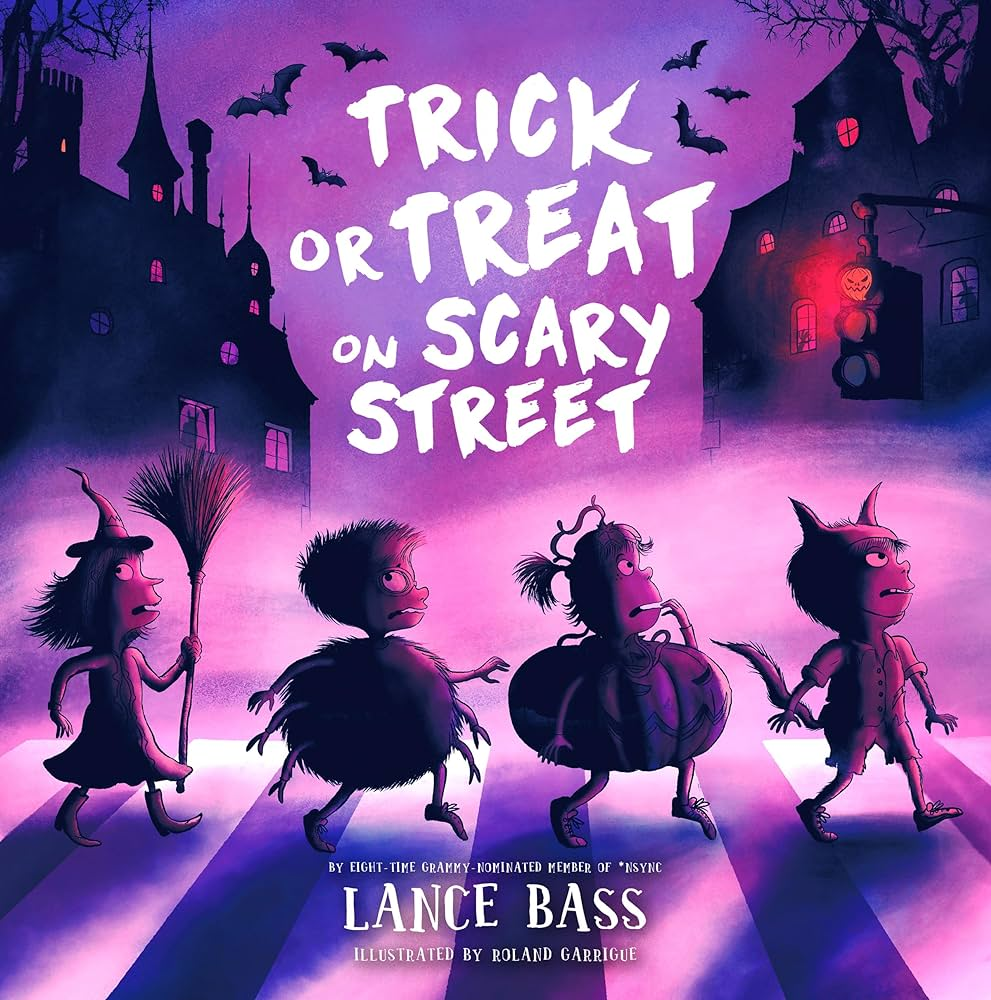
Trick or Treat on Scary Street by Lance Bass, illustrated by Roland Garrigue (Union Square Kids, 40 pages, ages 4-8). A kid dressed in a wolf costume leads a pack of trick-or-treaters down Scary Street. Although he assures them that, “You’re safe and sound on Scary Street,” the houses all seem to be occupied by monsters like a vampire, witch, and ghost. The last house is a doghouse, and the narrator appears to transform into a real wolf by the light of the full moon. Just when thinks are getting really creepy, he opens the door to reveal a rocking Halloween Disco, with monsters and kids alike enjoying the chance to dance together.

I don’t usually review celebrity authors, but due to the fact that I was particularly uncool through the 1990’s, I didn’t recognize the name of former NSYNC member Lance Bass. I give him credit, though, he’s put together a fun Halloween book with some bouncy rhymes and a creepy parade down Scary Street. The illustrations are just the right combination of scary and funny, and kids are sure to enjoy this Halloween book.

Into the Goblin Market by Vikki VanSickle, illustrated by Jensine Eckwall (Tundra Books, 48 pages grades 1-5). While Millie is happy staying home on the farm with her books, her sister Mina is bored and longs for adventure. One night, Mina sneaks out to the goblin market in town. When Millie discovers her sister is missing, she studies up on how to outwit goblins, packs a few things, and heads to the market. There, the wily goblins try to ensnare her, but Millie is prepared and manages to escape their tricks. When the sun is about to rise, she tries to leave, but the goblins tell her she has to buy something before they’ll let her go. She decides on the wolf that’s been guarding them, even though the goblins scream at her that it’s not for sale. Returning home, the wolf gradually changes shape into Mina, and the two sisters prepare to live happily ever after.

I’m excited to try this book out on my fourth and fifth graders, having already read Jon Klassen’s The Skull to most of them at Halloween last year. The rhyming text (inspired by the Christina Rossetti poem “The Goblin Market”) is catchy, and the gothic-style black and white illustrations with just a touch of red are delightfully creepy. Most reviewers are recommending this for ages 4-8, but personally I think it would be better received by a slightly older audience.

Poetry for scientists

A Planet Is a Poem by Amanda West Lewis, illustrated by Oliver Averill (Kids Can Press, 40 pages, grades 2-5). An introduction explains that a planet is a poem, and a poem is a planet, setting the stage for the integration of science and poetry. There’s a poem for each planet, as well as for the sun (but, surprisingly, not the moon), the Kuiper Belt, Arrokoth (an object located in the Kuiper Belt), and one for future astronomers. Each poem is on a page that unfolds to a gatefold that contains additional information on both the subject of the poem and the poetic form, with illustrations that expand as well. It’s a clever concept that educates about both planets and poetry, but I’m hesitant to get this for my library, knowing how even one gatefold page tends to get destroyed pretty quickly. Back matter includes information about writing your own poem, with facts about Planet X to serve as possible inspiration; a glossary of space terms; and a list of sources and resources.

The City Sings Green & Other Poems About Welcoming Wildlife by Erica Silverman, illustrated by Ginnie Hsu (Clarion Books, 40 pages, ages 4-8). In a dozen poems, Erica Silverman describes projects around the world where a single person or small group has made a difference with conservation. Each poem is spread over two or three pages, accompanied by colorful illustrations and a paragraph describing the project. From rewilding the playground in Los Angeles to cleaning a beach and restoring a sea turtle habitat in India to creating a bee “highway” in Norway, these projects will inspire kids to find ways to make a difference. With plenty of resources in the back, this would make a great starting place for a unit on ecology that might inspire hands-on projects.

You might not know it, but these two are poets

Amazing Animals from A to Z by Cece Bell (Walker Books, 64 pages, grades K-4). In her introduction, Cece Bell writes of her love of animal albums, a collection she’s acquired through the years by scouring thrift shops and antique malls. The heyday of these albums was the 1940’s through the 1980’s, when artistic differences (and toileting issues) between the animals and their human producers led to the industry’s demise. Cece has compiled an A-Z collection of her albums, with the lyrics to a song from each, from “My Aromatic Armpit Is Astonishing to All” by armadillo accordion player Arnie Dillow to “You Snooze, You Ooze” by the Zydeco Zebras. Amazingly, a QR code allows readers to listen to a recording of every song in the book. An “About the Artists” section rounds out the collection, with a paragraph about each musician or band.

This incredibly original, creative, and funny book will have kids laughing and rocking out as they enjoy the animal musicians both on the page and on their phones. I confess that the introduction was so convincing that for a second there I thought such albums actually existed. At the other end of the book, I had a brief moment of concern when I noticed that Tom Angleberger isn’t included in the “About the Author” information, but a quick trip to Wikipedia assured me that children’s literature’s favorite wacky couple is still together.

Poetry Comics by Grant Snider (Chronicle Books, 96 pages, grades 2-5). And speaking of favorites, everyone’s favorite orthodontist-by-day-illustrator (and now poet)-by-night has produced a fun and appealing collection of poems, illustrated comic-style. Divided by season, both the poems and the illustrations are brief meditations on nature, school, and life, both funny and profound. The poems are one to two pages, divided into comic book squares, with a line or two in each box, and illustrated with simple figures and backgrounds.

These would make an excellent introduction to poetry for the primary grades. Older students, even middle schoolers, might enjoy trying their hands at poetry comics of their own. All in all, this is a fun and accessible introduction to poetry.

Two picture books that may inspire a family camping trip

Eclipse by Andy Rash (Scholastic Press, 40 pages, ages 4-8). ”Two months ago, I learned there would be a total solar eclipse,” the narrator begins. ”A month ago, I picked out the perfect place and time to watch the eclipse.” The countdown is on as he orders official eclipse glasses a week before the eclipse, travels with his dad a day before to a campsite near the big event, packs up to go to the perfect viewing site an hour before, and arrives a minute before. ”Now, Dad and I are in the dark.” Following this climactic moment, he and his dad will sit in traffic, finally get home, and savor their memories. 

I learned from reading this book that there’s a total solar eclipse in the United States on April 8! It looks like my school will be at about 90-95% totality, occurring right at dismissal, which could very well spell the end of the world. To prepare, I plan to read this fun and informative book to as many classes as I can. I liked the format of story, placing the eclipse as the central event, with the past and future referenced from the moment of totality. There’s additional information about different types of eclipses at the end, and the endpapers have a map showing annular and total eclipses in the US from now until 2048. I couldn’t see the path the April 8 one will take over Massachusetts, because it was hidden by the taped-down dust jacket.

Climbing the Volcano: A Journey in Haiku by Curtis Manley, illustrated by Jennifer K. Mann (Neal Porter Books, 48 pages, ages 4-8). A boy narrates his family’s adventure to climb South Sister, a dormant volcano in the Cascade Mountains of Oregon, using haiku poetry to tell the story. It’s an all-day hike, up past the tree line, into the snow, and finally to the summit! The descent is easier, and they finish the day back at their campsite for dinner and a well-earned rest. There’s additional information at the end about South Sister, the Cascades, what to bring on a hike, the flora and fauna encountered in the book, and haiku.

I love Jennifer Mann’s illustrations; just like in The Camping Trip, she makes you want to get out in nature. And of course, haiku is all about nature, making it an excellent format for describing the journey. This haiku doesn’t follow the 5-7-5 rule that’s often taught in schools, so read the end material to prepare if you’re reading with kids who know that format. 

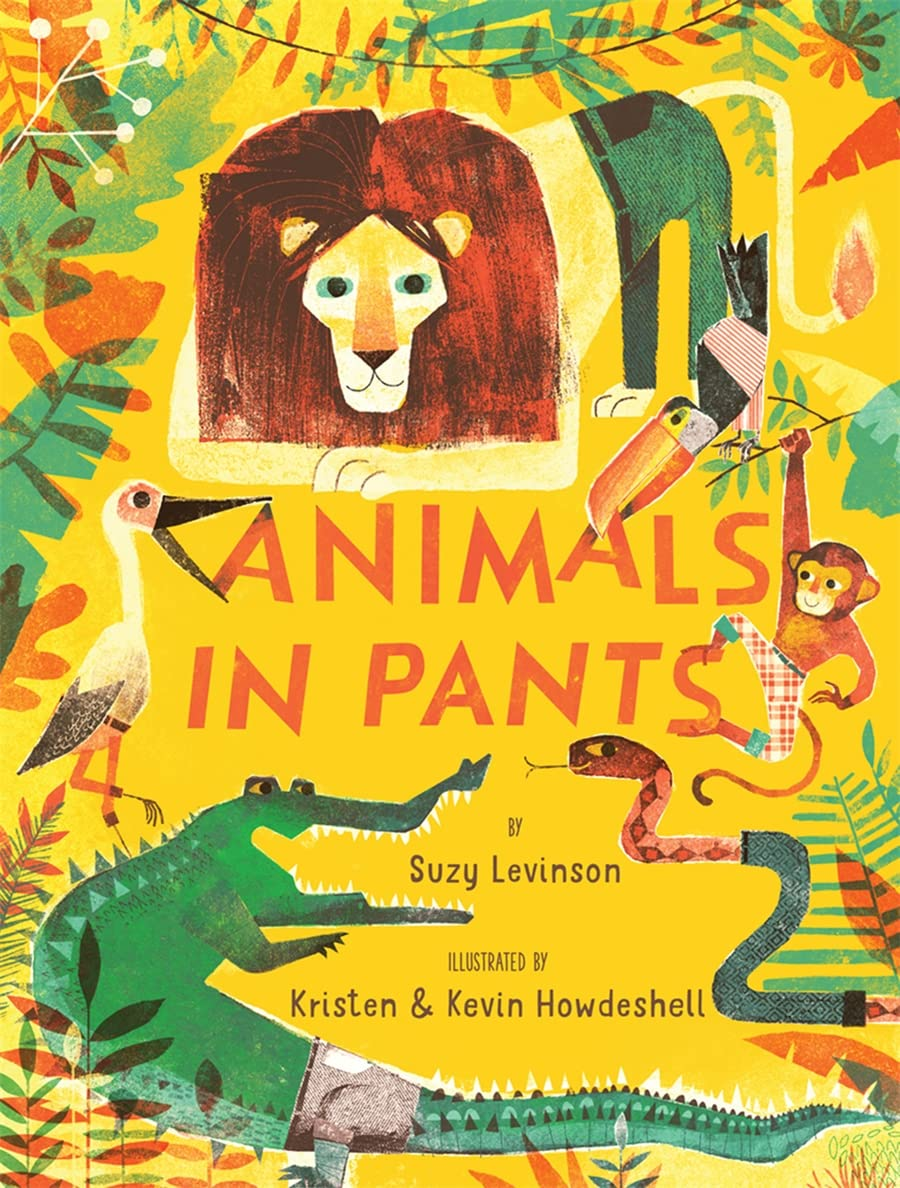
Animals in Pants by Suzy Levinson, illustrated by Kristenand Kevin Howdeshell

Published by Harry N. Abrams

Summary:  “Don’t put a goat in overalls. Really. I mean it. They tend to eat their overalls. Trust me. I’ve seen it.”  Yet the goat and a couple dozen of her friends are rocking their pants, from jeans to lederhosen to slacks (for yaks).  Each poem is just a few lines long, accompanied by humorous illustrations, making this short enough to easily read in a single sitting.  Prepare yourself for the end: “The bad news? The tailor’s incredibly slow. It takes him forever to stitch and to sew. To let out a pant seam, it could be a year. To add a new zipper, the timeline’s unclear. He fusses and frets over each inch of cloth…The good news? He’s fast for a sloth.” 32 pages; ages 4-8.

Pros:  Kids will get a kick out of these animals in their pants with impeccably rhymed poems and fun illustrations.  These took me back to A. A. Milne poems of my early childhood.  A perfect introduction to poetry, and for what it’s worth, this is currently #15 on the Goodreads list of Newbery predictions.

Cons:  I almost missed the child saying, “What? You’ve never seen animals in pants?” on the front endpapers, due to the jacket flap covering up most of her.  The good news is, she’s on the back asking the same question about animals in hats, which bodes well for a sequel.

There Was a Party for Langston by Jason Reynolds, illustrated by Jerome Pumphrey and Jarrett Pumphrey

Published by Atheneum/Caitlyn Dlouhy Books

Summary:  When Jason Reynolds saw a photo of two of his favorite poets, Maya Angelou and Amiri Baraka, dancing at a party in honor of his all-time favorite Langston Hughes, he was inspired to write this ode to the three of them and their poetry.  They laughed at those who tried to ban their books or break their words, and those words are woven into the illustrations of the party held at the New York Public Library’s Schomburg Center in 1951.  Other stars of the Black literary world peek out from their books on the library shelves, arranged alphabetically from James Baldwin to Richard Wright.  Includes an author’s note with the photo of Maya Angelou dancing with Amiri Baraka.  56 pages; grades 2-5.

Pros:  One of the most anticipated books of the year, here’s the picture book debut of beloved author Jason Reynolds, illustrated by the inimitable Pumphrey brothers.  Sure to be a Caldecott contender.

Cons:  There were so many allusions in this book to people (like Amiri Baraka) and poems that I didn’t know about.  I wish that the author’s note had been at the front and that there had been a list somewhere of poems referenced in the book.

Coretta’s Journey: The Life and Times of Coretta Scott King by Alice Faye Duncan, illustrated by R. Gregory Christie

Published by Calkins Creek

Summary:  With alternating pages of poetry and prose, Alice Faye Duncan tells the story of Coretta Scott King, starting with her childhood in Alabama.  Her parents were determined to give their children an education and worked hard as farmers and small business owners, starting over again when both their home and their lumber mill were burned by segregationists who didn’t want to see them succeed.  Coretta went on to study education at Antioch College, then to Boston to pursue her love of music.  It was there that she met Martin Luther King, Jr.  The two of them found much in common with their passion for justice, and even after they were married with four children, they supported each other’s work.  After Martin’s death, Coretta continued this work, focusing on the establishment of the King Center in Atlanta to teach nonviolence and the campaign to get Martin’s birthday made a national holiday.  Includes a timeline, author’s note, photos, and bibliography.  48 pages; grades 2-5.

Pros:  Duncan writes in the introduction that she chose to tell some of Coretta Scott King’s story in poetry because of Coretta’s love of music and lyrical voice.  It works well, interspersed with the lengthy prose pieces.  There were a lot of rich details about her early life which showed how she got her love of justice and her determination to work for it.

Cons:  Although this has the look of a picture book, the prose pages are so long that this would be difficult to do as a read-aloud.

A Long Time Coming: A Lyrical Biography of Race in America from Ona Judge to Barack Obama by Ray Anthony Shepard, illustrated by R. Gregory Christie

Published by Calkins Creek

Summary:  Six Black Americans are profiled in five chapters: Ona Judge, Harriet Tubman and Frederick Douglass together, Ida B. Wells, Martin Luther King, Jr., and Barack Obama.  Their stories are told in verse, weaving together scenes from their lives to paint engaging portraits of their work, their dreams, their discouragements, and their successes and failures.  Each section begins with an illustration and a bit of personal history from the author, connecting his life to his subjects’.  Includes a timeline, additional resources, a bibliography and source notes for each section, and an index.  336 pages; ages 12 and up.

Pros:  Ray Anthony Shepard has written a masterful poetry collection, telling stories that will immediately engage readers.  He doesn’t shy away from telling both the terrible events his subjects witnessed and the less-than-great choices they sometimes made to fully portray their humanity.  Definitely deserving of some serious Coretta Scott King Award recognition.

Cons:  I wish there had been some information on the poetry and poetic forms used.

My Head Has a Bellyache and More Nonsense for Mischievous Kids and Immature Grown-Ups by Chris Harris, illustrated by Andrea Tsurumi

Published by Little, Brown Books for Young Readers

Summary:  A companion to I’m Just No Good at Rhyming, this book of poems begins with “World, Watch Out!” where the narrator is ready to conquer the world…until he trips down the stairs after forgetting to tie his shoes.  The poems cover all kinds of topics like families (“Sometimes Dads Are No Help At All”), holidays (“Valentine Poem for Someone You Don’t Care About”), books (“Help! I’m Trapped in ‘Happily Ever After’!”), and so much more.  Many of the page numbers have fun facts next to them that also form rhymes: “78: one right through twelve added up all the way, 79: a really bad year to have been in Pompeii.”  Includes a glossary of terms (written as a 14-verse poem); somewhat unconventional indexes by title and subject; and a list of books by (and not by) the author and the illustrator.  192 pages; grades 1-5.

Pros:  The back cover cautions that, “extreme laughter while reading this book may give your belly a headache.”  It’s a fair warning, as the book is packed with funny and clever poems and illustrations.  Just the first few pages gave me ideas for sharing with various age groups.  I wouldn’t try to read the whole book at once but to savor it a few pages at a time.

Cons:  I prefer a bit more color variety in illustrations.