Coyote Moon by Maria Gianferrari, pictures by Bagram Ibatoulline

Published by Roaring Brook Press
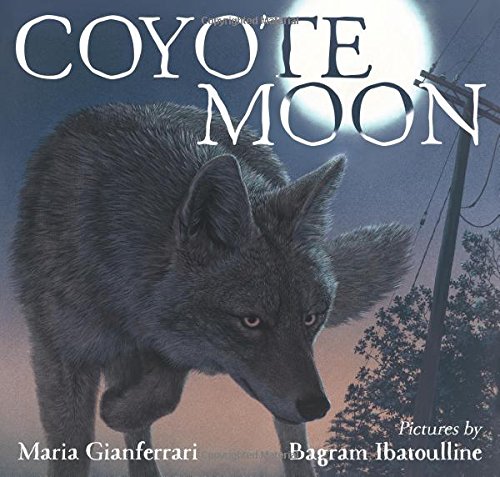
 

Summary:  A coyote explores a nighttime suburban neighborhood, looking for food to bring back to his family’s den in a cemetery.  He is unsuccessful in catching a mouse and a rabbit; geese at a neighborhood pond chase him away before he can get to their eggs.  Just before dawn, he manages to kill a turkey.  His song awakens a little girl, who looks out her bedroom window to see him walking through her backyard.  Finally, he returns to his den, where his family eats, then falls asleep for the day.  The last two pages contain a wealth of coyote facts and some books and websites for further research.  32 pages; ages 4-8.

Pros:  An interesting and positive look at an animal that (I learned from this book) lives in every state except Hawaii, and is often considered a nuisance at best and a danger at worst.  The illustrations are stunning and realistic, capturing the coyote’s beauty and movements perfectly.

Cons:  Given the prevalence of coyotes in the U.S., it would have been helpful to offer tips about what to do if you encounter a coyote.
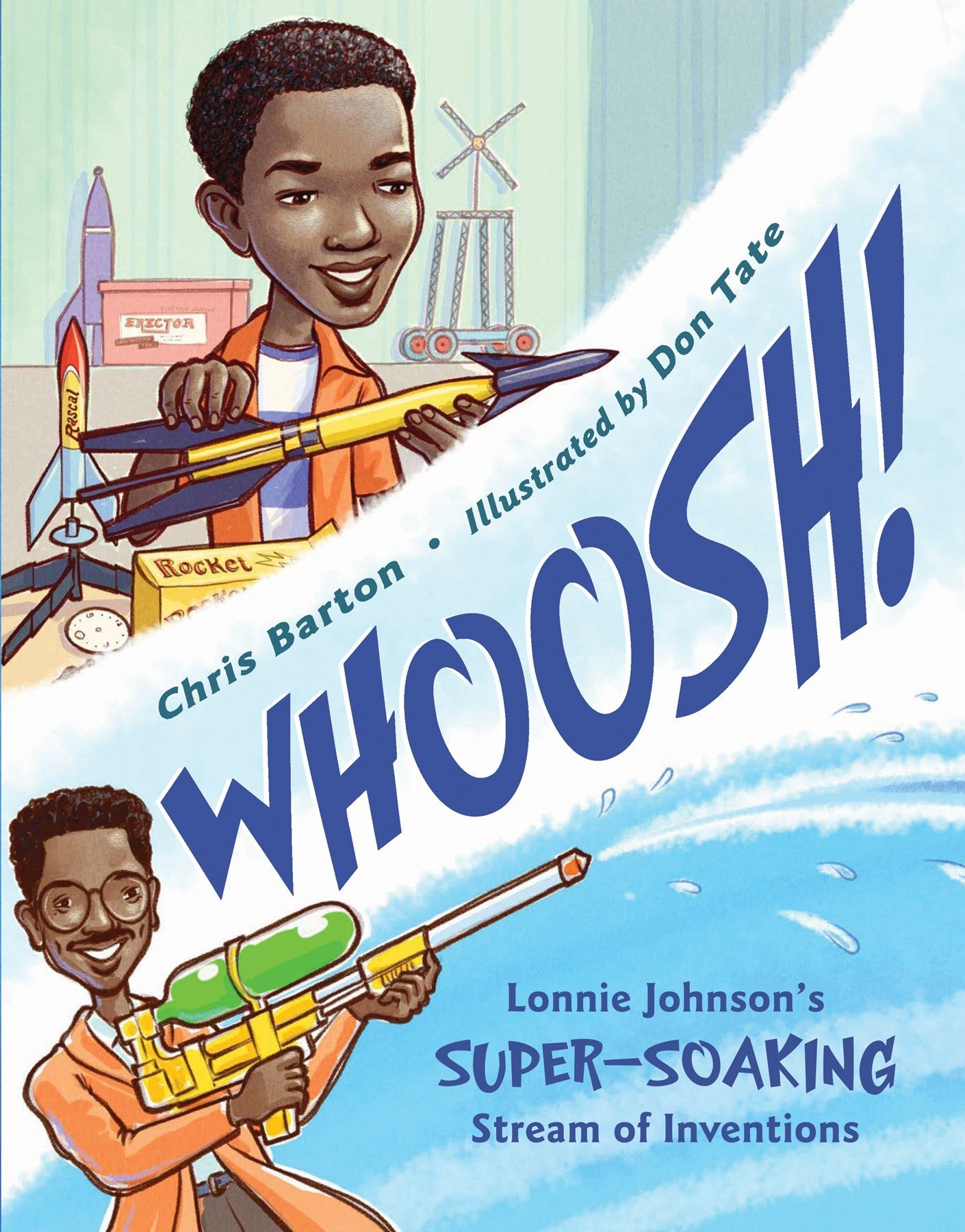
 

Whoosh! Lonnie Johnson’s Super-Soaking Stream of Inventions by Chris Barton, illustrated by Don Tate

Published by Charlesbridge

Whoosh!: Lonnie Johnson's Super-Soaking Stream of Inventions: Barton,  Chris, Tate, Don: 9781580892971: Amazon.com: Books

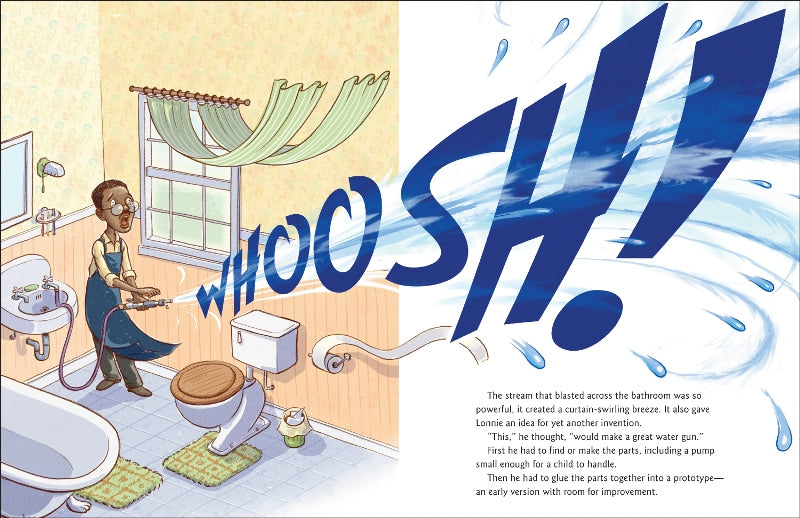
Summary:  When Lonnie Johnson was growing up in Alabama, his small house and large family didn’t leave him with much space to do what he loved best…invent.  Still, he had supportive parents (when his rocket fuel caught fire in the kitchen, his mom just sent him outside) and a lot of perseverance.  His hard work paid off in high school, when his robot won first place at a science fair at the University of Alabama—a school that African-American students like Lonnie hadn’t been allowed to attend just a few years before.  Lonnie graduated from Tuskegee, then went on to work for NASA, but he kept inventing in his spare time.  While testing an environmentally-friendly cooling system, he serendipitously invented the Super Soaker water gun.  This hit toy has given Lonnie enough income to allow him to continue working on his inventions full-time.  The author’s note explains how he learned about kids’ stereotypical ideas about scientists, leading him to write a biography of a man who doesn’t fit those stereotypes. 32 pages; grades 1-5.

Pros:  Kids will connect with this hard-working, but fun-loving scientist who invented a much-loved toy; teachers will make connections to science and African-American history curriculum; and librarians will enjoy using this book to tie in with their maker spaces.

Cons:  It seemed to me that Lonnie Johnson was a bit hasty in disregarding the advice, “Don’t quit your day job”.

Circle by Jeannie Baker

Published by Candlewick Press 

Summary:  Before the title page, a boy lies on his bed, wishing he could fly.  A couple pages later, he’s in wheelchair on the beach, watching a bird called a godwit flying with his flock.  They’re heading north, on the longest migration any animal in the world makes, traveling 7,000 miles from Australia to Alaska.  It’s a perilous journey, but the godwit finally makes it.  He builds a nest and finds a mate.  Together they have four babies, only one of which survives to make the return trip with his parents.  The flock flies for nine days and nights without stopping, arriving back at the beach where the story started, and where the boy has now abandoned a set of crutches to run along the beach.  An author’s note tells more about godwits and some of the threats to their survival.  48 pages; grades K-3.

Pros:  Beautiful collage illustrations capture the various environments inhabited by this remarkable bird.

Cons:  A hungry fox eats the other three chicks.

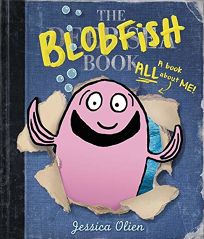
The Blobfish Book by Jessica Olien

Published by Balzer + Bray 

Summary:  Blobfish takes a book called The Deep Sea Book and turns it into The Blobfish Book.  The original is about the deepest part of the ocean, with photographs of some of the animals that live there.  Blobfish’s version has a pink cartoon of himself drawn onto the photographs, attempting to make it all about him.  Finally, the book gets to the page about blobfish, but the sentence “The blobfish was once voted the world’s ugliest animal” stops the narrator in his tracks.  Fortunately, the other sea creatures are paying attention, and they join forces to create a final page that celebrates Blobfish and cheers him up again.  Includes more facts about the deep sea and its creatures, plus a list of additional resources.   40 pages; ages 4-8.

Pros:  2016 is turning into The Year of the Blobfish…this is the second kids’ book featuring a blobfish in the last six months (see Pink is for Blobfish).  This one is a fun blend of fact and fiction, with some facts about the deepest parts of the ocean being snuck in around Blobfish’s slightly obnoxious, but always good-intentioned narration.

Cons:  The informational part is pretty slight.

Follow the Moon Home: A Tale of One Idea, Twenty Kids, and a Hundred Sea Turtles by Philippe Cousteau and Deborah Hopkinson, illustrated by Meilo So

Published by Chronicle Books

Summary:  Viv is new in town, and unsure how she feels about her new home.  On her first day of school, her new teacher encourages the class to look for a problem in their community that the kids can work to solve.  Walking on the beach, Viv learns that sea turtles nest there, and that the babies often get disoriented by beach house lights and can’t find their way to the ocean.  Her own difficulties finding her way in a new place makes Viv sympathetic for the turtles.  Soon her whole class is involved in researching the turtles’ plight and spreading the word to turn out lights and close curtains at night.  Their hard work pays off, and on a night patrol, Viv gets to see a line of loggerhead turtles heading for the sea.  Back matter includes a letter to young activists, a note to parents and teachers on how to help kids make a difference in their communities, and additional information about sea turtles.  48 pages; grades K-4.

Pros:  Environmental activist Cousteau (grandson of Jacques) and award-winning write Hopkinson join forces for an inspiring tale about young kids making a difference, backed up with information readers can use themselves.

Cons:  I was hoping this was based on a true story, but it seems to be fictional.

Slickety Quick: Poems About Sharks by Skila Brown, illustrated by Bob Kolar

Published by Candlewick


Summary: 14 different types of sharks get a poem, along with a brief factual description and two-page illustration. There are well-known sharks, such as the great white and the whale shark, and some lesser known species, like the cookie-cutter shark and wobbegong. Some of the poems are only a few lines (“Whale Shark: In water she dangles, and bubbles and jangles, and blinks her mouth right up at me. Her back spots they shimmer, her tail getting dimmer, the silkiest wave of the sea.”); others are a few stanzas. All are descriptive and playful with language. 32 pages; grades K-4.

Pros: The Venn diagram showing the intersection of poetry readers and shark fans must be pretty close to the null set. Slickety Quick does its part to remedy this situation, with fun poems and interesting shark lore to appeal to both groups.

Cons: Back matter with additional shark information would have been a nice addition.

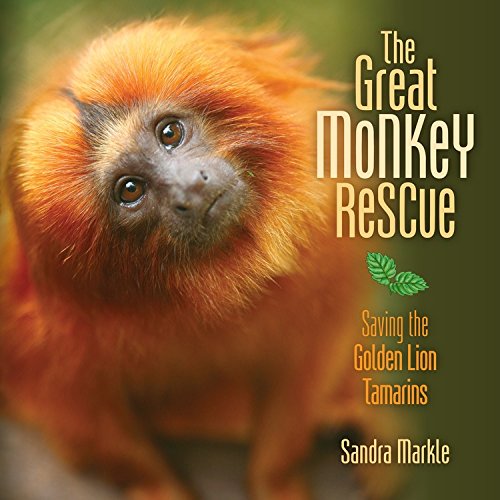
The Great Monkey Rescue: Saving the Golden Lion Tamarins by Sandra Markle

Published by Millbrook Press 

Summary: The story begins with a female golden lion tamarin trying to find a place to start a family. She’s rejected by groups of tamarins until she finally comes to the edge of the forest and realizes she has nowhere else to go. The narrative then moves to a look at the last few decades of human efforts to save this endangered Brazilian species. So much of the tamarins’ habitat has been destroyed that the animals were in danger of extinction. Tamarins in zoos weren’t breeding much, and if they did, the babies usually did not survive. Studying how the animals live in the wild led to greater success with zoo breeding programs, but challenges remained on how to introduce animals back into the rainforests. Slowly, over many years, scientists learned more about the golden lion tamarins and their environment, so that today the outlook for these animals looks positive. The female from the beginning discovers a tree bridge planted by scientists that leads her to a new home and family.   Includes a timeline, glossary, additional resources, and index. 48 pages; grades 4-7.

Pros: Packed with information, this book is written so engagingly that it’s hard to put down.  Plus, it has a happy ending.

Cons: The tamarins’ situation still seems somewhat tenuous.

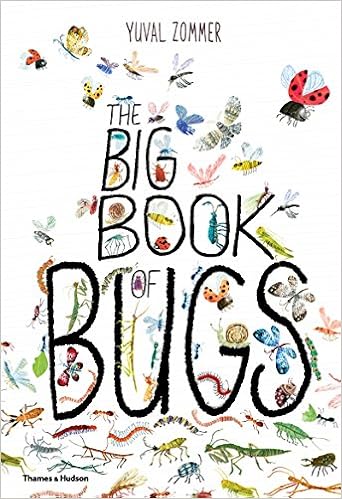
The Big Book of Bugs by Yuval Zommer

Published by Thames & Hudson 

Summary: It’s difficult to come up with an insect category that doesn’t have its own section in this oversized book. Beetles, praying mantises, flies, crickets…they’re all there, as well as a few non-insects like spiders and snails. Each two-page spread has several facts and detailed illustrations. Some pages contain an “I Spy” type challenge, such as finding 29 moths, two praying mantises eating dinner, or a family of silverfish. There are also sections on baby bugs, bugs on the move, house-loving bugs, bugs at work, and bugs in your garden. The last several pages include answers to the challenges, an illustrated glossary (“Bug words”), and an index. 64 pages; grades Pre-K-2.

Pros: Anyone with even the slightest interest in insects will find a lot of interesting facts here, as well as have the opportunity to see the beautiful Eric Carle-like illustrations of all the different creatures in their natural habitats. The wealth of information and attractive pictures might even be able to help the squeamish overcome their trepidation around creepy-crawlies.

Cons: This is indeed a big book—almost 14 inches tall—so you may need some special accommodations for library shelving.


Every Day Birds by Amy Ludwig VanDerwater, illustrations by Dylan Metrano

Published by Orchard Books 

Summary:  20 North American birds are introduced in simple rhyming text (“Chickadee wears a wee black cap/Jay is loud and bold/Nuthatch perches upside down/Finch is clothed in gold”).  Each line of the rhyme is on a separate page with a large cut-paper illustration of the bird.  The entire text is included on two pages at the end, followed by smaller pictures and additional information about each bird, listed alphabetically.  32 pages; ages 2-5.

Pros:  Each line perfectly captures a characteristic of the bird it describes.  The illustrations are simple and bright, appealing for young kids, yet accurately depicting the bird.  Readers will be ready to head outside and look in trees and the sky for some feathered friends.

Cons:  So many birds in one place triggered a brief Alfred Hitchcock moment.

Finding Wild by Megan Wagner Lloyd, pictures by Abigail Halpin

 Published by Alfred A. Knopf 

Summary:  A boy and a girl explore the world around them, seeking to answer the questions posed on the first page: What is wild? And where can you go to find it?  They see it (“It leaps and pounces and shows its teeth”), hear it (“Wild roars and barks and hisses and brays”), smell it (“Every scent begging you to drink it in”), and taste it (“honey from bees and sap from trees”).  Sometimes wild burns or stings, but other times it soothes.  When the explorers enter the city, it seems as though wild has been completely covered over by pavement and buildings, but peeking through a fence they discover that wild is everywhere.  32 pages; ages 3-7.

Pros:  The vivid, mainly green illustrations nicely complement the descriptive text.  Younger readers will be inspired to explore the natural world around them; older readers may be inspired by the beautiful, descriptive language to write about it.

Cons:  Do kids really get to go off and explore the wild by themselves anymore?