Flying Frogs and Walking Fish: Leaping Lemurs, Tumbling Toads, Jet-Propelled Jellyfish, and More Surprising Ways That Animals Move by Steve Jenkins and Robin Page

Published by Houghton Mifflin Harcourt 

Summary:  The Jenkins-Page team takes on animal movement, asking if you’ve ever seen a walking octopus or a swimming elephant.  After the page on the walking octopus, for example, comes a two-page spread of several other animals that walk in some unusual way.  The illustrations are done in Jenkins’ inimitable cut-paper style with amazing details.  The last two pages include thumbnail pictures of all the animals with a few sentences of additional information for each.  40 pages; ages 4-7.

Pros:  This award-winning team just keeps cranking out beautifully-illustrated, engaging science picture books.  Kids will love browsing through the pictures and descriptions, or listening to the book as a fun read-aloud.

Cons:  The format is nothing new, similar to other Jenkins books like What Do You Do With a Tail Like This? and How Many Ways Can You Catch a Fly?

Worms for Breakfast: How to Feed a Zoo by Helaine Becker, illustrated by Kathy Boake

Published by Owlkids Books

Summary:  “Real Recipes Included!” boasts the front cover, but don’t head to the kitchen just yet: these recipes are for such treats as Predator Popsicles (bones and blood are involved) and Flamingo Chick Formula (simulating regurgitated fish).  As you may have guessed, the focus of this book is feeding animals at the zoo.  In addition to the recipes, it includes lots of information about zoo animals, how and what animals eat, profiles of zoo nutritionists, and tips for how kids can help animals, both inside and outside of the zoo.  Glossary and index are included.  40 pages; grades 1-5.

Pros:  Lots of information with plenty of humor, both in the writing and the illustrations.  The text is presented in (appropriately) bite-sized chunks, with lots of side bars and captioned illustrations.  The illustrations are a nicely goofy mix of photos and paintings.  Animal lovers of all reading levels will enjoy browsing and learn quite a bit in the process.

Cons:  “Tiger’s Birthday Cupcake” may have permanently put me off of cupcakes.


Olinguito, de la A a la Z! by Lulu Delacre

Published by Lee and Low Books 

Summary: Never heard of the olinguito? Don’t worry, scientists have only known about it since 2006. Lulu Delacre has created an alphabet book with text in both Spanish and English that follows zoologist Dr. Kristofer Helgen through the cloud forest of Ecuador as he looks for and finally finds this little animal. The olinguito doesn’t make an appearance until “W”, though, so the reader gets introduced to many other flora and fauna of the rainforest. Extensive back matter includes information about the discovery of the olinguito, the cloud forest, the illustrations, plus a lengthy glossary…all in both English and Spanish. 40 pages; grades K-4.
Pros: The illustrations are as lush and colorful as the cloud forest. The text could be used as a simple alphabet book or as a resource for research, depending on which parts are used.

Cons: The English is sometimes not as alliterative as the Spanish in the alphabet portion of the book.

Prairie Dog Song by Susan L. Roth and Cindy Trumbore

Published by Lee & Low Books 

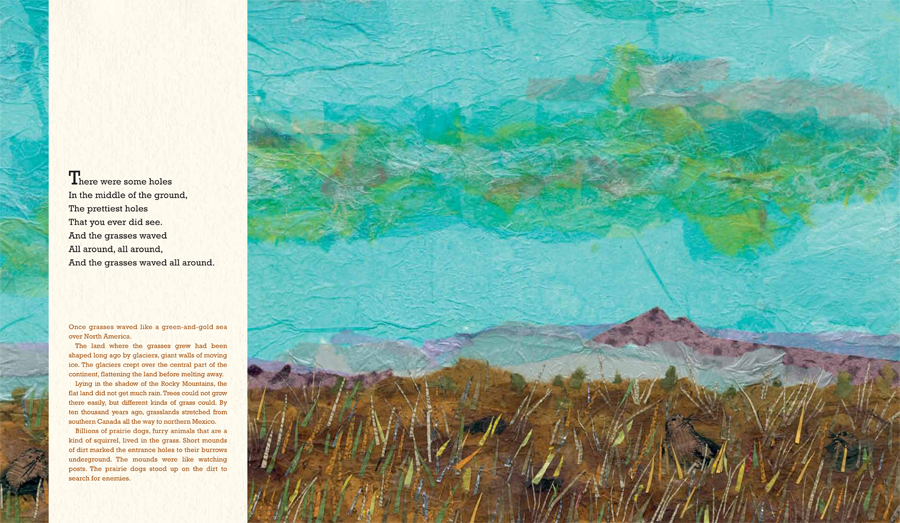
Summary: Prairie dogs are what is known as a keystone species–an animal that, through its activities, helps many other plants and animals survive. When people moved into the prairie dogs’ habitat and started using it as farmland, many other species were affected as well. The tale is told both through a song based on “And the Green Grass Grew All Around” and a more detailed description of how the prairie dogs once lived, the other animals that were part of the grasslands, and how that habitat has changed. The final few pages explain how the work of the Janos Biosphere Reserve in Mexico is helping to restore grasslands and the animals that make them their home. 40 pages; grades 1-5.

Pros: The beautifully colored and textured cut-paper illustrations illuminate the information-rich text about this endangered habitat and the many varied species that live there.

Cons: While the song is written in a good-sized font, the rest of the text is a bit on the small side.

Whose Eye Am I? by Shelley Rotner

Published by Holiday House


Summary: The eyes have it in this collection of animal photographs and facts about eyes and vision. Many pages feature a close-up of an eye with the caption “Who am I?” with the answer revealed on the following page. Animals are arranged by mammal, bird, reptile and amphibian, and insect. The last page explains how the human eye works, followed by a glossary and index.  32 pages; ages 4-8.

Pros: The beautiful photos and interesting facts make this an inviting book to browse. Readers will also enjoy the guessing game element.

Cons: I found the book a little disjointed; it took me about half the book to pick up on the arrangement by type of animal.

Otters Love to Play by Jonathan London, illustrated by Meilo So

 Published by Candlewick 

Summary: Did you know otters often take over dens left behind by beavers, muskrats, or woodchucks? That’s the first of many facts you’ll learn in this information-packed book that follows a year in the life of an otter mother and her two offspring. As the babies grow, they learn the playful moves that characterize otters, moves that are useful for hunting and self-defense. By the end of the year, the babies have reached their full size, but continue to enjoy sliding and playing in the spring mud. Includes an index and a page of additional information about otters. 32 pages; grades K-3.

Pros: The text has both large and small fonts, so the book can be read as a quick read-aloud, or used for more in-depth research. The illustrations capture the happy, playful otter spirit.

Cons: How could I possibly say anything bad about otters?

Green City: How One Community Survived a Tornado and Rebuilt for a Sustainable Future by Allan Drummond

Published by Farrar Straus Giroux 

Summary: When a tornado hit Greensburg, Kansas in 2007, so much of the city was destroyed that  townspeople questioned whether it should be rebuilt at all.  But some forward-thinking residents decided to create a new community.  Not only would the houses and commercial buildings be tornado-proof, but they would be as energy efficient and green as possible.  Donations came in from all across the country, and people in neighboring communities helped design and build the new town.  It took a few years, and some former residents didn’t want to wait, or couldn’t afford to.  But about 800 of the 1400 townspeople stuck it out, and today they live in one of America’s greenest cities.  Back matter includes an author’s note and tips for going green.  40 pages; grades K-4.

Pros:  Busy, colorful illustrations show the many steps of planning and creating a new town.  The anonymous child narrator tells the story in a chatty, optimistic voice.  Sidebars give more information on green living and construction.

Cons:  The idea of an entire town being destroyed in just a few minutes.

Our Moon: New Discoveries About Earth’s Closest Companion by Elaine Scott

Published by Clarion Books


Summary:  Everything you ever wanted to know about the moon but were afraid to ask..  From the earliest ancient astronomers who observed Earth’s satellite with the naked eye to the scientists today who are trying to figure out a way to colonize the moon, Our Moon traces the history of humans’ lunar interactions.  It also looks at how the moon has also been studied to learn more about the history of the solar system, particularly after rocks and dust were brought back to Earth from the Apollo missions.  Back matter includes an extensive glossary and index and sources for further information.  72 pages; ages 10-13

Pros:  This book is positively dripping with information. The engaging writing style will appeal to researchers and browsers alike.  Filled with color photos, diagrams, and sidebars, this is nonfiction at its best.

Cons:  The subtitle makes it sound like this is a book about new discoveries about the moon, while that is actually only one small part of the whole.


Fabulous Frogs by Martin Jenkins, illustrated by Tim Hopgood

Published by Candlewick Press 

Summary:  “Did you know that there are more than 5,000 kinds of frogs?” begins this book, and then proceeds to describe some of the more unusual ones.  There are big frogs and little ones, poisonous frogs, and frogs that can jump sixteen feet, appear to fly, and live buried underground for years.  The last two pages include eight more frog portraits, a very short index, and a recommended website for learning more.  32 pages; ages 5-8.

Pros:  This would be a great nonfiction read-aloud for young animal lovers.  The big, colorful illustrations (by Tim Hopgood, how perfect is that?) nicely complement the conversational text.

Cons:  My curiosity at how the Australian water-holding frog lives underground for “years and years” in a very small hole was not satisfied.

Pink is for Blobfish: Discovering the World’s Perfectly Pink Animals by Jess Keating, with illustrations by David Degrand

Published by Alfred A. Knopf 

Book trailer: https://www.youtube.com/watch?v=YKCGtE693T4

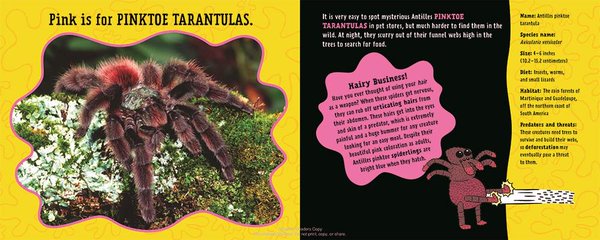
Summary: If your list of pink animals begins and ends with “flamingo”, you need to take a look at this book. And if you think pink is a dainty, girly-girl color, check out the photos of the pinktoe tarantula and the dragon millipede.  Not to mention the blobfish, recently voted the ugliest animal in the world by the Ugly Animal Preservation Society.  Each two-page spread includes a full-page photo and the name, species name, size, diet, habitat, predators and threats, and some fun facts.  End matter includes a glossary, list of further resources, and a color-coded map that shows where each animal lives.

Pros:  A unique approach to animal facts, written in an easy-to-read format that kids will enjoy.  This is the first in a series called “The World of Weird Animals”.

Cons:  I found the map a little difficult to use.