Our Moon: New Discoveries About Earth’s Closest Companion by Elaine Scott

Published by Clarion Books


Summary:  Everything you ever wanted to know about the moon but were afraid to ask..  From the earliest ancient astronomers who observed Earth’s satellite with the naked eye to the scientists today who are trying to figure out a way to colonize the moon, Our Moon traces the history of humans’ lunar interactions.  It also looks at how the moon has also been studied to learn more about the history of the solar system, particularly after rocks and dust were brought back to Earth from the Apollo missions.  Back matter includes an extensive glossary and index and sources for further information.  72 pages; ages 10-13

Pros:  This book is positively dripping with information. The engaging writing style will appeal to researchers and browsers alike.  Filled with color photos, diagrams, and sidebars, this is nonfiction at its best.

Cons:  The subtitle makes it sound like this is a book about new discoveries about the moon, while that is actually only one small part of the whole.


Fabulous Frogs by Martin Jenkins, illustrated by Tim Hopgood

Published by Candlewick Press 

Summary:  “Did you know that there are more than 5,000 kinds of frogs?” begins this book, and then proceeds to describe some of the more unusual ones.  There are big frogs and little ones, poisonous frogs, and frogs that can jump sixteen feet, appear to fly, and live buried underground for years.  The last two pages include eight more frog portraits, a very short index, and a recommended website for learning more.  32 pages; ages 5-8.

Pros:  This would be a great nonfiction read-aloud for young animal lovers.  The big, colorful illustrations (by Tim Hopgood, how perfect is that?) nicely complement the conversational text.

Cons:  My curiosity at how the Australian water-holding frog lives underground for “years and years” in a very small hole was not satisfied.

Pink is for Blobfish: Discovering the World’s Perfectly Pink Animals by Jess Keating, with illustrations by David Degrand

Published by Alfred A. Knopf 

Book trailer: https://www.youtube.com/watch?v=YKCGtE693T4

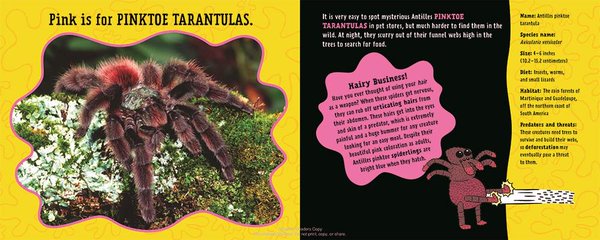
Summary: If your list of pink animals begins and ends with “flamingo”, you need to take a look at this book. And if you think pink is a dainty, girly-girl color, check out the photos of the pinktoe tarantula and the dragon millipede.  Not to mention the blobfish, recently voted the ugliest animal in the world by the Ugly Animal Preservation Society.  Each two-page spread includes a full-page photo and the name, species name, size, diet, habitat, predators and threats, and some fun facts.  End matter includes a glossary, list of further resources, and a color-coded map that shows where each animal lives.

Pros:  A unique approach to animal facts, written in an easy-to-read format that kids will enjoy.  This is the first in a series called “The World of Weird Animals”.

Cons:  I found the map a little difficult to use.

Glow: Animals with Their Own Night Lights by W. H. Beck

Published by Houghton Mifflin Harcourt 

Summary: An introduction to bioluminescence, showing a variety of glowing animals on a background of black pages with white text. The “how” of bioluminescence is very briefly described, as well as a variety of reasons why animals glow.  An author’s note explains that some photos have been enlarged and that some are a bit blurry due to the difficulties of photographing animals deep in the ocean.  Thumbnail photos and descriptions of all the animals are included on the last two pages.  32 pages; ages 4-7.

Pros:  Bioluminescence is very cool!  The photos are eye-catching and the text is simple enough for young children.

Cons:  The explanation of why animals glow is very brief.

Tooth by Tooth: Comparing Fangs, Tusks, and Chompers by Sara Levine, illustrations by T. S. Spookytooth

Published by Millbrook Press 

Summary:  How many teeth do you have?  What are the names and functions of different types of teeth?  What kind of an animal would you be if you had really long incisors?  Or teeth that were all the same? Tooth by Tooth draws readers right in with questions about something all of us are pretty familiar with—our teeth.  Kids will learn which types of teeth are used by carnivores, herbivores, and omnivores, and why only mammals have different types of teeth.  The last few pages include a glossary, additional resources, and more information about mammals and their teeth.  32 pages; grades K-4.

Pros:  The first book by this author/illustrator team, Bone by Bone is one of my favorite nonfiction read-alouds.  The questions make both books very interactive, and the illustrations are lots of fun, showing what you would look like with different types of bones or teeth.  Not only that, but there’s a ton of information packed into a short amount of text.

Cons:  I didn’t find teeth quite as varied and interesting as bones.

Solving the Puzzle Under the Sea: Marie Tharp Maps the Ocean Floor by Robert Burleigh, illustrate by Raul Colon

Published by Simon and Schuster 

Summary: Marie Tharp fell in love with maps when she and her family moved from place to place for her father’s job. After attending 17 different schools, she studied geography in college, then got a job at Lamont Geological Laboratory at Columbia University.  Looking for a groundbreaking project to work on, she teamed up with her colleague Bruce Heezen to map the ocean floor.  For 20 years, from 1957 to 1977, Heezen collected data on many ocean trips, and Tharp turned the data into maps.  Along the way, she discovered a deep rift in the Atlantic Ocean which helped support the theory of continental drift.  Her maps have been used in schools and museums around the world.  End matter includes more information about Marie Tharp, a glossary and bibliography, and a page entitled, “Things to Wonder About and Do”.  40 pages; grades K-4.

Pros: The first person narration imbues the story with Marie’s own energy and enthusiasm. Colon’s illustrations beautifully capture the light and colors of the seas and the intricacies of Tharp’s maps.

Cons:  The continents are moving an inch or two every year?!

Ada Byron Lovelace and the Thinking Machine by Laurie Wallmark, illustrated by April Chu

Published by Creston Books

Summary:  From the time Ada Byron was a child, she loved the world of science and, especially, math.  She designed a flying machine at the age of 12, shortly before becoming very ill with a case of the measles that left her temporarily blind and paralyzed.  She persevered with her education, however, and when she was 17, she met Charles Babbage, a mathematician and inventor who had created a mechanical calculating machine.  He had also designed, but not built, an Analytical Engine, which was a more sophisticated machine, the forerunner of a computer.  Ada studied his designs for this machine, and created a numerical algorithm that would instruct it.  Although Babbage never built his machine, Ada’s algorithm is considered to be the first computer program.  Back matter includes an author’s note, timeline, and bibliography.

Pros: An inspiring story of a brilliant girl growing up in a time when such brilliance was not generally recognized and nurtured. Chu’s illustrations evoke the early 19th-century feel of Ada’s time in history.

Cons:  The pages describing the young Ada’s design of a flying machine, followed by her bout with measles, seemed a little disjointed and confusing to me.

Forgotten Bones: Uncovering a Slave Cemetery by Lois Miner Huey

Published by Millbrook Press


Summary: When construction workers near Albany, New York, dug up a human skull, police, town officials, and archaeologists were all called in. The skull was determined to be over a century old.  Construction was halted, and an archaeological site was set up.  More skeletons were found, indicating a cemetery had been there.  Since there were no markers and it was far away from the main house of the farm that had been there in the 1800’s, the archaeologists were fairly certain it had been a slave cemetery.  This book looks at how scientists, historians, and artists worked together to learn the history of the people who had been buried there, as well as in two other slave cemeteries in New York City and Portsmouth, New Hampshire.  Using clues from the bones, DNA, and artifacts found on or near the bodies, much could be learned about the people, where they came from, what their lives were like, and even what their faces looked like.  Back matter includes an author’s note, glossary, bibliography, and places to visit to learn more.  112 pages; grades 5-7. 

Pros:  A fascinating blend of science and history, covering both the history of slavery in the northern United States, and the science of how the skeletons contributed to this knowledge.

Cons: A picture of a slave being burned alive near the end of the book could be disturbing to some readers.

The National Geographic Book of Nature Poetry edited by J. Patrick Lewis

Published by National Geographic 

Summary: Over 200 poems are paired with nature photographs, arranged in sections about animals, seasons, specific places, and natural disasters. J. Patrick Lewis, former U.S. Children’s Poet Laureate, edited the collection and wrote an introduction about looking at nature and responding to it poetically.  He includes six of his own poems in post-it note form at the end, and an essay on “Who is Mother Nature?” that invites kids to write their own poetic answer to that question.  Also included at the end: a bibliography of children’s books on wordplay in poetry arrange by category (acrostics, anagrams, epitaphs, etc.), and indices by title, poet, first line, and subject.  192 pages; grades K-6.

Pros:  This is a rich collection of poetry by many different writers that invites children to engage in the creative processes of enjoying poetry and creating their own.  Readers will be drawn in by the beautiful, National Geographic quality photographs on every page.

Cons:  It would have been interesting to know a little more about some of the lesser-known poets; at the very least, the year they wrote their poems.

Breakthrough! How Three People Saved “Blue Babies” and Changed Medicine Forever by Jim Murphy

Published by Clarion Books

Summary: In November, 1944, Dr. Alfred Blalock made history by performing delicate cardiac surgery on 18-month-old Eileen Saxon, repairing heart defects that had caused her “blue baby syndrome”. Standing beside him was Dr. Helen Taussig, a pediatrician who had worked with blue baby patients for many years before recruiting Dr. Blalock to help her.  Although Blalock received most of the fame and celebrity from this groundbreaking operation, the procedure had been developed and refined by his research assistant, Vivien Thomas.  It would be years before Thomas, who was African American, received any credit for his contributions.  Whether this was because of racism or his position as a research assistant instead of a doctor is unclear, but despite this, Thomas continued his hard work and dedication for many years, training many other surgeons at Johns Hopkins.  In 1971, his work there was recognized when his portrait was hung in Blalock Building alongside other great surgeons from that institution.  Back matter includes extensive source notes, a bibliography, and an index.  130 pages; grades 5-8.

Pros: A fascinating look at medical history and the contributions of three unique and interesting individuals.

Cons:  This could be a hard sell in the middle school community.