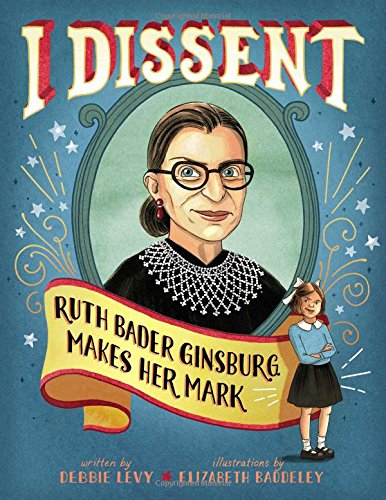
I Dissent: Ruth Bader Ginsburg Makes Her Mark by Debbie Levy, illustrated by Elizabeth Baddeley

Published by Simon and Schuster 

Summary:  Growing up in the 1940’s, Ruth Bader noticed many prejudices and injustices.  There were hotels and restaurants that banned her family because they were Jewish.  Girls weren’t expected or encouraged to do many of the things boys could do.  Even as a left-handed person, Ruth faced discrimination, getting a “D” in penmanship when she was forced to write with her right hand.  Ruth’s mother took her to the library and encouraged her to get an education; although she died the day before Ruth’s high school graduation, Ruth persisted and went to college and law school.  Overcoming the difficulties of being hired as a female lawyer, she eventually became a law professor, then a judge.  In 1993, Ruth Bader Ginsburg was appointed to the Supreme Court.  Throughout her career, up to the present day, she has fought for the rights of those who experience discrimination.  Now the oldest member of the Supreme Court, there are those who think it’s time for her to retire.  Ruth Bader Ginsburg dissents.  Includes an extensive author’s note with additional biographical information, notes on the Supreme Court cases mentioned in the text, and a bibliography.  40 pages; grades 1-4.

Pros:  The first picture book about this woman who continues to inspire.  Building Ruth’s story around her experiences with discrimination and passion for justice gives the story a good focus.  The illustrations add a bit of humor and incorporate some of the text into the pictures.

Cons;  Those whose politics don’t match Ginsburg’s may disagree with the way some of the Court cases are described.

I

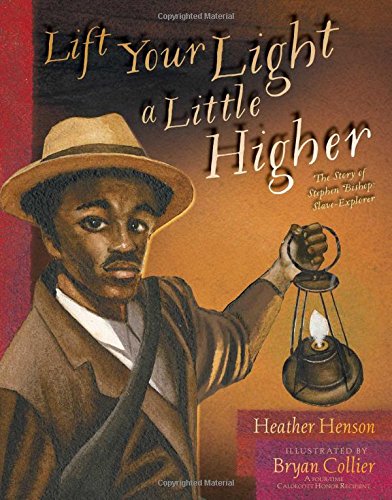
Lift Your Light a Little Higher by Heather Henson, illustrated by Bryan Collier

Published by Atheneum


Summary:  Stephen Bishop invites you to join him on a tour of Kentucky’s Mammoth Cave.  Born a slave, Bishop was trained as a tour guide for this huge cave system (the longest in the world) that was on his master’s plantation.  Although other slaves also guided visitors, Stephen became the most famous.  He discovered new animals and forged new paths through the caves.  He shows visitors his name on the cave wall, written along with his wife’s and many other visitors’, with the smoke from a candle tied to a long stick.  Little is known of Stephen Bishop’s life, which ended at the age of 37.  He is buried not far from the entrance to Mammoth Cave.  Author’s and illustrator’s notes at the end give more information about Bishop and how this book was created.  32 pages; grades 1-4.

Pros:  The lyrical text and beautiful illustrations by Bryan Collier bring this little-known man to life, along with the caves he loved and studied for many years.  Since so little is known about him, this isn’t really a biography, but more an imagined meditation on slavery, race, and life.

Cons:  Read the author’s note first, or the story will be hard to understand.

Be the Change: A Grandfather Gandhi Story by Arun Gandhi and Bethany Hegedus, illustrated by Evan Turk

Published by Atheneum Books for Young Readers 

Summary:  In this companion to Grandfather Gandhi, Arun Gandhi tells of his experiences as a child living in the ashram started by his grandfather, Mahatma Gandhi.  The ashram, devoted to living simply and nonviolently, had eleven vows.  The one young Arun struggled with the most was the vow not to waste.  One day, he threw away a stub of pencil and went to his grandfather to ask for a new one.  Big mistake. Grandfather told him he had to look in the tall grasses where he had thrown his away to find it.  His grandfather then had Arun create a tree on the wall where he would add “leaves” that were acts of passive violence, like wastefulness.  As the tree grew, so did Arun’s understanding of how his actions, even ones that seemed harmless, could create violence in the world.  Eventually, he came to see the truth of some of his grandfather’s most famous words, “Be the change that you wish to see in the world.”  A note from the authors explains more about not wasting resources, and there is a “Be the Change Pledge” for readers to make.  48 pages; grades 1-5.

Pros:  Difficult concepts are related from a child’s perspective, strikingly illustrated by Evan Turk.  With adult guidance, kids will come away from this book with new perspectives on what constitutes nonviolence and how they can help create peace in the world.

Cons:  There’s a lot for young readers to grasp.

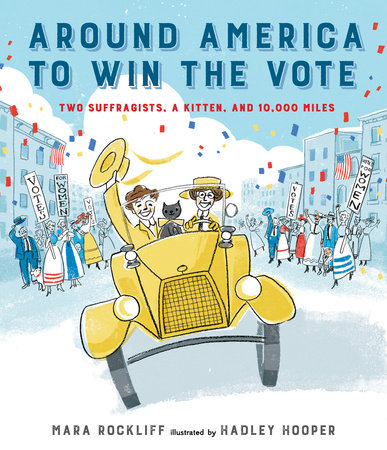
Around America to Win the Vote: Two Suffragists, a Kitten, and 10,000 Miles by Mara Rockliff, illustrated by Hadley Hooper

Published by Candlewick Press 

Summary:  On April 6, 1916, Nell Richardson and Alice Burke drove off from New York City in a little yellow car packed with, among other things, a tiny black kitten.  On September 30, they pulled back into New York City, smiling, sunburned, and with a full-grown cat.  They had circled the United States, driving south out to California and north back to New York, to promote the cause of women’s suffrage.  They got stuck in the mud, drove through a blizzard, and dodged bullets by the Rio Grande.  They attended parties and teas, drove in a circus parade, and won a medal at a fair in California.  It was a remarkable trip, given that the first cross-country car trip had only happened thirteen years before, and these two women doubled that. Each step of the way, they worked tirelessly for their cause, “Votes for women!”  At the end of the journey, Nell stayed home to rest, but Alice boarded a train and began the journey all over again.  The author’s notes give more information about both the drive and women’s struggle to get the vote in the United States; there’s also a list of books for further reading. 40 pages; grades K-3.

Pros:  A great addition to any unit on women’s studies or the right to vote.  The lively text is complemented by the cheerful, predominantly yellow (the color that represented women’s suffrage) illustrations.

Cons:  It seemed kind of icky that the women brought a sewing machine so that if anyone told them women should stay home to cook and sew, Nell would sew while making a speech to prove women could do both.

Living in…Brazil by Chloe Perkins, illustrated by Tom Woolley

Published by Simon and Schuster 

Summary:  Kids will find out what it’s like to live in Brazil, courtesy of an enthusiastic narrator whose home is in Recife, on the coast.  He takes readers on a tour of Brazil, describing its geography, natural features, and some of the cities.  Then he focuses on his own home, giving kids a look at what his typical day is like.  Additional information about Brazil is conveyed through what the narrator learns about in school.  The last page has a picture of the Brazilian flag and some fast facts.  32 pages; grades K-3.

Pros:  Part of a new Living in… series, this book would be enjoyed by kids who like learning about other cultures.  The series would also work well for a classroom research project on different countries.

Cons:  A detailed map of Brazil and some photos would have been nice additions.

Lady Liberty’s Holiday by Jen Arena, illustrated by Matt Hunt

Published by Knopf Books for Young Readers 

Summary:  The Statue of Liberty is feeling blue, even though she’s green.  She’s stiff, achy, and tired of seeing the same skyline every day.  Her friend Moe the pigeon suggests she take a vacation.  So one night, Lady Liberty breaks free of her pedestal and goes on a walking tour of the United States.  She’s delighted by all she sees—from the Jersey shore to the wheat fields of Kansas to the Rocky Mountains to the Golden Gate Bridge.  Unfortunately, she is missed back in her home town of New York City, and, as spring moves into summer, there are rumors that the Fourth of July celebration will be canceled.  Moe goes off in search of his friend, and finds her perched on the edge of the Grand Canyon, feeling small for the first time in her life.  Hearing about the Fourth of July, Lady Liberty rushes home, making it back just in time for a grand fireworks display on the Fourth.  The final two pages tell the story of the Statue of Liberty and some little known facts about her, along with some additional resources.  40 pages; grades K-3.

Pros:  This would make a great introduction to some of America’s famous landmarks, as well as a great Fourth of July read-aloud.

Cons:  Sorry to be reviewing a great Fourth of July read-aloud on August 30.

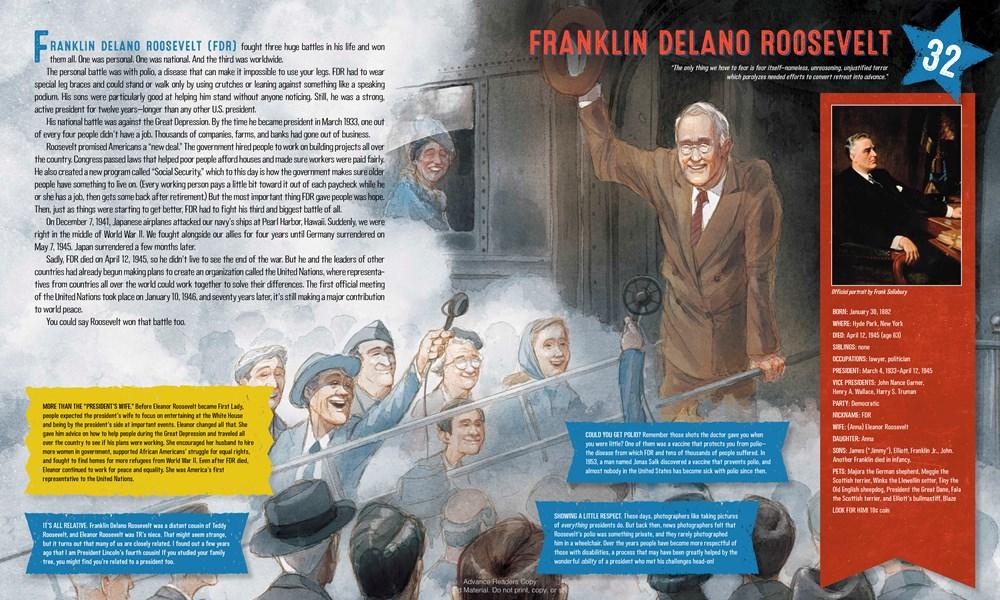
Grover Cleveland, Again! A Treasury of American Presidents by Ken Burns, illustrated by Gerald Kelley

Published by Alfred A. Knopf 

Summary:  Many years ago, Ken Burns used to recite the names of the U.S. presidents to his four daughters.  When he got to #24, the girls would say, “Grover Cleveland, again!”  He resolved then to write a book about the presidents for kids, and we now have the result of that.  Each two-page spread includes a chatty summary of that president’s term in office, a few highlighted facts, and a sidebar with fast facts such as family members, nickname, and pets.  There’s a large illustration covering both pages, plus a portrait at the top of the sidebar.  The last few pages include a glossary and a list of presidential birthplaces, libraries, museums, and historic sites arranged by state.  96 pages; grades 5 and up.

Pros:  This is a great book to browse or read cover to cover.  Burns uses his down-to-earth style to make each president’s history accessible to young readers.  The fast facts would be helpful for report writing.

Cons:  Burns doesn’t always write an unbiased account (Under Calvin Coolidge: “I believe that one of the best things the government can do is help people when their friends and neighbors can’t…”).  An astute reader will probably be able to guess who the author is hoping to write about for President #45.

Brave Like Me by Barbara Kerley

Published by National Geographic Society 

Summary:  What’s it like when your mom or dad has to go overseas to do their job?  Through text and photos, this book explores kids’ feelings and day-to-day lives when their parents are deployed to another country.  The book opens with kids playing with their parents, then sending them off.  There are pictures of children and parents going through their days when they are separated.  The last two pages show the happy hugs of returning soldiers reuniting with their kids.  Back matter includes a map showing where all the photos in the book take place; and information on dealing with separation, who serves overseas from the United States, quotes on being brave, a note for caregivers, and additional resources.  48 pages; ages 4-8.

Pros:  This would be an extremely helpful book for kids whose parents are traveling abroad in any capacity.  The large clear photos and simple text focus more on the kids’ day-to-day lives and their feelings about separation than on the activities their parents are engaged in.

Cons:  Although many overseas workers are mentioned in the section at the end, the photos included are only of military personnel.

Mountain Chef: How One Man Lost His Groceries, Changed His Plans, and Helped Cook Up the National Park Service by Annette Bay Pimentel, illustrated by Rich Lo

 Published by Charlesbridge


Summary:  In 1915, there were eleven national parks, but no service to administer them.  Assistant Secretary of the Interior Stephen Mather knew the country needed one, but couldn’t get through the Washington red tape to set it up.  To convince lawmakers, he organized a two-week camping trip through the mountains of California, and hired Tie Sing, a Chinese American trail cook reputed to be the best.  Tie Sing had his hands full, transporting and preparing such delicacies as frogs’ legs and Lyonnaise potatoes, and serving them on a table set with a tablecloth and fine china.  Along the way, he lost a couple of mules packed with supplies and food, and often had to improvise.  He succeeded in keeping the campers well-fed and happy, though, and the National Parks Service will celebrate its 100th birthday on August 25. Back matter includes more information about Tie Sing, the expedition, and several members of the party.  40 pages; grades 1-5.

Pros:  A fascinating story about a little-known man; Pimentel and Lo have succeeded admirably in bringing to life someone about whom very little is known.  There’s a lot of text, but the story is so engaging that this would make an excellent read-aloud.  As someone who has camped all over the U.S. and Canada, I appreciated Stephen Mather’s philosophy: “Give a man a poor breakfast after he has had a bad night’s sleep and he will not care how fine your scenery is.”

Cons:  It’s my opinion that any activity that involves English plum pudding with brandy sauce, peaches and cream, and a heavy linen tablecloth cannot really be described as “camping”.

Seven and a Half Tons of Steel by Janet Nolan, illustrated by Thomas Gonzalez

Published by Peachtree Publishers 

Summary:  The USS New York is a Navy ship weighing 25,000 tons.  Seven and a half of those tons are made of steel from a most unusual source—the World Trade Center.  After the September 11 destruction of the Twin Towers, work crews removed a steel beam and had it transported from New York to Louisiana.  There it was melted down and molded into a ship’s bow.  The work of building the ship was interrupted by Hurricane Katrina, but eventually, the ship was completed and brought back to New York.  There it was greeted with a twenty-one gun salute before sailing off to do its work at sea.  An author’s note gives more facts about the USS New York and the meaning of the different colors and symbols of its crest. 36 pages; grades 2-5.

Pros:  History buffs, particularly fans of military history, will enjoy learning about the construction of this special ship.  The large, vivid paintings offer plenty of visual details to the story.

Cons:  There are only a few sentences about September 11 and Hurricane Katrina, so kids may need more information on both of these events to truly appreciate this book.