The Monster and the Maze (Monkey King and the World of Myths) by Maple Lam (G. P. Putnam’s Sons Books for Young Readers, 240 pages, grades 3-7). Sun Wukong, or the Monkey King, comes to life in a graphic tale combining Chinese and Greek mythologies. Bold, confident and fearless, the Monkey King sneaks into heaven where he confronts the gods with his request to become one of them. Although he’s a lowly beast, he’s told his wish will be considered if he can go on a quest to slay a monster. Sun Wukong ends up in Crete, on a quest to destroy the legendary Minotaur. When he finds the monster, tough, he learns that he’s not evil and is suffering at the hands of his father, King Aegeus. The Monkey King discovers the problem–an evil spirit has possessed Aegeus–and is able to convince the king to release the spirit and return to his kindly ways, making an impassioned case for beasts and monsters in the process. Sun Wukong’s work may be done in Crete, but it looks like there will be more adventures for him ahead. The two mythologies are woven together seamlessly, making a fun and extremely engaging story. Includes additional information about the mythical characters and an author’s note.
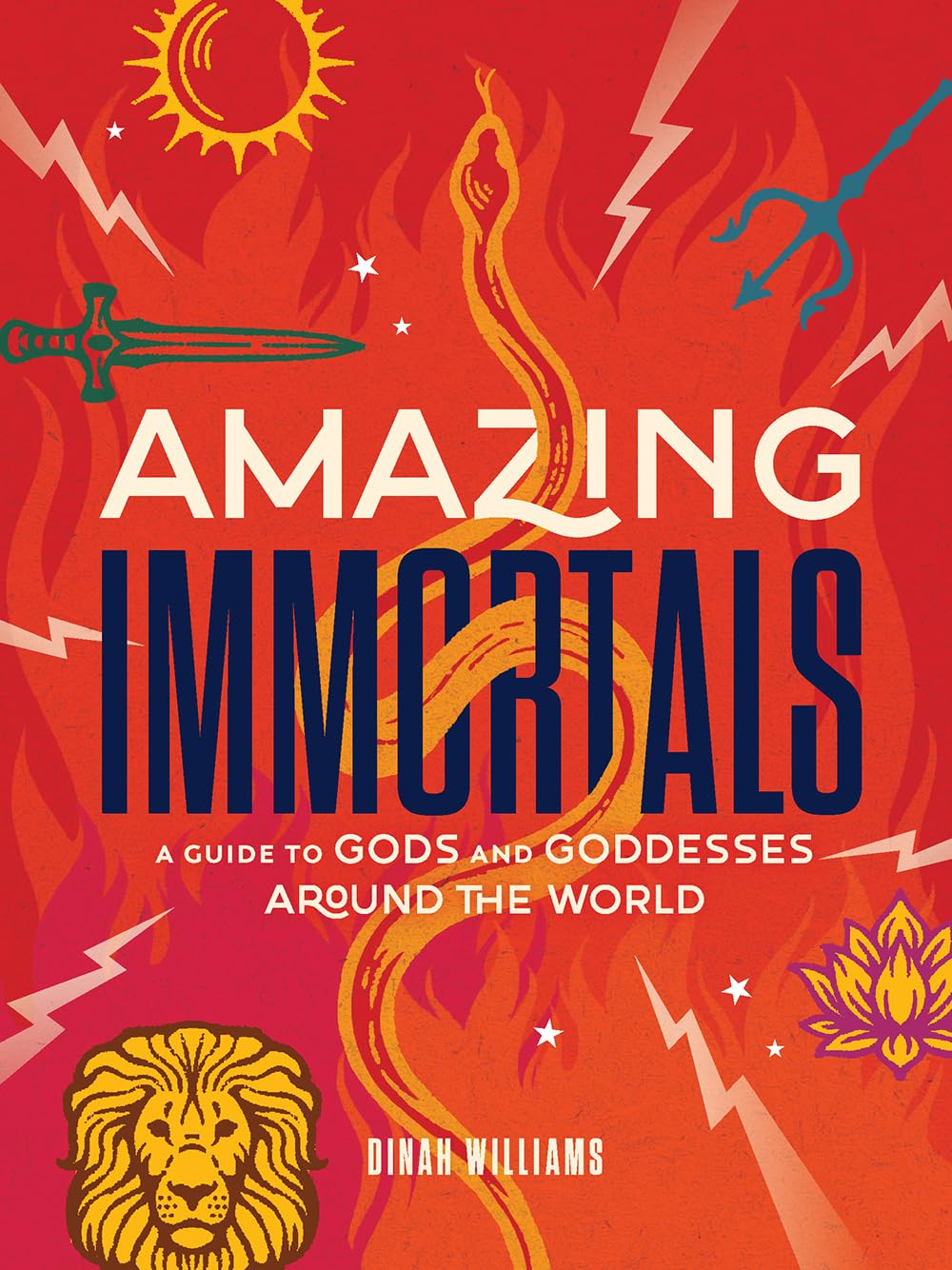
Amazing Immortals: A Guide to Gods and Goddesses Around the World by Dinah Williams (Harry N. Abrams, 208 pages, grades 4-8). Arranged by categories of power (creation, weather, tricksters, etc.), this collection of myths focuses on cultures other than the familiar Greek and Roman ones. Each two-page spread contains a brief retelling of the myth, along with gorgeous color art, created by 17 different artists. The left-hand margin contains information about the country (or region), culture, and era of each myth, which is unfortunately small enough that it took some diligent searching for me to discover. Each myth includes a fun fact or a tie-in to modern times, like Marvel movies or Rick Riordan books. The back matter includes information about the author and artists, as well as an index, a list for further reading, and an extensive bibliography, making this a great starting place for more research. It’s an amazing and visually appealing resource for upper elementary and middle school mythology fans.
Finding Home: Words from Kids Seeking Sanctuary by Gwen Agna and Shelley Rotner, photographed by Shelley Rotner (Clarion Books, 32 pages, ages 4-8). Children and their families from around the world come to the United States seeking sanctuary from war, famine, natural disasters, and other dangers. Many of the photos have cartoon bubbles with kids describing in their own words how they felt when they had to leave their countries, what they miss, and the difficulties and joys in their new homes. There’s additional narrative at the end about how some of the families got to the United States, as well as resources for kids, adults, and parents, caregivers, and educators about how to make families feel welcome.
This book has some personal connections to me, because: 1. the author and photographer live near me, and I have met Shelley Rotner, 2. my Quaker meeting is part of a Circle of Care for one of the families in this book, and 3. my school in Springfield has three classes of refugee kids who have missed at least two years of school due to their circumstances. This book is at just the right level for helping kids (and adults) understand what these families have gone through and to help make them welcome in the U.S.
The Circuit: Graphic Novel by Francisco Jiménez, illustrated by Celia Jacobs (Clarion Books, 240 pages, grades 4-8). Francisco Jiménez’s memoir has been adapted as a graphic novel, telling the story of Francisco as a child, moving with his family from Mexico to California, where they became migrant workers, traveling from one farm to the next to pick cotton, strawberries, grapes, and other crops. Francisco loves to learn, but school is sandwiched between jobs, and his story is a series of losses, as he befriends kids he’ll never see again and loses his precious journal in a fire. There’s enough humor and joy to prevent the story from getting too bleak, and the story feels somewhat timeless, although I think it takes place in the 1940’s. The heart stopping cliffhanger on the last few pages will leave readers like me fervently hoping that more of Jiménez’s books will be published in graphic format.
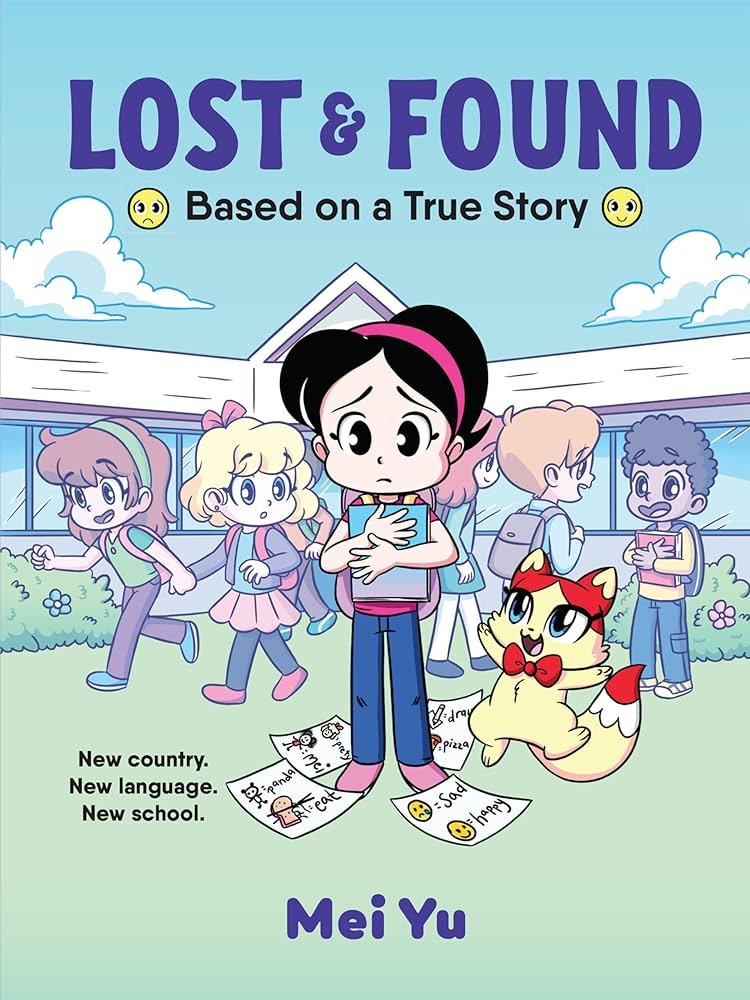
Lost & Found: Based on a True Story by Mei Yu (Union Square Kids, 128 pages, grades 2-5). Mei Yu recounts her memories of moving from China to Canada at a young age (probably six or seven). With English words in a green font, readers can see how few words she understands at school and the scary situations that ensue: using the wrong bathroom, thinking kids are laughing at her, losing her beloved sketchbook. Mei eventually uses the sketchbook to create a collection of English words, and before long, she is able to communicate and begin to make friends. An author’s note gives more information about her experience, as well as a simple glossary of Chinese words. There’s a funny bonus story about how Mei got her beloved toy cat, who appears real to her, a la Calvin and Hobbes.
It’s a pretty simple story, but the difficulties of immigration are presented in a way that beginning readers will be able to understand, and everyone is sure to love the manga-style artwork.
Max in the House of Spies: A Tale of World War II by Adam Gidwitz (Dutton Books for Young Readers, 336 pages, grades 4-7). “Once there was a boy who had two immortal creatures living on his shoulders. This was the fourth most interesting thing about him.” The other things about Max are that he’s a genius, particularly in the mechanical realm, that his parents send him from Berlin to England as part of the Kindertransport in 1939, and that he falls in with some spies, even though he’s only 11. The immortal creatures, a kobold named Berg and a dybbuk named Stein are invisible and inaudible to everyone but Max, which proves both huge help and a terrific nuisance.
Max wants nothing more than to return home and save his parents. Much to his surprise, he ends up living with a Jewish family in London, giving him the chance to observe British antisemitism up close. It’s this family that brings him into contact with the spies, allowing Max to use his genius to get them to agree to send him back to Berlin as a British spy. First there’s an intense training, where it takes every bit of Max’s brains, as well as help from Berg and Stein, to pass to the next level. Finally, Max is ready to go, assigned to be carried in by a paratrooper in the dead of night. That’s as much as I can tell you now, except to assure you that the cliffhanger ending will have you praying that Adam Gidwitz is a speedy writer who can produce book 2 ASAP.
The Enigma Girls: How Ten Teenagers Broke Ciphers, Kept Secrets, and Helped Win World War II by Candace Fleming (Scholastic Focus, 384 pages, grades 5-9). If you’ve seen The Imitation Game, you’re familiar with Bletchley Park, the top-secret British facility where thousands of men and women worked day and night to crack German codes. This book focuses on ten of the young women, many still in their teens, who came to work in various jobs there. Each one had a very specialized task, whether it was translating, indexing, or keeping machines running. The work was absolutely grueling, with rotating eight-hour shifts to keep a 24-hour schedule, and it was top, top secret. Workers couldn’t even discuss what they were doing with those in a different department.
All were motivated by a desire to save lives and win the war, although at one point, one of the women reflects on the fact that saving British lives meant losing German lives. They all put their lives on hold, some for years, to do their important work. When the war ended, the girls went their separate ways, never telling anyone, including spouses and family members, what they had done. It wasn’t until the late 1970’s that some of the secrecy was lifted and stories started to be told. In the 1990’s, what was left of Bletchley Park was restored and opened as a museum. An author’s note and extensive source notes and index are a testament to the research done by Candace Fleming.
Reading these two books caused me to reflect on how World War II is still being mined for stories for all ages, more than any other time period I can think of. It seems like an era that easily lends itself to unambiguous tales of good versus evil. I appreciate how Adam Gidwitz subtly points out the racism and antisemitism that was prevalent in Britain, as well as making a point of England’s centuries of colonialism and empire building that preceded the war, with little concern for indigenous people in the conquered lands. The Enigma Girls is a more straightforward war story, with an interesting emphasis on the importance of women’s work that is often missing (e.g., Christopher Nolan’s Oppenheimer). Ten enigma girls were a lot for me to keep track of, especially since their stories were all woven together, and, although I would have liked to have known each one better, it did emphasize the diversity of backgrounds of those who ended up at Bletchley Park. It’s also unfortunate, although understandable, that not many photos exist of the facility, and Candace Fleming made the decision not to include any of the women’s photos, since she couldn’t find pictures of all of them.
The Last Stand by Antwan Eady, illustrated by Jarrett and Jerome Pumphrey (Knopf Books for Young Readers, 40 pages, ages 4-8). A boy tells the story of his grandfather’s farm stand, the last stand in a community where there used to be a whole farmers’ market. Not only does Papa grow food and sell it at his stand, but he delivers to neighbors who can’t get out. The day comes when Papa is the one who isn’t well enough to go to the stand, and the boy has to use his own resourcefulness to keep the business going. Fast forward a few years, and the last page shows the boy grown, Papa apparently having passed away, and another stand re-opened, offering hope that the market can come back again.
I’m thrilled to see a new book illustrated by the Pumphrey brothers, almost as thrilled as I was when they won a Caldecott Honor this year for There Was a Party for Langston. This story harkens back to my favorite book of theirs, The Old Truck, with its empowering themes of Black farmers surviving despite the odds being stacked against them and passing a legacy down to the next generation. Be sure to read the author’s note to learn more about the struggles of Black farmers, as well as offering an acknowledgement of discrimination against other farmers, including women and Indigenous communities.
Tree of Life: How a Holocaust Sapling Inspired the World by Elisa Boxer, illustrated by Alianna Rozentsveig (Rocky Pond Books, 40 pages, grades 1-4). In the Czechoslovakian ghetto of Terezin, a teacher named Irma Lauscher secretly taught children to read, write, and celebrate Jewish holidays. To help them observe Tu Bishvat (The New Year of the Trees), she obtained a maple sapling, putting herself and the prisoner who got it for her at enormous risk. The children shared their water rations with the sapling, watching it grow, until many of them were “taken away on trains to a place that was even worse.” Miraculously, the tree grew and flourished until the end of the war when it was five feet tall. Eventually it grew to sixty feet, and Irma Lauscher, who also miraculously survived, sent seeds from the tree to places around the globe. When the tree finally died in 2007, there were 600 descendants all over the world, including one planted outside New York City’s Museum of Jewish Heritage in 2021.
Elise Boxer’s author’s note also adds context to this story of brave people finding hope in tragedy, and offers additional information about Terezin, a Nazi propaganda camp that sent most of its inhabitants to Auschwitz. It includes the chilling statistic that 90% of Europe’s Jewish children were killed in the Holocaust, serving as a timely reminder of the horrors of war in which the innocent are victims. I hope this will be a contender for the Sydney Taylor award.
Small Shoes, Great Strides: How Three Brave Girls Opened Doors to School Equality by Vaunda Micheaux Nelson, illustrated by Alex Bostic (Carolrhoda, 40 pages, grades 2-5). Ten minutes before Ruby Bridges entered William Frantz Elementary School on November 14, 1960, three other six-year-old girls, Leona Tate, Tessie Provost, and Gail Etienne, started school across town at McDonogh 19 Public School. Escorted by U. S. Marshals, the girls were in a first-grade class taught by Miss Florence Meyers. Although there were other white students at school that day, they quickly left, leaving the girls as the only three students in the building for the rest of the year.
The girls were heroic, as were their parents, Miss Meyers, and the marshals, who helped them find the courage to keep going and made their first-grade year as normal as possible. Second grade proved a bit easier; after Christmas, about twenty-five new students arrived, and the kids were allowed to go outside for recess. Unfortunately, the girls were sent to a different school the following year, where they experienced bullying, racism, and occasional physical violence from students and even some of the teachers. In the end, the girls “survived and helped change our nation.”
This fascinating book will appeal to kids who are familiar with Ruby Bridges’s story. Leona, Tessie, and Gail were all interviewed for the book, as was one of the surviving U.S. Marshals. The text is quite long, and there’s a ton of back matter: more about school desegregation in New Orleans and Norman Rockwell’s painting based on it, what happened to the three girls when they grew up (two opted for all-Black schools in sixth grade, but all graduated high school, and two finished college.) There are also photos, a glossary, a bibliography, and websites with additional information.
Do You Know Them? Families Lost and Found After the Civil War by Shana Keller, illustrated by Laura Freeman (Atheneum Books for Young Readers, 40 pages, grades 1-4). After the Civil War, Lettie and her Uncle Charlie are searching for lost family members. The newspapers are filled with ads, mostly people seeking information about their families, but occasionally someone reporting that a loved one has been found. Lettie holds on to this hope as she saves her pennies and reads the ads aloud to the congregation at church. Finally, she and Uncle Charlie have saved the fifty cents needed for an ad. Weeks go by, until one Sunday, Lettie is able to share the ad from a woman saying she knows their family. “Hallelujah!” rings out through the church, celebrating with Lettie.
This moving historical fiction story of the post-Civil War years weaves some of the real ads into the narrative (the author’s note at the end tells more about them) and doesn’t shy away from stories that don’t end as happily as Lettie’s. The illustrations are beautiful, incorporating the ads and the pennies Lettie saves into the main pictures.
More Than a Dream: The Radical March on Washington for Jobs and Freedom by Yohuru Williams and Michael G. Long (Farrar, Straus, and Giroux, 272 pages, grades 6 and up). What many Americans know about the 1963 March on Washington begins and ends with Martin Luther King, Jr.’s “I Have a Dream” speech. But the march, the full name of which was the March on Washington for Jobs and Freedom, was much more radical than that one speech might suggest. Impatient with the slow pace of the Kennedy administration to pass even a watered-down civil rights bill, organizers A. Philip Randolph and Bayard Rustin wanted to advocate for more sweeping changes such as school integration, an end to police brutality, and economic justice for all races, including the possibility of replacing capitalism with socialism.
I was fascinated by this story, and there may be extra interest generated from last year’s movie Rustin, about Bayard Rustin, a queer Black Quaker who was an outsider in every way possible, but who never gave up on his vision of justice. Filled with photos, sidebars, and stories of ordinary people who went to incredible lengths to organize and/or attend the march, this is an engaging read, and the 15 pages of notes at the end are a testament to how well-researched it is. If you’re a Kennedy fan, prepare for some disillusionment, such as when Robert Kennedy casually refers to the march as “that old black fairy’s anti-Kennedy demonstration.”
We Are Your Children Too: Black Students, White Supremacists, and the Battle for America’s Schools in Prince Edward County, Virginia by P. O’Connell Pearson (Simon and Schuster Books for Young Readers, 288 pages, grades 5-8). As promised in an earlier post, here’s a more in-depth look at what happened when the Prince Edward County, Virginia public schools closed down for four years to prevent integration. The book starts with a 1951 walkout organized by high school student Barbara Johns to bring attention to the deplorable conditions of her all-Black high school. Her case eventually became part of Brown vs. Board of Education, the Supreme Court ruling that ultimately led to the shutdown of the schools.
While a segregated private academy solved the problem of education for the county’s white residents, Black families scrambled to find a way to send their children to school. Quakers and other activists around the country offered to host kids, while other students lived with relatives or traveled long distances each day. Some tried to get an education through hastily organized schools in homes or churches. But all suffered in some way; even those who graduated from high school usually had to leave their families and go live in unfamiliar communities, often the only Black students in their new schools. And many simply missed the four years of school, leading to poor economic outcomes for them as adults.
Sadly, this felt like reading a blueprint of efforts today to use vouchers and “school choice” to keep schools segregated and to diminish or even eliminate public education. The story is infuriating, and so is the fact that it’s not more widely known about. There’s a lengthy timeline at the end that puts the events of the book into context with what else was happening in the civil rights movement at the time, as well as a bibliography, index, and notes.
Unequal: A Story of America by Michael Eric Dyson and Marc Favreau (Little, Brown Books for Young Readers, 368 pages, grades 7-12). ”This is a book of truth. So we’ll start by telling you the stone-cold fact that there are many people who do not want you to read it.” American history has been whitewashed time and again, the authors state in their prologue, by people who don’t want to “feel victimized or collapse in a puddle of guilt.” True history is important, though, and they relate it in twenty chapters, each opening with a contemporary scene demonstrating that the injustices of the past often continue into the present.
Topics range from school segregation to Jim Crow and lynching to voting rights to police brutality. Each chapter could easily stand on its own to teach a particular topic and tie it to current events. The writers tell their stories compellingly in a way that would undoubtedly engage both middle school and high school students. The final chapter, about Nikole Hannah-Jones and her struggles to teach Black history, would make an excellent introduction to a wide range of history classes. Almost 30 pages of notes and a comprehensive index round out this well-researched book.
I can’t remember how I heard about this book, but somehow I had it in my mind that it was from 2024. After reading it, I discovered it was actually published in 2022, but it’s certainly still timely and having put in the effort to read it, I’m including it with the 2024 books.
With Martin Luther King, Jr. Day in January and Black History Month in February there are always new books about Black history to start the year off. Today, I bring you three nonfiction picture books, but there’s more to come! Stay tuned for some historical fiction and longer nonfiction–even a YA book, as I expand my horizons in the new year.
Fighting With Love: The Legacy of John Lewis by Lesa Cline-Ransome, illustrated by James Ransome (Simon and Schuster/Paula Wiseman Books). This comprehensive look at Lewis’s life begins with John’s Alabama childhood, surrounded by the love of family and church, and continues through his early years of activism, particularly with the Freedom Riders, ending with him about to lead the march across the Edmund Pettus bridge.
The back matter gives some additional information about Lewis’s life, including a timeline, sources, a bibliography, and photos of the author and illustrator with John Lewis. At 48 pages, each with a pretty good chunk of text, it’s a great and thorough biography, although perhaps a tad long for younger listeners. (48 pages, grades 2-5)
When the Schools Shut Down by Yolanda Gladden, as told to Dr. Tamara Pizzoli, illustrated by Keisha Morris (HarperCollins). When Yolanda Gladden was ready to start school, the public schools in her town of Farmville, Virginia were closed. From 1959-1963, Prince Edward County closed its schools to avoid integration, opening a private academy for white children. Black parents scrambled to find ways to educate their children, and Yolanda went to school at First Baptist Church until she was 10 years old, when the public schools finally re-opened. She was at the top of her class and kept the lessons she had learned in resiliency and pride in her heritage. Includes authors’ notes, photos, a timeline, and sources for further reading.
This is an inspiring story about an important–and shocking–chapter of U.S. history that has often been neglected. However, having just finished a longer book on this topic (coming soon in another blog post), I found Yolanda’s story a bit too rosy. The real story is more complicated and didn’t have this happy of an ending for many kids. (40 pages; grades 1-4)
We Dream a World by Yolanda Renee King, illustrated by Nicole Tadgell (Orchard Books). Yolanda Renee King, the only grandchild of Dr. Martin Luther King, Jr. and Coretta Scott King, expresses gratitude to her grandparents for their vision and hard work. She then shares her own dreams for the future, inviting others of her generation to create a better world. Yolanda has been an activist from a young age, as her parents explain in the back matter, describing the 2018 March for Our Lives where she was asked to address the crowd and made an excellent impromptu speech (watch it here). There are plenty of photos in the back matter, too, as well as some information about Martin Luther King, Jr.
It’s an inspiring read that encourages kids to dream and to speak up for what they think is right, all beautifully illustrated with soft watercolors. It would be easy to get some writing prompts from the text, and I can imagine kids being extremely interested in the backmatter with the photos and description of Yolanda’s activism. A little more editing would have served the book well, giving it a sharper focus. (40 pages; grades K-5)
Summary: Even before the Japanese bombed Pearl Harbor, Japanese Americans faced daily racism, but afterward, things got much worse, as families were rounded up and sent to concentration camps. This story profiles four young Nisei (those with Japanese ancestry born in America) who fought back in different ways. Rudy Tokiwa, Fred Shiosaki, and Kata Miho volunteered for the 442nd, a regiment made up entirely of Japanese American men, while Gordon Hirabayashi, a Quaker and conscientious objector, served jail time for refusing to be deported to an internment camp. The story follows the four young men from December 7, 1941 until shortly after the bombings of Hiroshima and Nagasaki and the end of World War II. Includes additional resources, notes, a bibliography, and an index. 240 pages; grades 6-9.
Pros: A fascinating history that shows the courage of so many Japanese Americans during World War II, particularly the young men who were determined to show their loyalty to the United States, even after losing their homes and being sent to internment camps. The 442nd became known as one of the toughest, bravest regiments to fight in Europe.
Cons: I loved Gordon Hirabayashi’s story and was disappointed that it kind of fizzled out once the battle action began about halfway through the book.
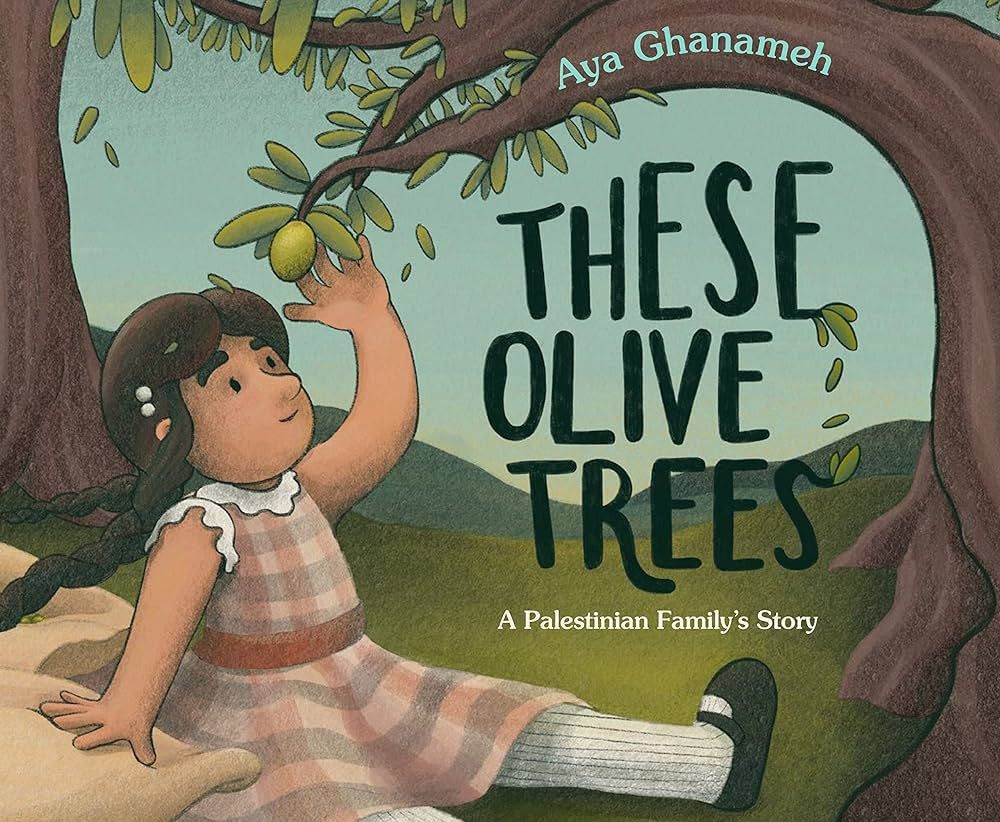
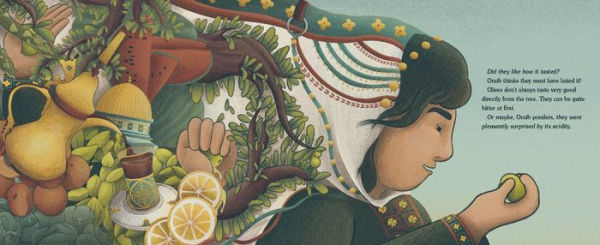
Summary: Oraib and her family live in a refugee camp with olive trees nearby. As she watches her mother curing and brining the olives, she wonders how people first came to eat the bitter fruit. The trees also provide wood and oil for those living in the camp. One day, Oraib sees her mother packing olives and learns that war has come to the region. The family must once again pack up and move, just like her parents did when they were forced to leave their home before Oraib was born. Before leaving, Oraib plants an olive pit, promising that one day she’ll return to harvest the olives. An author’s note tells about her grandmother, the inspiration for Oraib, whose family was displaced from their home in Palestine. Includes photos of the family. 40 pages; grades K-3.
Pros: Beautiful illustrations and a moving story bring to life the plight of a refugee Palestinian family during the 1950’s.
Cons: I was struck by how much this photo in today’s New York Times looks like Oraib’s camp.
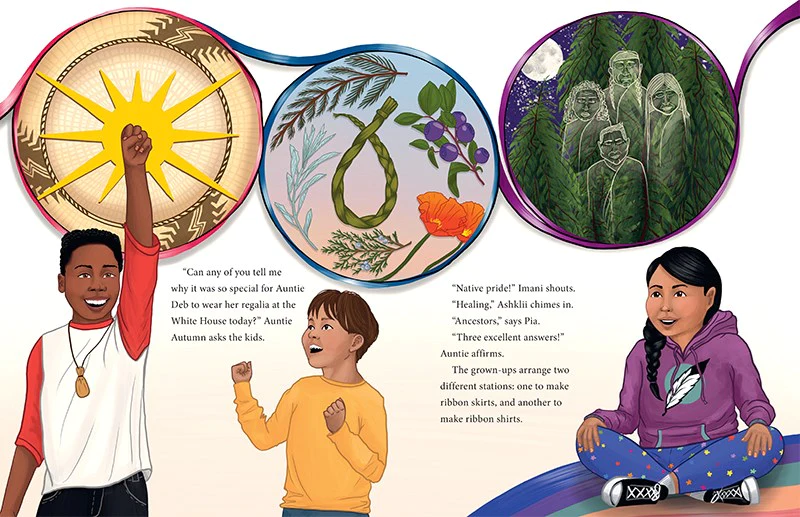
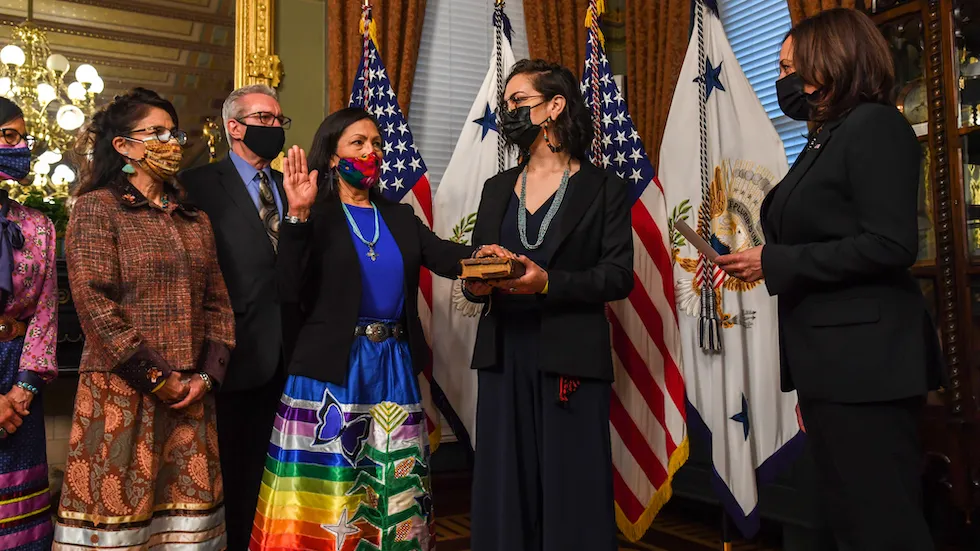
Summary: At the end of the school day, Pia is excited to go to the Native American Center. Everyone is gathered around the TV to watch the inauguration of Deb Haaland as Secretary of the Interior. After the ceremony, there’s a potluck feast, then the adults help the kids make ribbon shirts or ribbon skirts, like the one Auntie Deb wore on TV. As they work, they talk about the significance of the ribbon skirt. When her skirt is done, Pia decides to give it to Jasmin, a new girl at the center, to help her feel welcome. Includes additional information about Deb Haaland, with a photo of her swearing-in ceremony, as well as more about ribbon skirts and suggestions for writing a letter to the government about preserving the environment. 40 pages; ages 4-8.
Pros: Details about Turtle Island indigenous culture (food, prayers, clothing) are woven into this story which also does a good job of introducing Secretary of the Interior Deb Haaland. I liked how the back matter encourages kids to take action.
Cons: It would take me a lot longer than the time shown here to put together a ribbon skirt.