A Kids’ Guide to America’s First Ladies by Kathleen Krull, illustrated by Anna DiVito


Published by HarperCollins
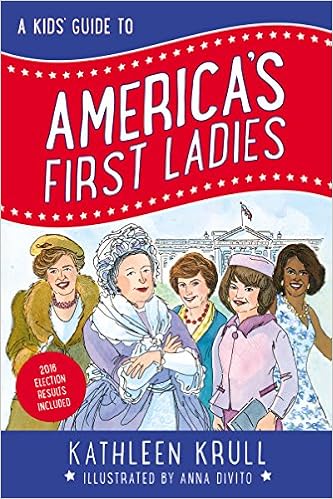
Summary:  Which First Lady raised silkworms in the White House?  Who crocheted 3,500 pairs of slippers while her husband was President?  Kathleen Krull profiles each U.S. President’s wife, including Melania Trump, in 20 chapters.  Some, like Martha Washington, Jackie Kennedy, and Michelle Obama, get their own chapters, while others are put in groups of two to five.  Biographical information is given, along with each woman’s contributions to her husband’s administration.  There are boxes of interesting informational tidbits through each chapter, as well as a “Women Break Through” section that shows what was going on for women at the time.  Two drawings of each First Lady are given, one a portrait-style head shot and the other showing her in the White House.  A final chapter summarizes the role of the First Lady and how it has changed over time.  Includes a list of selected resources and an pretty extensive index. 256 pages; grades 3-7.

Pros:  I read this fascinating book in a single day.  The chapters about lesser-known First Ladies are particularly interesting.  Krull’s writing style is so engaging, the pages just fly by.

Cons:  It seemed odd that there was no mention of Hillary Clinton running for President, given that Melania Trump was profiled.  
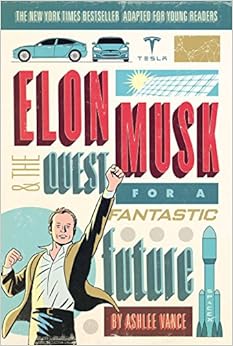
Elon Musk and the Quest for a Fantastic Future (Young readers’ edition) by Ashlee Vance

Published by HarperCollins

Summary:  If you haven’t heard of Elon Musk, maybe you’re familiar with the Tesla electric car.  Or SpaceX, the company that’s sending reusable rockets to the International Space Station at a fraction of NASA’s cost, and is planning how to colonize Mars.  Or maybe you’ve leased some solar panels from SolarCity.  All of these companies have Elon Musk as the driving force behind them.  A brilliant visionary who grew up in South Africa, Musk emigrated to the U.S as a young man, and made his way to Silicon Valley just in time for the dotcom boom.  He got in on the ground floor of PayPal and made a fortune, which he then proceeded to plow back into his companies, determined to create a better, less oil-dependent world.  It’s been a roller coaster ride from multimillion dollar fortune to near bankruptcy and back again as Elon Musk dreams of the impossible…and then proceeds to make those dreams come true.  274 pages; grades 5-8.

Pros:  Musk’s story will inspire technology-loving readers who will be excited to learn it’s possible to save the world and make a lot of money in the process.

Cons:  I glazed over a bit on some of the more technical descriptions.

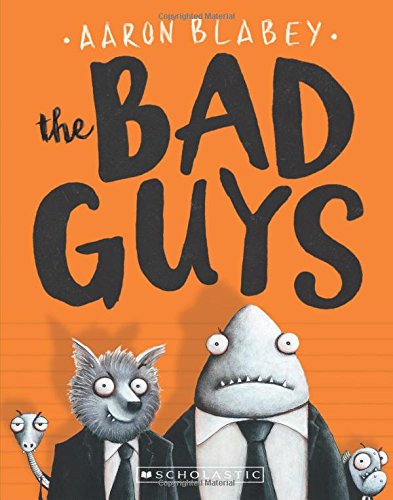
The Bad Guys by Aaron Blabey

Published by Scholastic

Summary:  Mr. Wolf is attemptng to turn over a new leaf, going from Bad Guy to Good Guy.  He tries to recruit a few other reputed Bad Guys to join him: Mr. Snake, Mr. Piranha, and Mr. Shark.  It’s pretty clear these three are okay with being bad, but they reluctantly agree to go along with Mr. Wolf’s plans.  After a crazy rescue of a cat from a tree, they decide to liberate 200 dogs from the local pound.  The plan, involving a flying snake and piranha, a shark in drag, and a love-struck gorilla, eventually succeeds…after a fashion.  In the final chapter, the Bad Guys admit it felt pretty good to be Good Guys, and offer a preview of the next book, in which they will rescue 10,000 chickens from a high-tech cage farm.  144 pages; grades 2-4.

Pros:  Reminiscent of the Bad Kitty chapter book format (almost a graphic novel, with just a few sentences per page, mostly dialogue), this is a guaranteed laugh-out-loud hit for readers of a certain age.  Yes, there’s a fart joke (or two), but even I, a good 40+ years past the target demographic, found the whole thing pretty darn funny.

Cons:  This book was released on December 27, so technically it’s a 2016 book, not 2017.

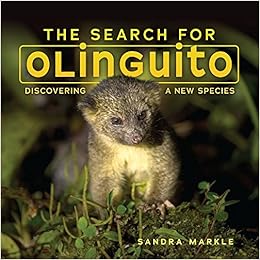
The Search for Olinguito: Discovering a New Species by Sandra Markle

Published by Millbrook Press

Summary:  On August 15, 2013, Kristofer Helgen from the Smithsonian Museum of Natural History announced the discovery of a new mammal called the olinguito.  How was this little animal, a relative of the raccoon and the kinkajou, discovered?  Sandra Markle takes the reader through the preceding decade, during which time Helgen studied pelts and skeletons of an animal called the olingo at museums around the world.  He noticed that some of them were quite different, enough to possibly be a different animal from the olingo.  Eventually, his research led him to the cloud forests of Ecuador and Colombia, where he was able to study the new animal in its habitat, learning enough about it to publish a paper and make his announcement about the new species from the Smithsonian. Includes, glossary, index, and resources to learn more. 40 pages; grades 1-4.

Pros:  An accessible look at science at work, generously illustrated with photographs and maps.  Young scientists will be inspired by the final question: what else is out there?

Cons:  If I discovered a new species based on my knowledge of the olingo, I would come up with a much more original name than olinguito.

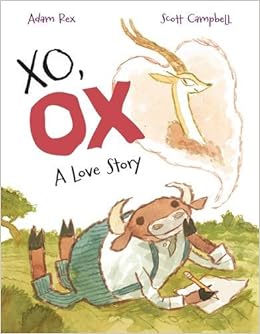
XO, OX: A Love Story by Adam Rex, illustrated by Scott Campbell

Published by Roaring Brook Press

Summary:  Ox has a thing for the beautiful Gazelle, and sends her letters expressing his admiration.  His first two attempts are answered by identical form letters:  (“Dear _Ox_, I hope you understand that I have many admirers and cannot reply to each one personally.”).  Ox can only see the good in Gazelle (“This is an amazing coincidence!  You have written back using the exact same words!”), and no matter how hard she tries to snub him, he won’t be deterred.  When Ox replies yet again, this time with a photo, Gazelle, now completely frustrated, tears up his letter and picture.  But then she pauses, gazing  thoughtfully at the two pieces of the ripped photo.  The final picture shows her sitting on her bed, taped-up Ox photo hanging on the wall, writing, “Dear Ox,”.  40 pages; ages 4-8.

Pros:  A tale of unconditional love, just in time for Valentine’s Day.  Kids will laugh out loud, and will also enjoy speculating about what happens after the final page.

Cons:  The ambiguous ending may bother some readers.

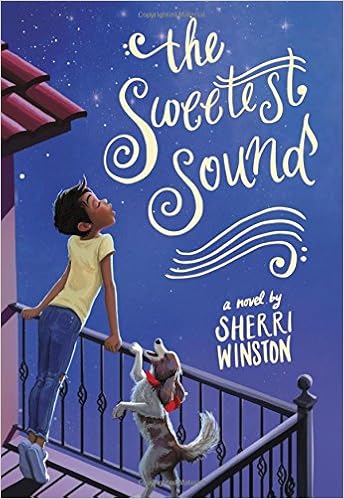
The Sweetest Sound by Sherri Winston

Published by Little, Brown Books for Young Readers

Summary:  Cadence hasn’t enjoyed her birthday since her mother left home the day after she turned 7.  Now she’s about to turn 11, which means she’ll be old enough to make the big move from her church’s Children’s Choir to the Youth Choir…if she can find the courage to audition.  Cadence has a secret: she’s inherited her mother’s beautiful singing voice, but she’s too shy to share it with even her family and closest friends.  Tired of being called Mouse, Cadence struggles to express herself and stand up to her father and friends who mean well but often put their own interests ahead of hers.  After accidentally releasing a video of herself, disguised, singing a gospel song, Cadence becomes an overnight YouTube sensation.  Now she must decide if she’s brave enough to step into the spotlight and let her true self shine.  272 pages; grades 4-7.

Pros:  An upbeat story with a positive message about being yourself, peopled with a fun, culturally diverse cast of characters.

Cons:  Two of her friends’ mothers, one Chinese and one Jewish, are a bit stereotypical.

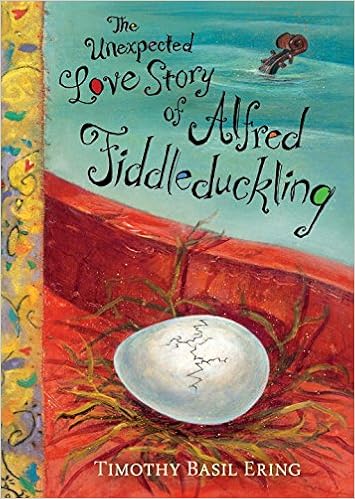
The Unexpected Love Story of Alfred Fiddleduckling by Timothy Basil Ering

Published by Candlewick

Summary:  Captain Alfred is sailing home to his wife with new ducks for their farm and a egg that is ready to hatch stored in his fiddle case.  They’re almost home when they sail straight into a huge storm that washes the egg overboard.  The duckling hatches, and the first thing he sees is the captain’s fiddle bobbing in the water nearby.  Grabbing hold, he realizes that the fiddle makes beautiful sounds, and plays until they are both washed ashore near the captain’s house.  His dog hears the fiddle music, and discovers the duckling, and the two become fast friends.  They try to find their way home through the fog, and once again the music comes to the rescue.  The captain’s wife hears it, and is overjoyed to find her dog, as well as a new friend.  The duckling keeps playing, and the final page shows the captain floating on a raft, paddled by ducks, following the sound of the music.  48 pages; ages 4-8.

Pros:  A whale of a tale, illustrated with beautiful colors that show the color of the music in the gray stormy seascape.

Cons:  That is one ugly dog.

Frederick Douglass: The Lion Who Wrote History by Walter Dean Myers, illustrated by Floyd Cooper

Published by HarperCollins

Summary:  Frederick Douglass was born into slavery in 1818.  Through hard work, determination, and perseverance, he taught himself to read, stood up to a cruel master, and ultimately made a daring escape to the north.  There, he became a noted speaker and writer, publishing his autobiography when he was only 27, and speaking out against slavery and in favor of women’s rights.  As differences between the north and south grew, Douglass was recruited by John Brown to participate in the raid on Harper’s Ferry; he correctly predicted that Brown would fail and chose not to join him.  After the Civil War started, Douglass convinced Lincoln to integrate the Union army.  He continued to serve the government after the war, helping to write American history in many ways.  Includes a timeline and brief bibliography.  40 pages; grades 1-5.

Pros:  An engaging story of Frederick Douglass’s life written by the late award-winning author Walter Dean Myers, and illustrated by Coretta Scott King winner Cooper.

Cons:  Contrary to what President Trump seems to believe, Frederick Douglass is actually dead.

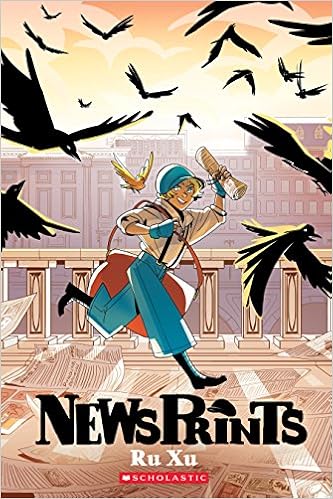
NewsPrints by Ru Xu

Published by Graphix

Summary:  Blue is an orphan who lives at a newspaper office and works as a newsboy…except that she’s really a girl in disguise.  Her country is at war, and only boys are supposed to sell the important newspapers that tell the people what’s going on.  Besides having to keep such a big secret, Blue is happy, enjoying her work and the people she lives for.  Then she meets Jack, a mysterious inventor, and Crow, an even more mysterious boy.  As she slowly learns their secrets, she starts to suspect that the people in her life aren’t always being truthful, and she can’t believe everything she reads in the paper.  By the end of the story, she is ready to reveal the truth about herself and to prepare to take a potentially dangerous trip to help her new friends.  208 pages; grades 4-7.

Pros:  Graphic novel fans will love the latest entry from Scholastic’s popular Graphix imprint.  Blue’s world is filled with intrigue, fascinating characters, and dozens of fairy tale references.  The art will draw readers in; by the end, they will be eagerly anticipating the next installment.

Cons:  There were a lot of characters and storylines to keep track of.

Wolf in the Snow by Matthew Cordell

Published by Feiwel and Friends

Summary:  Before the title page of this wordless winter tale, a girl and a wolf pup are each shown safe at home with their families.  As the story begins, snow is starting to fall as the girl leaves school, wrapped up in a red coat and hood, a scarf around her face. The wolves are also traveling through the snow.  The heavy white curtain causes both girl and pup to lose their way, and they cross paths.  When the girl hears howling, she heads in that direction, hoping to reunite the pup with its family.  She succeeds, but the long detour exhausts her, and she collapses in the snow.  The wolves stay with her, howling to alert her dog to her whereabouts, and at last she is rescued by her parents.  The wolves howl in the distance as she heads home at last.  48 pages; ages 3-8.

Pros:  I do enjoy a good wordless book, and this one satisfies, with a fairly straightforward tale of friendship told through beautiful, snowy illustrations, and a few howls, huffs, and barks.

Cons:  The wolves are much better looking than the humans.