Away by Emil Sher, illustrated by Qin Leng

Published by Groundwood Books
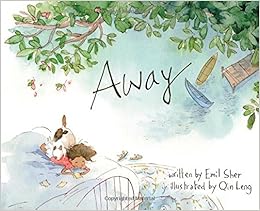
Summary:  A young girl (who could also be a boy, but is referred to as a girl on the book flap) is worried about her first summer at sleepaway camp.  She and her mother have a lot to do before she goes, but they find ways to stay in touch through post-it notes.  The entire story is told through these brief messages.  The girl’s grandmother, Mimsy, arrives, and shows her pictures of her mother crying before she went to camp.  The mom replies that her tears didn’t last, but her memories did.  Finally, the big day arrives, and the girls goes off on the camp bus, with notes from her mother to write and have fun.  The penultimate page shows three post-its with these messages, “So far I have two new friends.  And 3217 enemies [accompanied by a picture of a mosquito].  Next year’s goodbye will be easier!”  And the final page shows the happy girl hugging her mother upon her return.  32 pages, ages 4-7.

Pros:  Kids will want to pore over the busy watercolor illustrations to understand all the details of the story.  The post-it notes are an unusual but effective way to show how a mom stays connected with her daughter despite their busy lives.

Cons:  A notation on the calendar reading “hearing aid battery” made me wonder if one of the main characters had a hearing loss (which would maybe explain all the written communication), but I couldn’t find any other evidence for this.
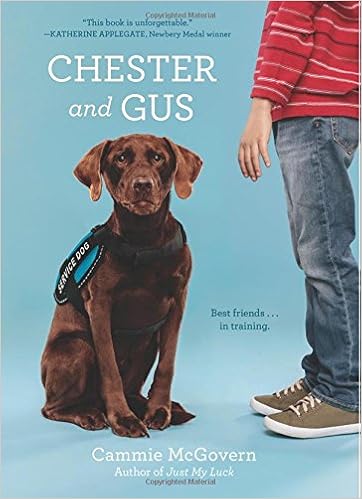
Chester and Gus by Cammie McGovern

Published by HarperCollins

Summary:  Since birth, Chester has aspired to be a service dog like his mother was.  He’s got everything it takes, except that he can’t overcome his fear of loud noises.  When a thunderstorm rolls in on the day service dogs are being chosen, Chester is left behind.  Instead, he is sold to a family with an autistic son, Gus.  Although he is brought into the family as a pet, Chester takes it upon himself to serve Gus.  Gus is almost completely nonverbal, but Chester can occasionally communicate with Gus through their thoughts.  Eventually, Chester is allowed to go to school with Gus, where the dog sees things that the humans are missing.  When the principal discovers Chester isn’t a certified therapy dog, he’s barred from the school, unable to help Gus when he’s beaten up by a bully with no witnesses around.  When Gus starts having seizures, his parents are at their wits’ end, but Chester may have the answer to turn the situation around and move Gus’s life in a positive direction.  272 pages; grades 3-7.

Pros:  Chester is funny and lovable, as one would expect of a dog narrator.  His insights about Gus and his parents will give readers a new understanding of severely autistic kids.  I flew through this book in two days.

Cons:  At times, Chester’s intelligence and communication with Gus strained credulity.  Also, I’m pretty sure dogs can’t perceive what’s on a TV screen to pick up the many lessons about humans that Chester does.

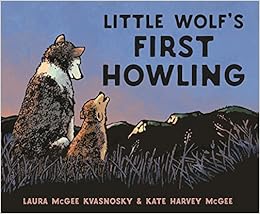
Little Wolf’s First Howling by Laura McGhee Kvasnosky, illustrated by Kate Harvey McGee

Published by Candlewick

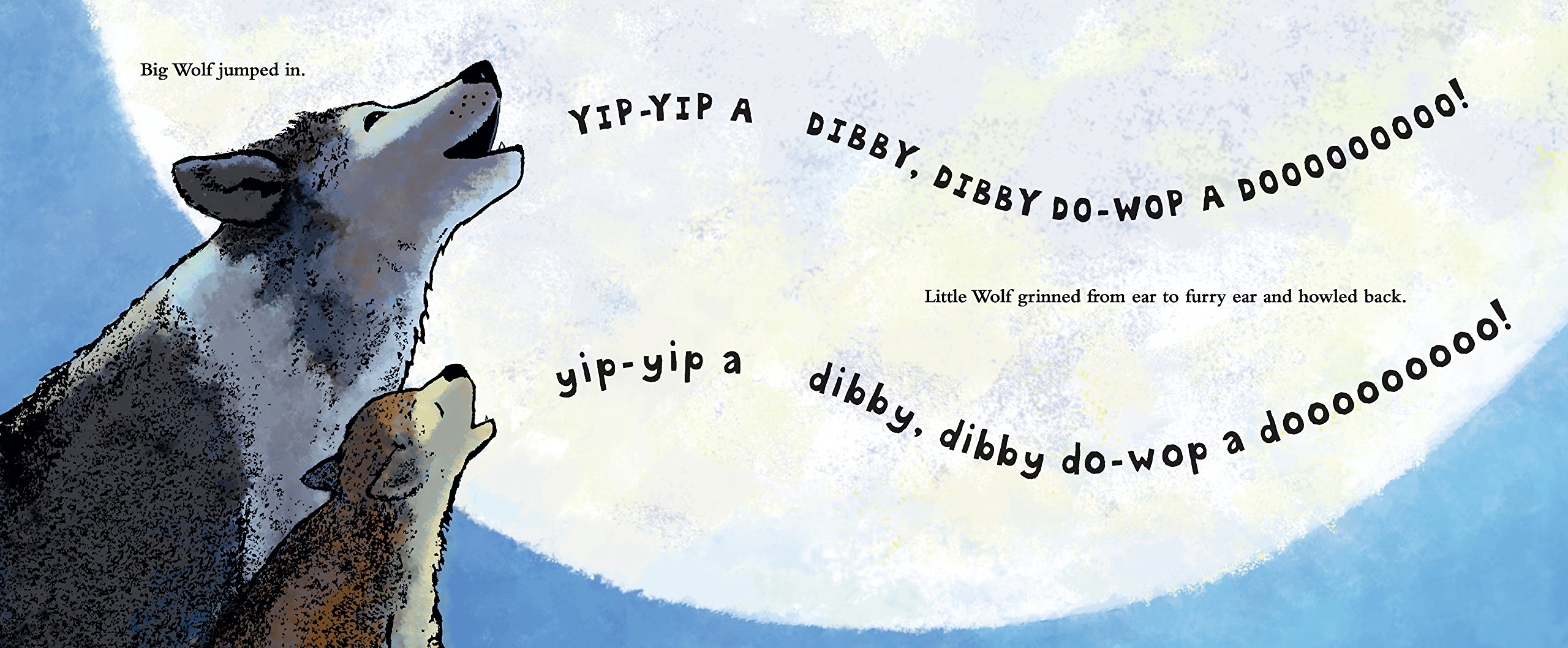
Summary:  It’s a big night for Little Wolf–his first howling.  He and his father, Big Wolf, travel to just the right spot under the stars and a full moon.  Big Wolf demonstrates, “Aaaaaoooooooo!”.  Then Little Wolf tries.  “Aaaaaooooooooo! I’m hoooowling, ‘oooowlng, ooooowling!”  Hmm, not quite.  Big Wolf tries again.  And again.  But each time Little Wolf adds more and more, skiddily skoddily beep bop and some diddily daddily dooooooo.  Big Wolf tells him it’s not proper howling form, and Little Wolf tries one last time.  This time, Big Wolf can’t help himself.  His paws start tapping, and before long he joins in, do-wopping just like his son.  “Wait until we tell the others!” exclaims Little Wolf as they head for home.  “Oh, I expect they already know,” says his father.  32 pages; ages 3-7.

Pros:  The pictures are gorgeous, perfectly capturing the moonlit night and the two beautiful wolves.  The message about self-expression is just right for kids.  And the right reader could have a lot of fun reading those howls.

Cons:  I suspect I’m not the right reader.

The Secret Life of the Red Fox by Laurence Pringle, illustrated by Kate Garchinsky

Published by Boyds Mills Press

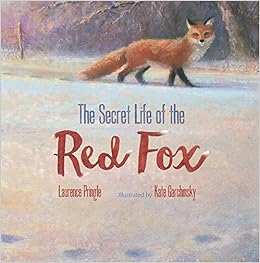
Summary:  A year in the life of Vixen, a female fox.  The reader follows her as she hunts in the snow, pouncing on a mouse in an acrobatic move, and escapes a couple of barking dogs.  She meets up with her mate, and eventually moves into a den.  When spring comes, there are four fox kits in the den.  The grow all summer, and on the last page, they are ready to go off on their own, just as autumn arrives.  There are two pages of additional information about the red fox, plus a brief glossary and bibliography.  32 pages; grades 1-4.

Pros:  The story of Vixen is packed with information about foxes.  Woven into the story are facts about how foxes find food, what they eat, how they take over other animals’ burrows for their dens, and how the parents take care of their babies.  The illustrations are beautiful and add additional information.  There is plenty here for a research report, or simply to satisfy a curious child.

Cons:  I seriously hope I never stumble across a hole in the snow like the one Vixen used as a storage place for her dead mice.

Niko Draws A Feeling by Bob Raczka, illustrations by Simone Shin

Published by 21st Century

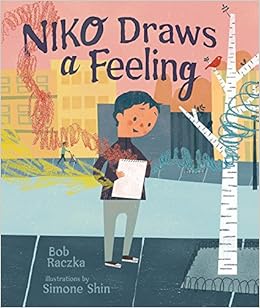
Summary:  Niko loves to draw his feelings.  When he sees something, he tries to capture the way it makes him feel with splashes of color on the paper.  His family and friends don’t understand.  They keep trying to figure out what the object is that he’s drawn.  This makes Niko sad, and he draws that sadness.  Then one day, he meets Iris.  When she asks to see his pictures, Niko is hesitant, afraid she will react like everyone else.  Finally, he takes her to his room, and she looks at all the pictures.  She just looks at first, but when she sees his picture of sadness, she says, “You must have been sad when you drew that picture.”  Nico feels like a window has opened in his brain.  Immediately, he draws a new picture–one that shows how it feels to make a new friend.  32 pages; ages 4-8.

Pros:  A gentle, warm introduction to art, friendship, and being yourself..

Cons:  Young readers may label Niko’s drawings as “scribbling”.

Fish Girl by Donna Jo Napoli and David Wiesner, pictures by David Wiesner

Published by Clarion Books

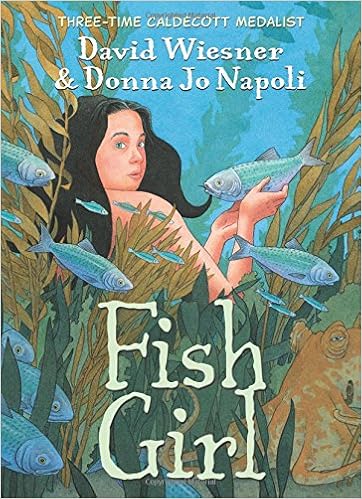
Summary:  Neptune welcomes you to Ocean Wonders, a three-story building that houses a giant aquarium.  Along with the octopus, shark, and fish, there lives a mermaid whom you just might catch a glimpse of if you are patient.  After hours, Neptune tells the fish girl the story of how he rescued her when fishermen and sharks killed off all the other mermaids.  Now he protects her, and in return she hides among the sea flora and fauna, revealing just enough of herself to lure humans into Ocean Wonders.  One day, though, she makes a connection with a girl her own age, who names the fish girl Mira.  The two become friends, and Mira’s world begins to change.  She learns that Neptune is really just an ex-fisherman, who creates his “magic” world with machines.  One night she manages to leave the tank, and learns that her tail becomes legs on dry land of water.  Mira sees her chance to escape, but will she be able to leave behind the aquarium world she has known all her life?  192 pages; grades 5-8.

Pros:  Triple Caldecott medalist David Wiesner creates a fairy-tale world reminiscent of his book Flotsam.  Middle school readers will relate to Mira’s struggle to figure out who she is and where her place in the world is.

Cons:  The relationship between Neptune and Mira borders on creepy.

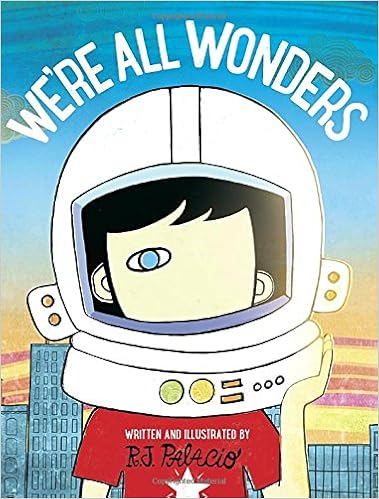
We’re All Wonders written and illustrated by R. J. Palacio

Published by Knopf Books for Young Readers

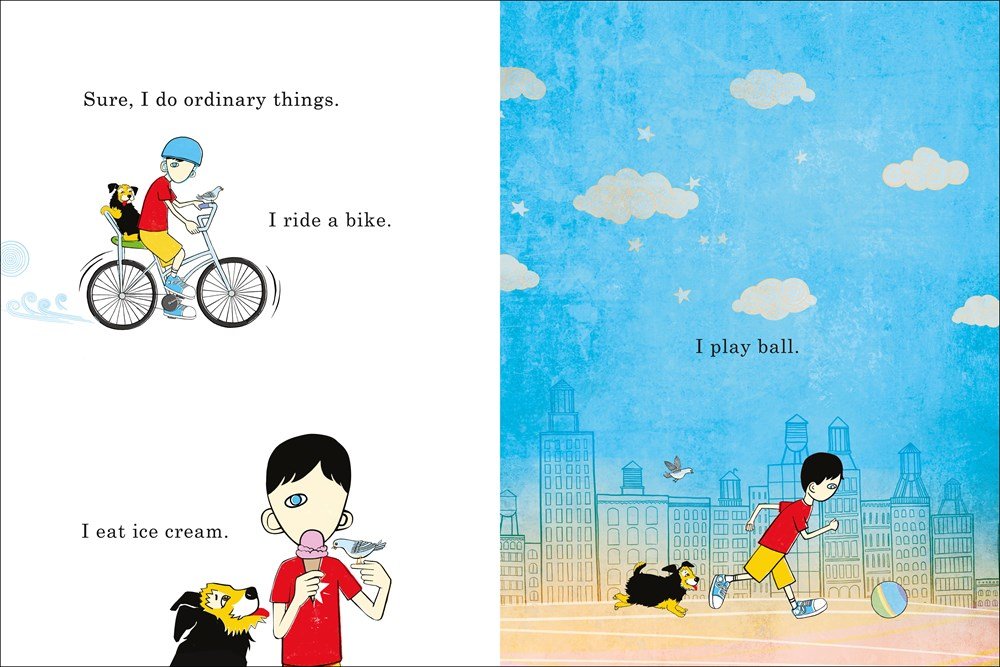
Summary:  Auggie, the protagonist of Palacio’s Wonder, narrates this book, explaining that he is different from other kids.  Even though he does ordinary things like ride a bike and eat ice cream, the way he looks sets him apart and sometimes makes him a target for cruelty.  His mom tells him he’s a wonder, and he’s sure his dog Daisy thinks that he is, too.  When life gets too difficult, Auggie and Daisy pretend to blast off into space and hang out with the aliens on Pluto.  He concludes by stating that if people could see differently, they would realize that he and everyone else in the world are all wonders.  The final illustration shows Auggie making a new friend.  32 pages; ages 4-8.

Pros:  A good introduction to the themes introduced in the longer book. Lots of appeal for younger audiences, particularly with the movie of Wonder coming out in the fall.

Cons:  Will R. J. Palacio eventually write a new story, or will she just have one hit, Wonder? (See what I did there?)

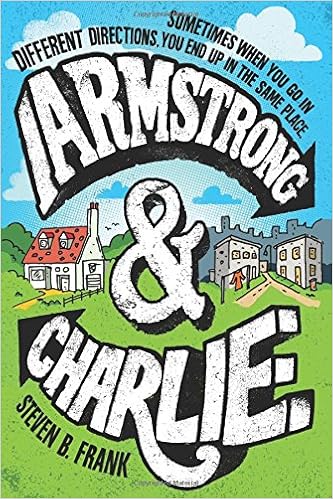
Armstrong & Charlie by Steven B. Frank

Published by HMH Books for Young Readers

Summary:  When “Opportunity Busing” comes to Charlie’s neighborhood school in 1970’s southern California, many of his friends’ parents opt for other schools.  But Charlie’s parents, who have experienced some prejudice against their Jewish faith, choose to keep Charlie at Wonderland.  Some 15 miles away, Armstrong’s parents decide to take advantage of the opportunity, and send their reluctant son to sixth grade at Wonderland.  Told in the alternating voices of the two boys, the story shows the two-steps-forward-one-step-backwards progress of school segregation.  Gradually, the two boys go from sworn enemies to a tentative truce to a close friendship.  Charlie, still hurting from the death of his older brother the previous year, eventually shares his pain with Armstrong, who in turn gives Charlie a taste of what his life in the projects is like.  By the end of sixth grade, they are almost like brothers, unsure if they will see each other again as separate junior high schools loom in their futures.  304 pages; grades 5-8.

Pros:  Both funny and poignant, Armstrong & Charlie grabs the reader immediately with two distinct voices switching off every page or two. With lots of 1970’s era details (how could I have forgotten about click-clacks?), kids will get a taste of what school segregation was and how it affected ordinary kids of both races.

Cons:  While many fifth graders would enjoy this book, be aware that there is quite a bit of profanity, plus detailed discussions of French kissing and spying on naked women, before recommending it to them.

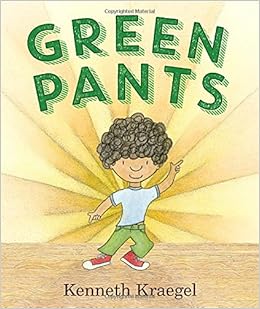
Green Pants by Kenneth Kraegel

Published by Candlewick

Summary:  Jameson refuses to wear anything but green pants, going so far as to wear them exclusively for swimming.  Any attempts by others to foist red or blue pants on him result in blue pants in a tree or red pants on the dog.  Jameson believes he can do anything, as long as he’s wearing his green pants.  So he can’t make up his mind when Uncle Armando and his beautiful fiance Jo invite Jameson to be in their wedding.  He really wants to do it, but one of the requirements is wearing a tuxedo–with black pants.  His indecision persists until moments before the big event.  Finally, with a little help from Jo, he’s able to be in the wedding but still find a way to express himself.  40 pages; ages 3-7.

Pros:  An empowering story for kids who have definite ideas about their likes and dislikes.  The illustrations are funny and pretty cute.

Cons: I’m no fashion expert, but has anyone actually worn green pants since Mr. Green Jeans hung out with Captain Kangaroo?

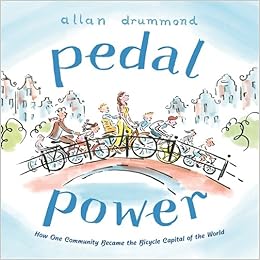
Pedal Power: How One Community Became the Bicycle Capital of the World by Allen Drummond

Published by Farrar, Straus, and Giroux

Summary:  Forty years ago, the Dutch city of Amsterdam had streets clogged with traffic, dangerous to anyone attempting to ride a bicycle.  How did it become the capital city of bicyclists, home to more bikes than cars?  Back in the 1970’s a young mother named Maartje Rutten watched beautiful old buildings being destroyed to make room for more highways, roads that were dangerous for her and friends who wanted to bicycle with their kids.  She began organizing protests, blocking the roads with demonstrations and even parties.  The fun turned serious when she met Vic Langenhoff, a reporter whose young daughter was killed by a car while biking to school.  The two joined forces, and their steady pressure on the government resulted in fewer cars, more bicycles, and safer streets.  Amsterdam has served as a model for making streets bike-friendly in other cities around the world like Tokyo and New York.  An author’s note tells more about Maartje Rutten and her campaign and gives a brief bibliography.  Great cyclists from around the world are shown on the endpapers.  40 pages; ages 4-10.

Pros:  Just in time for Earth Day, another inspiring environmental story from Allen Drummond, nicely illustrated with his cartoon-style watercolors.

Cons:  Kids may have to be led to this book, as the subject matter might not grab them right away.