Waylon! One Awesome Thing by Sara Pennypacker, illustrated by Marla Frazee

Published by Disney Hyperion


Summary: Waylon’s finding fourth grade tough, both at school and at home. In school, Arlo Brody, the kid everyone wants to be like, has decided that the boys should be divided into two teams. Waylon just wants to be friends with all the kids, but Arlo says the teams are at war. A new boy, Baxter, who might be a criminal, seems to want to hang out with Waylon. Meanwhile, Neon (Waylon’s 14-year-old sister formerly known as Charlotte) has taken to wearing all black and locking herself into her room. Waylon’s passion is science, but even his best ideas can’t help him figure out the people around him. When he learns the word isthmus in geography class, he decides that’s what he has to be—the bridge between friends and family members who seem to be living in two different countries. A happy almost-ending is in store for everyone—until the final end raises a big question that will surely need a sequel to resolve. 208 pages; grades 1-4.

Pros: Clementine’s classmate gets a story of his own, with the Sara Pennypacker-Marla Frazee team produces a book every bit as winning as their first series.

Cons: See pages 12 and 13 for some pretty egregious typos.

Place Value by David A. Adler, illustrated by Edward Miller

Published by Holiday House

Summary:  A group of cooking monkeys demonstrate how place value works.  Starting with the concept of using 26 letters to make up words, they show how ten digits make up numbers.  Just as rearranging letters gives words different meanings, so does moving around the digits in large numbers.  The concept of place value to show ones, tens, hundreds, and on up is introduced and reinforced with several examples.  A brief history of the Hindu-Arabic number system and its basis in the number ten is given.  There are also explanations of the comma in large numbers and the decimal point, with a brief explanation of numbers to the right of the decimal.  32 pages; grades K-4.

Pros:  A fun introduction to an important mathematical concept.  The illustrations add a light touch.

Cons:  The information about decimals may be a bit too much for kids just learning about place value.

The Forest Feast for Kids: Colorful Vegetarian Recipes That Are Simple to Make by Erin Gleeson

Published by Abrams Books for Young Readers 

Summary: The subtitle says it all…this collection of vegetarian recipes are all healthy, colorful, and simple to make. Recipes are divided into sections: snacks, drinks, salads, meals, sweets, and parties. Introductory material includes definitions of cooking terms, measurements, and illustrated guides to kitchen tools and prep techniques. Every recipe is accompanied by labeled photos of each ingredient, as well as a full-page color picture of the final product. 112 pages; ages 6-12.

Pros: Erin Gleeson is a former New York Times food photographer, so the pictures are gorgeous. Recipes are simple and healthy, with plenty of tips to help young chefs find their way around the kitchen. Some of the recipes require a bit more of an adventurous palate than others…more power to you if you can get your 6-year-old to eat kale and black bean tacos.

Cons: According to Amazon reviewers, there are a lot of repeat recipes in this book from the original The Forest Feast cookbook.

The Remarkable Journey of Charlie Price by Jennifer Maschari

Published by Balzer + Bray 

Summary: Charlie’s had more to handle in the last year than any 12-year-old should have to deal with. Not only has his mother died of cancer, but his best friend Frank has disappeared. His dad is working all the time, leaving Charlie to try to help his younger sister Imogen. When Imogen starts acting strange and talking about visiting Mom, Charlie investigates and finds a trapdoor under Imogen’s bed. When he climbs down, he finds himself back in his own house…only Mom is alive in this house. He spends a wonderful evening with her and Imogen, feasting on Mom’s famous spaghetti. Returning to the house without Mom is almost impossibly difficult, though, and much to his dismay, Charlie discovers he has lost his memory of ever eating spaghetti with his family. On the next trip back, Charlie thinks he catches a glimpse of Frank walking with his deceased grandmother. Charlie is drawn to go back with Imogen, but what price will they pay for their visits? And is it too late for Frank to ever return? 304 pages; grades 4-7.

Pros: Wow, it can’t be easy to write a book about a deceased parent that includes a courageous cast of kid characters and a hopeful ending, but Jennifer Maschari has nailed it on her first try. There’s also a trace of Coraline-like creepiness that will draw kids in to the story. And a cute, heroic, slightly magical dog is the cherry on top.

Cons: This book tackles a bunch of difficult themes that kids may appreciate more with some adult guidance.

On the Farm, At the Market by G. Brian Karas

Published by Henry Holt and Company

Summary:  Where does all that yummy food at the farmers’ market come from?  This book goes behind the scenes to a farm, a dairy, and a mushroom grower to see what happens the night before market day.  Everyone is busy into the night, harvesting, cooking, and packing.  Early in the morning, the food is transported and unpacked, and then the fun begins.  Chef Amy from the Busy Bee Cafe makes her usual rounds, selecting fresh food for the evening’s special.  At the end of the day, all of the farmers and their helpers head over to the cafe to relax and enjoy the fruits (and veggies) of their labors.  40 pages; grades K-3.

Pros:  Kids who have never gone to a farmers’ market will want to check one out after reading this book; those who are regulars will want to thank the farmers for their hard work creating all that delicious food.

Cons:  The Amazing Cheese Dairy Farm seems to be flirting with some child labor law violations.

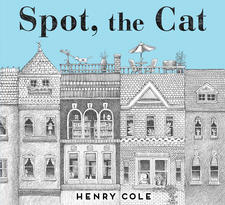
Spot, the Cat by Henry Cole

Published by Simon and Schuster 

Can you spot the cat?

Summary:  Spot the Cat sees a bird through the open window.  The temptation is too great; he jumps out and is off, into the city.  His boy discovers he’s missing and makes flyers on his computer while Spot continues his adventures.  The boy goes out looking for him.  Connections are missed.  Finally, the boy gives up and comes home only to discover, to his delight, that Spot is at his window, home again.  32 pages; ages 4-8.

Pros:  The title of this wordless picture book has a double meaning.  Readers must spot Spot the cat on every page of detailed black and white illustrations.  There is often a spotted dog or some other decoy.  The pictures are beautifully drawn, and children will enjoy studying them.

Cons:  Be sure to allow plenty of time with this book.  I tried to rush it a little, and my heart would sink every time I turned a page and felt compelled to stop until I had spotted Spot.

Will’s Words: How William Shakespeare Changed the Way You Talk by Jane Sutcliffe, illustrated by John Shelley

Published by Charlesbridge 

Summary: A letter from the author at the beginning of the book tells her dilemma: in trying to tell the story of William Shakespeare and the Globe Theater, she kept running into Will’s words. Shakespeare created and/or popularized so many words and phrases that it’s almost impossible to tell a story without using some of them. She then proceeds with her original task on the left-hand pages, bolding Will’s words. The right-hand pages explain the history of those words and where they appear in Shakespeare’s plays. A final author’s letter tells a bit more about William Shakespeare, mostly how little we know of him. A time line and bibliography are also included at the end. 40 pages; grades 3-6.

Pros: A nice introduction to Shakespeare’s plays and the Globe Theater, with the added element of looking at the impact these plays had on the English language. The illustrations do a wonderful job of conveying the enthusiastic audiences crowded into the theater and the exuberant actors preparing and performing the shows.

Cons: Although this book is targeted to an elementary audience, I couldn’t help feeling it would be more appreciate by older students studying Shakespeare’s works.

Fluffy Strikes Back by Ashley Spires

Published by Kids Can Press 

Summary: Fluffy is the lead cat of P.U.R.S.T. (Pets of the Universe Ready for Space Travel). Although he used to work out in the field, he now spends his days behind a desk five stories underground, protecting the humans and pets of the world from aliens. But one day, those aliens (insects) invade P.U.R.S.T. headquarters, and Fluffy has to spring back into action to defeat them. It’s a tough job, but with the help of his right-hand cat and chief engineer guinea pig (hamster?), Fluffy is able to get the job done. 72 pages; grades 1-4.

Pros: A fun beginning graphic novel; not too much text, but plenty of cat action.

Cons: A bit of bathroom—or rather, litter box–humor.


The Secret Subway by Shana Corey, illustrated by Red Nose Studio

Published by Schwartz and Wade

Summary:  New York City in the 1860’s had a horrendous traffic problem.  Alfred Ely Beach thought he had a solution: build an underground tunnel and send a train through the tunnel to transport people in a way that would keep them off the street.  Unable to get approval for his project, he pretended he was constructing a pneumatic mail tube under the city.  In reality, he was creating a tunnel big enough for a train.  In just two months, he built the first subway, unveiling his invention to the public on February 26, 1870.  People loved his train at first, but eventually the novelty wore off, and it would be decades before the rest of New York City caught up with Beach and built the present-day subway.  40 pages; ages 4-9.

Pros:  The story is well-told, and will appeal to fans of trains and other inventions.  The real marvel of this book are the multimedia pictures which are a cross between Claymation and Hanna Barbera animation.  The illustrations will sell this book to many readers.

Cons:  I thought Beach had created the subway used in New York today, so it was a bit of an anticlimax to learn his invention never really took off.


Clean Sweep! Frank Zamboni’s Ice Machine by Monica Kulling, illustrated by Renne Benoit

Published by Tundra Books


Summary:  Anyone who’s ever gone ice skating, or watched a sports event that took place on ice, has observed the giant Zamboni machine that drives around the rink and quickly resurfaces the ice.  But 70 years ago, there was no machine, and it took several men 90 minutes or more for that ice treatment.  And for Frank Zamboni, owner of the Iceland rink in California, that was too many man hours.  Fortunately, Frank was a tinkerer who knew a lot about machinery.  He had come up with an innovative way to design Iceland that resulted in smoother ice than other rinks.  Nine years passed, as Frank got busy raising a family and was shut down from working on his machine during World War II.  Many people said what he was trying to do was impossible, but he persevered.  In 1949, his machine took to the ice, and did in minutes what had previously taken over an hour.  Frank named his new machine after himself, which is good, because it’s so much fun to say “Zamboni”.  Today, Zamboni machines are on every continent…except the ice-covered continent of Antarctica.  32 pages; grades K-4.

Pros:  The story of an ordinary man who saw a problem, persevered, and succeeded in solving it.  This would be a great book to include in a unit on inventors and inventions.

Cons:  The poem at the beginning about ice skating is cute but seems sort of unnecessary.