Jazz Day: The Making of a Famous Photograph by Roxanne Orgill, illustrated by Francis Vallejo

Published by Candlewick


Summary: In 1958, graphic designer Art Kane sold Esquire on the idea of taking a picture of as many jazz musicians as he could gather together. Looking for the perfect backdrop, he traveled to Harlem, where he spent a full day seeking the brownstone he wanted to use for the shot. Although he wasn’t a professional photographer, Kane got his photo of 57 jazz musicians, now known as Harlem 1958. This book tells the history of that day through poems about Kane and some of his subjects. Thelonius Monk was an hour late because he was picking out the perfect outfit to wear. Count Bassie explains many of the musicians’ nicknames, including his own. “There’s A Hole in the Picture” recounts the reason Duke Ellington is missing from the photo (he was on the road). Other poems are about lesser-known performers, as well as some of the Harlem kids who ended up in the photo, lining up in the front row or peeking out the windows of the house. An oversized page near the end unfolds to finally reveal the photograph. Back matter includes an extensive author’s note, an outline picture identifying all the musicians, thumbnail biographies of all the subjects of the poems, and a huge bibliography. 66 pages; grades 4-7.

Pros: This carefully researched, beautifully illustrated collection of poems requires a slow reading. Readers will find themselves flipping between the poems, the photo, and the back matter. 66 pages jam-packed with information, presented with enormous artistic flair.

Cons: It’s difficult to know who the audience would be for this book. Most kids in grades 4-7 won’t have the context to really appreciate it, yet clearly it’s written for an upper elementary/middle school reader.
 

Daniel Finds a Poem by Micha Archer

Published by Nancy Paulsen Books 

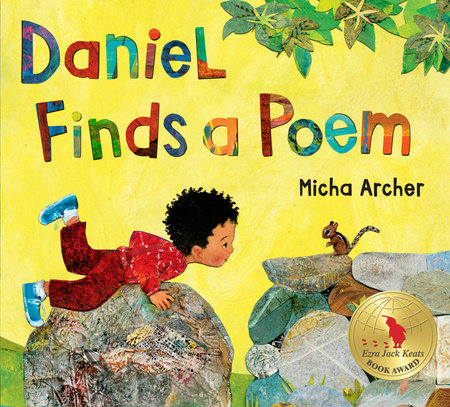
Summary:  Daniel is an observant boy.  He knows all the rocks, trees, and animals in the park.  One day he sees a sign advertising “Poetry in the Park” for the following Sunday.  Unsure about what poetry is, Daniel starts to ask his animal friends.  The spider says poetry is when the morning dew glistens.  Squirrel’s answer is it’s when crispy leaves crunch.  Frog tells him poetry is a cool pool to dive into.  By the time Sunday arrives, Daniel has enough answers to be able to put them all together into one poem.  On the way home, he sees the sunset reflected in the pond, and knows he has the seed for a new poem.  32 pages; grades K-3.

Pros:  A simple and beautiful introduction to poetic language and the creation of poetry.  The colorful illustrations are pretty poetic themselves.

Cons:  The concept may be a bit abstract for the intended audience.


How to Put Your Parents to Bed by Mylisa Larsen, illustrated by Babette Cole

Published by Katherine Tegen Books 

Summary:  Those parents!  Just when you’re ready for bed, they’re more wide awake than ever.  You try getting them in their pajamas, making sure they’ve brushed their teeth, and reading them bedtime stories, but they still want to have pillow fights, watch TV, or stay on their cell phones.  You know they’re tired, but they insist on getting distracted by every little thing.  When you finally get them settled, and are ready for some time to yourself, you’re so exhausted, you can’t stay awake another minute.  32 pages; ages 4-8.

Pros:  Kids will howl with laughter at both the goofy illustrations and the crazy text that turn the whole bedtime routine on its head.  This would make a good beginner mentor text for procedural writing.

Cons:  I could have lived without the underwear scene.  Although those under the age of ten will love it.

Green City: How One Community Survived a Tornado and Rebuilt for a Sustainable Future by Allan Drummond

Published by Farrar Straus Giroux 

Summary: When a tornado hit Greensburg, Kansas in 2007, so much of the city was destroyed that  townspeople questioned whether it should be rebuilt at all.  But some forward-thinking residents decided to create a new community.  Not only would the houses and commercial buildings be tornado-proof, but they would be as energy efficient and green as possible.  Donations came in from all across the country, and people in neighboring communities helped design and build the new town.  It took a few years, and some former residents didn’t want to wait, or couldn’t afford to.  But about 800 of the 1400 townspeople stuck it out, and today they live in one of America’s greenest cities.  Back matter includes an author’s note and tips for going green.  40 pages; grades K-4.

Pros:  Busy, colorful illustrations show the many steps of planning and creating a new town.  The anonymous child narrator tells the story in a chatty, optimistic voice.  Sidebars give more information on green living and construction.

Cons:  The idea of an entire town being destroyed in just a few minutes.

My Life in Pictures written and illustrated by Deborah Zemke

Published by Penguin Young Readers Group


Summary:  Bea Garcia likes to draw pictures of everything in her life.  She keeps her drawings in a book she calls—you guessed it—My Life in Pictures.  She has pictures of her mom and dad, pictures of her little brother Pablo, a.k.a. The Big Pest, and pictures of her best friend Yvonne, who, sadly, has just moved to Australia.  Yvonne’s house next door is empty, but not for long.  Pretty soon a new family moves in with a boy just Bea’s age—or is he really a monster?  Bert, a.k.a. Burp, ends up in Bea’s class, and she’s pretty sure nothing can be worse than the first day of school…until she gets to the second day.  Just when it seems like disaster is about to strike, Bea’s book of pictures winds up saving the day.  134 pages; ages 6-9.

Pros:  Bea is a likeable character with realistic-sounding problems and a spunky attitude to handle them.  The heavily illustrated text will make this a good choice for readers transitioning to longer chapter books.

Cons:  I was a bit disturbed that Bea’s teacher showed her artwork to the whole class without first asking her permission.

Fearless Flyer: Ruth Law and Her Flying Machine by Heather Lang, illustrated by Raul Colon

Published by Calkins Creek


Summary:  Ruth Law loved to entertain crowds with her daredevil flying, but after four years of shows, she was ready for a new challenge.  In 1916, she decided to fly from Chicago to New York City, which would set a new American record for nonstop flight.  Although she had never flown more than 25 miles, Ruth was a mechanical whiz, and set about modifying her plane to get it ready for the journey.  She also cut a map into strips and put it on a roller.  She had to have both hands on the controls at all times, but managed to maneuver one control with her knee when she had to turn the roller and find her way.  (Kind of like those drivers who talk on their phones with one hand and hold their Slurpees in the other)  Flying in a 50-mile-per-hour late November wind, she made it as far as Haskell, NY before she ran out of gas.  That was enough for a new record, though, and the next day she landed in New York City, gliding past the Statue of Liberty before landing in the midst of a cheering crowd.  Grades 1-4.

Pros:  Heather Lang tells a fascinating story of an early aviation pioneer, with relevant quotes from Law interspersed throughout the text.  The illustrations capture the feel of flying in a primitive airplane, low enough to the ground to be able to navigate with a map.

Cons:  This is mostly the story of a single flight, not a complete biography of Ruth Law.

Wet Cement: A Mix of Concrete Poems by Bob Raczka

Published by Roaring Brook Press 


Summary:  “A poet uses words like colors to paint pictures inside your head,” says Bob Raczka in his introduction.  “In concrete poems, or shape poems, the words also paint pictures on the page.”  In each of these 21 concrete poems, the title is a single word, and the poem is only a few more lines.  Together they create an image, both concretely on the page, and more abstractly, in the reader’s mind.  For example, “Clock” is written with a capital L superimposed over the O to make it look like a clock.  The poem, “The clock on the wall says it’s five ‘til three, but the kids in my class say it’s five ‘til free” is written in lines going out from a center point, also resembling a clock.  Even the table of contents and copyright information are written in new ways for readers to enjoy.  48 pages; grades 2-6

Pros:  These poems make fun use of wordplay.  Kids will enjoy reading them and maybe even trying their own.

Cons:  You’ll need to be able to read backwards and upside down for some of the poems.

All Rise for the Honorable Perry T. Cook by Leslie Connor

Published by Katherine Tegen Books 

Summary:  11-year-old Perry Cook has grown up in an unusual home—the Blue River Coed Correctional Facility in Surprise, Nebraska, where his mother, Jessica, is serving a sentence for manslaughter.  Perry was born in prison, and the kind warden there has served as his foster parent, allowing him to grow up near his mother.  He leaves each day to go to school, where his best friend is Zoey Samuels.  Perry loves his life, but a new district attorney changes everything.  Convinced that prison is no place for a child, Thomas VanLeer not only postpones Jessica’s parole hearing, but insists that Perry be placed in a real home…namely VanLeer’s.  It turns out Thomas VanLeer is Zoey’s stepfather, and Perry finds himself living in his friend’s home.  Using the coping skills he’s learned from the other prison inmates, he works hard to stay upbeat, and focuses on a school project collecting the stories of how his friends ended up in jail.  This eventually leads him to learn more about his mother’s own story, and makes him more determined than ever to find a way for the two of them to be together again in their own home…on the outside.  380 pages; grades 4-7.

Pros:  A heartfelt and engaging story about a spunky protagonist who is able to rise above his circumstances to do what he thinks is best.  Although the prison setting is somewhat unrealistic, the characters are well-developed, and are motivated by trying to do the right thing…even when they aren’t really sure what that is.

Cons:  The story could be enjoyed by a third- or fourth-grader, but the almost 400-page length may be a big daunting.

The Night Gardener by Terry Fan, illustrated by Eric Fan

Published by Simon and Schuster Books for Young Readers 

Amazon.com: The Night Gardener: 9781481439787: Fan, Terry, Fan, Eric, Fan,  Terry, Fan, Eric: Books

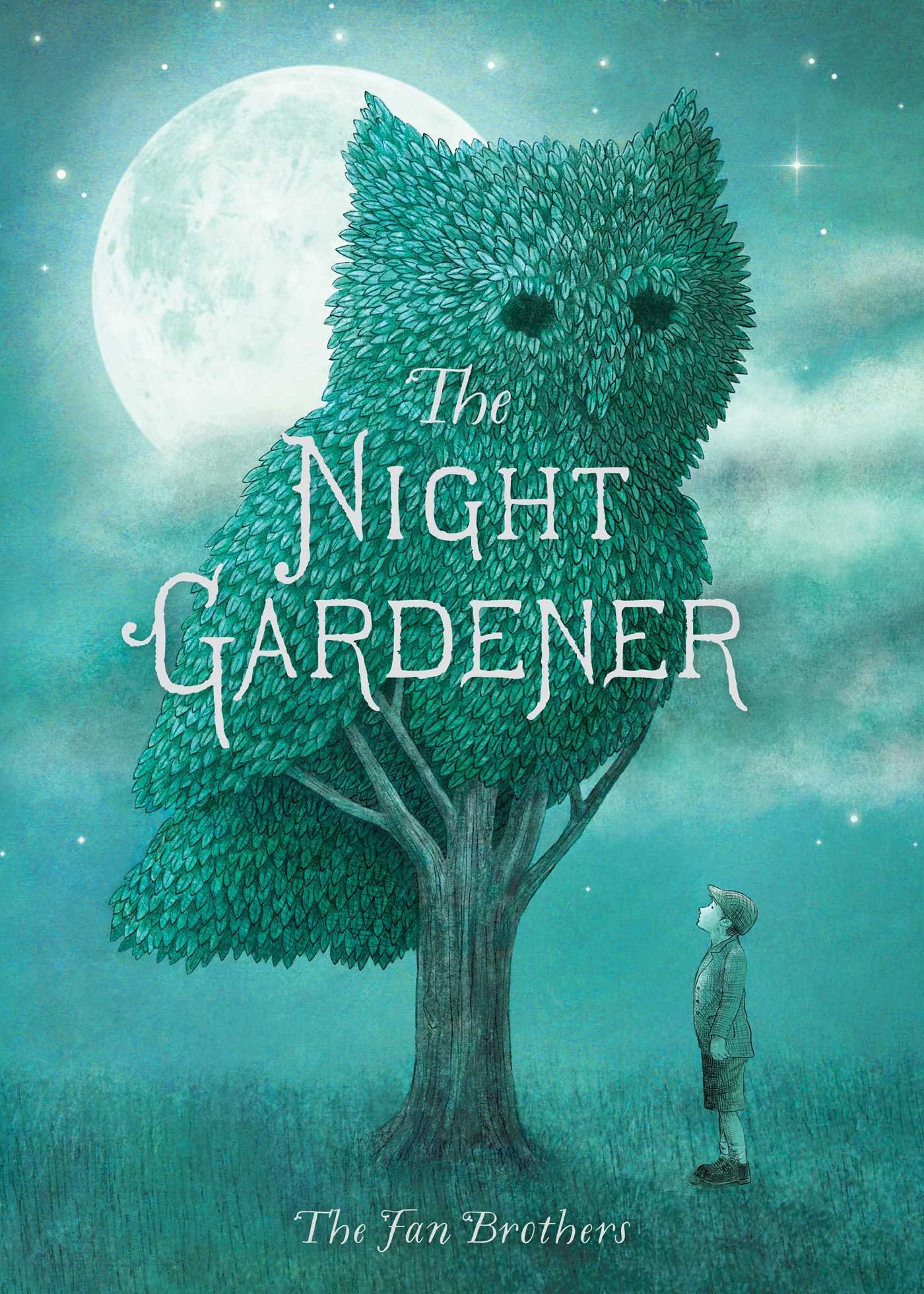
Summary:  Even before the title page, we see that Grimloch Lane looks a lot like it sounds, brown and dreary, populated with sad-looking people.  But wait, is that a man pruning a tree?  What is he doing?  Then the story begins.  William, looking through his window at the Grimloch Orphanage, hears a commotion. Running out the door, he discovers a giant owl has been cut into a tree.  As the days go by, trees are transformed into an elephant, a rabbit, a parrot, and then, the masterpiece, a two-tree dragon.  With each new creation, more townspeople come together and find reasons to celebrate.  At the end of the day of the dragon, William sees an unfamiliar figure in the streets, carrying a ladder and some pruning shears.  The man sees him, and the two of them work through the night to create a forest of animals.  Eventually, the leaves change colors and fall off the trees, and the animals are gone, but the town and William are never the same.  48 pages; ages 4-8.

Pros:  This simple story has a beautiful message, and the illustrations are worthy of Caldecott consideration.

Cons: This book has the same title as a very creepy book from a couple of years ago.  Make sure you don’t mix them up if you plan to read this aloud to a bunch of five year-olds.

Cricket Song written and illustrated by Anne Hunter

Published by Houghton Mifflin Harcourt


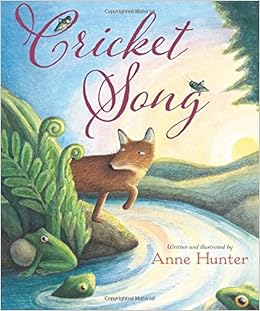
Summary:  As night falls in one place, a child drifts off to sleep.  The song of the crickets fills the room, and drifts out into the yard, where it is joined by the croaking of frogs.  The sounds and activities of one animal lead to those of another, from one page to the next.  At the bottom of each page is a picture of two places, separated by a large body of water.  On each page, the sun gradually moves from east to west.  At the beginning, night is falling in the eastern land, and by the end, the sun sets on the western one as well.  The child in that house drifts off to sleep.  32 pages; ages 3-7.

Pros:  The beautiful illustrations of animals combine with the poetic, soothing text to form a perfect bedtime story.  The series of pictures on the bottom make an interesting complement to the main illustrations.

Cons:  Although the pictures at the bottom of the page were cool and definitely added to the book, I found them distracting until I figured out what was going on in them.