How to Speak Dolphin by Ginny Rorby

Published by Scholastic Press

Summary:  Since her mother died suddenly two years ago, Lily has had far too much responsibility for her four-year-old autistic half-brother, Adam.  Her stepfather, Don, is a doctor and is overwhelmed by responsibility as well, causing him to make unreasonable demands upon Lily.  When the family discovers a dolphin at the local aquarium that seems to help Adam, Don is determined to keep the dolphin in captivity.  Lily and her new friend Zoe, who is blind, realize that the dolphin belongs in the wild.  Will Lily be able to speak up for what is right for the dolphin, even if it may mean hurting Adam?

Pros:  Fans of Cynthia Lord’s books, particularly Rules, will enjoy this book which looks at how a child with autism affects the whole family.  The dolphin story will appeal to animal lovers.

Cons:  The message that keeping dolphins in captivity is evil was hammered home a little too thoroughly.
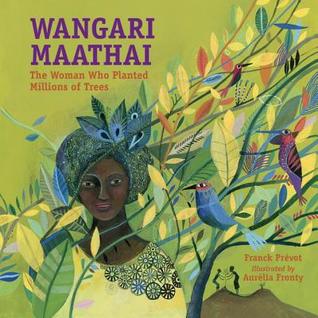
Wangari Maathi: The Woman Who Planted Millions of Trees by Franck Prevot, illustrated by Aurelia Fronty

Published by Charlesbridge

Summary:  While other picture book biographies about Wangari Maathi have focused on her tree planting, this book takes a broader look at her political activism.  She was fortunate to get a high school education in Kenya at a time when most girls didn’t go to school at all, and did so well that she was part of a group selected by President Kennedy to study in America.  Upon her return to Kenya, she observed how ravaged the land was from deforestation, and began her work to plant trees.  This work was in opposition to some of the plans of President Daniel arap Moi, and Maathai was imprisoned more than once.  In 2002, Moi was defeated, and Wangari Maathai was appointed assistant minister of the environment, natural resources, and wildlife.  In 2004, she was awarded the Nobel Peace Prize.  She died in 2011 at the age of 71.  End pages include an extensive timeline, information on Kenya today, quotes from Wangari Maathi, and further resources.  Grades 2-6.

Pros:  This French import is more extensive than other Maathi biographies, and would be appropriate for an older audience looking for more in-depth information.  The illustrations are striking, each one painted against a boldly colored background that fills the whole page.

Cons:  This is the fifth picture book biography of Wangari Maathi published since 2008, so some libraries may pass on purchasing this one, which would be too bad.

Daisy Saves the Day by Shirley Hughes

Published by Candlewick

Summary:  Even though Daisy loves her family and does well at school, times are tough, and she is sent out to live in a grand house and work as a scullery maid.  Her work is difficult and exhausting, but she works hard and tries to do what’s expected of her.  The two old ladies who own the house like her well enough, and when their niece comes from America, she encourages Daisy to read some of the books in the house.  All three women leave the house one day, to go see the coronation of a new king, George V.  Daisy’s left behind by herself, and decides to decorate the outside of the house with red, white, and blue clothing.  The only red she can find is the red flannel bloomers the ladies wear in the winter.  When they come home, they are horrified, and Daisy is in disgrace.  A few weeks later, though, she wakes up to the smell of smoke, and is able to put out a kitchen fire before it can do much damage, saving the house and its occupants.  As a reward, she is given enough money to be able to return home and go back to school.  Grades 1-4.

Pros:  This is a charming story about a winning cast of characters, particularly Daisy.  It has an old-fashioned feel to it, and illustrations reminiscent of Tasha Tudor.

Cons:  I looked for an historical note at the end, and was disappointed not to find one.

Dolley Madison: Parties Can Be Patriotic! By Kathleen Krull

Published by Bloomsbury USA Childrens

Summary:  When Dolley Madison died, her funeral was the largest ever seen in Washington, D.C. at that time.  It closed down the government, because so many people wanted to attend, including some of the twelve U.S. presidents she had known in her lifetime.  After a simple Quaker childhood and an arranged first marriage, Dolley, a widow at age 25, married James Madison, who later became the fourth U.S. President.  Dolley threw large parties every week, redecorated the White House, and famously rescued the portrait of George Washington just hours before the British burned down the White House during the War of 1812.  When Zachary Taylor referred to her as the First Lady, he coined a term that Dolley defined during her long, eventful life.  Ages 7-10.

Pros:  Veteran biographer Kathleen Krull has a new series, “Women Who Broke the Rules”.  This entry is fun, breezy, and informative.  At 46 pages, with illustrations on almost every page, it’s just the right length to give an enticing introduction to the life of a famous woman.

Cons:  The cover could be a bit more enticing.

A Nest Is Noisy by Dianna Hutts Aston, illustrated by Sylvia Long

Published by Chronicle Books

Summary:  Why is a nest noisy?  Because of the life being nurtured inside of it.  Nests are made of an almost infinite range of materials, from millions of interlocking army ants to the hardened saliva of a swiftlet (whose nest is used to make birds’ nest soup).  And nests aren’t just for birds.  Alligators, platypuses, orangutans, and others make nests, too.  Each two page spread has a statement about what a nest is (“A nest is neighborly”, “A nest is hidden”, etc.), followed by a paragraph or two explaining this statement, all gorgeously illustrated with exquisitely detailed watercolors.  The front endpapers show all the nests described in the book, and the back ones display all the animals that inhabit them.  Ages 5-10

Pros:  This award-winning team has produced beautiful nonfiction books about eggs, seeds, butterflies, and rocks.  The writing and illustrations ensure that readers will gain a wonder and appreciation of the world around them.

Cons:  There is a lot of information for younger readers.  They might appreciate this book more if read over several sessions rather than all at once.

Unusual Chickens for the Exceptional Poultry Farmer by Kelly Jones, illustrated by Katie Kath

 Published by Knopf Books for Young Readers

Summary:  12-year-old Sophie’s family has recently moved to the farm her father inherited from his Uncle Jim.  Her dad is recently unemployed and her mom is a freelance writer trying to pay the bills, so Sophie is left to her own devices to explore the farm.  She discovers a mysterious and unusual chicken named Henrietta living on the property, and soon a few more supernatural chickens show up, along with a potential chicken thief.  Sophie embarks on a correspondence with a mysterious woman named Agnes who supposedly runs Redwood Farm Supply, and who offers Sophie encouragement and chicken advice.  Told entirely in letters to Great Uncle Jim, Agnes,  and her deceased grandmother, the story follows Sophie as she figures out both the chickens and the humans in her new community.  Ages 8-12.

Pros:  Sophie is a likeable character, and the chickens with supernatural powers add an interesting element to the story.  The plentiful illustrations, quizzes, chicken manual excerpts, and other documents are a nice addition to Sophie’s letters.

Cons:  Although this book has gotten great reviews, I had a tough time getting through it. The story didn’t grab me, and I’m just not that into chickens.

How to Read a Story by Kate Messner, illustrated by Mark Siegel

Published by Chronicle Books

Summary:  In ten easy steps, the author covers how to read a story.  Some of the steps capture the fun of reading, like finding a reading buddy and a cozy reading spot.  Others cover strategies such as predicting and using the pictures to try to figure out words you don’t know.  Readers will enjoy the story the boy reads, called The Princess, The Dragon, and The Robot, which is used to give examples of the various steps.  From finding a story to reading “The End” (and going back to the beginning if you liked it), this is a celebration of the joy of reading.  Grades K-4.

Pros:  Keep this one in mind for the first week of school to introduce reading in the primary grades.  It’s also a perfect mentor text for procedural writing.  Kids will love the cheerful illustrations.

Cons:  All good stories must come to an end.

Float by Daniel Miyares

Published by Simon and Schuster Books for Young Readers

Summary:  In this wordless picture book, a boy goes out on a rainy day with a paper boat he has just made with his dad.  He floats the boat in puddles, but eventually it gets away from him.  By the end of his adventure, he’s left with a soggy piece of newspaper.  Disheartened, he returns home, where Dad dries him off and gives him some hot chocolate.  They get to work with the newspaper again, and on the last page, he is heading out the door on a sunnier day with a paper airplane.  Folding directions for a boat are on the front endpapers and a plane, on the back.

Pros:  The simple, peaceful story is reminiscent of The Snowy Day by Ezra Jack Keats.  The illustrations are beautiful and may catch the attention of the Caldecott committee.

Cons:  My struggles to make a paper boat go all the way back to my first reading of Curious George Rides a Bike.

An Ambush of Tigers: A Wild Gathering of Collective Nouns by Betsy R. Rosenthal, illustrated by Jago.

Published by Millbrook Press

Summary:  “Do you ever wonder what animals do/when they gather in groups of more than two?”  If the answer is yes, get ready to learn what different groups of animals are called.  Most of us have heard about a pack of wolves or a team of oxen, but how about a bouquet of pheasants or a prickle of porcupines?  A shiver of sharks or a rumba of rattlesnakes?  The richly colored illustrations portray the various animals interacting with each other, concluding with a panoramic view of all the animals together.  A glossary at the end lists all the animal group names and gives other definitions for the terms.

Pros:  Kids will love learning the names of their favorite animal groups, and the rhyming text makes it even more fun.  This could lead to researching other collective nouns.

Cons:  An intrusion of roaches.

Clover’s Luck (Magical Animal Adoption Agency) by Kallie George, illustrated by Alexandra Bolger

Published by Disney-Hyperion

Summary:  Clover loves animals, but she’s been unlucky with pets.  When a baseball breaks her bedroom window and her new bird escapes, Clover runs off to try to catch her.  The chase leads her into the Woods, a scary place she’s never been before.  To her surprise, she sees a sign advertising a need for volunteers at the Magical Animal Adoption Agency.  Clover follows the directions to get there, and finds herself at a cottage where animals such as unicorns, magical salamanders, and dragons await adoption.  The owner, Mr. Jams, invites Clover to come back and help out, and just like that, her luck has changed.  Every day she grows more enchanted with the Agency and the animals living there.  When Mr. Jams is called away on emergency business, he asks Clover to be in charge for a few days.  Will she be able to handle animal adoptions and outsmart a devious witch?  Grades 2-4.

Pros:  This is the first book in an enchanting new series, perfect for fans of animal stories and fantasy.

Cons:  Clover’s parents seem horribly neglectful, staying at their jobs so late that Clover has to make dinner for herself and go to bed before they’ve come home.