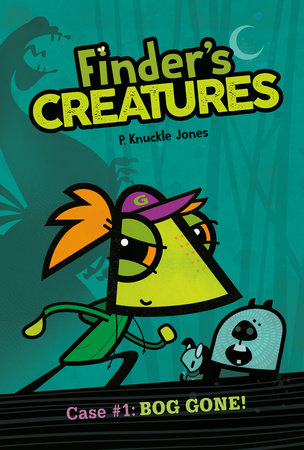
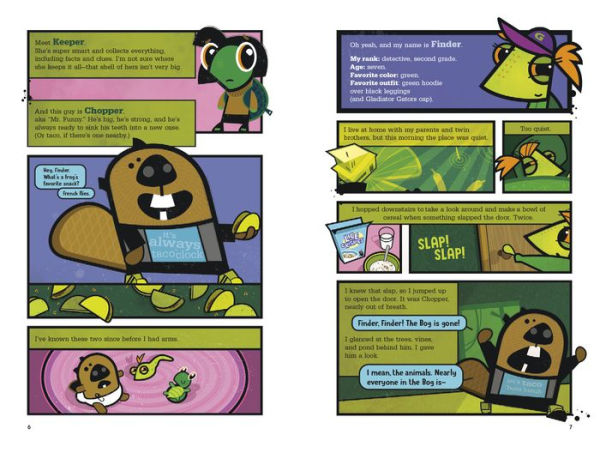
Summary: Second grader Finder (frog) and his friends Keeper (turtle), and Chopper (Beaver) have their hands/paws full when the other animals from Belly Acre Bog disappear. Finder’s hero is Seymour Warts, a brilliant detective based on Sherlock Holmes, who solves his own mystery during the course of the story. A series of misadventures ensues, but both Finder and Seymour manage to crack their cases. 112 pages; grades 2-4.
Pros: The many fans of early graphic novels like The Bad Guys, Max Meow, and The InvestiGators will enjoy this mystery, which includes plenty of madcap humor. The word choices and color-coded speech bubbles makes this a good choice for newly independent readers.
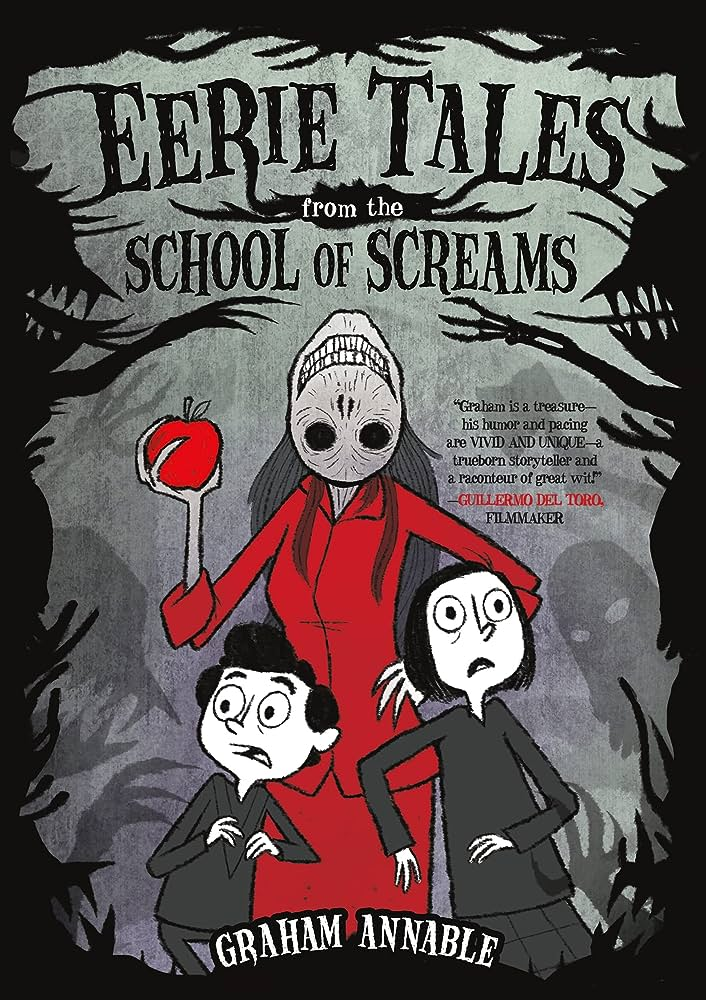
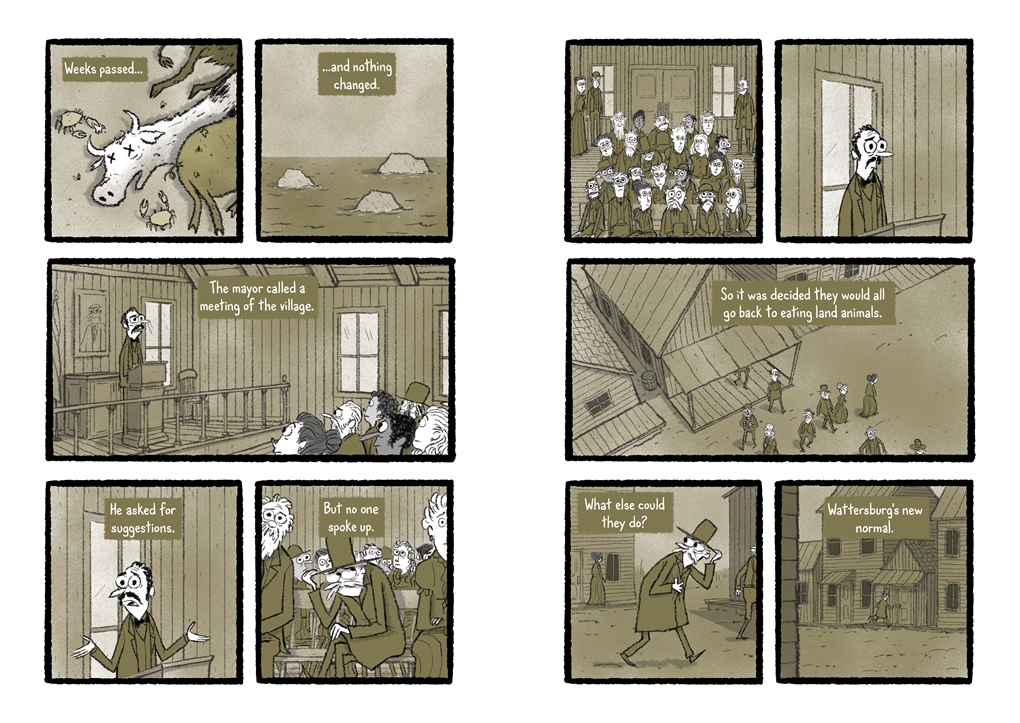
Summary: Ms. Nomed has her students come up one by one to share a scary story with the rest of the class. Each tale is illustrated with various shades of a single color to help differentiate one from the other. Humorous commentary from the other kids at the end of each one lightens the mood a bit before plunging back into another creepy world where things are not always what they seem and monsters, ghosts, and zombies are real. The final story turns out to be true, and the class has to join forces when Ms. Nomed reveals her true self. 368 pages; grades 4-7.
Pros: A graphic novel scary story collection? Someone has a finger on the pulse of elementary students! Plan on buying multiple copies for the library, as this is sure to be a huge hit. The artwork is excellent, and the stories are genuinely creepy.
Cons: As always with scary stories for elementary kids, be aware that these may be disturbing for some readers.
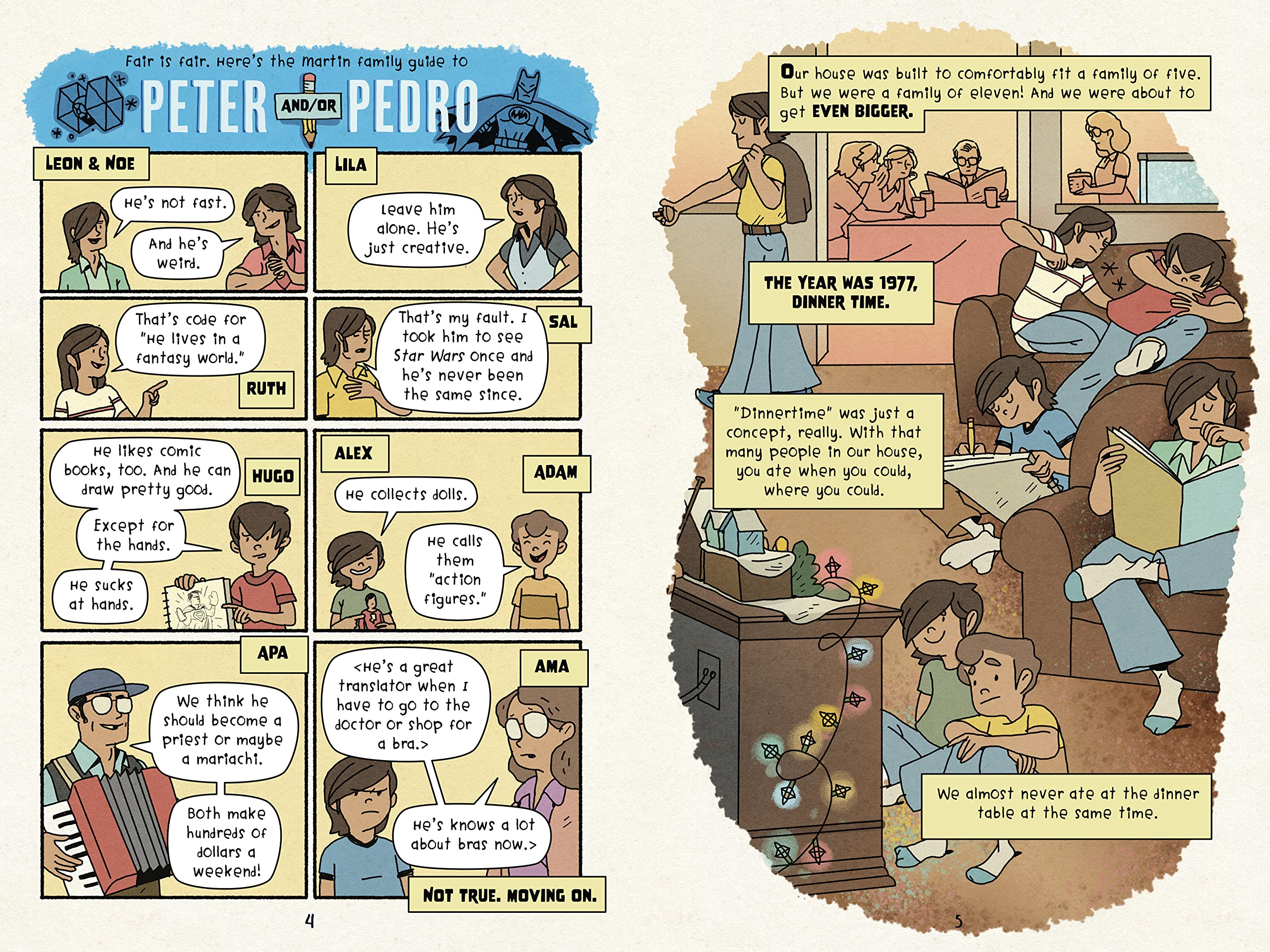
Summary: Pedro’s house feels pretty small with his parents and eight brothers and sisters, so when he learns that his grandfather is coming to live with the family, he’s not happy. Not only that, but the whole family has to travel to Mexico to pick up Abuelito. The kids are divided into two groups: the five oldest were born in Mexico, and the younger four, including Pedro, arrived after the family had moved to California. The older group takes a pick-up truck for the big road trip, and the rest of the family travels in a used RV. There are plenty of adventures both on the trip and during the weeks they spend in Mexico with their extended family. Pedro is in awe of his grandfather, who was part of the Mexican revolution, but by the end of the trip, he’s shown he has a few heroic qualities of his own. Available in both English and Spanish language editions. 320 pages; grades 4-8.
Pros: This road trip graphic novel strikes the perfect balance between funny and poignant, featuring a memorable immigrant family with ties to both Mexico and the United States. Readers of a certain age will appreciate the loving references to Star Wars, Fleetwood Mac, Happy Days, and other 1970’s touchstones.
Cons: I found the font a little hard to read, particularly the lowercase d’s that looked more like a’s.
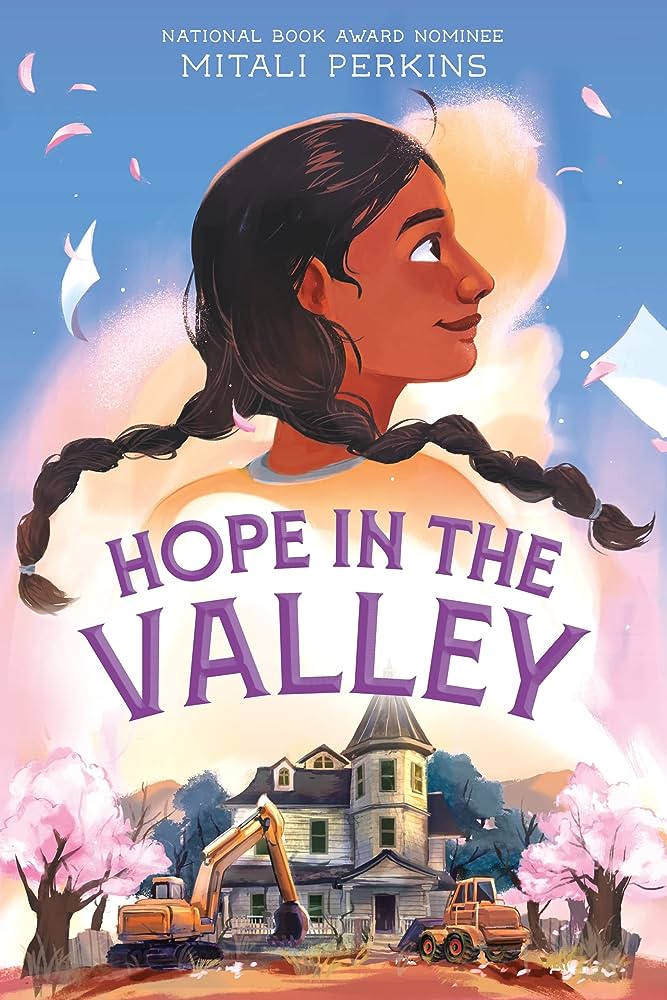
Summary: Pandita is looking forward to a relaxing summer of reading in her favorite secret hiding place–the porch of the abandoned house next door, a place she and her late mother liked to spend time. When she learns that the house is being torn down by developers, Pandita is horrified and becomes part of a group trying to save it for historical preservation. Her research on the old house leads to some surprising discoveries, as well as some new friendships. There are other changes afoot during the summer, including four weeks of drama camp and a potential new stepmother whose brash opinions cause Pandita to label her The Intruder. At first reluctant to attend drama camp, Pandita eventually discovers a talent for singing and learns to overcome her fear of speaking in public, a lesson that serves her well in her fight for the house. Although things don’t turn out exactly the way Pandita wants them to, she discovers that change can be a good thing sometimes, leading to new connections and experiences. 304 pages; grades 4-7.
Pros: This engaging historical novel documents the rapid changes going on in Silicon Valley in the 1980’s. Introverts will take Pandita’s struggles and triumphs to heart and cheer her on as she discovers new talents and makes new friends.
Cons: Although The Intruder eventually won the family over, she seemed pretty obnoxious at times, and I foresee some rocky times ahead for her and Pandita.
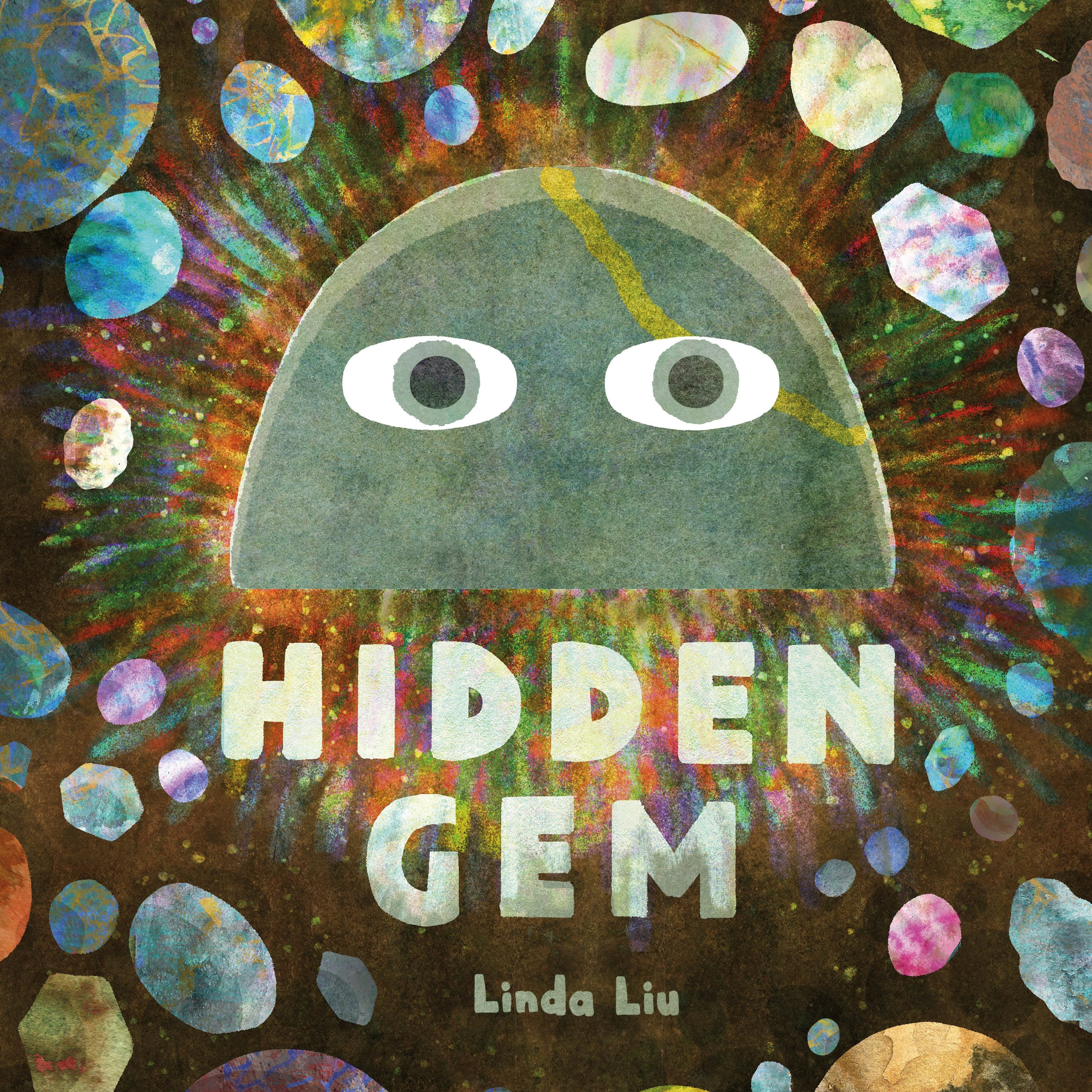
Summary: Two unconventional narrators discover their own value. Greenlight doesn’t like the fact that the cars slow down for Yellowlight, stop for Redlight, but speed through Greenlight, seeming to ignore it. Taking a break for a few minutes, with closed eyes and some affirmations repeated, Greenlight starts to see its own value and is ready to shine bright. In Hidden Gem, an ordinary rock can’t help comparing itself unfavorably when it goes to a museum exhibit of gems. But with the help of a spectacular diamond, the narrator comes to realize that every rock is special in its own way. 32 pages (Greenlight) and 40 pages (Hidden Gem); both ages 4-8.
Pros: With school starting up again, teachers and counselors will be looking for books like these that incorporate humor and striking illustrations (especially in Hidden Gem) to give kids some strategies for feeling good about themselves and accepting others for what they are.
Cons: Both books seemed to prioritize the message over the story.
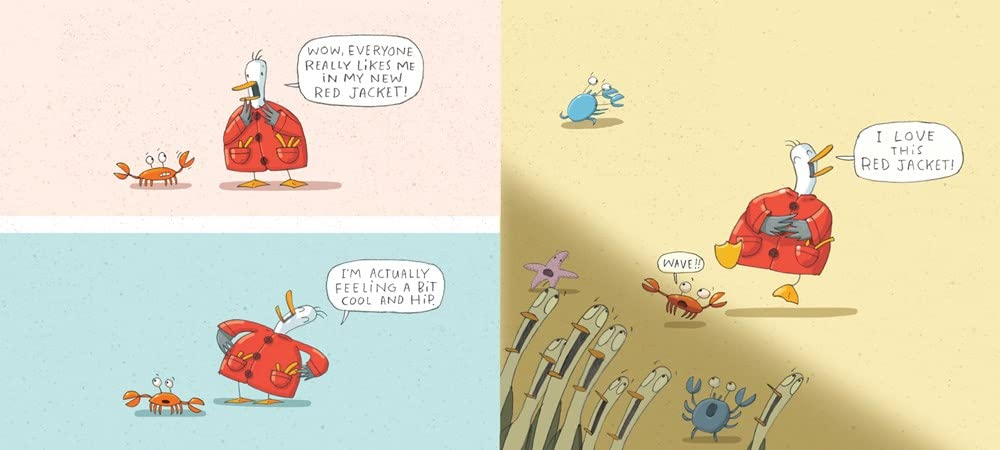
Summary: The first few wordless pages show Bob the seagull watching other sea creatures having fun together while he feels left out and alone. Another bird comes along and offers Bob her red jacket (with fries in the pockets!), saying that she no longer needs it. The jacket gives Bob the confidence to talk to the other animals. Their responses reveal that they’ve always liked Bob but never had the chance to get to know him (“I didn’t know Bob could talk”). When a huge wave causes Bob to lose his beloved jacket, his friends pitch in and help him recover it. Bob spots a lonely turtle and offers the jacket to her, saying that he no longer needs it. The turtle walks away happily, fries spilling from the pockets of her new red jacket. 40 pages; ages 4-8.
Pros: A cute story with appealing comic-style illustrations that could open up some interesting conversations about where self-confidence comes from.
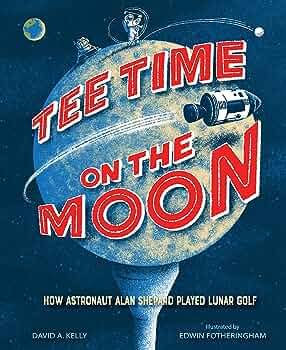
Summary: When Apollo 14 launched in 1971, astronaut Alan Shepard had a secret stash he was carrying with him. He revealed what it was after he and fellow astronauts Stuart Roosa and Edgar Mitchell had a successful landing, and he and Mitchell had walked on the moon. Shepard had a golf club and ball and wanted to see how far he could hit the ball in the low-gravity atmosphere of the moon. In front of TV cameras, he made a couple of unsuccessful swings before giving the ball a good whack, sending it flying into space. How far? It took almost fifty years to find out. A photographer used software to sharpen the moon images and discovered that the ball had only gone about 120 feet–a far cry from the miles Alan Shepard had claimed. The stunt made viewers think differently about the moon, though, seeing it as a place where one day everyday events like playing sports could take place. Includes five pages of additional information, including information about each of the Apollo missions, photos, and a bibliography. 40 pages; grades 2-5.
Pros: Alan Shepard, Jr.’s golfing stunt provides a great hook to draw readers into a history of the Apollo missions, with information on the history of the program, how the launches worked, and the space suits the astronauts wore, among other things. The additional information provides a good starting place for learning more.
Cons: The tiny font of the back matter was hard on my elderly eyes.
Summary: Anna’s new at her Madison, Wisconsin middle school. She’s a little young for eighth grade and still trying to figure out how the middle school social hierarchy works, so when she notices that a girl named Rachel Riley is shunned by all her classmates, she’s curious to find out why. Digging deeper into the mystery, Anna discovers that Rachel was one of the popular girls until the end of seventh grade, when a mysterious fire disrupted the end-of-the-year dance and awards ceremony. A devoted podcast fan, Anna decides to make a podcast to answer the question, what happened to Rachel Riley? In addition to her own narration, the story is told through texts, emails, letters, interviews, and news reports, which slowly reveal to Anna a tale of bullying and sexual harassment that has been ignored by teachers and administrators and laughed off by students. As Anna uncovers the truth, she learns the importance of using her own voice to speak up in defense of truth and justice. 352 pages; grades 4-8.
Pros: It’s not often that I wish I were still running middle school book clubs, but it happened as I read this perfect middle school story. The format and the mystery elements make it a quick and engaging read, and the story raises important questions about sexual harassment and how it affects both boys and girls.
Cons: The large cast of characters and story format left me feeling like I didn’t really get to know several of the secondary characters.
Summary: Boomi is reeling from the death of her father from Covid. Remote school is isolating, her best friend seems distant, and the final blow comes when she fails an audition at her ballet school. She receives an old boombox of her father’s under somewhat mysterious conditions, and when she tries to play the mixtape inside, she’s transported back to 1986 England. There she meets her 12-year-old father, Jeevan, as well as his mysterious older sister, and a younger version of her grandmother, Paati, who lives with Boomi’s family in the present and suffers from dementia. As Boomi travels back and forth between the present and the past, she learns about the racism that plagues her dad and his family, forcing Asian people to be silent and invisible in their mostly white community. By helping them speak up, Boomi learns to accept what has happened in her life and to embrace her love of dancing, even if her body is not the size and shape her ballet teacher is looking for. Working together, Boomi and Jeevan manage to heal the rifts within their families and change their lives for the better. 272 pages; grades 4-7.
Pros: I wasn’t expecting the time travel twist, which allowed Boomi to get closure around her father’s death and to witness the racism that shaped both her parents’ early years. Shanthi Sekaran deftly handles so many difficult topics including not only racism, but body image, grief, and the pandemic.
Cons: I was actually in London in 1987, which doesn’t feel as much like ancient history as this book makes it seem.
Summary: An adventurous raccoon narrates its travels by showing kids a series of maps, beginning with its bedroom and continuing to the neighborhood, a museum, a road map, and more (12 altogether). Each map has questions for kids to answer and introduces concepts like a compass rose and a map key with symbols. There are maps that show things other than geography, like the stars and the weather. Includes an index of all the maps with thumbnail drawings, definitions, and the pages where each can be found. 48 pages; grades K-2.
Pros: Kindergarteners at my school learn about maps, so I have read quite a few picture books on the subject, and this is the best that I have seen. I love how interactive it is, with the questions the kids can answer using the maps. It’s lots of fun, but also a pretty thorough introduction to all kinds of maps.
Cons: It felt a little long to maintain a kindergartener’s attention. You might want to break it into two or three reading sessions.







 A Kids Book A Day