Elephants Remember: A True Story by Jennifer O’Connell

Published by Tilbury House Publishers
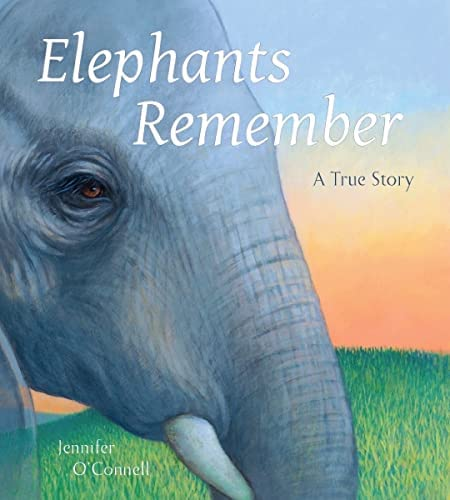
Summary:  When Lawrence Anthony gets a call saying that a herd of elephants will be shot if he can’t rescue them, he quickly sets up his wildlife reserve to accommodate them.  The animals have been traumatized after having members of their herd killed by poachers, including the matriarch and her baby.  Lawrence names the new matriarch Nana, and after the elephants trample the reserve’s electric fence and escape the first night, he sets out to earn Nana’s trust.  Slowly, she begins to let down her guard and allow Lawrence to come closer to her.  Over the years, Lawrence distances himself from the growing herd to help them remain wild, but he always keeps a connection with Nana.  When Lawrence dies of a heart attack, Nana leads the herd to his house and does so again on the same day for the next two years.  Includes an author’s note and three pages of additional information about elephants and Lawrence Anthony.  48 pages; grades 1-5.

Pros:  An incredibly moving story of a man dedicated to helping African wildlife and the amazing connection he made with elephants.  

Cons:  Some photos would have been a nice addition.
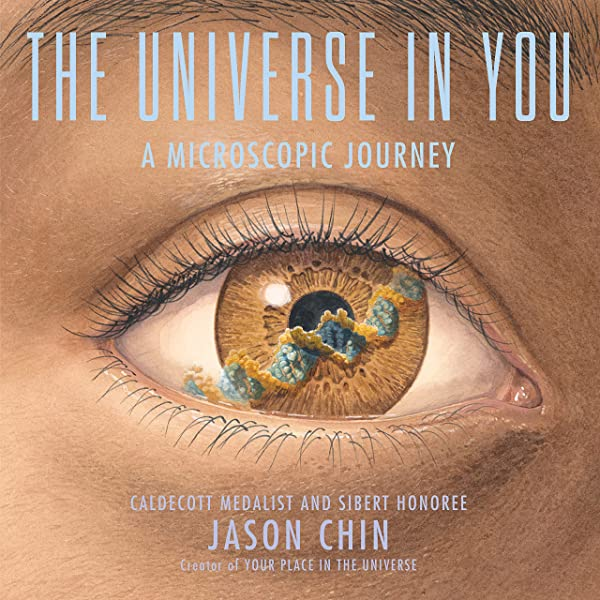
The Universe in You: A Microscopic Journey by Jason Chin

Published by Neal Porter Books

Summary:  In Your Place in the Universe, Jason Chin starts with a group of kids, then gradually moves out into the farthest reaches of the universe.  In this book, he goes in the opposite direction, beginning with the smallest bird–a Calliope Hummingbird–landing on a girl’s hand, then moving to the hair on her skin, then to cells, DNA, atoms, and eventually to elementary particles.  From there, the journey continues back outward, inviting a sense of wonder that everything in the universe is made of the same molecules, yet combines in a way to make a unique human.  Includes additional information on the building blocks of matter, as well as an author’s note and a note about the illustrations.  40 pages; grades 3-7.

Pros:  Another mind-blowing offering from last year’s Caldecott medalist, Jason Chin, with amazingly detailed illustrations, some of things that are too small to be seen with the human eye.  A contender for a Caldecott or Sibert, both of which Chin has already won.

Cons:  I’m more wowed by the larger universe than the subatomic one.

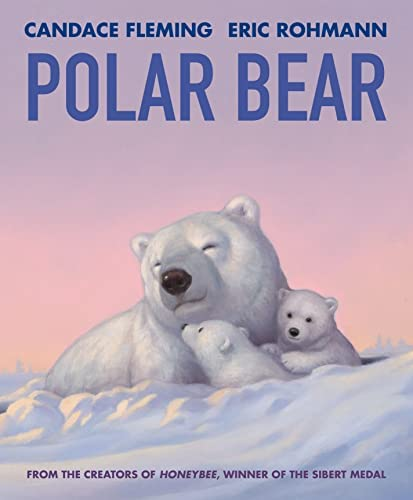
Polar Bear by Candace Fleming, illustrated by Eric Rohmann

Published by Neal Porter Books

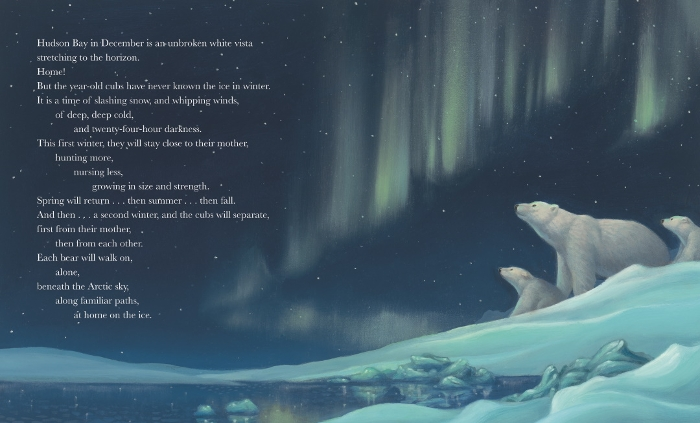
Summary:  The award-winning team behind Giant Squid, Honeybee, and Strongheart has created a new book that explores the world of a mother polar bear and her two cubs.  Emerging from five months in the den, during which time she gave birth and nursed her offspring, the mother bear emerges emaciated and hungry.  She heads for the ice where she knows she can hunt seals.  The narrative follows the bears through the year, showing how climate change affects their ability to hunt and perilously strands them on some floating ice.  They survive the dangers, and the final pages show them back on the ice in the 24-hour darkness of an Arctic winter.  Includes a two-page labeled diagram of a polar bear, additional facts about polar bears and the effects of warming in the Arctic, and a list of resources.  32 pages; grades K-5.

Pros:  Another breathtaking science book with poetic informative text and detailed realistic paintings of the polar bears and their environment.  With a Sibert Medal and Honor on their resumé, this team can expect awards consideration again for this book.

Cons:  As always, I found it stressful to read about the effects of climate change.

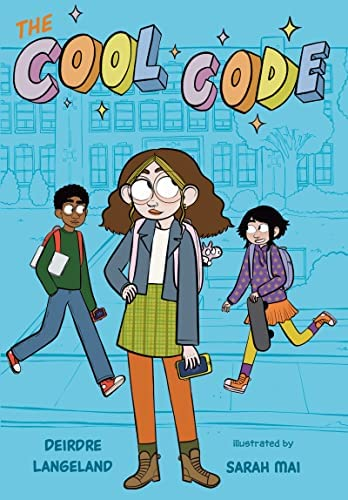
The Cool Code by Deirdre Langeland, illustrated by Sarah Mai

Published by Clarion Books

Summary:  Zoey’s parents are starting their own business and don’t have time to homeschool her anymore, so she’s going to public school for the first time as an eighth grader.  Worried about fitting in, she’s used her considerable coding skills to create an app that will help her figure out what’s cool.  This takes the form of a little pink llama that constantly offers advice on what to wear, say, and do as she navigates her way through the first day of school.  When Zoey decides to join the coding club, she meets a couple of other kids who love coding as much as she does, and who are looking for their next big project.  Zoey reluctantly reveals her app to them, and they decide to upgrade it to give better advice.  Result?  Zoey’s now just about the coolest girl in school but feels pulled in 100 different directions and is at risk of losing her real friends.  224 pages; grades 3-7.

Pros:  A fun middle school graphic novel with dual messages to be yourself and to not let work take over your life (a lesson Zoey’s parents need to learn as well).  

Cons:  Call me old-fashioned, but I just can’t get behind the bug-eyed look for comic book characters.

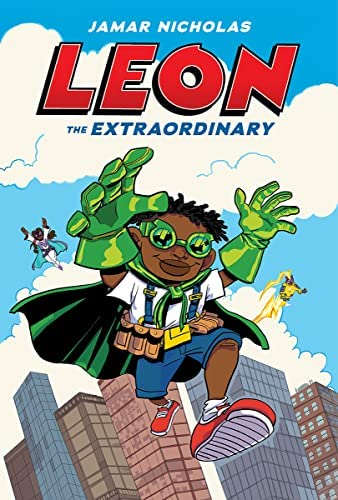
Leon the Extraordinary by Jamar Nicholas

Published by Graphix

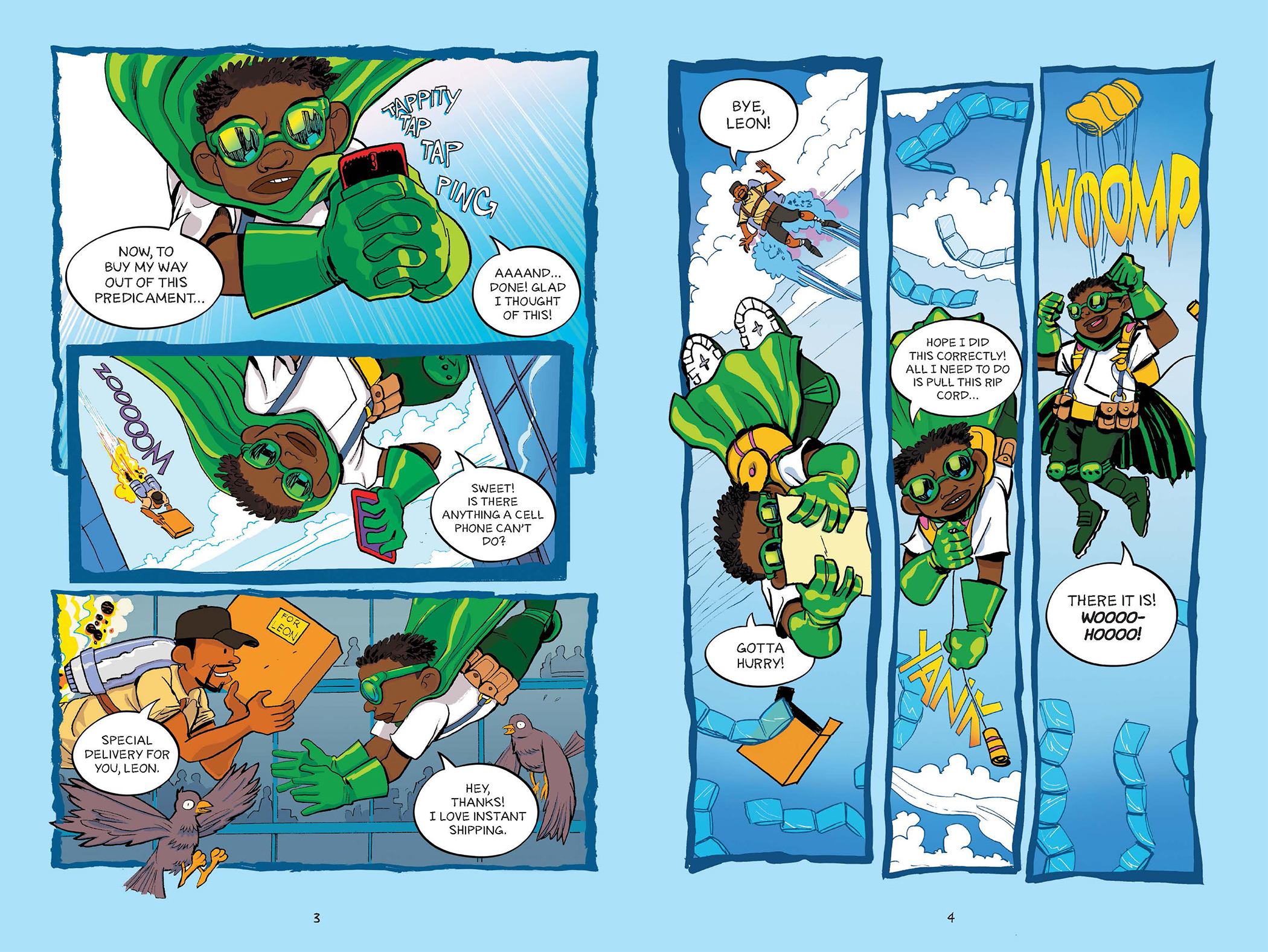
Summary:  Leon lives in a town populated by superheroes and villains, but he and his best friend Carlos are ordinary.  That doesn’t stop Leon from wanting to be a hero and wearing a cape, gloves, and goggles wherever he goes.  His former friend Clementine has let her new superpowers go to her head, but when a zombie-creating game starts appearing on other kids’ phones, Leon realizes he needs her help to save the school.  Not only does he track down and defeat the supervillain who is causing the problems, but he discovers some interesting and exciting things about himself and his family.  272 pages; grades 3-6.

Pros:  Kids will love this superhero graphic novel about an ordinary kid who manages to do extraordinary deeds through hard work and kindness.  The last page ends with the promising words “To be continued…”

Cons:  I was hoping Clementine would become a little less insufferable by the end.  Still, there were signs that things might turn around in book 2.

A Rover’s Story by Jasmine Warga

Published by Balzer + Bray

Summary:  Resilience comes to life in a NASA lab, a rover built to explore Mars.  At first, he thinks he is a back-up for another rover named Journey, but he eventually learns that he is the one being sent into space.  He is curious about humans, or hazmats as he calls them, and particularly takes a liking to engineers Rania and Xander.  Rania has a daughter named Sophie, who starts writing letters to Resilience.  Although the rover never sees them, the letters give readers some insights into Rania’s home and family life.  The book is divided into five parts that cover more than 20 years, as Resilience gets launched and explores Mars with his drone, and friend, Fly.  An accident puts the rover out of commission for many years, but in the end, he is able to realize his dream and Rania’s of returning him to Earth.  320 pages; grades 4-7.

Pros:  Jasmine Warga does an amazing job of realistically bringing Resilience to life with a personality and curiosity that still keeps him in the realm of machine yet shows readers human emotions.  The subplot about Raina told through Sophie’s letters is also extremely well done and very moving.  A great recommendation for fans of The Wild Robot, and a Newbery contender for sure.

Cons:  While I could very much appreciate this book, I never really got engrossed in it. I guess I just generally prefer reading about people.

Wibble Wobble BOOM! by Mary Ann Rodman, illustrated by Holly Sterling

Published by Peachtree

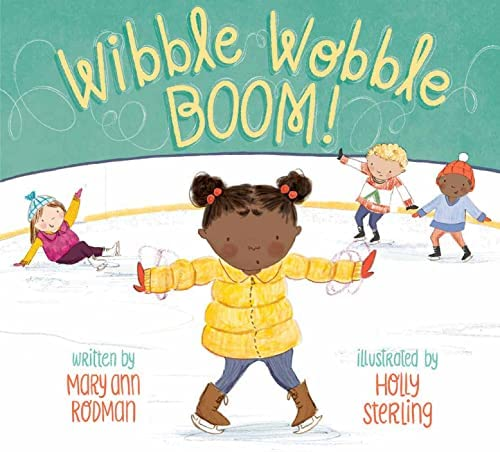
Summary:  Claire is excited about her first skating lesson, but reality rears its ugly head when she’s placed in the beginners’ group called the Snowplows and given brown rental skates.  The kids have to practice standing up off the bench before they’re even allowed onto the ice, and once they’re finally there, Claire is surprised at how hard it is to skate and how easy it is to fall.  She’s a keen observer, though, and noticing how the teacher pushes and glides across the ice leads to her being the first in the class to do some real skating.  Ultimately, Claire is glad to be a Snowplow, because snowplows work hard, and she’s excited for the next class and her dreams of being a real figure skater.  32 pages; ages 4-8.

Pros:  An engaging story that I am going to add to my list of books about persistence and grit, as Claire keeps going through some disappointing turns of events to ultimately find some success.  The cute illustrations portray a diverse cast of characters.

Cons:  The “hockey boy” in Claire’s class who keeps heckling her when she falls. “Know why you’re called a Snowplow? ‘Cause you clean the ice with your bottom!”  Let’s hope Claire checks him in the next class.

Stopping By Woods on a Snowy Evening by Robert Frost, illustrated by P. J. Lynch

Published by Candlewick

Summary:  in this illustrated version of Robert Frost’s poem, a young woman in a long dress is riding her horse through the dark woods on a snowy night.  Each page contains a line or phrase from the poem with a realistic illustration of the girl, who eventually dismounts and pauses to observe the snow.  The endpapers are part of the story, with the front cover showing her riding through a lighted village and the back depicting the sun rising on a snowy landscape.  32 pages; grades K-5.

Pros:  A beautiful introduction to a classic poem.  The female rider makes a nice new twist and spreading the text out one line at a time allows the reader to savor both the words and the gorgeous illustrations.

Cons:  Personally, if I got caught in a nighttime snowstorm in the woods while wearing a long dress, I would get on that horse and ride, not “stop by” for a lengthy meditation.

Too Early by Nora Ericson, illustrated by Elly MacKay

Published by Harry N. Abrams

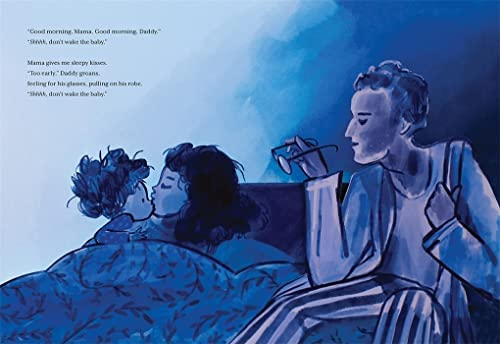
Summary:  “I wake up very early,” says the child narrator on the first page.  Mom gives a kiss and a warning not to wake up the baby.  Dad sleepily puts on his glasses and heads downstairs for coffee, grumbling, “You wake up too early.”  As dawn arrives, the two sit on the porch, looking at the moon and finding Venus.  Birds start to sing, the baby starts to cry, and the light starts to change.  As the sky turns from dark blue to bright yellow, the narrator says, “I wake up just in time.”  32 pages; ages 3-6.

Pros:  A lovely early morning book, kind of the antithesis of a bedtime story.  Kids and parents will find a lot to relate to, and the illustrations do a magnificent job of using color to show the changing time of day.

Cons: Flashbacks to early sleep-deprived days of child-rearing.

Luminous: Living Things That Light Up the Night by Julia Kuo

Published by Greystone Kids

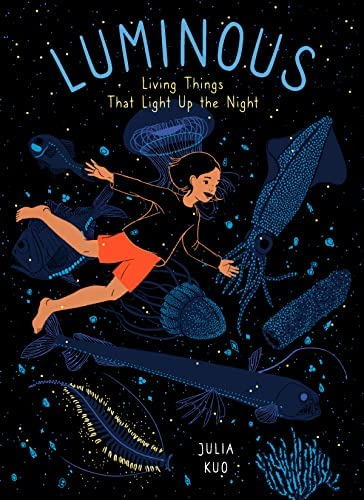
Summary:  A mother and child travel through the night, walking, boating, and swimming to observe bioluminescence in many different forms.  The pages are all in black, making the colors glow brightly.  Each page has a single phrase or sentence in a larger font, then a few sentences in smaller print that give additional information.  A sense of wonder is conveyed in the last few pages, sharing the information that many life forms have yet to be discovered, and encouraging readers to look closely at the world around them.  44 pages; ages 4-10.

Pros:  A beautiful introduction to bioluminescence that will encourage kids to look for other wonders in the world as well.  The illustrations are striking and there is plenty of interesting information.

Cons:  No back matter.