Answers in the Pages by David Levithan

Published by Knopf Books for Young Readers

Summary:  Donovan is a fifth-grade student whose mother challenges the book his teacher assigns, The Adventurers, because she sees the two main characters as being gay.  Gideon and Roberto are two fifth-grade boys whose friendship turns into something more romantic.  Rick and Oliver are the two main characters in The Adventurers, who, along with their friend Melody, are trying to stop an evil genius from stealing the Doomsday Code.  Each story unfolds in alternating chapters until they come together at an important meeting of the school board to decide the fate of the book.  Includes a three-page author’s note acknowledging the work of other authors who write books about LGBTQIA+ characters (many of whom have characters named for them in the story) as well as the work of those defending challenged books.  176 pages; grades 3-7.

Pros:  This book could hardly be more timely, and I appreciate David Levithan’s nuanced writing about this issue. I liked how Donovan’s mother was able to change her position after an honest conversation with her son.  I totally did not see how the stories were coming together at the end and was delighted by that twist.

Cons:  I was reading this book kind of quickly, and it took me a while to figure out the structure with the three alternating stories.

Time to Shine: Celebrating the World’s Iridescent Animals by Karen Jameson, illustrated by Dave Murray

Published by Groundwood Books

Summary: The first page defines iridescence as “the rainbow-like shimmer seen on some bird feathers, fish scales, insect bodies and more.”  Each two-page spread after that shows a brilliantly-colored illustration of the iridescent animal with a rhyming couplet and a paragraph of additional information.  The final two pages show all the animals.  Includes additional information about iridescence (including the recent discovery of a dinosaur with iridescent feathers) and a list of sources.  32 pages; ages 4-8.

Pros:  The gorgeous illustrations are sure to catch kids’ eyes, and the brief but informative text will have them looking for iridescent animals wherever they go.

Cons:  Apparently there are no iridescent mammals.

Being a Dog: A Tail of Mindfulness by Maria Gianferrari, illustrated by Pete Oswald

Published by HarperCollins

Summary:  Can you be like a dog?  Dogs are always in the present, not the past or the future. They stretch when they wake up, then greet the day and the people they love.   Dogs feel their feelings, then let them go.  They play every day, and sniff deeply wherever they go.  And at the end of the day, dogs notice the night, feel their fatigue, and drop and dream.  Includes lists of ways to use each of your senses on a mindfulness walk and a mindful breathing exercise.  40 pages; ages 4-8.

Pros:  A delightful way to teach mindfulness that kids will easily understand and relate to, with Pete Oswald’s fun dog illustrations providing the visuals.

Cons:  Not everyone lives in a climate where they’ll be able to find the things listed on the mindfulness walk.

Lily Leads the Way by Margi Preus illustrated by Matt Myers

Published by Candlewick

Summary:  Lily is a little sailboat who is excited to be greeting a visiting fleet of tall ships.  To get to the harbor, she needs the lift bridge to raise itself and let her through.  She calls out to the bridge, but bigger, louder ships get ahead of her.  She finally makes it through and meets up with the tall ships: a sloop, a schooner, a brig, and a barque.  But none of them has any way to alert the bridge that it needs to let them through again, and it’s up to Lily to find a solution to their dilemma.  Includes an author’s note about lift bridges and her personal experience with sailboats and bridges.  32 pages; ages 3-7.

Pros:  Budding engineers will enjoy seeing all the different types of bridges and ships, and all kinds of kids will appreciate that Lily is the heroine of the story, despite her small size.

Cons:  Some of those big ships were kind of obnoxious.

The First Cat In Space Ate Pizza by Mac Barnett, illustrated by Shawn Harris

Published by Katherine Tegen Books

Summary:  When scientists on Earth discover that a pack of evil rats is eating away at the moon, they realize they only have three days to fix the problem.  The solution?  Send a microchipped cat to the moon to devour the rats.  Thus begins a series of adventures that involve the Moon Queen, a toenail-clipping robot, and a lot of pizza.  This story started out as a collaboration between former high school classmates Barnett and Harris during the 2020 lockdown, and their original videos can be seen on YouTube.  By the end of the book, the rats seem to have been eliminated, but there is sure to be at least one sequel.  316 pages; grades 3-5.

Pros:  As I’ve shown again and again, I have pretty lowbrow literary tastes, so this was a lot of fun for me, and I laughed out loud more than once.  Definitely plan to buy multiple copies for any elementary school library. Dog Man fans, rejoice.

Cons:  Don’t forget to fasten your seatbelt. It’s a wild ride.

Growing Pangs by Kathryn Ormsbee, illustrated by Molly Brooks

Published by Random House Books for Young Readers

Summary:  Kathryn Ormsbee’s memoir begins the summer before sixth grade when Katie and her best friend Kacey are going off to camp for a week.  Katie feels like a bit of an oddball as a homeschooled kid with red hair, crooked teeth, and a secret about the obsessive thoughts she sometimes has when she’s feeling anxious.  Camp turns out to be good, though, except that Kacey starts acting cold when Katie makes a new friend.  Katie hopes that things will get better when their homeschool co-op starts up again, but the two friends seem to be moving in different directions.  On top of that, Katie learns she has to have dental surgery and her obsessive thoughts are getting worse.  A chance to act in a local theater production and a couple of new friends help the situation, but things really start to improve when she’s forced to tell her parents about her anxiety.  The last page sees Katie about to walk into a therapist’s office where she feels hopeful that she can get some help.  Includes an author’s notes with photos from her childhood and an artist’s note showing how she developed the art.  250 pages; grades 3-6.

Pros:  Another one for Raina fans that even deals with some similar topics (dental difficulties, anxiety).  Katie is a character many kids will relate to as she navigates the ups and downs of friendships and the beginnings of puberty.  I loved how the artist portrayed Katie’s OCD thoughts with buzzing bees, and I also loved the support that Katie’s parents showed when they finally found out what was going on with her.

Cons:  I was so curious to know how the therapist appointment went.  I hope we get a sequel.

Swim Team by Johnnie Christmas

Published by HarperAlley

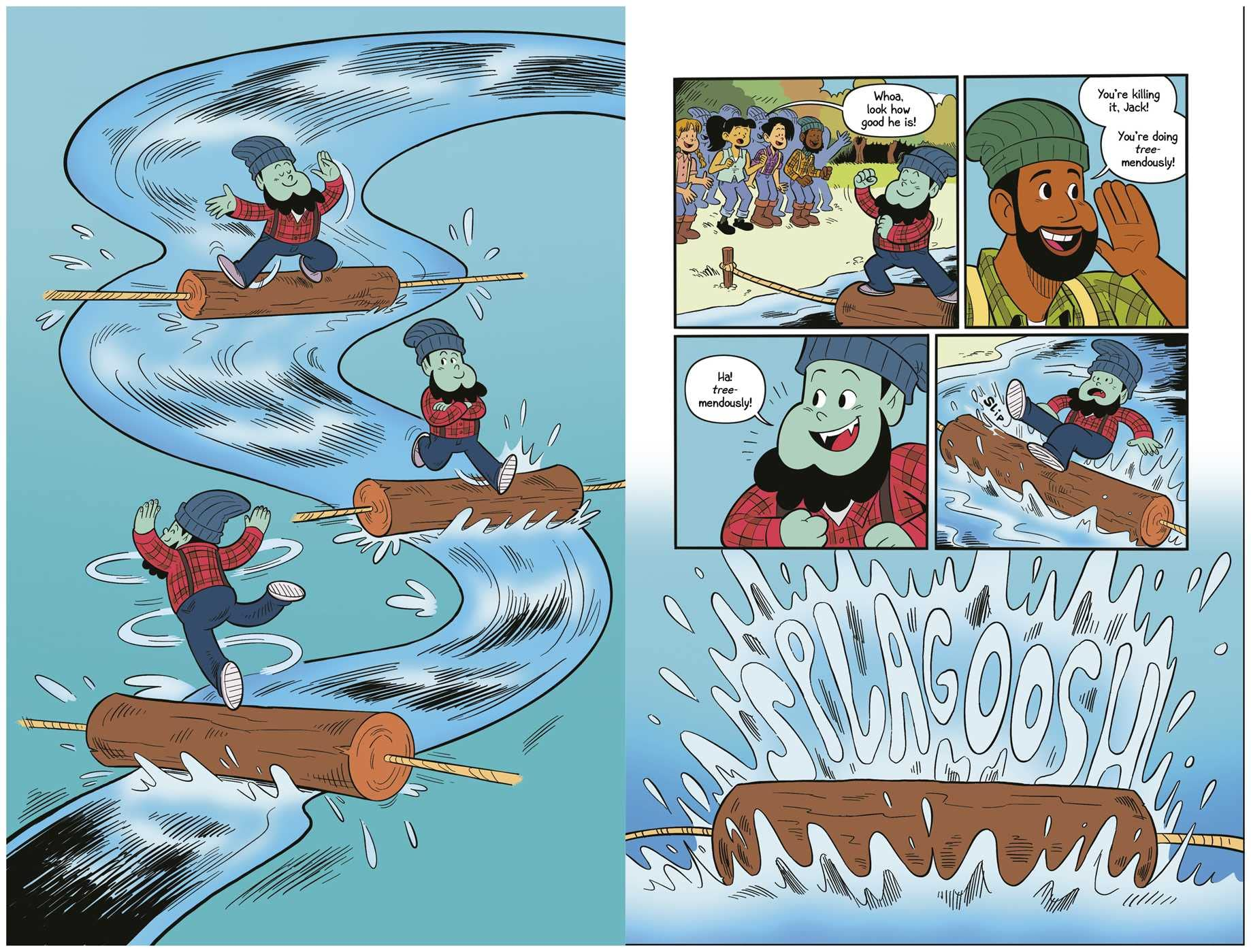
Summary:  Bree’s nervous about her big move with her dad from New York to Florida, but things seem to be going well until she finds out that her sixth-grade elective is Swim 101.  Surrounded by kids who have grown up around pools and the ocean, Bree is embarrassed that she doesn’t know how to swim.  All that changes one day when she accidentally falls into her apartment complex’s pool and is rescued by her neighbor, Miss Etta.  It turns out that Etta was a swimming champion, and she takes Bree under her wing and, step by step, teaches her how to swim.  To raise her Swim 101 grade, Bree agrees to try out for the swim team and to everyone’s surprise–including her own–she’s a natural.  The girls on the team have their ups and downs as they prepare for the big state championship.  When Etta sees their struggles, she decides to reunite with her old swim team, including one woman with whom she hasn’t spoken for decades.  The older women coach the girls to a nail-biting but ultimately entirely satisfying state championship win.  256 pages; grades 3-7.

Pros:  Fans of Raina Telgemeier and Jerry Craft will definitely want to dive into this graphic novel.  The excellent art (I especially love the swimming scenes) and compelling story will have them clamoring for a sequel.  The difficult history Black people in America have had with swimming and racism is seamlessly woven into the present-day narrative.

Cons:  Bree’s journey from non-swimmer to champion seemed a bit unrealistically short.

Those Kids from Fawn Creek by Erin Entrada Kelly

Published by Greenwillow Books

Summary:  The kids in the tiny town of Fawn Creek, Louisiana have known each other for most of their lives.  So it’s a big deal that Renni moved away last year, and an even bigger deal when new girl Orchid shows up in their sixth grade class.  Not only does Orchid have beautiful hair (rumor has it that she’s had it insured), but she tells enchanting stories about her life in New York City and Paris.  Everyone expects her to become part of Janie’s popular crowd, but instead she gravitates toward outcasts Grayson and Dorothy.  The story takes place in the days leading up to a much-anticipated dance in the neighboring town where Renni now lives, and many of the kids find themselves reevaluating their personalities and roles as a result of their interactions with Orchid.  This culminates the night of the dance, when Grayson finally shows his true self, and a bullying incident leads both Dorothy and Janie to see who they really are.  336 pages; grades 4-7.

Pros:  Erin Entrada Kelly has created a memorable cast or characters who are all brought to life through a series of what seem to be small, everyday experiences.  With four starred reviews, this book is likely to be considered for another Newbery Medal or honor to put alongside the two Kelly already has.

Cons:  For the first half of the book, I struggled to keep all the characters straight and was grateful for the list of characters (grouped by clique) on the inside jacket flap.

I’m Not Small by Nina Crews

Published by Greenwillow Books

Summary:  Asa feels big when he’s allowed to go outside by himself.  He’s also big when he compares himself to his dog, his cat, his rabbit, the birds, a bee, and especially an ant.  He could crush the ant with his foot but decides he’d rather watch it carry a big crumb instead.  Asa loves being big, but when his mom comes out to tell him breakfast is ready, he is happy to go back to being small and let her carry him inside.  32 pages; ages 3-6. 

Pros:  Preschoolers will relate to Asa’s observations about size and the natural world.  The illustrations, described as “digitally drawn and collaged…incorporating photographs and textures created by the artist,” are unique and beautiful.

Cons:  A scary bee.

Gigi and Ojiji by Melissa Iwai

Published by HarperCollins

Summary:  Gigi is excited that her grandfather, Ojiisan, is coming from Japan to live with her and her family.  She makes a picture to give him at the airport, but when they finally meet, Gigi is disappointed.  Ojiisan doesn’t hug her, he struggles with English, and when Roscoe has an accident, Ojiisan says that dogs belong outdoors.  Fortunately, Mom explains a few cultural differences, and before long Ojiisan has become Ojiji and he and Gigi are having a great time together.  32 pages; ages 4-8.

Pros:  An engaging early reader.  Kids with families who come from other countries or who speak different languages will appreciate some of Gigi’s hesitancy and can learn from her how to overcome cultural obstacles.

Cons:  I’m hoping this is a series starter, but I can’t find any evidence of book 2.