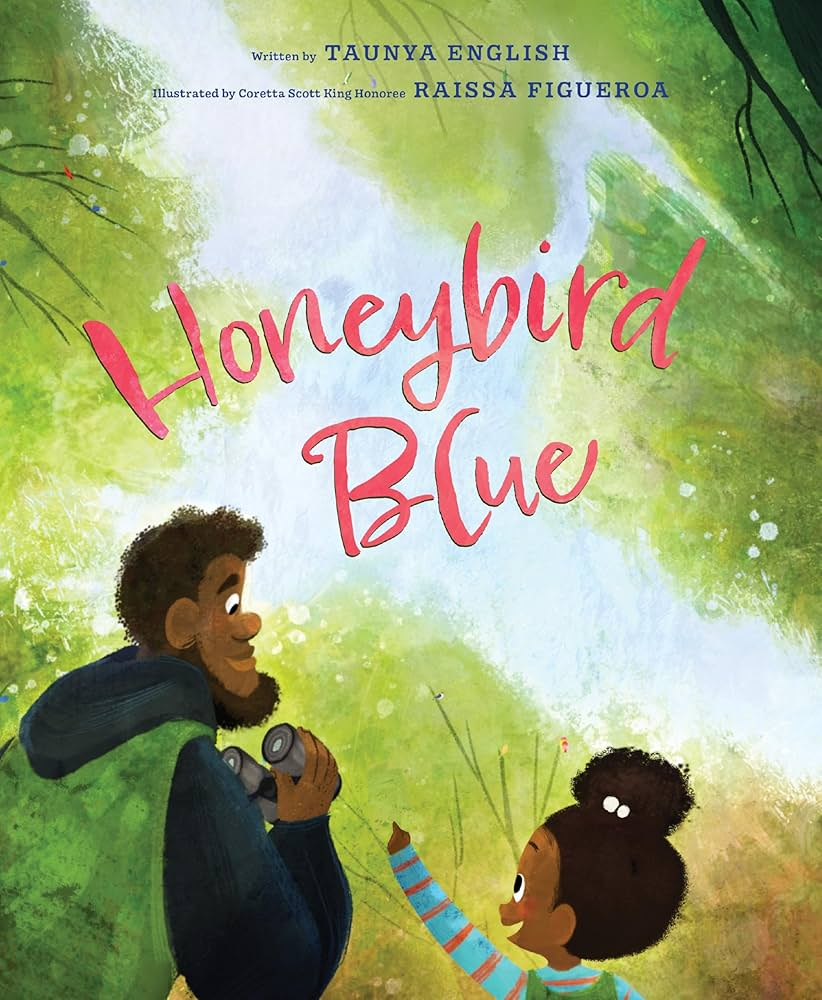
Honeybird Blue by Taunya English, illustrated by Raissa Figueroa (HarperCollins, 40 pages, ages 4-8). Honeybird and Pop get up before the sun to head into the John Heinz National Wildlife Refuge in Philadelphia for a day of birding. Honeybird has a list of birds by color that she hopes to see, and she’s sure today will be the day that she finally sees Blue: the great blue heron, who has skinny legs and a topknot just like her. Off they go, and as the day progresses, they see Yellow (yellowthroats), Green (mallards), Grey (woodpeckers), Black (blackbirds), Brown (geese)…but no Blue. Pop reminds Honeybird that “birding is seeing what you see,” but she’s still disappointed as they head back to the car. Right before they go, they gather in a circle with other birders, each one naming a favorite bird (“Honeybird,” says Pop). Just as they pose for a photo…there’s Blue! Flying in the sky, then landing nearby so that Honeybird gets a good look and makes the last tick on her list. Includes a birding glossary as well as pictures and additional information about all the birds in the book, including the honeybird.
This lovely book with illustrations by Coretta Scott King Honoree Figueroa is an excellent introduction to birding with an enthusiastic and knowledgeable main character. It would also make a nice Father’s Day gift and might inspire a father-child outing into nature.
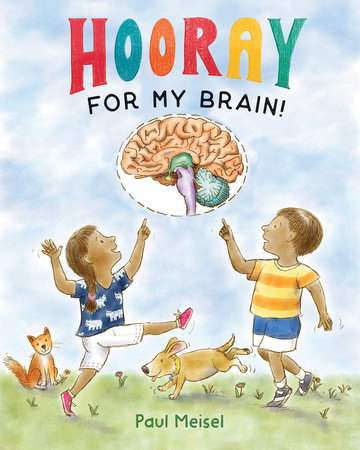
Hooray for My Brain! by Paul Meisel (Holiday House, 32 pages, grades K-4). “Look at us!” two kids call from the first page. “We can run! We can read and play the drums! We can jump and draw and throw and talk!” And it’s all thanks to their brains. They then get into the details, introducing readers to the way the brain connects to the spinal cord and nerves to allow our bodies to do so many amazing things. Information on the structure of the brain shows which lobes are responsible for which bodily functions. Glands located in the brain–the pituitary and the hypothalamus–are described. “Hooray for my brain!” the narrators say in unison as they ride their bikes off the last page. Includes a glossary.
Theodor Seuss Geisel Honoree has created a science book that’s accessible for younger readers but doesn’t shy away from challenging vocabulary and complex concepts. The illustrations play a big role in providing clarity, and showing the two kids on many of the pages helps readers understand how different parts of the brain make different activities possible. Kids may want to do additional research on some of the concepts introduced, and a list of resources would have made a nice addition.

