Moto and Me: My Year As a Wildcat’s Foster Mom by Suzi Eszterhas

Published by Owlkids
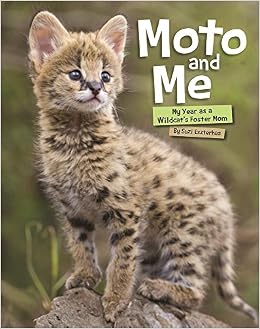
Summary:  While trying to rescue her kittens from a fire, Moto’s mother was scared by a truck and dropped one of them in the road.  The tourists on the truck didn’t see the mother.  Thinking they were rescuing the tiny serval, they took it to a ranger station.  By the time they got there, the ranger knew Moto’s mother would never take her kitten back, so he was given to Suzi Eszterhas, who was working as a wildlife photographer.  She became his foster mom, taking care of him, but also making sure that he followed his instincts and learned how to live in the wild.  As Moto grew up, he spent increasingly long periods of time in the wild until one day he didn’t return.  Eszterhas feared the worst, but a week later, she spotted him, and he came over to her jeep to greet her.  He was seen again several times by rangers, and Suzi knew she had succeeded as a serval foster mom.  Includes a page of facts about servals.  40 pages; grades K-5.

Pros:  An engaging nonfiction narrative that kids could read for either pleasure or research.  Eszterhas is a wildlife photographer, so the many photos are cute and captivating.

Cons:  I’m not really sure how to pronounce “serval”.
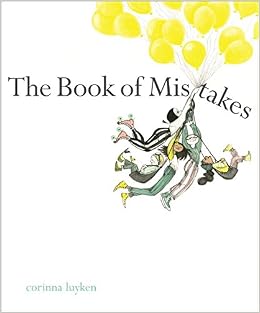
The Book of Mistakes by Corinna Luyken

Published by Dial Books

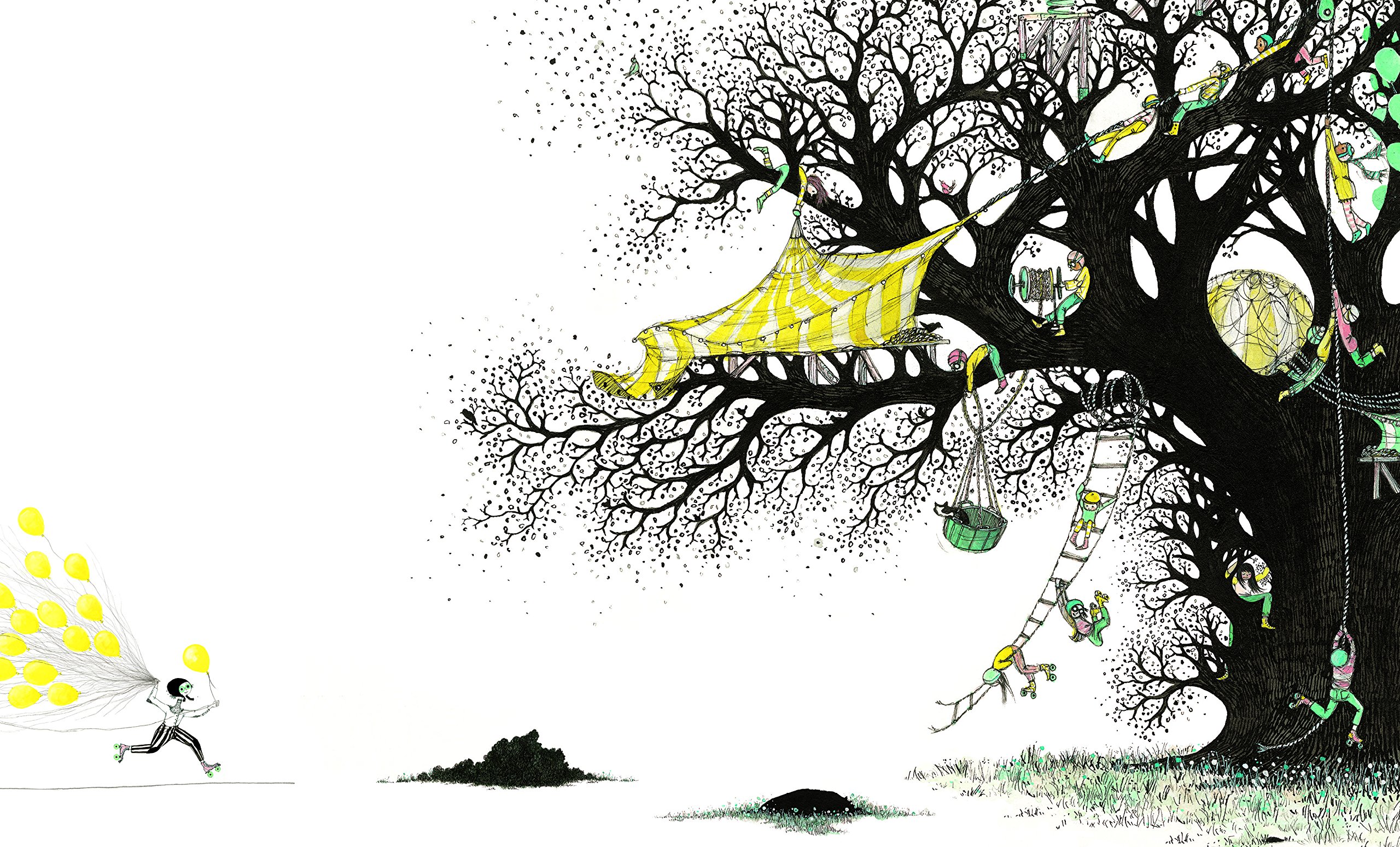
Summary:  Is it a mistake or an opportunity to be creative?  When an artist draws a girl with two different-sized eyes, glasses fix the problem.  When her feet don’t quite meet the ground in the picture, the addition of a pair of roller skates makes it look better.  A strange frog-cat-cow animal becomes a nice-looking bush.  Before long, the page is filled with an imaginative collection of people and animals doing all kinds of activities in a gigantic tree house.  Gradually, the artist moves away from the scene until it appears to be incorporated into the glasses girl’s head…and that girl is starting all over with a new picture.  56 pages; ages 4-8.

Pros:  The beautiful and intricate illustrations convey the message that it’s okay to make mistakes.  There is always a way to fix them, often making the new product better than the original.

Cons:  I found the last few pages confusing.

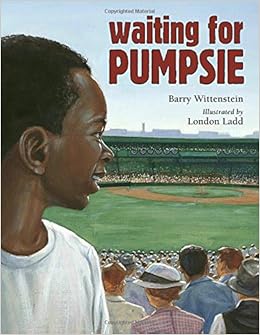
Waiting for Pumpsie by Barry Wittenstein, illustrated by London Ladd

Published by Charlesbridge

Summary:  Bernard lives in Boston and is “crazy, crazy, crazy” about the Red Sox.  He wants them to win, but his mom tells him they have to root for colored players.  It’s 1959, and Boston has the not-so-proud distinction of being the last team in the MLB to integrate.  Jackie Robinson has been retired for two years, and Hank Aaron and Willie Mays are big stars on other teams.  Bernard follows the “Negro stars” on the Celtics and Bruins teams, but the Red Sox remain all white.  Then, during spring training, he hears about Elijah “Pumpsie” Green, a new player in the minor leagues.  Bernard prays that Pumpsie will move up, and in July, it finally happens.  The whole family crowds around the radio to listen to his first game, and when he finally gets up in the eighth inning, Dad wipes tears away as he tells Bernard he can never forget this moment.  The next day, the whole family goes to Fenway to watch Pumpsie, and “for once, the stands are packed with colored faces.”  When Green hits a triple, it feels like a combination of New Year’s Eve and the Fourth of July, and Bernard sees celebrations going on all the way back home.  Includes an author’s note and four additional sources.  32 pages; grades K-4.

Pros:  An interesting look at a little-known chapter in the story of baseball integration.  The realistic paintings of the action at Fenway Park will be enjoyed by Red Sox fans.  And all fans should know the shameful history of Boston’s segregationist policies, led by Tom Yawkey, the 44-year owner of the team and namesake of Fenway’s Yawkey Way.

Cons:  No photos.

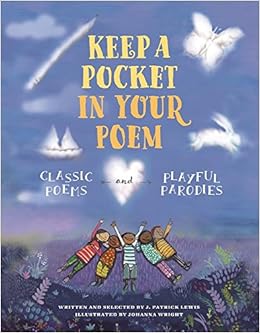
Keep a Pocket in Your Poem: Classic Poems and Playful Parodies written and selected by J. Patrick Lewis, illustrated by Johanna Wright

Published by WordSong

Summary:  Former U.S. Children’s Poet Laureate J. Patrick Lewis has put together a collection of thirteen (counting the one on the back cover) well-known poems, along with his parodies of them.  For instance, Robert Frost’s “Stopping By Woods on a Snowy Evening” is turned into “Stopping By Fridge on a Hungry Evening”, and Emily Dickinson’s “Hope Is the Thing With Feathers” becomes “Grief Is the Thing With Tissues”. The original poem is included with the new version.  Lewis explains what he has done in his introduction, and invites kids to write their own parodies, or “parroty’s”, as he calls them.  32 pages; grades K-5.

Pros:  A fun way to introduce kids to poetry, as well as providing an extension activity for those wanting to dive deeper.  The cute, colorful illustrations include a multicultural cast of children.

Cons:  To me, the word parody denotes a certain degree of mocking the original, which is clearly not Lewis’s intention here.

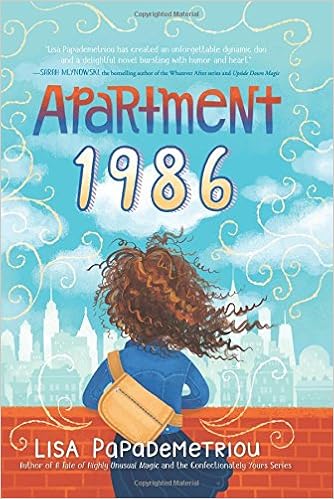
Apartment 1986 by Lisa Papademetriou

Published by HarperCollins

Summary:  On page 214, Callie has just gotten to school late after trying, unsuccessfully, to defend her younger brother from a bully.  She’s (sort of accidentally) skipped school all week.  Placement tests for eighth grade are about to start, and her history teacher is ordering her to get to her homeroom so she won’t be late.  Callie is failing history, a fact that she has hidden from her parents, who already have enough to worry about since her father lost his lucrative new job.  At that moment, Callie’s new friend Cassius, who is going blind, calls to tell her he’s lost in the subway and needs her to come help him.  There’s more, including a grandmother still mourning the loss of her son, who was estranged from his parents after coming out as gay; two wealthy friends who keep asking Callie for the $250 she owes them; and the man in Apartment 1986 of her grandmother’s building, who might be her grandmother’s new boyfriend, and whose apartment seems to be a sort of time machine back to the year 1986.  272 pages; grades 4-7.

Pros:  The pace is fast and furious, all told in Callie’s funny, honest voice.  Callie tries to be an optimist, no matter what, but by the end of the story, she’s learned that life is both sunshine and shadows, and the best you can do is try to tell the truth about it and hang on to the people you love.

Cons:  As someone who actually lived through 1986, I wouldn’t choose it for a time-travel destination.

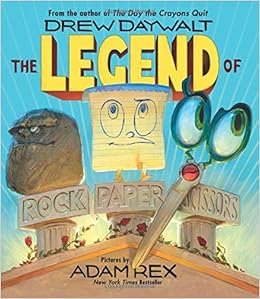
The Legend of Rock Paper Scissors by Drew Daywalt, pictures by Adam Rex

Published by Balzer + Bray


Summary:  Ever wonder where the game rock, paper, scissors came from?  Well, kids, it all started in the Kingdom of the Backyard where dwelt the mighty warrior Rock.  No one could defeat him, as he demonstrates in battles with Clothespin and Peach.  His victories bring him no joy, and he leaves the kingdom in search of a worthy foe.  A similar drama is played out with Paper in the Empire of Mom’s Home Office, and Scissors in the Kitchen Realm.  The three eventually meet up in the great cavern of the Two-Car Garage, where, you guessed it, Rock beats Scissors, Paper covers Rock, and Scissors cut Paper.  All three are so happy to have found a worthy opponent that they continue to re-enact their epic battles.  Which is why children everywhere honor these valiant warriors to this day by playing…that’s right: Rock, Paper, Scissors.  48 pages; ages 4-8.

Pros:  This gets my vote for the 2017 book I most want to read to first graders (so far!).  I can envision hordes of 5- , 6- , and 7-year-olds rolling on the floor with laughter over both the story and the pictures.  Have fun with this!

Cons:  Be prepared for the words “butt” and “underwear” if you read this out loud (see illustrations).  Which in part explains the rolling on the floor.

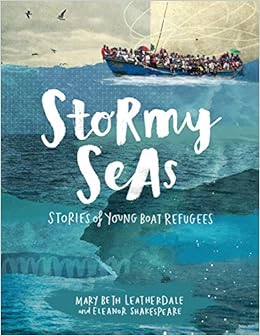
Stormy Seas: Stories of Young Boat Refugees by Mary Beth Leatherdale, illustrated by Eleanor Shakespeare

Published by Annick Press

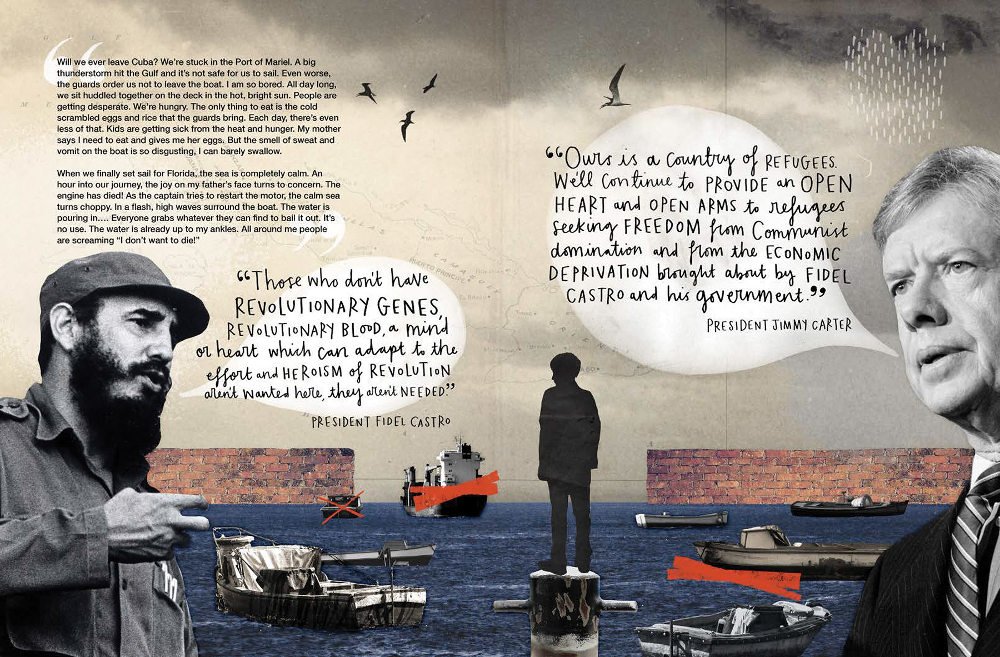
Summary:  Sixty five million people worldwide have been forced to leave their homes due to war, persecution, or natural disaster. Many of them, including a large number of children, are seeking refuge in countries in Europe and North America.  This book profiles five refugee kids from Germany, Vietnam, Cuba, Afghanistan, and Ivory Coast over the last 60 years.  They have undertaken dangerous journeys by boat, been attacked by pirates, been turned back from their original destinations, and have often arrived in an unknown place with little more than the clothes on their backs.  Yet each one has worked hard and become a productive citizen of his or her new country.  Each profile includes the narrative of the subject, much of it in his or her own words, a timeline of the journey, and a “What happened to?” section that tells the happy ending to each story.  Includes timelines and a list of resources.  64 pages; grades 4-7.

Pros:  Readers will empathize with the refugees’ stories, and by extension, the plight of refugees everywhere.  Fans of the “I Survived” series will find these suspenseful real-life survival tales riveting reading.  The collage illustrations add interest.

Cons:  There are some disturbing details, like the 14-year-old girls from Vietnam who are taken off the boat by marauding pirates.

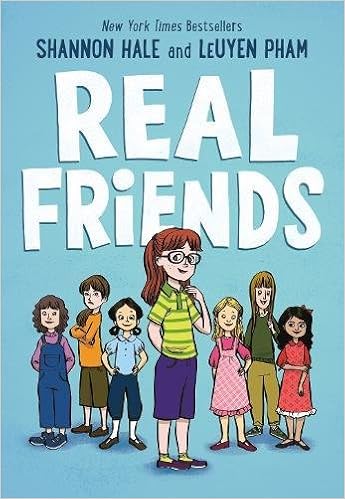
Real Friends by Shannon Hale, illustrated by LeUyen Pham

Published by First Second

Summary:  Shannon Hale recounts her elementary school days, starting with her first friend, Adrienne, whom she met in kindergarten.  Shannon loved creating imaginary games, and Adrienne was an enthusiastic participant.  Adrienne’s family moved away for a year.  When they returned to the neighborhood, things had changed.  Adrienne befriended second-grade ringleader Jen, and Shannon found herself on the outer fringes of the clique, desperately trying secure her position.  Things were pretty rough at home, too, being stuck in the middle of five children and often bullied by a troubled older sister.  Finally, in fifth grade, Shannon declared her independence from the clique and learned to make her own good friends.  Much to her surprise, Jen admired her independence and became a friend as well.  In an author’s note, Shannon Hale tells more about her childhood, and her class pictures from elementary school are included at the end as well.  224 pages; grades 3-6.

Pros:  Brought to you by the creators of the Princess in Black series, this heartfelt memoir with its message of being yourself will be a hit with fans of Smile, El Deafo, and Roller Girl.

Cons:  Shannon’s life got pretty depressing about halfway through the book.  (Don’t worry, it all turns around for a happy ending.)

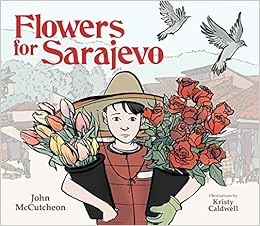
Flowers for Sarajevo by John McCutcheon, illustrated by Kristy Caldwell

Published by Peachtree Publishers

Summary:  Drasko helps his father sell flowers on the streets of Sarajevo.  But when war comes to their city, his father has to go away to fight.  Drasko is left on his own, and the older merchants push him away from the prime selling locations to a corner of the square.  The only good thing about his location is that he backs up to a concert hall and gets to hear the orchestra play.  One terrible day, at ten o’clock in the morning, a bomb falls on a nearby bakery, killing 22 people who were waiting to buy bread.  The next morning, when the clock strikes ten, a cellist from the orchestra comes out to the street and plays a sad and beautiful melody.  He continues to play every day at ten o’clock for 22 days, one day for each person killed by the bomb.  Slowly, life begins to return to normal in the square again, and Drasko works hard to do his part to make it beautiful once more.  Includes information about the Balkan region and Sarajevo, an author’s note about the events that inspired this story, additional resources, and the words and music to the author’s song, “Streets of Sarajevo”.  The book comes with a CD that includes this song and Albinoni’s Adagio in G Minor, the song played by Vedron Smailovic, the cellist in the story.  32 pages; grades 3-7.

Pros:  A sad, moving, and ultimately hopeful story about a part of history kids may not know much about.  The muted illustrations complement the story.  The musical tie-in adds another interesting element to the book.

Cons:  Definitely a picture book for older elementary and middle school students, needing adult support to fully understand the story.

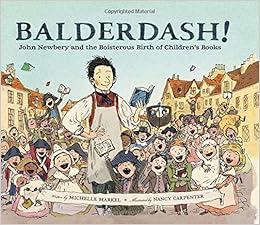
Balderdash! John Newbery and the Boisterous Birth of Children’s Books by Michelle Markel, illustrated by Nancy Carpenter

Published by Chronicle Books

Summary:  Pity the poor children growing up in early eighteenth century England.  Although there were plenty of books around for adults, kids only got preachy poems, sermons, and books of rules about manners and such.  Fortunately for them, a young printer named John Newbery thought they deserved better.  The fact that his books were entitled A Little Pretty Pocket-Book and The History of Little Goody Two-Shoes and became overnight bestsellers demonstrates what a deplorable condition children’s literature was in at that time.  John continued to work throughout his career to produce popular books for kids, and we remember him every January when the Newbery Medal is awarded to the book that has made “the most distinguished contribution to American literature for children”.  An author’s note gives additional biographical information.  44 pages; grades K-4.

Pros:  A lighthearted look at the life of a man whose name many librarians and teachers know, but whose life we are less familiar with.  Readers will appreciate the wealth of children’s literature that has grown since Mr. Newbery’s time.

Cons:  The subject may be of greater interest to adults than to kids.