I Dissent: Ruth Bader Ginsburg Makes Her Mark by Debbie Levy, illustrated by Elizabeth Baddeley

Published by Simon and Schuster 
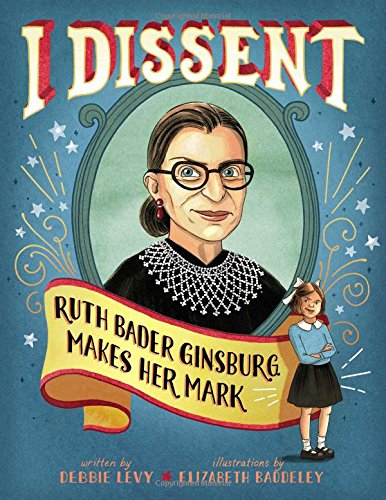
Summary:  Growing up in the 1940’s, Ruth Bader noticed many prejudices and injustices.  There were hotels and restaurants that banned her family because they were Jewish.  Girls weren’t expected or encouraged to do many of the things boys could do.  Even as a left-handed person, Ruth faced discrimination, getting a “D” in penmanship when she was forced to write with her right hand.  Ruth’s mother took her to the library and encouraged her to get an education; although she died the day before Ruth’s high school graduation, Ruth persisted and went to college and law school.  Overcoming the difficulties of being hired as a female lawyer, she eventually became a law professor, then a judge.  In 1993, Ruth Bader Ginsburg was appointed to the Supreme Court.  Throughout her career, up to the present day, she has fought for the rights of those who experience discrimination.  Now the oldest member of the Supreme Court, there are those who think it’s time for her to retire.  Ruth Bader Ginsburg dissents.  Includes an extensive author’s note with additional biographical information, notes on the Supreme Court cases mentioned in the text, and a bibliography.  40 pages; grades 1-4.

Pros:  The first picture book about this woman who continues to inspire.  Building Ruth’s story around her experiences with discrimination and passion for justice gives the story a good focus.  The illustrations add a bit of humor and incorporate some of the text into the pictures.

Cons;  Those whose politics don’t match Ginsburg’s may disagree with the way some of the Court cases are described.

I
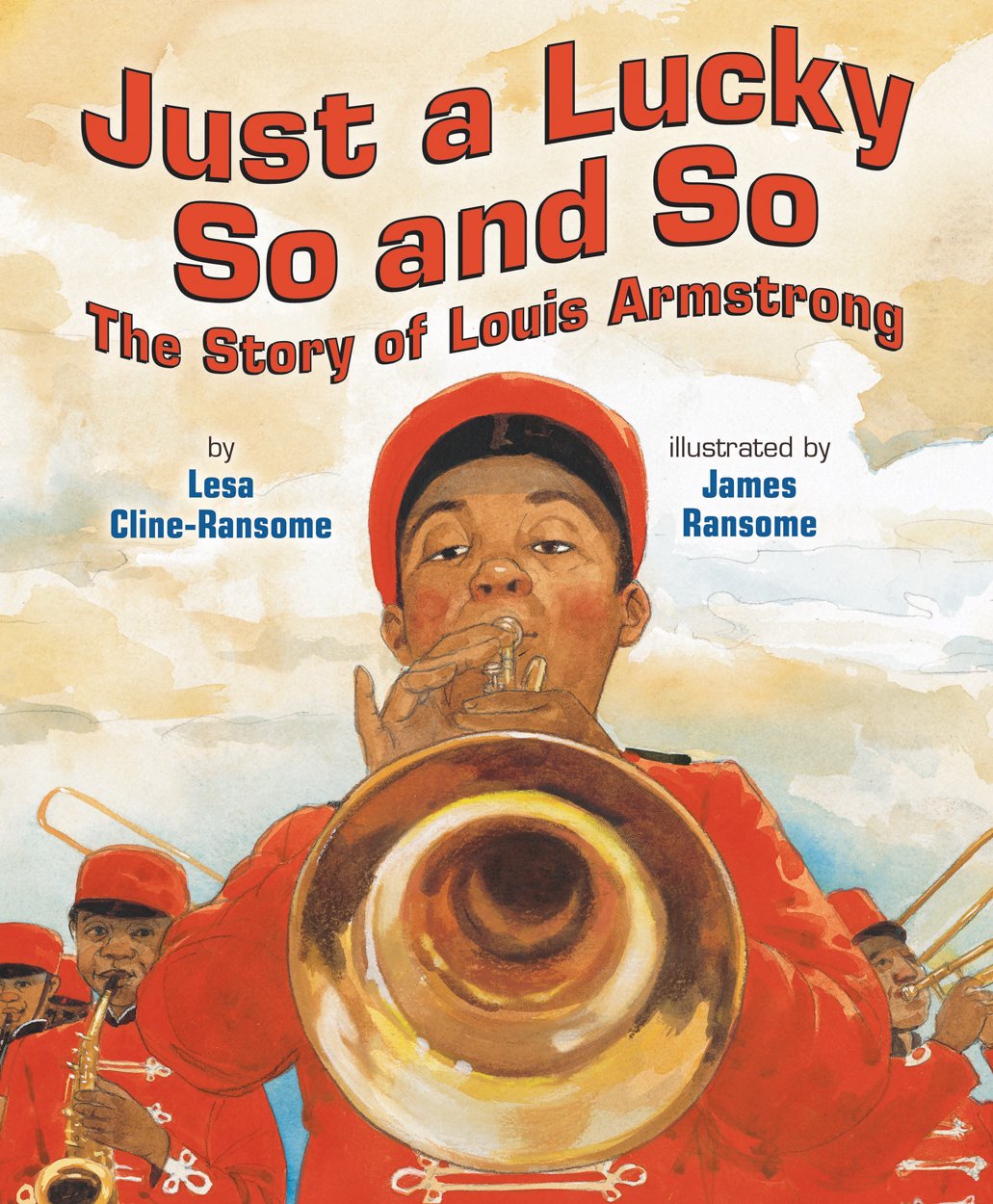
Just a Lucky So-and-So: The Story of Louis Armstrong by Lesa Cline-Ransome, illustrated by James Ransome

Published by Holiday House 

Summary:  Louis Armstrong considered himself to have led a lucky life, but his early days weren’t always so auspicious.  Born in The Battlefield, a tough part of New Orleans, young Louis started working at an early age to help his single mother.  He was surrounded by music, and a pawnshop cornet allowed him to begin to make his own tunes.  After shooting off a gun on New Year’s Eve, Louis was sent to reform school, where he worked his way up to bandleader.  After his stint there, he returned to his old neighborhood and pursued his career in earnest.  The book ends with him newly arrived in Chicago, being cheered on by the crowd to come forward and blow his horn.  A full-page author’s note gives more information on Armstrong’s life, and another page has resources for further research, including places to visit.  40 pages; grades 1-4.

Pros:  The large, full-color illustrations nicely complement the somewhat spare lyrical text.  The end matter gives plenty of material for researchers.

Cons:  The large number of people and places in a relatively short story was a little confusing.  Also, the quotes from Armstrong throughout the text aren’t cited.

Tiny Stitches: The Life of Medical Pioneer Vivien Thomas by Gwendolyn Hooks, illustrated by Colin Bootman

Published by Lee & Low Books 

Summary:  Vivien Thomas dreamed of becoming a doctor, but when the Great Depression hit, he lost all his college savings.  Determined to pursue a medical career, he found a job as a research assistant for Dr. Alfred Blalock at Vanderbilt University.  Vivien proved to be a quick study and soon was conducting his own experiments and mastering surgical skills like suturing blood vessels.  In 1941, Dr. Blalock was offered a job at Johns Hopkins University.  He accepted it on the condition that Vivien would go with him.  At Johns Hopkins, the two men met Dr. Helen Taussig, a pediatric cardiologist who was trying to find a cure for so-called “blue-babies” whose skin turned blue because of a heart defect.  Vivien Thomas ended up doing a large portion of the research, developing a procedure, and designing a needle tiny enough to do the surgery.  When Dr. Blalock performed the ground-breaking surgery in 1944, it was Vivien who stood behind him and coached him, a role he would continue to play after the first surgery was a success.  More than a quarter of a century went by before Vivien finally got the recognition he deserved, having his portrait hung in Johns Hopkins Hospital and being awarded an honorary doctorate.  Back matter includes more information about the surgical procedure and Vivien Thomas, as well as a medical glossary and sources.  32 pages; grades 2-5.

Pros:  A compelling story of a little-known African-American scientist who overcame a myriad of prejudices to make an important contribution to medicine.  Kids who find this book interesting may want to read last year’s Breakthrough! How Three People Saved “Blue Babies” and Changed Medicine Forever by Jim Murphy.

Cons:  There is a lot of text and somewhat technical information for a picture book.

Mountain Chef: How One Man Lost His Groceries, Changed His Plans, and Helped Cook Up the National Park Service by Annette Bay Pimentel, illustrated by Rich Lo

 Published by Charlesbridge


Summary:  In 1915, there were eleven national parks, but no service to administer them.  Assistant Secretary of the Interior Stephen Mather knew the country needed one, but couldn’t get through the Washington red tape to set it up.  To convince lawmakers, he organized a two-week camping trip through the mountains of California, and hired Tie Sing, a Chinese American trail cook reputed to be the best.  Tie Sing had his hands full, transporting and preparing such delicacies as frogs’ legs and Lyonnaise potatoes, and serving them on a table set with a tablecloth and fine china.  Along the way, he lost a couple of mules packed with supplies and food, and often had to improvise.  He succeeded in keeping the campers well-fed and happy, though, and the National Parks Service will celebrate its 100th birthday on August 25. Back matter includes more information about Tie Sing, the expedition, and several members of the party.  40 pages; grades 1-5.

Pros:  A fascinating story about a little-known man; Pimentel and Lo have succeeded admirably in bringing to life someone about whom very little is known.  There’s a lot of text, but the story is so engaging that this would make an excellent read-aloud.  As someone who has camped all over the U.S. and Canada, I appreciated Stephen Mather’s philosophy: “Give a man a poor breakfast after he has had a bad night’s sleep and he will not care how fine your scenery is.”

Cons:  It’s my opinion that any activity that involves English plum pudding with brandy sauce, peaches and cream, and a heavy linen tablecloth cannot really be described as “camping”.

The William Hoy Story by Nancy Churnin, pictures by Jez Tuya

Published by Albert Whitman and Company 

Summary:  When William Hoy graduated from high school in 1879, there wasn’t much chance of a deaf man making it in the world of professional baseball.  But Hoy was talented, hard-working, and determined, and he managed to snag a spot on a minor league team in Oshkosh, Wisconsin.  He loved the game, but often ran into trouble when he couldn’t hear the umpire make the calls.  After a humiliating incident in which he didn’t know he had struck out, Hoy came up with the idea of the ump using hand signals…the same signals that are used today.  Eventually, he went on to great success as a major league player with the Washington Senators, and lived a long and happy life, throwing out the first pitch of the World Series in 1961 at the age of 99.  Back matter includes author’s note and a timeline.  32 pages; grades K-3.

Pros:  A fun and inspirational baseball story about a little-known player who overcame difficulties and changed the game.

Cons:  Hoy’s nickname of “Dummy” (mentioned in the author’s note, not the main text) will need some explanation.


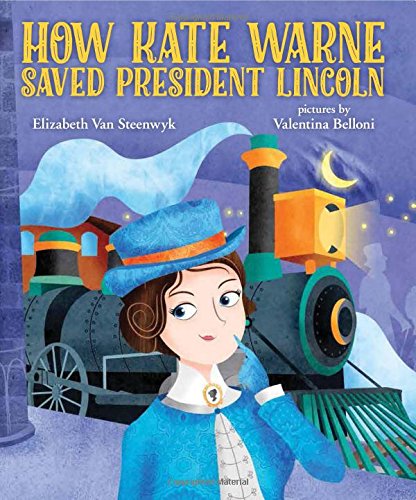
How Kate Warne Saved President Lincoln by Elizabeth Van Steenwyk, pictures by Valentina Belloni

Published by Albert Whitman and Company


Summary:  When Kate Warne walked into the Pinkerton Detective Agency in 1856, Allan Pinkerton had never considered hiring a woman to be a detective.  But Warne convinced him that women could go undercover in a variety of ways that men could not, and soon she was a valuable member of the world’s first detective agency.  She successfully worked on a number of cases, but her most famous was helping to thwart an assassination plot against Abraham Lincoln as Lincoln traveled from Illinois to Washington, D.C. to begin his term as President.  Kate infiltrated the group that was planning to kill the President, and learned that they had vowed to not let him leave Baltimore alive.  She and other detectives from the agency worked all night to make sure Lincoln got safely through the city, onto Philadelphia, and finally to Washington.  An author’s note tells a bit more about Kate Warne’s life, although little is known; a brief bibliography is also included.  32 pages; grades 1-4.

Pros:  Kate’s escapades make interesting and exciting reading, particularly given how difficult it was for women to have successful careers in her time.  The bright cartoon-like illustrations are appealing.  See last year’s The Detective’s Assistant by Kate Hannigan for an entertaining fictional account of Warne’s life.

Cons:  It’s frustrating that Kate Warne’s early life is a complete unknown.

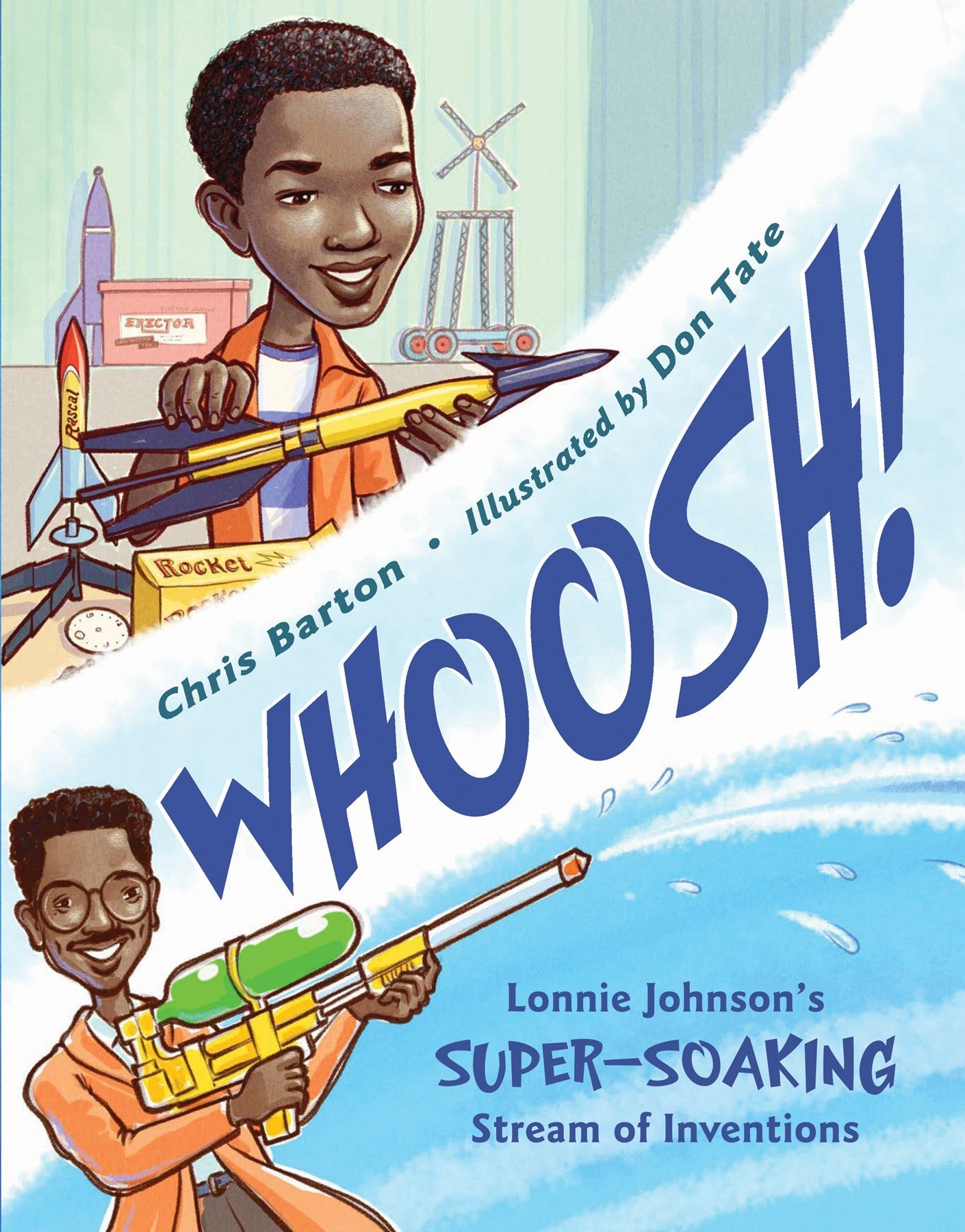
Whoosh! Lonnie Johnson’s Super-Soaking Stream of Inventions by Chris Barton, illustrated by Don Tate

Published by Charlesbridge

Whoosh!: Lonnie Johnson's Super-Soaking Stream of Inventions: Barton,  Chris, Tate, Don: 9781580892971: Amazon.com: Books

Summary:  When Lonnie Johnson was growing up in Alabama, his small house and large family didn’t leave him with much space to do what he loved best…invent.  Still, he had supportive parents (when his rocket fuel caught fire in the kitchen, his mom just sent him outside) and a lot of perseverance.  His hard work paid off in high school, when his robot won first place at a science fair at the University of Alabama—a school that African-American students like Lonnie hadn’t been allowed to attend just a few years before.  Lonnie graduated from Tuskegee, then went on to work for NASA, but he kept inventing in his spare time.  While testing an environmentally-friendly cooling system, he serendipitously invented the Super Soaker water gun.  This hit toy has given Lonnie enough income to allow him to continue working on his inventions full-time.  The author’s note explains how he learned about kids’ stereotypical ideas about scientists, leading him to write a biography of a man who doesn’t fit those stereotypes. 32 pages; grades 1-5.

Pros:  Kids will connect with this hard-working, but fun-loving scientist who invented a much-loved toy; teachers will make connections to science and African-American history curriculum; and librarians will enjoy using this book to tie in with their maker spaces.

Cons:  It seemed to me that Lonnie Johnson was a bit hasty in disregarding the advice, “Don’t quit your day job”.

Dorothea’s Eyes by Barb Rosenstock, illustrated by Gerard DuBois

Published by Calkins Creek 

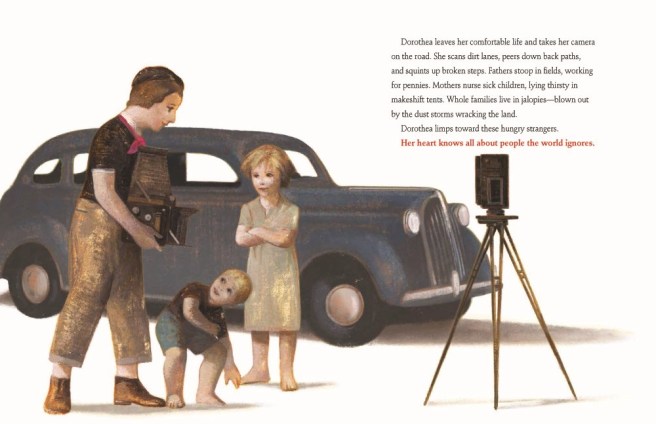
Summary:  Young Dorothea was a keen observer, often feeling like an outsider after a childhood bout of polio left her with a limp.  At the age of 18 she decided to become a photographer, even though she had never handled a camera.  She worked in a number of studios, first in New York, then in California, where she learned the art of taking pictures, eventually setting up her own portrait studio in San Francisco.  But she felt unfulfilled taking photos of wealthy people.  In the midst of the Great Depression, she took to the streets, photographing the poor and neglected, traveling across the country, and waking people up to the poverty that was sweeping the nation.  Although she was plagued with ill health for many years, Dorothea continued to be a crusader with her camera, both in the United States and abroad.  End matter includes several of Lange’s photographs, an author’s note, a timeline, and resources for further research.  40 pages; grades 1-5.

Pros:  An interesting biography of an inspiring woman who followed her heart to do work that made a difference.  The unique illustrations have an appropriately vintage feel to them.

Cons:  I really liked Dorothea Lange’s quote on the bibliography page.  Too bad it couldn’t have been worked into the text.

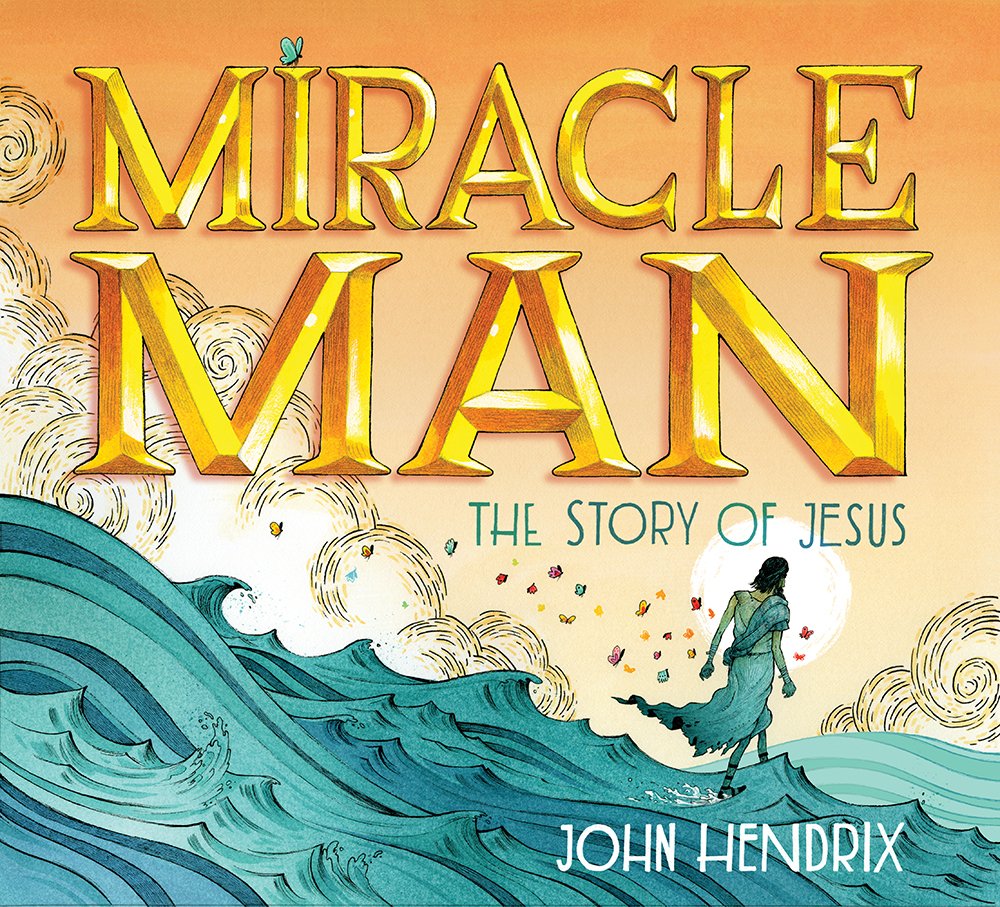
Miracle Man: The Story of Jesus by John Hendrix

Published by Abrams Books for Young Readers

Amazon.com: Miracle Man: The Story of Jesus (9781613758717): John ...


Summary:  The story of Jesus’ life is told from a Christian perspective, with an emphasis on miracles he performed.  The narrative begins with him calling his disciples from among the fishermen, then continues with various healings, Jesus calming the waves and walking on the water, and the miracle of the loaves and fishes.  His last supper is recounted, followed by his crucifixion, which is alluded to, but not shown in the pictures (something this reader, who was traumatized as a child by a book called The Easter Story for Children, appreciated).  The resurrection is covered in two pages, one showing a wrapped body lying in a tomb, the next showing Jesus in white, standing outside the tomb, and the sentence, “But God’s Son, Jesus, the Miracle Man, had in store one last glorious miracle…”  An author’s note explains how he came to create this book, and the process of choosing from among the stories of Jesus in the Bible, which necessarily left out some of the story.  40 pages; grades K-4.

Pros:  The beautifully designed illustrations, incorporating some of Jesus’ words into the pictures, are worthy of Caldecott consideration (would a group of 21st-century librarians recognize a book that is clearly written from a Christian perspective?).  The simple text is a good introduction to Jesus’ miracles and many aspects of his life.

Cons:  As noted by the author, this is a selection of stories, and some key parts of Jesus’ life (birth, John the Baptist, Sermon on the Mount, Mary Magdalene) are excluded.

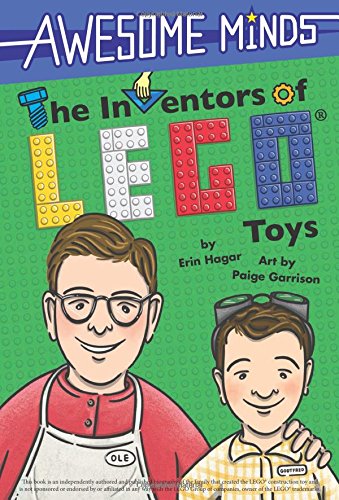
Awesome Minds: The Inventors of Lego Toys by Erin Hagar, art by Paige Garrison

Published by Duo Press 

Summary:  When Ole Kirk Christiansen made the decision to change careers from carpenter to toymaker, he couldn’t have predicted the impact he would ultimately have on the world.  His family-owned business became the LEGO company.  After World War II, Ole Kirk decided to switch from wooden toys to plastic.  His son Godtfred took over the business, and ultimately made the fateful decision to focus on one toy—the sets of LEGO bricks the company had begun manufacturing in 1949.  Of course, this expanded to the LEGO empire we know today.  The story goes up to the present, with a couple pages devoted to the development of LEGOLAND and some of the amazing ideas that have come out of the LEGO company.  Includes a glossary, index, and book list of other books about inventors.  48 pages; grades 2-5.

Pros:  Filled with colorful illustrations and interesting sidebars on almost every page, this engagingly written biography/history will entertain and education LEGO fans everywhere.

Cons:  Should we be afraid that if minifigs got together to form their own country, it would be greater than the population of the United States, China, India, Indonesia, Brazil, Pakistan, Nigeria, and Bangladesh combined?