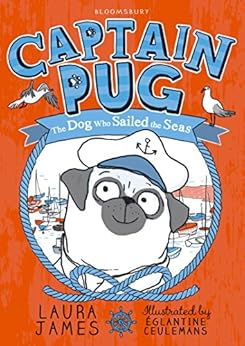
Captain Pug: The Dog Who Sailed the Seas by Laura James, illustrated by Eglantine Ceulemans

Published by Bloomsbury

Summary:  Lady Miranda and her pug Pug have been invited to a birthday party at the lake.  Despite his new captain’s uniform, Pug’s not crazy about the water, but he likes the fact that there’s lots of picnic food around.  He dives into a basket for a closer look, but accidentally gets stuck inside and carried off by the Picnic Lady onto a bus.  Thus begin Captain Pug’s adventures.  He serves as the coxswain on a crew boat, and gets rowed out to a cruise ship where he meets a real sea captain.  All the while, Lady Miranda is searching everywhere for her beloved pet.  An errant seagull finally leads her to Pug’s ship, where she makes quite a splash.  Girl and dog are reunited and head back home…until their next adventure.  128 pages; grades 1-3.

Pros:  Fans of Mercy Watson and Princess in Black will enjoy this funny early chapter book, with plenty of illustrations and not a lot of text on each page.

Cons:  I just can’t warm up to pugs.

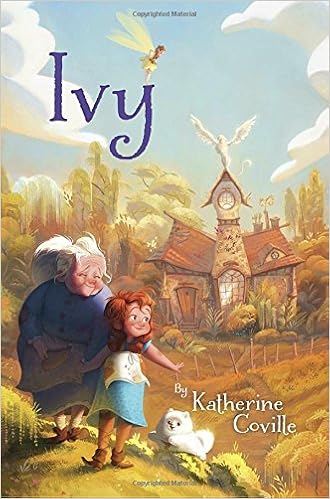
Ivy by Katherine Coville

Published by Knopf Books for Young Readers

Summary:  Ivy and her grandmother live in the messiest cottage in Broomsweep…messy, because her grandmother is Meg the Healer, whose large garden and knowledge of plant medicines have made her a famous doctor of humans and animals.  Rumor has it that the new queen is traveling through her kingdom to find the best town.  Ivy and Grandmother are under pressure from the mayor’s wife to get their property up to the standards of the rest of Broomsweep.  When an injured griffin, a dragon with a severe head cold, and a flock of pixies arrive, cleaning up seems like an impossible task.  But Grandmother assures Ivy it will all work out.  And when four trolls invade the village at the same time the queen shows up unexpectedly, it all (eventually) does.  144 pages; grades 2-4.

Pros:  A cozy fantasy with a fairy-tale feel and a happily-ever-after ending.  A large font and plenty of illustrations make this a good choice for early chapter book readers who are ready to move on from the Magic Tree House.

Cons:  Not too many surprises in this fairly predictable tale.

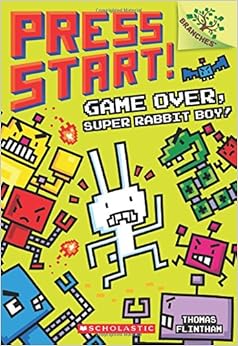
Game Over, Super Rabbit Boy! (Press Start! series) by Thomas Flintham

Published by Scholastic

Summary:  King Viking has not only kidnapped Singing Dog and taken him back to Boom Boom Factory, but he has left his Robot Army behind to stamp out all the fun of Animal Town.  It’s up to Super Rabbit Boy to get through the six levels required to make it to Boom Boom Factory.  Of course, this is all part of a video game.  The boy who is playing it can’t get through all six levels on the first try…or the second, or the third.  Finally, after many, many attempts, and great persistence, Super Rabbit Boy succeeds, and there is a happy ending for Animal Town.  The video game is put aside, with the words “Game Over” coming from it.  And then the boy’s sister picks it up….  74 pages; grades 1-4.

Pros:  Another entry in Scholastic’s Branches imprint that is sure to be a hit with the early chapter book crowd.  Lots of video game-inspired illustrations and cartoon bubble dialogue add to the appeal.

Cons:  This story was a little simple even for my low-brow taste.  Still, I’m confident it will be loved by those in the intended demographic.

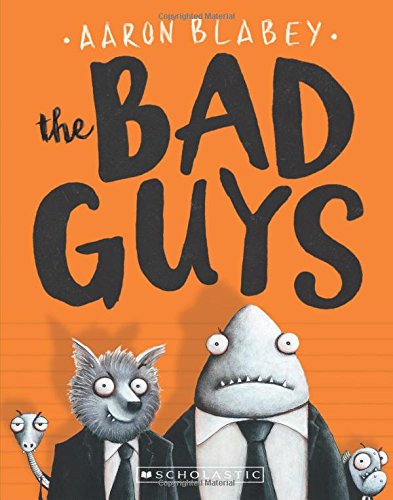
The Bad Guys by Aaron Blabey

Published by Scholastic

Summary:  Mr. Wolf is attemptng to turn over a new leaf, going from Bad Guy to Good Guy.  He tries to recruit a few other reputed Bad Guys to join him: Mr. Snake, Mr. Piranha, and Mr. Shark.  It’s pretty clear these three are okay with being bad, but they reluctantly agree to go along with Mr. Wolf’s plans.  After a crazy rescue of a cat from a tree, they decide to liberate 200 dogs from the local pound.  The plan, involving a flying snake and piranha, a shark in drag, and a love-struck gorilla, eventually succeeds…after a fashion.  In the final chapter, the Bad Guys admit it felt pretty good to be Good Guys, and offer a preview of the next book, in which they will rescue 10,000 chickens from a high-tech cage farm.  144 pages; grades 2-4.

Pros:  Reminiscent of the Bad Kitty chapter book format (almost a graphic novel, with just a few sentences per page, mostly dialogue), this is a guaranteed laugh-out-loud hit for readers of a certain age.  Yes, there’s a fart joke (or two), but even I, a good 40+ years past the target demographic, found the whole thing pretty darn funny.

Cons:  This book was released on December 27, so technically it’s a 2016 book, not 2017.

Agnes and Clarabelle Celebrate! By Adele Griffin and Courtney Sheinmel, illustrated by Sara Palacios

Published by Bloomsbury

Summary: Agnes Pig and Clarabelle Chicken are best friends who help each other celebrate holidays.  When Clarabelle struggles with the Maypole dance, Agnes makes her feel better.  When Agnes gets stage fright at the Fourth of July parade, Clarabelle helps her out.  They also enjoy Halloween trick-or-treating and trying to stay up on New Year’s Eve together.  Each of the four chapters highlights their holiday adventures.  80 pages; grades 1-3.

Pros:  A perfect first chapter book, full of cheerful illustrations.  Part of Bloomsbury’s new Read and Bloom series for newly independent readers.

Cons:  I somehow got the second book in the series instead of the first one.  Fortunately,  I was able to pick up the storyline pretty quickly.  In the interest of full disclosure, the pages shown above are from the first book.

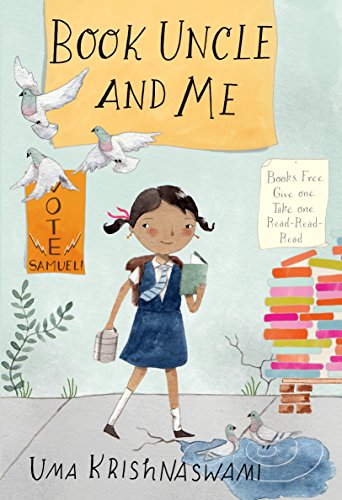
Book Uncle and Me by Uma Krishnaswami

 Published by Groundwood Books


Summary:  Yasmin has a goal to read a book a day, an achievement she has maintained for over 400 days.  Getting the books is easy, because elderly Book Uncle has set up his free lending library right outside her apartment building.  Lots of people in her building enjoy his generosity, so Yasmin is shocked and dismayed when she finds out that Book Uncle has been told he needs an expensive permit to continue operating.  There’s an election going on for a new mayor, and Yasmin decides to take Book Uncle’s plight to her favorite candidate.  She slowly builds her case, eventually getting help from her friends and family, to effect a happy ending for Book Uncle.  149 pages; grades 2-4.

Pros:  A sweet story originally published in India. Yasmin will inspire readers to find out how they can make a difference in their own communities.

Cons:  Kids may need some help with some of the Indian names and customs.

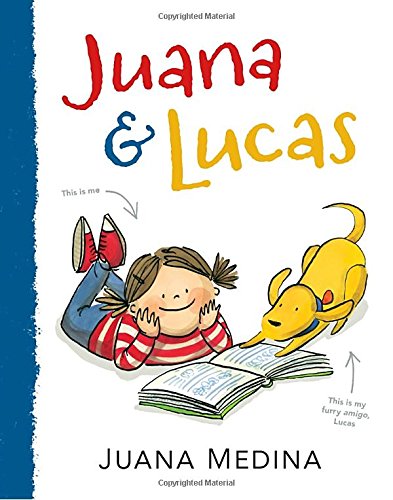
Juana & Lucas by Juana Medina

Published by Candlewick 
Summary:  Juana lives in Bogota, Colombia with her mother, Mami, and her dog Lucas.  She loves soccer, her best friend Juli, and Astroman.  She does not love learning “the English” at school.  It’s hard, and there doesn’t seem to be much point to it.  But then her beloved grandparents tell her they want to take her to Spaceworld in Orlando, Florida, where Juana will get to meet Astroman.  Her grandfather tells her that at Spaceworld, everyone speaks English, and Mami tells her that if her grades don’t improve, there will be no Spaceworld.  That’s all the inspiration she needs, and before long, the family has an amazing trip, and Juana gets to tell Astroman her whole life story.  96 pages; grades 2-4.

Pros:  Fans of Judy Moody and Junie B. Jones will enjoy the spunky Juana and her affectionate dog.  The Colombian setting and frequent Spanish words give this a nice international flavor.  Lots of colorful, cartoony illustrations throughout.

Cons:  It would have been nice to have a Spanish to English translation guide for all the Spanish words in the text.

Pedro, First Grade Hero by Fran Manushkin, illustrated by Tammie Lyon

Published by Picture Window Books 

Summary:  Katie Woo’s friend Pedro has his own new series.  This collection contains four stories, which are also available as individual books.  Pedro collects bugs, tries out for soccer goalie, starts a mystery club with his friends, and runs for first grade class president.  Katie is a pretty prominent character in every story, along with several of their classmates.  The last four pages, “Joke Around With Pedro”, contain jokes in keeping with the themes of the four stories.  96 pages; grades K-2.

Pros:  A great choice for newly independent readers, this feels like a chapter book, but reads like an easy reader, with just a few sentences of text on each page.  There are plenty of cheerful illustrations, and an ethnically diverse cast of kid characters.

Cons:  First graders Pedro and Katie are way more civil in their presidential election than some other politicians we know.

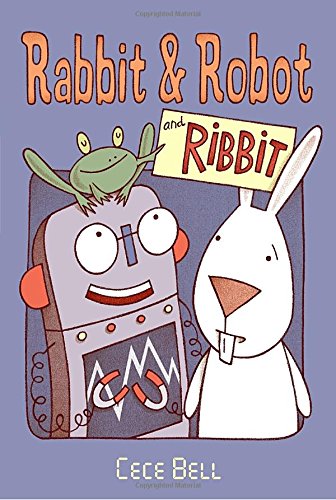
Rabbit & Robot and Ribbit by Cece Bell

Published by Candlewick Press 

Summary:  When Rabbit goes to visit Robot, he’s dismayed to find that Robot has another friend over, a frog named Ribbit.  Ribbit’s vocabulary is limited to a single word, “Ribbit”, which Robot is able to understand using his frog translation software.  Rabbit starts feeling jealous, and pretty soon Rabbit’s and Ribbit’s emotions are running so high that Robot overheats himself trying to interpret them all.  When Robot collapses, Rabbit and Ribbit have to work together to learn how to revive him.  In the end, the three friends discover that three isn’t really a crowd and learn to play together.  48 pages; grades K-3.

Pros:  The sequel to Rabbit and Robot: The Sleepover, this long easy reader/short chapter book with cartoon illustrations and silly dialogue is just right for emerging independent readers.

Cons:  Let’s hope Cece Bell doesn’t wait another 2 ½ years before writing another Rabbit and Robot book.

The Infamous Ratsos by Kara LaReau, illustrated by Matt Myers

Published by Candlewick Press 

Summary:  Louie and Ralphie Ratso live with their father, Big Lou, who is one tough rat.  Their mother has been gone for a while, but they all try not to think about that.  Instead they focus on being tough.  For the boys, that means thinking up bullying schemes to torture their neighbors and classmates.  Trouble is, their plans keep backfiring to make them look like the good guys.  When they steal a hat from a boy in their class, it turns out he stole the hat to begin with.  He gets punished, while the Ratsos get praised by their teacher.  A plan to pile up snow in front of their neighbor’s store goes awry when the boys take a wrong turn and end up clearing his sidewalks.  As the final insult, the boys’ teacher sends home a note, letting their father know what upstanding citizens they are.  To their amazement, their tough-as-nails dad breaks down in tears and tells them how proud their mother would be of them.  From then on, the Ratsos go from trying to be infamous to being famous…for their good deeds.  64 pages; grades 1-4.

Pros:  What could have been a sappy, moralistic tale is actually very funny, with a lesson snuck in pretty surreptitiously.  Plenty of illustrations and large text make this a good choice for those just moving in to chapter books.

Cons:  If your young reader doesn’t get the concept of “irony” when reading about the Ratsos’ antics, you may be in for a long school year.