Dog Man by Dav Pilkey

Published by Graphix


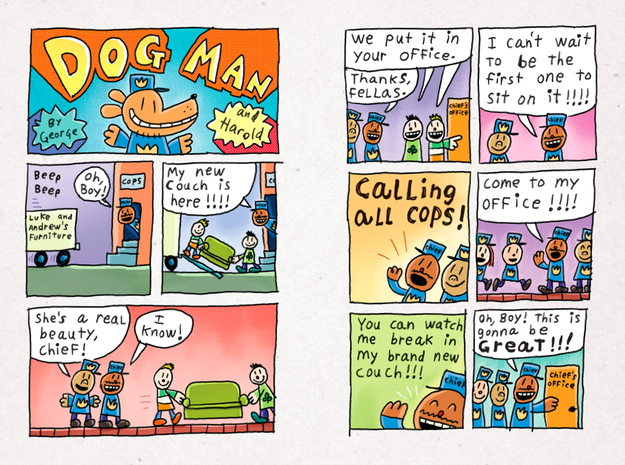
Summary:  George and Harold, creators of Captain Underpants, revisit a character they came up with in first grade.  Police officer Knight has a strong body but a weak brain; his canine companion Greg has a brilliant mind, but isn’t very big or powerful.  An accident results in Greg’s head being stitched on to Officer Knight’s body, creating superhero Dog Man.  Dog Man has four adventures in this comic book, all of them involving his nemesis, Petey the Cat.  The pictures and text channel a talented first grader, complete with occasional crossed-out words and grammatical errors.  “Extra cheesy Flip-o-ramas” are inserted throughout the text to create some “animation”.  The last few pages have instructions on how to draw some of the characters, and there is a preview of Dog Man 2: Unleashed, available January 2017.  240 pages; grades 2-4.

Pros:  Once again, Dav Pilkey has his finger firmly on the pulse of an 8-year-old.  Reluctant readers everywhere, as well as non-reluctant ones, will enthusiastically embrace Dog Man and his adventures.

Cons:  I fear that by reviewing Inspector Flytrap and Dog Man in the same week, I may have irrevocably labeled myself “literary lightweight”.

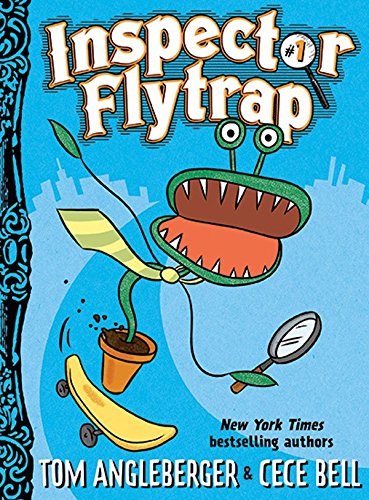
Inspector Flytrap by Tom Angleberger and Cece Bell

Published by Amulet Books 

Summary:  In a literary first, a Venus flytrap with dreams of becoming a detective pairs up with a goat named Nina, who pushes Flytrap around on a skateboard and eats everything in sight.  The opening book in the series has the two of them solving three mysteries.  In the first, an art museum hires the pair to identify a mysterious orange blob on a famous painting (hint: it involves a sneeze on the part of the artist); next, they figure out how a giant stinky shoe got on top of a cookie store; finally, they solve the mystery of a missing rose, which leads to a surprise romance for both Flytrap and Nina.  All stories are generously sprinkled with Bell’s black, white, and green illustrations.  112 pages; grades 2-4.

Pros:  Quirky author Angleberger (Origami Yoda) and his Newbery honoree wife Cece Bell (El Deafo) team up for a wild, crazy, and hilarious new mystery series.  Readers will be as helpless as a bug in a Venus flytrap to resist the second installment, Inspector Flytrap in the President’s Mane is Missing, released the same day as this one.

Cons:  Nina the goat is pretty annoying.

The Big Move (Commander in Cheese series) by Lindsey Leavitt, illustrated by A. G. Ford

Published by Random House 

Summary:  Excitement is building in the White House as a new President is about to be inaugurated.  Mouse siblings (and White House residents) Ava and Dean are particularly excited because the new Commander in Chief has two children of her own.  The mice hope to add a Lego to the collection of White House treasures that generations of mice have maintained in tunnels around the house.  They see their chance to explore the kids’ rooms when everyone else is distracted by the inauguration ceremony, but plans go awry.  First, they get locked into a room with no tunnels, then the kids come back and discover them, resulting in a “Code Brown” that brings in Secret Service agents to try to get rid of the “vermin”.  There’s a happy ending for all, both human and rodent, and a promise of further interactions and adventures between the mice and their new human friends.  Back matter includes pictures of all the U.S. Presidents, fun facts about Inauguration Day, a floor plan of the part of the White House in the story, and a preview of book #2.  112 pages; grades 1-3.

Pros:  As a kid, I would have loved imagining being a mouse in the White House.  Ava and Dean are likeable characters, and readers will effortlessly learn a few facts about the presidency while enjoying the mice’s adventures.

Cons:  The plot is fairly predictable and the characters are pretty one-dimensional.

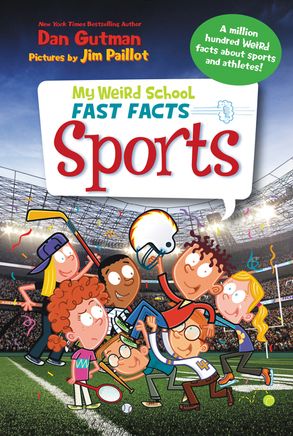
Sports (My Weird School Fast Facts) by Dan Gutman

Published by HarperCollins 

Summary: A.J. and Andrea, two of the wisecracking, squabbling kids from the My Weird School series, offer weird and interesting facts about a variety of sports. In addition to more well-known information, such as how different sports were invented, there are tidbits that will appeal specifically to elementary boys (some early hockey pucks were made of frozen cow poop) and some that are just bizarre (a hockey puck once hit a player in the chest, where he had a pack of matches, and his uniform caught on fire). Chapters include baseball, football, soccer, basketball, hockey, golf, car racing, the Olympics, and a couple chapters of miscellaneous facts. Includes lots of black-and-white illustrations by My Weird School illustrator Jim Paillot, as well as some photos. Look for a similar book with geography facts, and undoubtedly more on the way. 175 pages; grades 1-4.

Pros: Perfect for reluctant readers, this new series combines popular topics, interesting facts, and plenty of the humor that has made this series a favorite.

Cons: To my mind, the fast-fact format got a little old in the last few chapters. It wouldn’t have been a great loss to edit out the miscellaneous stuff.

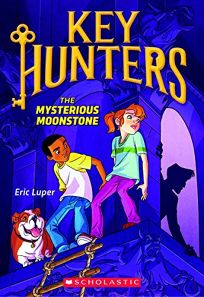
The Mysterious Moonstone (Key Hunters series) by Eric Luper

Published by Scholastic 

Summary:  Cleo and Evan miss their favorite school librarian, Mrs. Hilliard.  After she mysteriously disappeared, the strange Ms. Crowley took over.  One day, Ms. Crowley is acting odder than ever.  The two kids follow her, and discover a secret underground library.  They find a note from Mrs. Hilliard telling them she’s trapped in a book, and they need to solve the mysteries in the other books to free her and avoid getting stuck themselves.  Entering one of the books, they find themselves in 19th century London, where they help a teenage Sherlock Holmes-like detective figure out who stole a diamond from a wealthy family.  Ms. Crowley makes an appearance in this mystery, and after it’s solved, the three of them return to their school.  More mysteries await, however, as they work to free Mrs. Hilliard.  128 pages; grades 2-4.

Pros:  The mystery was surprisingly good, with a cast of suspicious characters and a bumbling, yet charming detective.   The story-within-the-story structure is a fun way to move the series along.

Cons:  The beginning was a little slow.

The Gold Medal Mess (MVP) by David A. Kelly

Published by Random House 

Summary:  Nico, Kat, Max, Luke, and Alex can’t wait for their school’s upcoming Olympics.  So they’re worried when they find a note threatening to sabotage the games.  Their principal doesn’t seem too concerned, but when the events begin, a series of mishaps confirms the kids’ suspicions that someone is out to ruin the fun.  The kids decide to take matters into their own hands and figure out who is behind the evil plot.  128 pages; grades 1-4.

Pros:  The first in a new sports-themed series, this will be welcomed by fans of A to Z Mysteries and David A. Kelly’s other series, Ballpark Mysteries.

Cons:  Five detectives is a little unwieldy and doesn’t allow for much character development in such a short story.

March of the Mini Beasts (The Data Set #1) by Ada Hopper, illustrated by Sam Ricks

Published by Little Simon 

Summary:  Gabe, Laura, and Cesar call themselves The Data Set because they collect enough data—random information—to stump even their teachers.  One day they’re on a mission to sell enough candy bars in their neighborhood to fund their science club’s field trip.  Knocking on doors, they eventually get to a strange-looking house that turns out to be inhabited by Dr. Bunsen, a kindly mad scientist.  He introduces them to his growth ray machine, which turns out to not only cause their little plastic animals to grow, but also brings them to life.  The animals start out as mini pets that fit into a terrarium, but rapidly begin to grow to full size.  The kids must put their heads together to figure out how to find a safe home for their new pets.  The zoo animals prove to be manageable, but the fast-growing stegosaurus presents a problem to be solved in book #2.  128 pages; grades 1-3.

Pros:  This face-paced humorous adventure is a perfect first chapter book, with a large font and plenty of illustrations on just about every page.

Cons:  The Data Set didn’t seem all that brainy…everyone gasped with amazement when Cesar came up with the idea to take the growing wild animals to the zoo.

Danger! Tiger Crossing (Fantastic Frame series) by Lin Oliver, illustrated by Samantha Kallis

Published by Grosset and Dunlap 

Summary:  Tiger’s exploring his new neighborhood when he sees an orange pig in a hat and tie.  Pursuing this unusual neighbor, he meets a girl named Luna, and the two of them trace Chives the Pig to an old haunted-looking house.  Boldly making their way inside, they meet ancient Viola Dots, who hasn’t left her house in 50 years, ever since her son David disappeared into a picture frame, and Chives popped out in his place.  Upon close examination of the frame, Tiger discovers a clock, which he sets back an hour.  Almost immediately, the picture opens up, and he and Luna are sucked inside.  There they meet David, who is still 13, and have to outrun the hungry tiger that was in the painting.  They manage to find their way back, but David is left behind once again, leaving the reader ready for book #2, Splat! Another Messy Sunday, now available at a library or bookstore near you.  Back matter includes information about the painting the kids go into, Surprised! By Henri Rousseau. 128 pages; grades 2-4.

Pros:  A reasonably exciting adventure for early chapter book readers, with lots of illustrations, black and white for the times outside of the picture and color inside of it.

Cons:  It didn’t seem realistic that 50 years had gone by since David disappeared.  Viola Dots would have to be closing in on 90, yet looked and acted about 60.

Poptropica: Mystery of the Map by Jack Chabert, illustrated by Kory Merritt

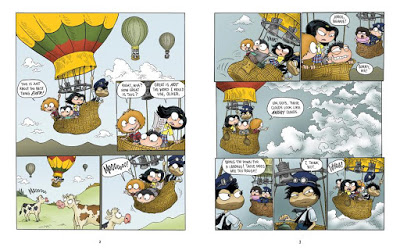
Summary: A hot-air balloon ride gone wrong lands Oliver, Mya, and Jorge on a mysterious island inhabited by dodo birds and Vikings. The dodos are entertaining and companionable, the Vikings, not so much. Not only are Erik the Red and his band after the kids, but Octavian, the balloon’s pilot, wants the magic map they took from him. After a daring prison break and a series of exciting chase scenes, the three children manage to outwit them all and sail off in a Viking vessel. The trip home promises an exciting sequel. 112 pages; grades 1-4.

Pros: This graphic novel is based on the Poptropica website, a gaming site co-founded by Diary of a Wimpy Kid creator Jeff Kinney. All the kid-friendly elements are in place to make this a surefire hit with even reluctant elementary readers.

Cons: Is it really okay to have a positive Jeff Kinney blurb on the front cover a book based on a website he helped create?

Weekends with Max and His Dad by Linda Urban, illustrated by Katie Kath

Published by HMH Books for Young Readers

Summary:  Max’s parents have recently separated, and now Max spends every weekend with his dad at his new apartment.  At first, the new place feels unfamiliar, and Max’s dad isn’t always tuned in to what Max likes in terms of room decor or activities.  But Dad is a good listener, and eventually he gets things right.  He takes Max on adventures to explore his new city, but again, he lets Max take the lead in terms of pace and direction.  As the weeks go by, Max gets to know the neighbors, and to feel comfortable enough to invite his best friend for a sleepover.  By the final page, Max has realized he now has two homes, and that he feels happy and safe in each one.  160 pages; grades 1-4.

Pros:  Max and his dad are likeable, yet realistic characters.  I loved how Dad kept pretending he wasn’t sick the weekend of the sleepover…so like a parent to keep soldiering along, even when you can barely stay awake!  The gradual pace of Max’s adjustment felt natural.  Both parents and children of divorce would benefit from reading this book.

Cons:  160 pages is a bit long for those readers just transitioning to chapter books.  The book is divided into three parts, so some may want to just try part 1 before deciding whether or not to tackle the whole thing.