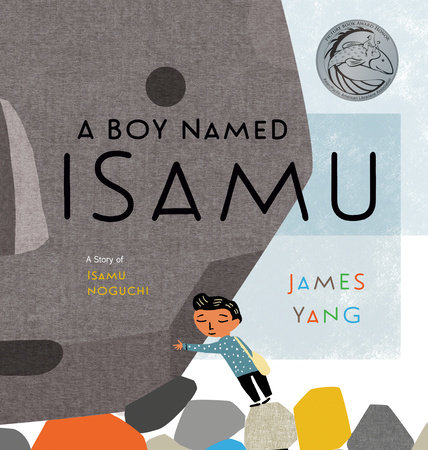
A Boy Named Isamu: A Story of Isamu Noguchi by James Yang

Published by Viking Books for Young Readers

A Boy Named Isamu by James Yang: 9780593203446 | PenguinRandomHouse.com:  Books

Amazon.fr - A Boy Named Isamu: A Story of Isamu Noguchi - Yang, James -  Livres

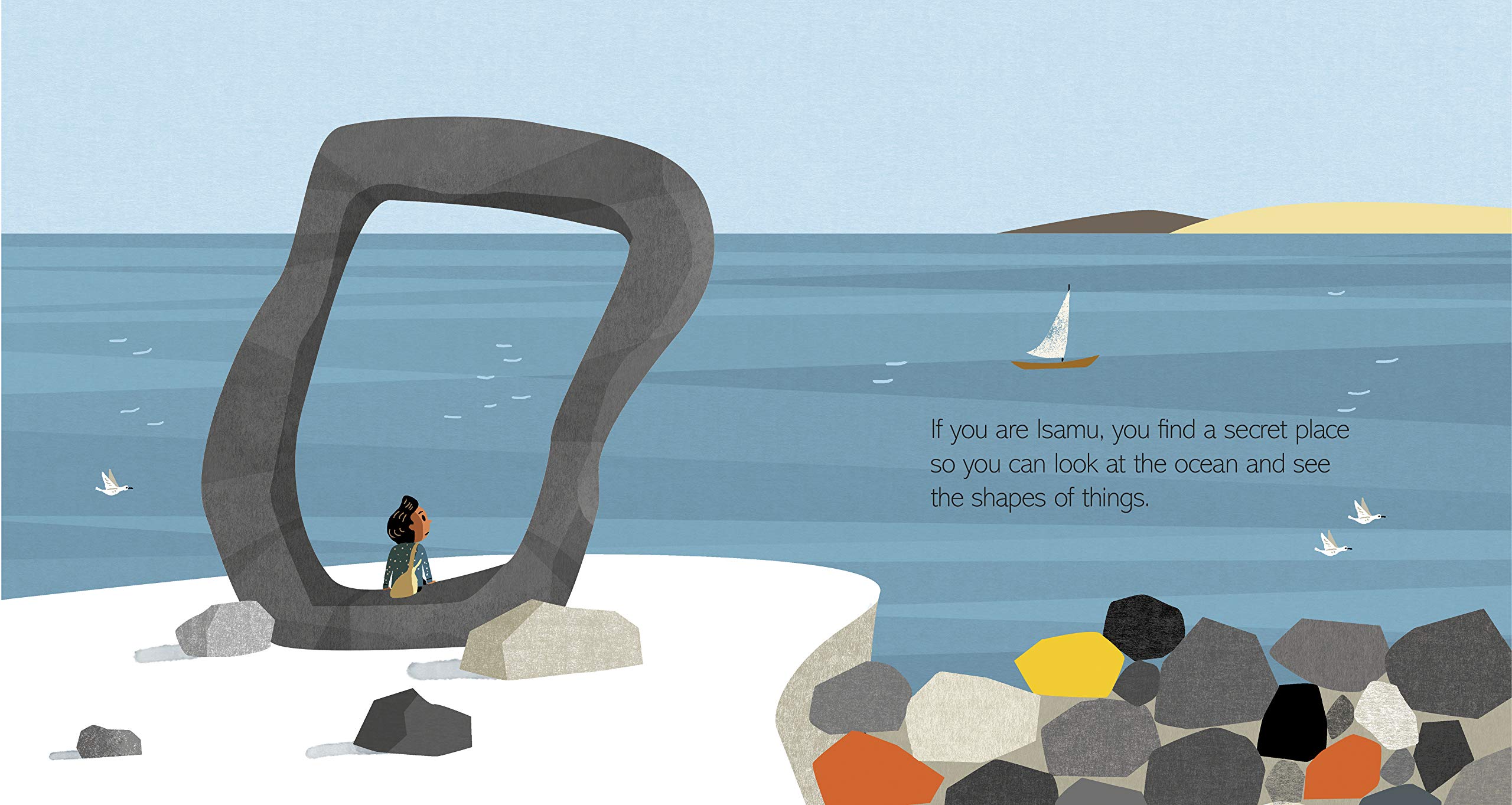
Summary:  “If you are a boy named Isamu…at the market with your mother, it can be a crowded and noisy place.  Maybe there is a quiet space that feels more like you.”  Isamu prefers to observe the world by himself, wondering about everything he sees around him: the colors of the fruit at the market, the light through the paper lanterns near his home, the leaves that he finds in the forest.  In the evening, his mother asks him how his day was.  Isamu thinks how he was alone but not lonely, and how the forest and beach were like friends giving him gifts like sticks, pebbles and shells.  Includes an author’s note with additional information about Japanese American artist Isamu Noguchi and two photos of Isamu as a child and as an adult with one of his sculptures.  40 pages; ages 4-8.

Pros:  Introspective children will find a kindred spirit in Isamu Noguchi, and all readers can embrace Isamu’s wonder and appreciation for the natural world.

Cons:  There aren’t many details about Isamu Noguchi or his art, nor are there any additional resources given.

Seen and Unseen: Noguchi's Gateways - The Noguchi Museum

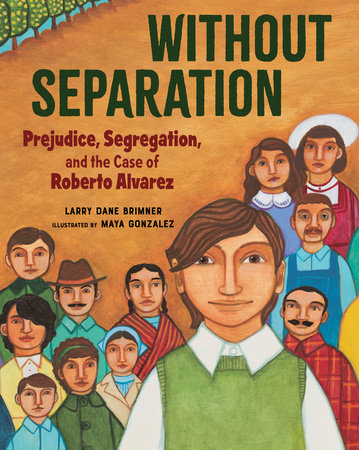
Without Separation: Prejudice, Segregation, and the Case of Roberto Alvarez by Larry Dane Brimner, illustrated by Maya Gonzalez

Published by Calkins Creek

Without Separation by Larry Dane Brimner: 9781684371952 |  PenguinRandomHouse.com: Books
Without Separation: Prejudice, Segregation, and the Case of Roberto Alvarez  by Larry Dane Brimner and Maya Gonzalez

Summary:  When Roberto Alvarerez returned to school from Christmas vacation on January 5, 1931, he was told he was no longer a student at the Lemon Grove Grammar School in Lemon Grove, California.  He and the other Mexican American children were supposed to go to the new Olive Street School.  Most of the kids headed home, as they had been instructed to do by their parents when rumors of the new school started to make their rounds in the neighborhood.  Families filed a lawsuit with Roberto’s name on it against the Lemon Grove School District.  On March 12, a judge ruled that there could be no separate school for Mexican children, and the students were allowed to return to Lemon Grove.  Includes a six-page author’s note with additional information and photos; and sources and source notes.  40 pages; grades 2-5.

Pros:  This straightforward picture book tells a story of standing up to school segregation that happened years before Brown vs. Board of Education.  While the story and folk art style illustrations could be understood and appreciated by a second-grader, there’s enough information in the author’s note to get a good start on a middle school project.

Cons:  90 years later, de facto school segregation is still prevalent all over the United States.

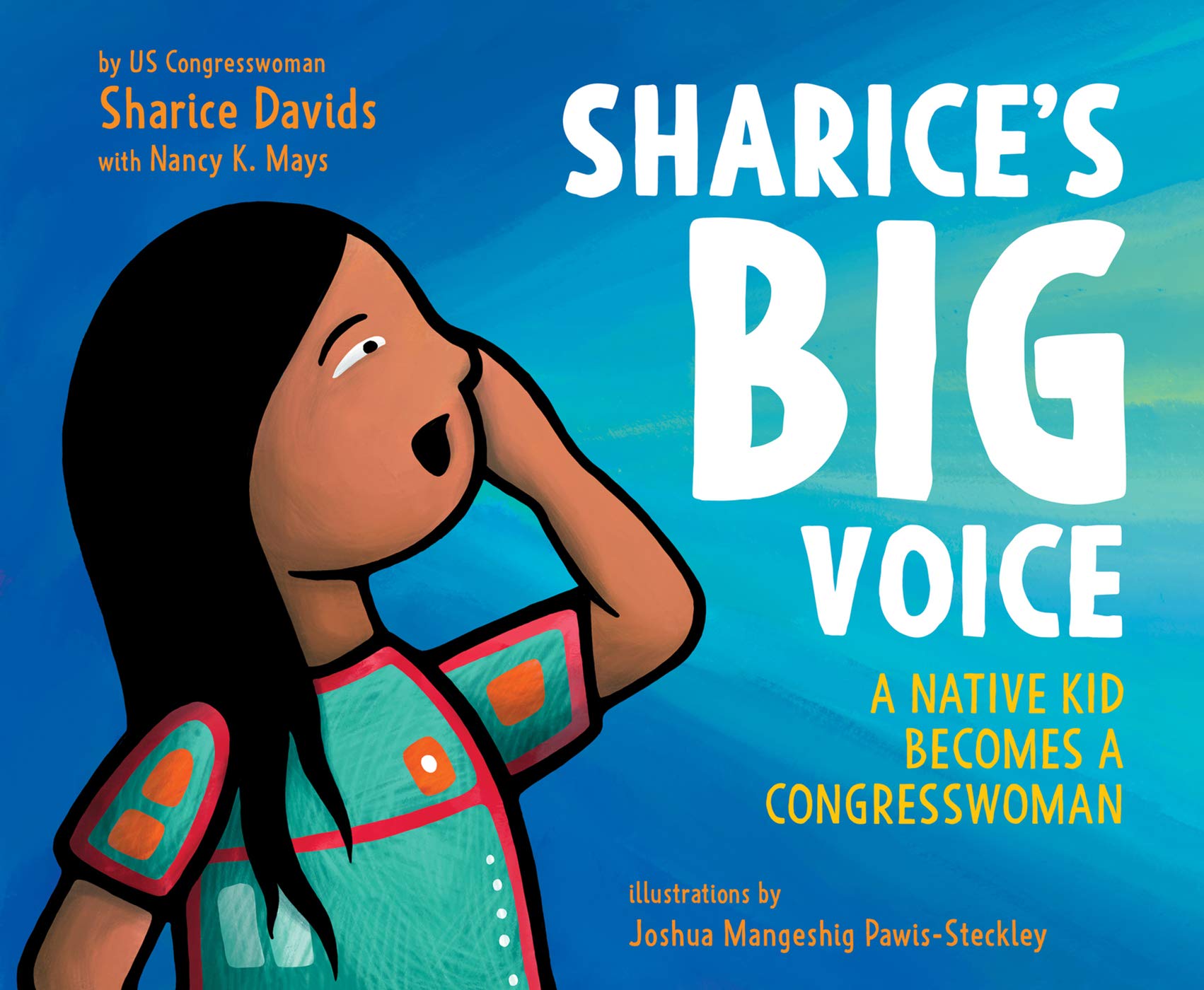
Sharice’s Big Voice: A Native Kid Becomes a Congresswoman by Sharice Davids with Nancy K. Mays, illustrated by Joshua Nageshig Pawis-Steckley

Published by HarperCollins

Sharice's Big Voice: A Native Kid Becomes a Congresswoman: Davids, Sharice,  Mays, Nancy K., Pawis-Steckley, Joshua Mangeshig: 9780062979667:  Amazon.com: Books

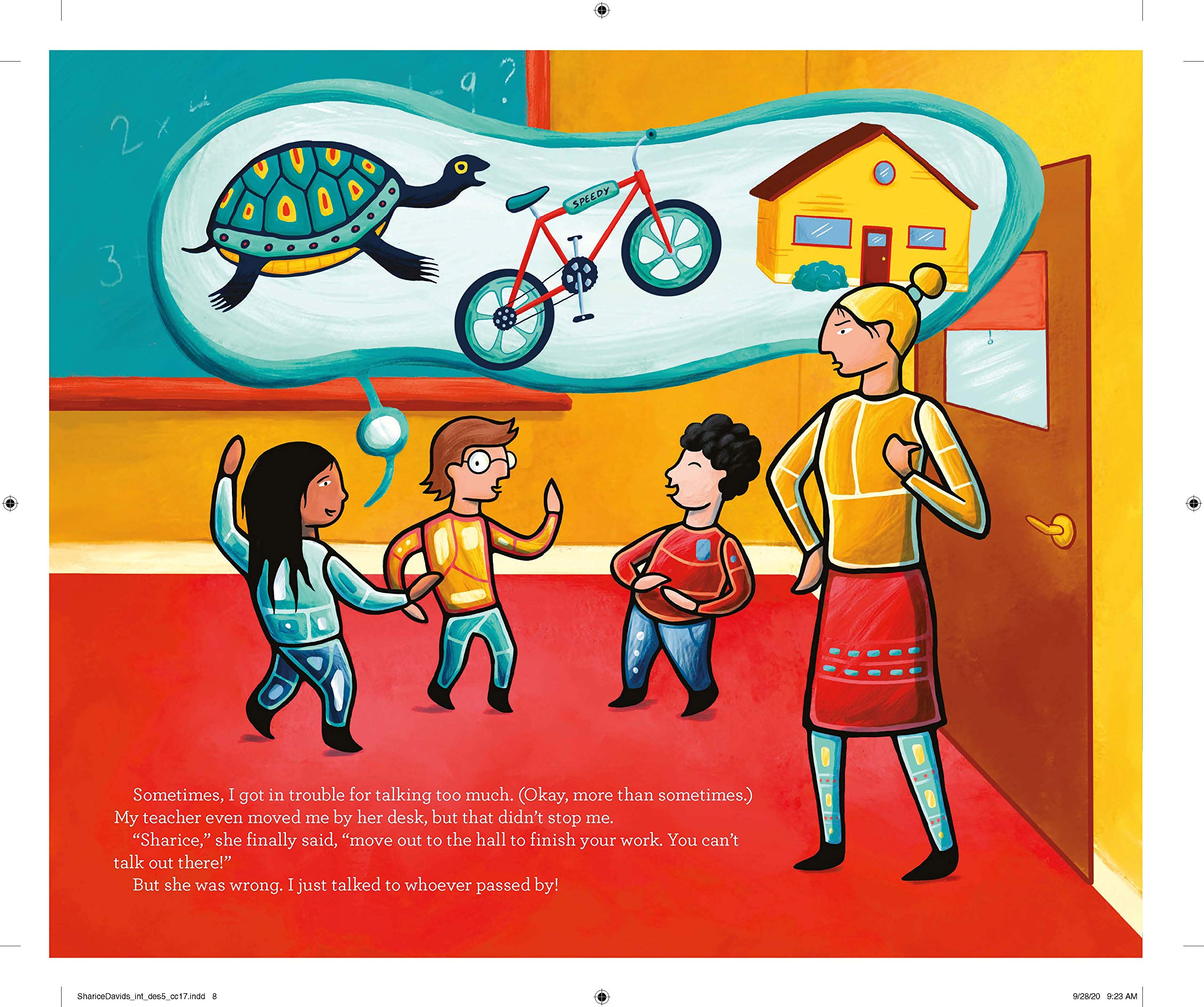
Summary:  In 2018, Sharice Davids became one of the first two Native American women in Congress.  From a young age, Sharice loved to talk and used her big voice to make friends when her single mother’s army career forced them to move several times.  She worked hard to get through college and law school and to pursue a passion for martial arts.  Her law degree led her to a South Dakota reservation, where she helped people start small businesses, and eventually to a career at the White House.  In Washington, she noticed that there weren’t a lot of people who looked like her, and decided to try to change that by running for Congress.  Her victory made her not only one of the first Native women in Congress, but also the first LGBTQ Native American there.  Includes an author’s note, an illustrator’s note, and additional information about Davids’ Ho-Chunk tribe.  40 pages; grades K-4.

Pros:  The chatty, informal tone of the writing makes Sharice seem like an old friend, and like pursuing your dreams is a real possibility.  I loved the art for this book, created by Ojibwe Woodland artist Pawis-Steckley. I want to mention that this is the third book I’ve reviewed in the last week that’s by a Native American author with Native main characters. Things sure have changed since I started this blog in 2015, and it’s about time.

Cons:  I wish there were more photos with the author’s note.  I think the one there is of Sharice with her mom, but it wasn’t labeled, so I’m not sure.

Watch Me: A Story of Immigration and Inspiration by Doyin Richards, illustrated by Joe Cepeda

Published by Feiwel and Friends

Watch Me: A Story of Immigration and Inspiration: Richards, Doyin, Cepeda,  Joe: 9781250266514: Amazon.com: Books
Watch Me | Doyin Richards | Macmillan

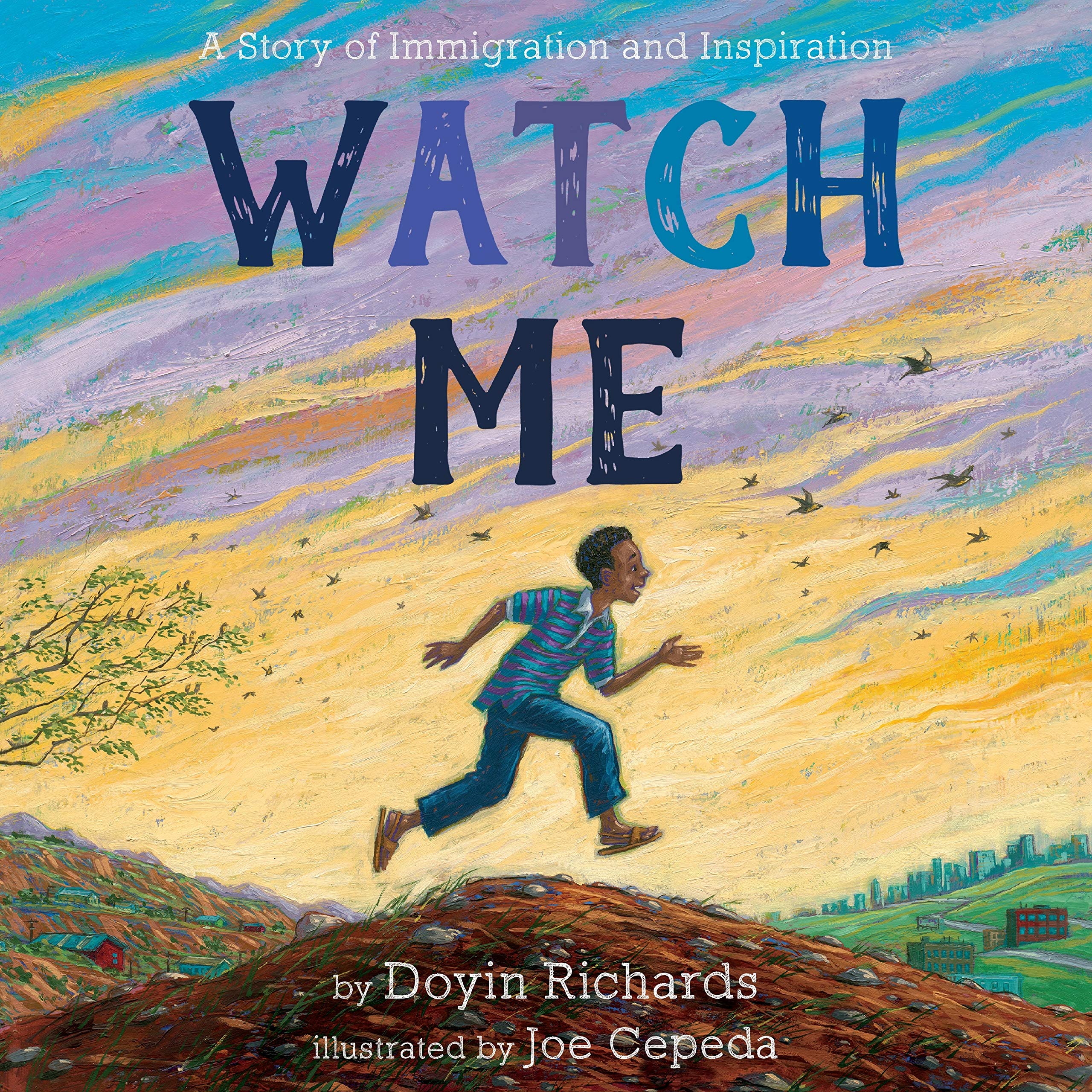
Summary:  Growing up in Sierra Leone, Joe had big dreams.  He decided he needed to go to America to follow them.  Family and friends told him people in America would laugh at his accent and be afraid of his dark skin, but Joe said, “Watch me,” and moved to America.  People did, in fact, make fun of his accent and sometimes told him to go back to Africa.  Joe was homesick, but he persisted.  Sometimes he felt he had to work twice as hard to prove himself, but in the end he kept going and became a doctor.  How does the narrator know all this?  Dr. Joe was his dad.  40 pages; ages 4-8.

Pros:  This inspiring narrative tells Dr. Joe’s story, but also asks a lot of questions of the reader: do you know people like Joe?  Do you see them at your school?  Did they come by plane or boat?  Maybe you did, too?  The text is simple, but it is sure to provoke discussion and encourage kids to make connections between Joe and themselves or people around them.

Cons:  I wanted to know a lot more about Dr. Joe, but there was no additional information.

If the World Were 100 People: A Visual Guide to Our Global Village by Jackie McCann, illustrated by Aaron Cushley

Published by Crown Books for Young Readers 

If the World Were 100 People: A Visual Guide to Our Global Village: McCann,  Jackie, Cushley, Aaron: 9780593310700: Amazon.com: Books

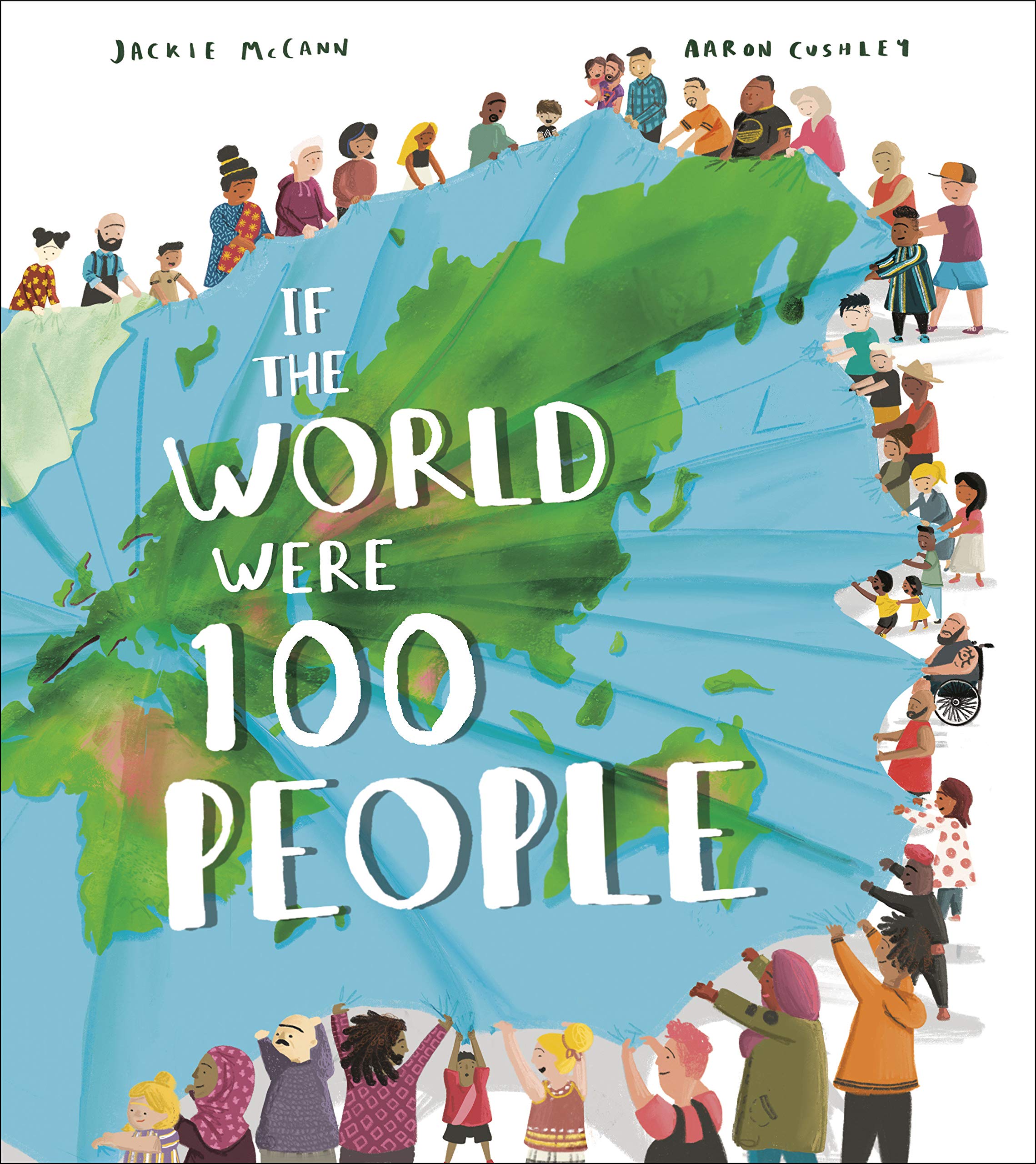
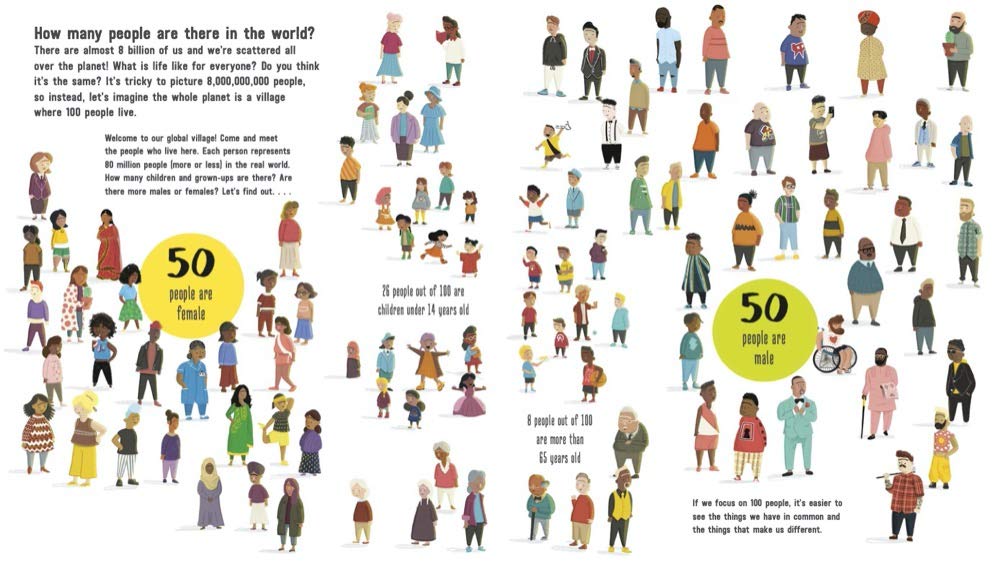
Summary:  It’s hard to envision 8 billion people (the current population of Earth), so what if that number is reduced to 100?  60 people live in Asia, 5 in North America.  11 don’t have enough to eat (although enough food is wasted each day to feed them), and 29 don’t have access to clean water.  26 are under 14, and 8 are over 65.  And, as you may have already heard, 10 people have 85% of the world’s wealth.  Each of these facts is accompanied with an infographic that helps readers see the information.  The final two pages attempt to answer the question, “What are the big questions?” as we move into a future that will likely see 10 billion people on the planet by 2050.  32 pages; grades 2-5.

Pros:  I love information like this, and really, who doesn’t?  It makes demographics so much more accessible, with the fun illustrations adding another level of access.  I learned some surprising facts, as I’m sure most readers would. This could be used for social studies into middle school or even high school.   

Cons:  No back matter.

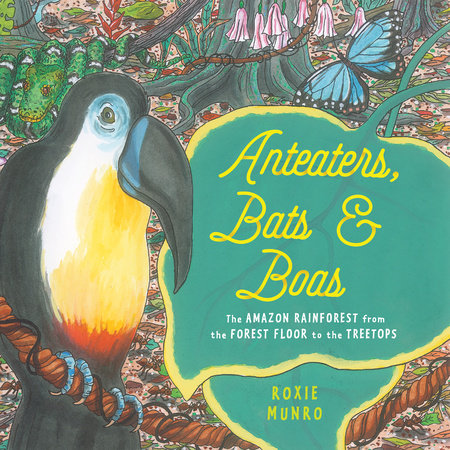
Anteaters, Bats & Boas: The Amazon Rainforest from the Forest Floor to the Treetops by Roxie Munro

Published by Holiday House

Anteaters, Bats & Boas by Roxie Munro: 9780823446568 |  PenguinRandomHouse.com: Books

Summary:  Thirty animals from the rainforest are profiled, beginning with an introduction that tells readers a little bit about rainforests, specifically the Amazon, where the animals in the book live.  From there, the two-page spreads show two or three animals with a paragraph of facts about each one.  The animals are pictured in their natural habitats and shown in proportion to each other.  A final spread includes black-and-white outlines of all the animals with a color-coded list that categorizes them by class.  There’s also information on the layers of the rainforests and rainforest preservation, as well as a glossary, index, and list of additional information sources.  32 pages; grades 2-5.

Pros:  The large, full-color illustrations really make this book, which also includes interesting tidbits of information about each animal, and excellent backmatter which can lead readers to further research.

Cons:  It’s a beautiful and interesting catalog of animals, but kids will have to look elsewhere for more comprehensive information about the rainforest.

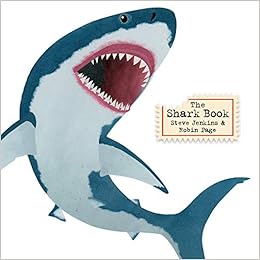
The Shark Book by Steve Jenkins and Robin Page

Published by Clarion Books

The Shark Book: Jenkins, Steve, Page, Robin: 9781328569493: Amazon.com:  Books
Bound To Stay Bound Books, Inc. - Bookstore

Summary:  The husband-and-wife team of Jenkins and Page introduce readers to the world of sharks through cut-paper illustrations and text describing different types of sharks, how sharks reproduce, what they eat, and more.  Of course, what readers REALLY want to know is how dangerous sharks are to humans, and this is addressed as well, along with additional information about how dangerous humans are to sharks.  Includes a chart showing size, range, danger to humans, and conservation status of all the sharks in the book as well as a bibliography.  40 pages; grades K-4.

Pros:  One can never have too many shark books on the library shelves, and, as per usual, Jenkins and Page do a stellar job of making the information interesting and accessible to the intended audience, with excellent illustrations as well as text.

Cons:  The font seemed a bit small to me, especially since it was one that looked like handwriting.

Hidden Planet: Secrets of the Animal Kingdom by Ben Rothery

Published by Tilbury House Publishers

Hidden Planet: Rothery, Ben: 9780241361016: Amazon.com: Books
Hidden Planet: An Illustrator's Love Letter to Planet Earth: Rothery, Ben:  9780241361009: Amazon.com: Books

Summary: This animal book focuses on secret or hidden aspects of the animal kingdom.  There are hidden relationships like mutualism and parasitism; hidden families, like the surprising connections among the elephant, the manatee, the dugong, and the rock hyrax; and hidden abilities, such as camouflage and other defenses.  Each oversized page contains at least one illustration (sometimes filling the whole page), and often has two, three, or more, some in color and some black and white.  Includes an introduction and a final author’s note that explain how he became interested in illustrating and writing about animals, why it’s so important to understand animals better, and an invitation to readers to start their own writing and drawing; also, an index.  96 pages; grades 3-8.

Pros:  The wealth of information and especially the illustrations are phenomenal.  Any kid interested in animals will love this book, whether it’s just to browse through the gorgeous pictures or to pore over the interesting facts. 

Cons:  So many of the full-color illustrations are suitable for framing; if I were a kid with an Exacto knife, well…I might not be responsible for my actions.

Why Longfellow Lied by Jeff Lantos

Published by Charlesbridge

Why Longfellow Lied: The Truth About Paul Revere's Midnight Ride: Lantos,  Jeff: 9781580899338: Amazon.com: Books

Summary:  Listen, my children: many of us have grown up with at least some knowledge of Henry Wadsworth Longfellow’s poem “Paul Revere’s Ride”.  Jeff Lantos takes a deeper look, going through it piece by piece with a retelling of the actual events and how they compare with the poem.  Both the prologue and the final chapter give additional context to the poem and the reasons that Longfellow wrote it in the early days of the U.S. Civil War.  Includes a cast of characters (the people mentioned in the book); the complete text of the poem; many illustrations, photos, maps, and sidebars; 18 pages of source notes; a six-page bibliography; and an index.  160 pages; grades 5 and up.  

Pros:  A lively addition to any American history curriculum, which not only presents the facts around the events of April 18-19, 1775, but also puts Longfellow’s poem in the context of the U.S. Civil War, and his fervent hope to end slavery and preserve the Union.  The plentiful illustrations and maps, the brief but interesting sidebars, and the extensive source material make this an excellent nonfiction resource.

Cons:  The title seems a bit of a harsh judgement on Longfellow, although I guess “Why Longfellow Used Artistic License in Recounting Historical Events in a Heartfelt Attempt to Preserve the Union” isn’t quite as catchy.  

The Story of Bodri by Hédi Fried, illustrated by Stina Wirsén

Published by Eerdmans Books for Young Readers

The Story of Bodri - Kindle edition by Fried, Hédi, Wirsén, Stina. Children  Kindle eBooks @ Amazon.com.
Sneak peek: The Story of Bodri – Eerdlings

Summary:  The author recounts the story of her childhood, beginning with a happy life with her parents, younger sister, best friend Marika, and most of all, her special dog Bodri.  Then soldiers came to their town, and everything changed.  Jews like the author and her family could no longer go places, and the two best friends couldn’t play together.  Eventually, her family was taken away to a concentration camp, and the two sisters separated from their parents.  They almost died, but Hédi kept dreaming about Bodri, and the memories kept her going.  Finally, the two girls–emaciated, with their heads shaved–were free, and Hédi and Bodri had a miraculous reunion.  “We are here, and we go on telling everyone about what happened.  So that it will never happen again.”  32 pages; grades 2-5.

Pros:  A moving Holocaust story, with an unusual focus on what happened to the family dog.  The illustrations of the girls in the concentration camp are disturbing, but appropriately so for the history being told.  The beautiful pictures of trees throughout the story help to mark the passage of time.

Cons:  I was curious to learn more of Hédi Fried’s story, but I couldn’t find much biographical information about her.