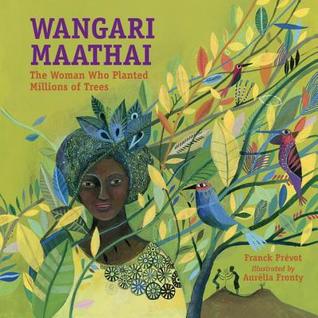
Wangari Maathi: The Woman Who Planted Millions of Trees by Franck Prevot, illustrated by Aurelia Fronty

Published by Charlesbridge

Summary:  While other picture book biographies about Wangari Maathi have focused on her tree planting, this book takes a broader look at her political activism.  She was fortunate to get a high school education in Kenya at a time when most girls didn’t go to school at all, and did so well that she was part of a group selected by President Kennedy to study in America.  Upon her return to Kenya, she observed how ravaged the land was from deforestation, and began her work to plant trees.  This work was in opposition to some of the plans of President Daniel arap Moi, and Maathai was imprisoned more than once.  In 2002, Moi was defeated, and Wangari Maathai was appointed assistant minister of the environment, natural resources, and wildlife.  In 2004, she was awarded the Nobel Peace Prize.  She died in 2011 at the age of 71.  End pages include an extensive timeline, information on Kenya today, quotes from Wangari Maathi, and further resources.  Grades 2-6.

Pros:  This French import is more extensive than other Maathi biographies, and would be appropriate for an older audience looking for more in-depth information.  The illustrations are striking, each one painted against a boldly colored background that fills the whole page.

Cons:  This is the fifth picture book biography of Wangari Maathi published since 2008, so some libraries may pass on purchasing this one, which would be too bad.

Dolley Madison: Parties Can Be Patriotic! By Kathleen Krull

Published by Bloomsbury USA Childrens

Summary:  When Dolley Madison died, her funeral was the largest ever seen in Washington, D.C. at that time.  It closed down the government, because so many people wanted to attend, including some of the twelve U.S. presidents she had known in her lifetime.  After a simple Quaker childhood and an arranged first marriage, Dolley, a widow at age 25, married James Madison, who later became the fourth U.S. President.  Dolley threw large parties every week, redecorated the White House, and famously rescued the portrait of George Washington just hours before the British burned down the White House during the War of 1812.  When Zachary Taylor referred to her as the First Lady, he coined a term that Dolley defined during her long, eventful life.  Ages 7-10.

Pros:  Veteran biographer Kathleen Krull has a new series, “Women Who Broke the Rules”.  This entry is fun, breezy, and informative.  At 46 pages, with illustrations on almost every page, it’s just the right length to give an enticing introduction to the life of a famous woman.

Cons:  The cover could be a bit more enticing.

A Nest Is Noisy by Dianna Hutts Aston, illustrated by Sylvia Long

Published by Chronicle Books

Summary:  Why is a nest noisy?  Because of the life being nurtured inside of it.  Nests are made of an almost infinite range of materials, from millions of interlocking army ants to the hardened saliva of a swiftlet (whose nest is used to make birds’ nest soup).  And nests aren’t just for birds.  Alligators, platypuses, orangutans, and others make nests, too.  Each two page spread has a statement about what a nest is (“A nest is neighborly”, “A nest is hidden”, etc.), followed by a paragraph or two explaining this statement, all gorgeously illustrated with exquisitely detailed watercolors.  The front endpapers show all the nests described in the book, and the back ones display all the animals that inhabit them.  Ages 5-10

Pros:  This award-winning team has produced beautiful nonfiction books about eggs, seeds, butterflies, and rocks.  The writing and illustrations ensure that readers will gain a wonder and appreciation of the world around them.

Cons:  There is a lot of information for younger readers.  They might appreciate this book more if read over several sessions rather than all at once.

An Ambush of Tigers: A Wild Gathering of Collective Nouns by Betsy R. Rosenthal, illustrated by Jago.

Published by Millbrook Press

Summary:  “Do you ever wonder what animals do/when they gather in groups of more than two?”  If the answer is yes, get ready to learn what different groups of animals are called.  Most of us have heard about a pack of wolves or a team of oxen, but how about a bouquet of pheasants or a prickle of porcupines?  A shiver of sharks or a rumba of rattlesnakes?  The richly colored illustrations portray the various animals interacting with each other, concluding with a panoramic view of all the animals together.  A glossary at the end lists all the animal group names and gives other definitions for the terms.

Pros:  Kids will love learning the names of their favorite animal groups, and the rhyming text makes it even more fun.  This could lead to researching other collective nouns.

Cons:  An intrusion of roaches.

Water Is Water by Miranda Paul, illustrations by Jason Chin

Published by Roaring Brook Press

Summary:  “Drip. Sip. Pour me a cup. Water is water unless…it heats up.”  Each page has a rhyme to show a different form water can take—steam, clouds, rain, snow, etc.  The brief text is beautifully illustrated by incomparable nature artist Jason Chin.  Kids will connect with the brother and sister as they experience the different forms of water in their everyday lives.  End pages give a brief explanation of the stages of the water cycle, a comparison of what percent water different animals are (humans=65%), and resources for further reading.  Preschool-grade 2.

Pros:  A perfect pairing of text and pictures that will explain the water cycle to even the youngest reader.

Cons:  The title struck me as a bit inane, but it makes more sense when you read the book.

A Chicken Followed Me Home! Questions and Answers about a Familiar Fowl by Robin Page.

Published by Beach Lane Books

Summary:  Did you know there are approximately 19 billion chickens on earth?  Or that chicken can run as fast as the average human (9 miles per hour)?  Learn this and much more about everyone’s favorite fowl in this informational picture book.  Most of the text is in question-and-answer format, answering the narrator’s questions when a chicken follows her home.  What do I feed my chicken?  Will my chicken lay eggs?  How can I get the eggs to turn into more chickens?The answers are straightforward and brief, most just two or three sentences.  The large, simple illustrations are the perfect complement to the text.  The final two pages answer more chicken questions and provide additional resources.  Recommended for ages 4-9.

Pros:  This is the first solo effort by Robin Page, collaborator and wife of author/illustrator Steve Jenkins.  She has put together a near-perfect informational book, simple but packed with facts.  I didn’t realize exactly what I wanted to know about chickens, but Robin did, and she got all the answers just right.

Cons:   19 billion chickens running 9 miles per hour = a nightmare.

Founding Fathers: Those Horse-Ridin’, Fiddle-Playin’, Book-Readin’, Gun-Totin’ Gentlemen Who Started America by Jonah Winter, illustrated by Barry Blitt

Atheneum Books for Young Readers

Summary:  Who were the men who helped start America, and what exactly did it mean to be a Founding Father?  Jonah Winter takes an irreverent look at fourteen of them, giving each one a page of information that includes height, weight, shoe size, career and wealth, slaveholding status, position on the Boston Tea Party, famous quotes, and a few other facts and anecdotes.  Each page is accompanied by a full-page portrait.  The introduction or “Preamble” tells a little about this group and draws some comparisons to present-day politics and arguing over issues.  The final few pages take a closer look at some of the issues including the Declaration of Independence, the U.S. Constitution, religion, slavery, government, foreign wars, and taxes, then concludes with a full page of additional resources.  Grades 2-5.

Pros:  The writing is heavy on humor and kid-friendly facts.  Yet this is a great introduction to the whole concept of “Founding Fathers” (a term coined by Warren G. Harding in 1918, in case you were wondering).  It might also make you feel better about today’s Congress to learn that so much was accomplished in spite of 18th-century partisan bickering.

Cons:  There’s not much depth.  The additional resources will be needed to cover the history of the period more thoroughly.

Kate & Pippin: An Unlikely Friendship by Martin Springett, photograph by Isobel Springett

Published by Square Fish

Summary:  When Isobel Springett found an abandoned fawn in the woods, she brought it home and put it near her Great Dane, Kate’s dog bed.  Kate immediately took to the fawn, who the family named Pippin, and Pippin followed Kate everywhere.  Before long, Pippin began spending her nights in the woods, but would return every day to play with her friend.  Pippin grew into a doe, and one day she appeared with two fawns of her own.  Although the fawns were too wild to come near a dog, Kate and Pippin continue to be friends, and still enjoy daily visits.  Ages 4-8.

Pros:  Animal lovers will enjoy this easy reader, illustrated with photos of Kate and Pippin.  For more information, they can read Kate & Pippin: An Unlikely Love Story by the same authors.

Cons:  The author flirts a bit with the anthropomorphic line.

Up In the Garden and Down in the Dirt by Kate Messner with art by Christopher Silas Neal

Published by Chronicle Books

Summary:  A little girl and her grandmother plant a garden in spring, care for plants in the summer, and harvest in the fall.  While they watch what is happening up in the garden, there is plenty of activity down in the dirt.  Many animals make their homes in both places, some helpful to the garden plants and some harmful.  The last few pages list the sixteen animals pictured in the book and give a bit more information on their roles in the garden.

Pros:  This is a perfect beginning-of-summer book to take into the garden.  Readers will enjoy finding the different life forms pictured in the bold, beautiful illustrations.

Cons:  The picture of the garter snake about to chomp a grasshopper may give you nightmares.

The Underground Abductor (An Abolitionist Tale About Harriet Tubman) by Nathan Hale

Published by Harry N. Abrams

Summary:  Nathaniel Hale is about to be executed, but his executioners want to hear another one of his tales.  One of them accuses him of always making America sound perfect.  So Nathaniel tells the story of Harriet Tubman, which is also the story of slavery and the Underground Railroad.  Told in graphic novel format, the story spans the years from Harriet’s (or Minty’s, as she was known as a child) birth through the end of the Civil War.  Brief stories of Frederick Douglass and John Brown are woven into Harriet’s tale, and additional resources are listed at the end.  Ages 9 and up.

Pros:  This is the fifth installment in Nathan Hale’s Hazardous Tales. (It’s a little confusing. Nathan Hale is the real name of the author, but Nathaniel Hale of Revolutionary War fame narrates the stories). These books do an amazing job of teaching history through an appealing graphic novel format.  I learned a lot from reading this book, and it reads like a great story from start to finish.  I have a small but dedicated group of fifth grade boys in my school who have read all these books, and I can’t wait to give them a copy of this one.

Cons:  It’s impossible to tell Harriet Tubman’s stories without relating some of the horrors of slavery, so make sure readers are prepared.