A Poem for Peter: The Story of Ezra Jack Keats and the Creation of The Snowy Day by Andrea Davis Pinkney, pictures by Lou Fancher & Steve Johnson

Published by Viking

Summary:  Andrea Davis Pinkney’s poetic homage weaves together biographical information about Keats with the story of the creation of his most famous book.  Born Jacob Ezra Katz, the son of Polish immigrants, the artist grew up in a poor Brooklyn neighborhood with a father who faced job discrimination and a mother whose secret dreams of becoming an artist never came to fruition.  Young Ezra loved art and won an art school scholarship, but when his father died of a heart attack the day before his high school graduation, his school days were over.  He was helped by the New Deal’s WPA, and went on to become a comic book artist before moving to children’s book illustration.  When he was asked to write and illustrate his own book, he thought of a little African-American boy whose picture in Life magazine had hung on Keats’s wall for many years.  This boy became Peter and the book was The Snowy Day.  Back matter includes “Ezra’s Legacy” with more information about the books that celebrated city life and the people from different cultures who lived there, and “Keats, the Collage Poet”, explaining how the verse narrative used for this book reflects Keats’ collage style of art.  60 pages; grades 2-5.

Pros:  A beautiful celebration of a life and a book, illuminated with illustrations inspired by Ezra Jack Keats’s art.

Cons:  I find the poetic biographies are a hard sell with the elementary crowd.


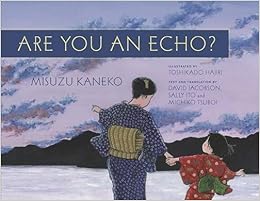
Are You an Echo? The Lost Poetry of Misuzu Kaneko narrative and translation by David Jacobson, Sally Ito, and Michiko Tsuboi; illustrated by Toshikado Hajiri

Published by Chin Music Press 

Summary:  Born in a Japanese fishing village in 1903, Misuzu Kaneko was fortunate enough to receive more education than most of her female contemporaries.  She worked in her mother’s bookstore and published her poems in magazines.  Then she made the unfortunate decision of marrying one of the bookstore clerks who was abusive, unfaithful, and passed on a devastating disease to Misuzu.  She divorced him, but when he insisted on full custody of their daughter (a right given to fathers only at that time in Japan), Misuzu committed suicide.  The first half of the book tells the story of her life, and the second half is a collection of her poems, written in both Japanese and English.  An author’s note and translators’ note explain the careful work and research that went into creating this book.  64 pages; grades 2-7.

Pros:  This might be the most moving book I have read in 2016.  Misuzu Kaneko’s life was ultimately tragic, but her poetry reveals a beautiful spirit who saw life and hope in ordinary objects around her.  Her poems are accessible to kids, yet infused with deeper meaning.  The gorgeous illustrations should receive Caldecott consideration.

Cons:  I was unprepared for the shock of reading about Misuzu’s suicide.

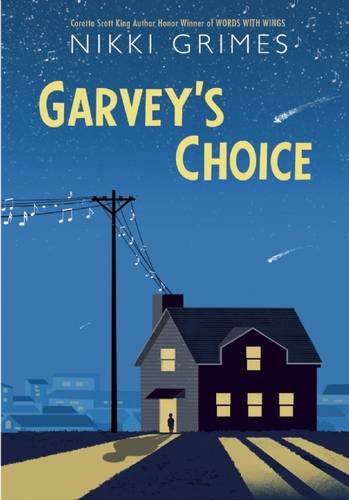
Garvey’s Choice by Nikki Grimes

Published by Wordsong 

Summary:  Garvey can’t seem to please his father, who wants a football-player son, not one who struggles with his weight and hates sports.  But Garvey’s good at chess, loves to read, and is interested in astronomy.  Encouraged by his best friend Joe, Garvey overcomes his fears and tries out for chorus, where his talents really start to emerge.  He discovers he has a strong tenor voice, and he even makes a new friend, Manny, a boy with albinism who shows Garvey how to ignore teasing and be himself.  When the first concert arrives, Garvey is shocked to see his father wiping away tears after his solo.  It turns out Dad was in a band way back when, and father and son finally find a connection through music.  A note at the end explains tanka, a Japanese form of poetry used to write this story.  120 pages; grades 4-7.

Pros:  A brief novel in verse that lingers long after the first page.  Garvey and his family are sympathetically portrayed, and readers will be rooting for him as he slowly finds his place in the world.

Cons:  At times, Joe and Manny’s advice seemed unrealistically wise beyond their years.

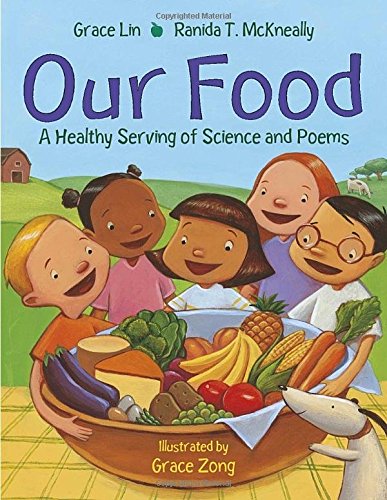
Our Food: A Healthy Serving of Science and Poems by Grace Lin and Ranida T. McKneally, illustrated by Grace Zong

Published by Charlesbridge 

Summary:  Each two-page spread includes a large, colorful illustration, a haiku poem, and a question such as “Why are so many vegetables green?” and “What makes a grain a grain?”  Each question is answered with several paragraphs of kid-friendly text.  Five food groups are covered: fruits, vegetables, dairy, protein foods, and grains.  The book supports the USDA recommendations for eating these different types of foods.  The last couple pages encourage eating a variety of healthy foods and explain a little more about the food groups.  Includes a glossary.  40 pages; grades K-3.

Pros:  A good basic introduction to food and nutrition.  The haikus and cheerful illustrations add fun touches.

Cons;  Food allergies receive a one-sentence mention at the bottom of the third-to-last page, and varieties on the USDA-recommended diet, such as vegetarianism or gluten-free, are not mentioned.  A list of additional resources could have addressed some of those topics.


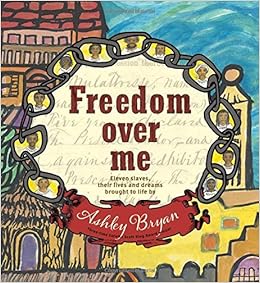
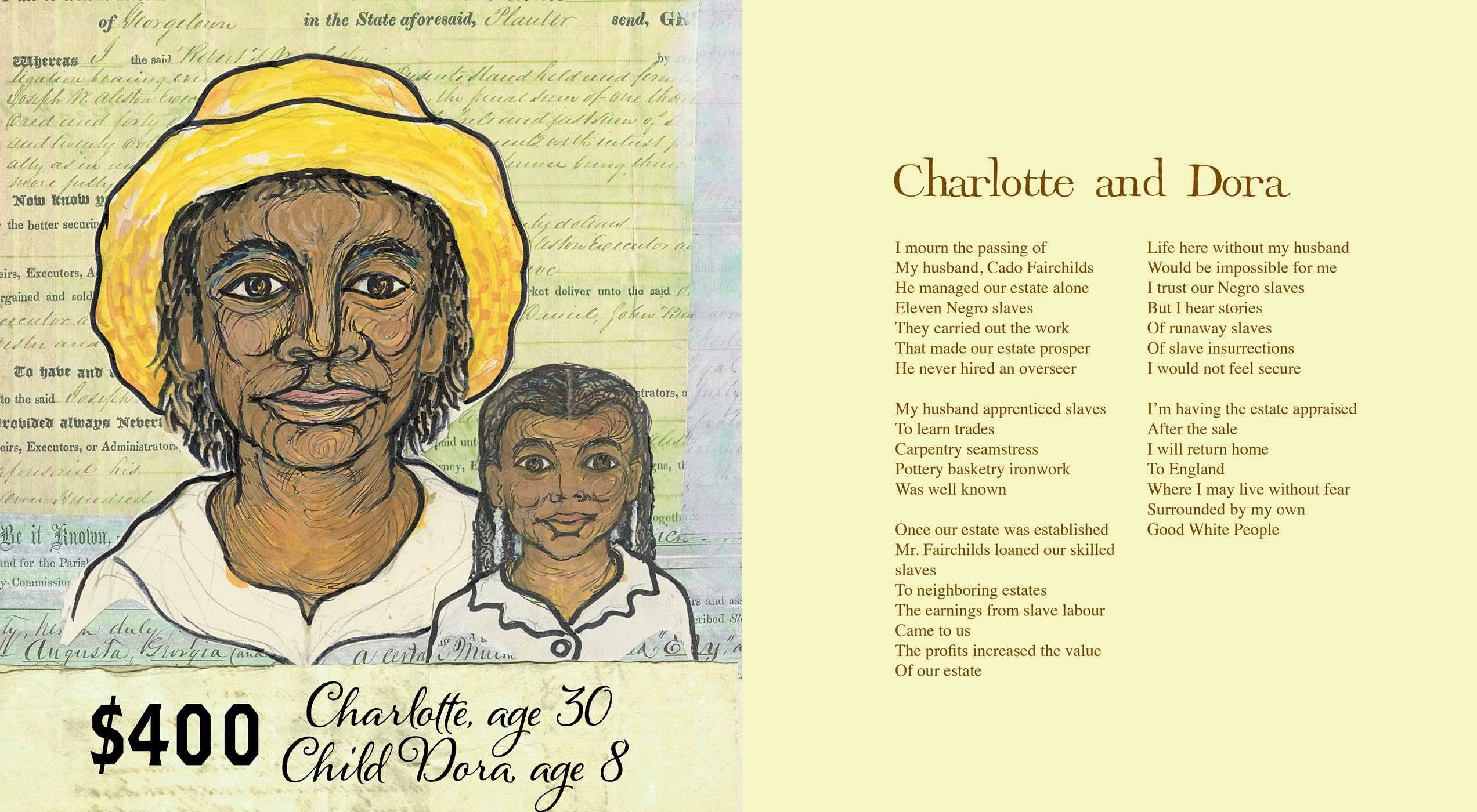
Freedom Over Me: eleven slaves, their lives and dreams brought to life by Ashley Bryan

 Published by Atheneum Books for Young Readers 

Summary:  Many years ago, as he explains in his ending author’s note, Ashley Bryan received a collection of documents relating to slavery from the 1820’s through the 1860’s.  He chose one of these, an 1828 appraisal of 11 slaves from the Fairchilds estate and created stories for each of them.  He has given each of them a name, connections to each other, and a trade or talent that each has used to increase the wealth of the estate.  Of course, this increase in wealth was not enjoyed by any of them.  Each slave has a portrait and two narrative poems, one describing himself or herself, and the other telling about his or dreams.  Almost everyone ends with a longing for freedom.  Their master has died, the mistress is selling the slaves, and they have no idea where they will end up.  The original document is shown at the end, along with the author’s note.  56 pages; grades 4-7.

Pros:  The sadness of slavery is profound in these poems of dignified, talented people, many of whom remember their lives and families in Africa.  Bryant has done a masterful job of bringing them to life, both in words and pictures.

Cons:  I wanted to know where the estate was, but no details were given.

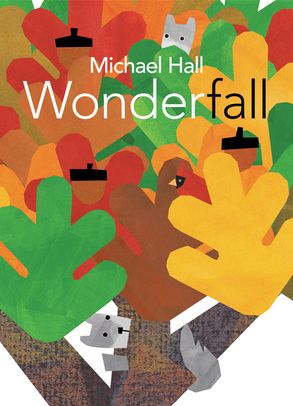
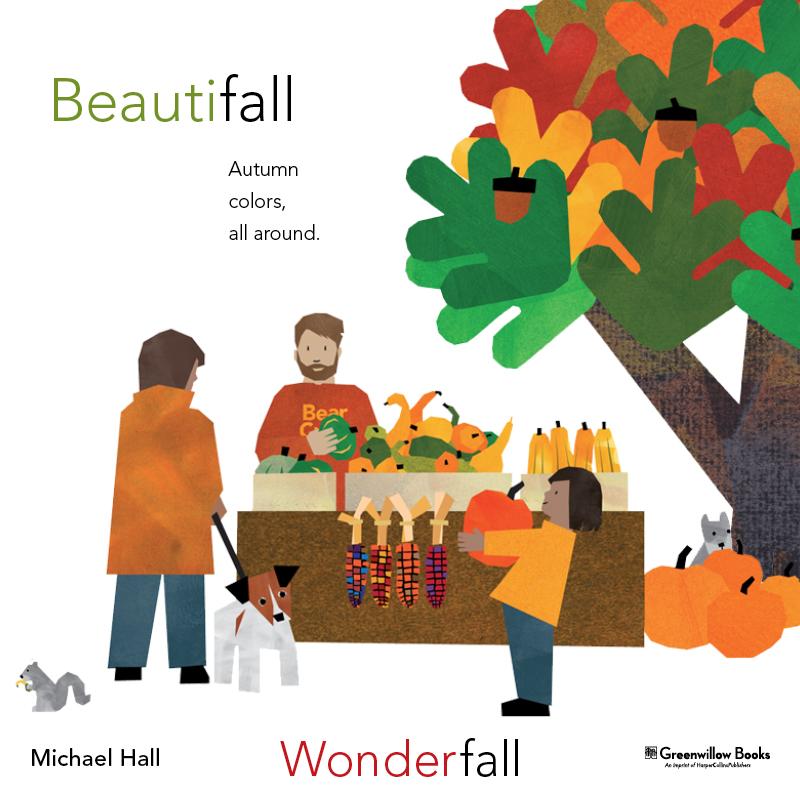
Wonderfall by Michael Hall

Published by Greenwillow Books 

Summary:  Each page has a picture of an oak tree and a poem about what is going on through the fall.  The poems are entitled with –fall words, such as thankfall, delightfall, and peacefall.  Gradually, the tree changes from green to multi colored to bare.  The school bus appears at the beginning, followed by a farmer’s market, an autumn parade, Halloween, Thanksgiving, and finally, clean-up of the fallen leaves.  The final word heralds a new season: snowfall.  Back matter includes information on how the animals pictured spend the winter (introducing the terms hibernation and migration), as well as the connection between squirrels and acorns, and how the tree will survive the cold weather.  40 pages; ages 4-8.

Pros:  A beautiful introduction to fall, with scenes kids will recognize from the season, illustrated with Michael Hall’s bright, simple creations.  The end matter will give readers more scientific information to appreciate the changing seasons.

Cons:  I couldn’t tell from the information given if some of the animals hibernate or stay awake in the winter.

Guess Who, Haiku by Deanna Caswell, illustrated by Bob Shea

Published by Harry N. Abrams 

Summary:  Ten haiku poems are offered as riddles for the reader to guess:  “new day on the farm/muffled mooing announces/a fresh pail of milk”.  The next page shows the cow, who has her own haiku to offer.  So it goes, until the final poem, “two hands hold a book/guessing animals’ puzzles/written in haiku…It’s YOU!”  The final page explains a little about haiku, including defining what a syllable is, and invites readers to explore the playfulness of the form.  24 pages; ages 4-8.

Pros:  An excellent introduction to haiku for the very young.

Cons:  The “riddles” aren’t particularly challenging.

Slickety Quick: Poems About Sharks by Skila Brown, illustrated by Bob Kolar

Published by Candlewick
 

Summary: 14 different types of sharks get a poem, along with a brief factual description and two-page illustration. There are well-known sharks, such as the great white and the whale shark, and some lesser known species, like the cookie-cutter shark and wobbegong. Some of the poems are only a few lines (“Whale Shark: In water she dangles, and bubbles and jangles, and blinks her mouth right up at me. Her back spots they shimmer, her tail getting dimmer, the silkiest wave of the sea.”); others are a few stanzas. All are descriptive and playful with language. 32 pages; grades K-4.

Pros: The Venn diagram showing the intersection of poetry readers and shark fans must be pretty close to the null set. Slickety Quick does its part to remedy this situation, with fun poems and interesting shark lore to appeal to both groups.

Cons: Back matter with additional shark information would have been a nice addition.

The White Cat and the Monk by Jo Ellen Bogart, illustrations by Sydney Smith

Published by Groundwood Books


Summary:  While a monk seeks knowledge among his manuscripts, his white cat, Pangur, seeks something a little more substantial; namely, a tasty mouse.  The first several pages are wordless, following Pangur as he explores the monastery, finally arriving at his master’s door and sticking a paw under to alert the monk to his presence.  The monk then narrates their activities, concluding with a happy ending in which the cat snares his prey and the monk finds an answer to his puzzle.  The author’s note at the end explains more about the poem “Pangur Ban”, written by a ninth-century Irish monk, on which this book is based.  32 pages; grades K-3.

Pros:  A poem by a ninth-century Benedictine monk seems like an unlikely source for a children’s book, but somehow this works, due in large part to the beautiful illustrations that perfectly enlarge upon the simple text.  Cat lovers will be captivated by Pangur and his antics.

Cons:  Probably better for one-on-one sharing than reading to a larger group.

The Last Fifth Grade of Emerson Elementary by Laura Shodd

Published by Wendy Lamb Books 

Summary:  Emerson Elementary School will be razed and replaced by a supermarket at the end of the year.  The eighteen fifth graders in Ms. Hill’s class have a range of emotions about this.  To express them, their teacher has them write poems which will be placed in a time capsule inside the wall of the new store.  The class is diverse in ethnic and family backgrounds, and their individual struggles at school and at home show up in their poetry.  Each one grows through the year, making and losing friends, accepting changing family situations, and learning about themselves.  By the end of the year, they are ready to accept the inevitable, and find their own ways into middle school.  End matter includes several pages about the different forms of poetry and the prompts the students had to work from, as well as a glossary.  256 pages; grades 3-7.

Pros:  This first-time author does an amazing job of creating 18 distinct, likeable characters.  Although this could be a quick read, it pays to take it slowly, going back to see other poems written by each student to really get to know them.  The extra information on different poetic forms would make this an excellent and accessible introduction to poetry.

Cons:  It’s pretty difficult at the beginning to keep track of who’s who in the class.