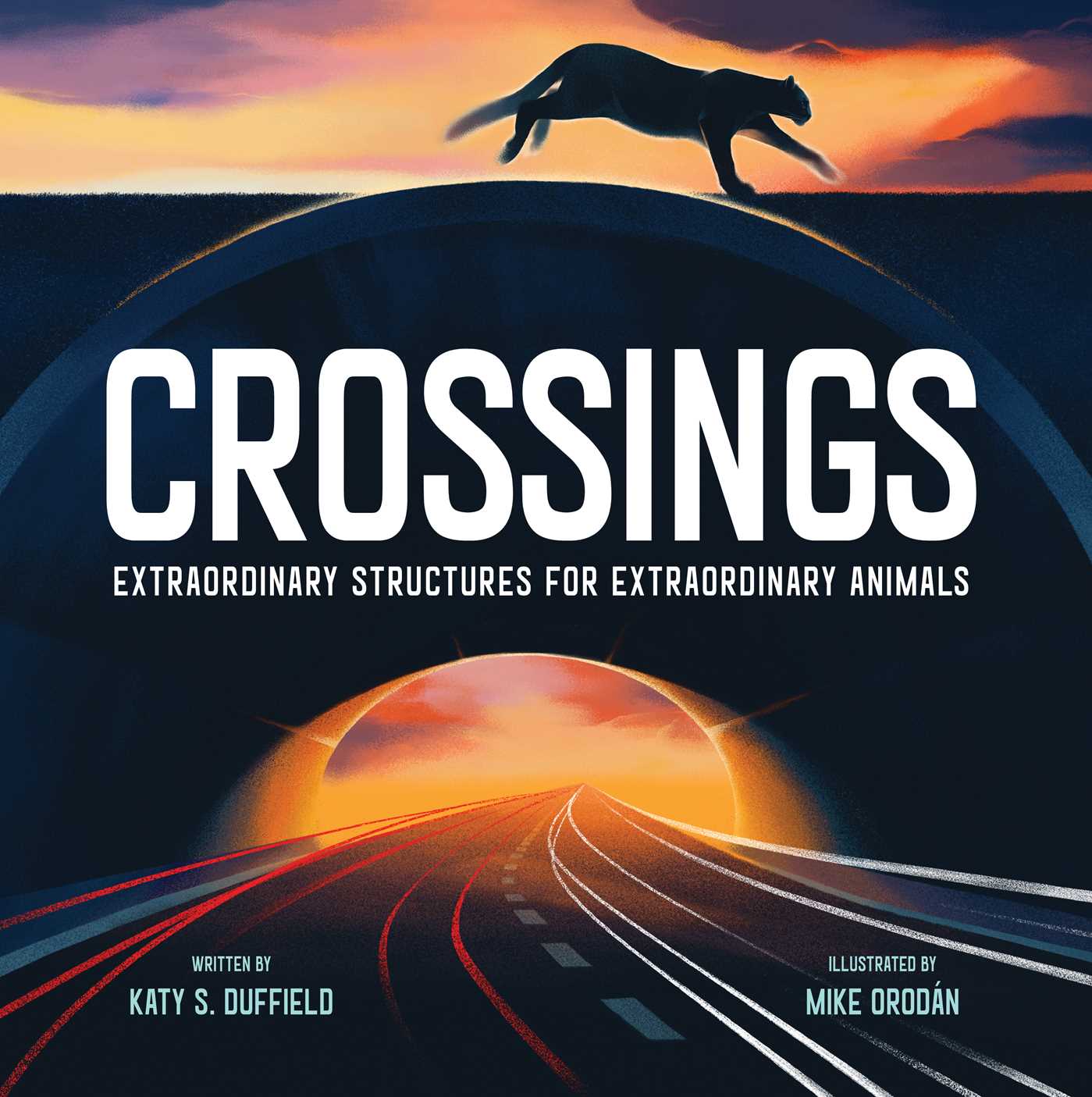
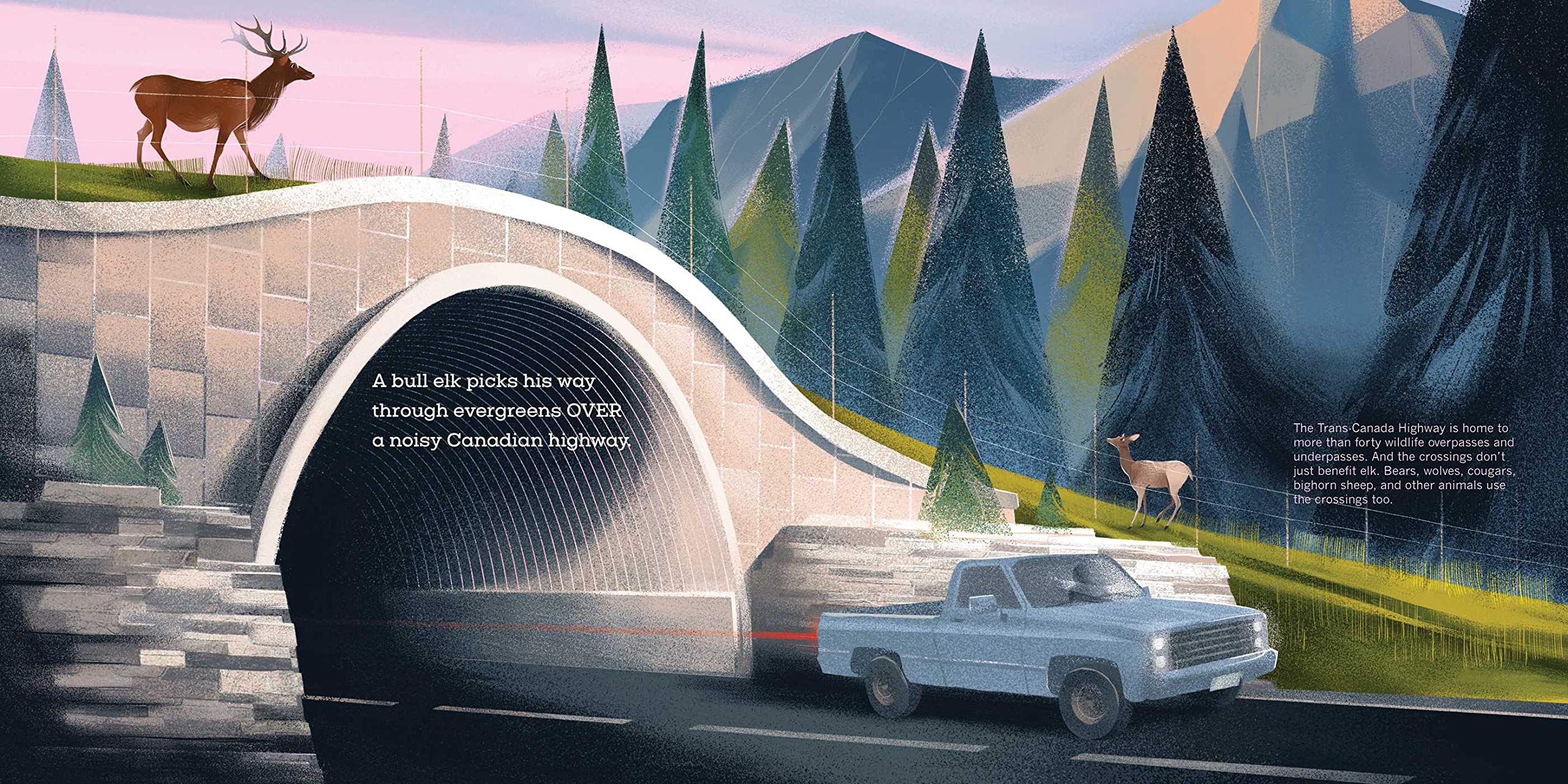
Crossings: Extraordinary Structures for Extraordinary Animals by Katy S. Duffield, illustrated by Mike Orodán

Published by Beach Lane Books

Crossings | Book by Katy S. Duffield, Mike Orodán | Official Publisher Page  | Simon & Schuster
Crossings: Extraordinary Structures for Extraordinary Animals: Duffield,  Katy S., Orodán, Mike: 9781534465794: Amazon.com: Books

Summary:  Animals struggle to survive in a world overrun by humans, but there are people who build structures to make life a little easier for them.  They’ve created overpasses, underpasses, bridges, and tunnels to help different creatures move from one place to another safely.  From overpasses across the Trans-Canada Highway to rope bridges over Australia’s Hume Highway to tiny passageways built for spotted salamanders in Massachusetts, engineers have come up with some creative solutions to help animals threatened by traffic and other human activities.  Includes two pages with additional information about each structure and a bibliography.  48 pages; ages 4-9.

Pros:  Kids will enjoy learning about both the animals and the structures, but the real appeal of this book is the large, colorful illustrations of all the critters.  I hope we’ll be seeing more from illustrator Mike Orodán.

Cons:  I hope I never stumble upon those millions of crabs crossing their special crab bridge on Christmas Island.

If you would like to buy this book on Amazon, click here.

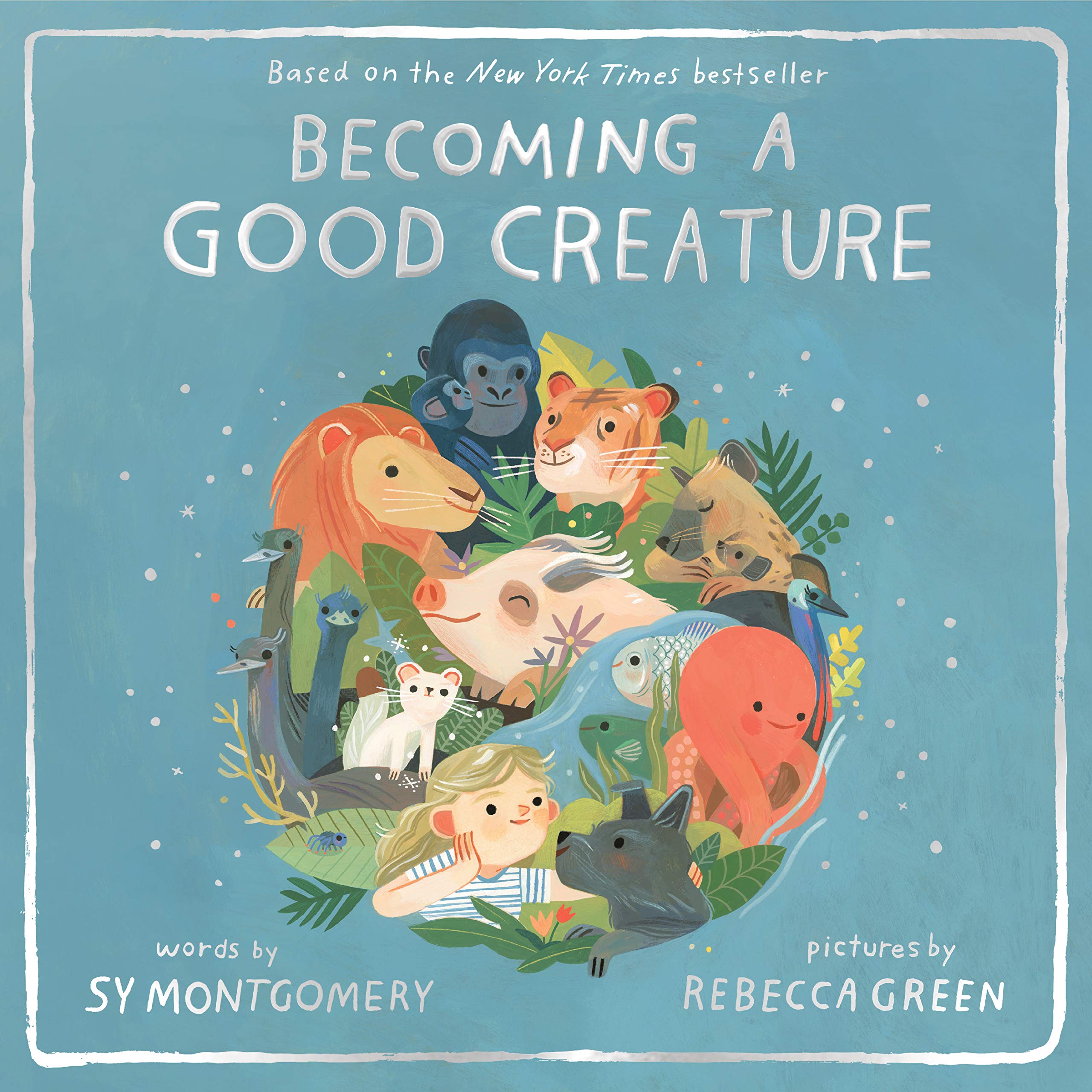
Becoming a Good Creature by Sy Montgomery, illustrated by Rebecca Green

Published by HMH Books for Young Readers

Becoming a Good Creature: Montgomery, Sy, Green, Rebecca: 9780358252108:  Amazon.com: Books
Becoming a Good Creature - Kindle edition by Montgomery, Sy, Green, Rebecca.  Children Kindle eBooks @ Amazon.com.

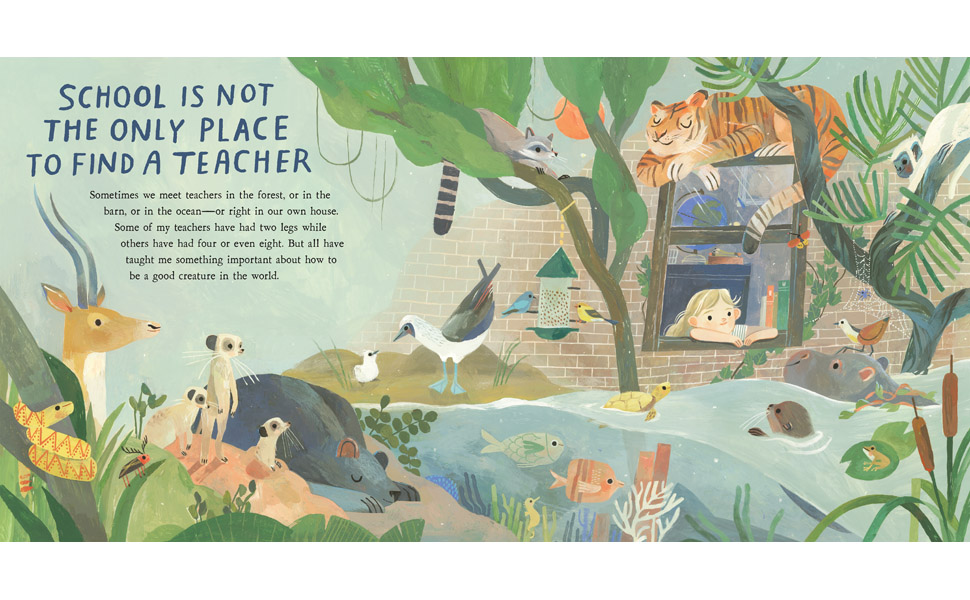
Summary:  Based on her 2018 YA/adult book How to Be a Good Creature, Sy Montgomery shares with readers the lessons she has learned from animals.  Her earliest teacher was her childhood dog Molly, who helped her discover how to observe animals.  She used those skills to study emus, gorillas, tigers, sharks, and more all over the world.  Animals taught her to be patient, to forgive, and to not be afraid.  A pig named Christopher Hogwood helped Sy and her husband create a unique kind of family.  Even animals that aren’t always loved–hyenas, a tarantula, and a weasel–helped her to become more open-minded and understanding.  The last lesson, “Trust tomorrow” tells how a border collie puppy who was blind in one eye reminded her that, even when things seem like they’re ending, there’s promise in a new day.  Includes a brief thank-you note to the animals from the author with photos of her with a few of the animals from the book.  40 pages; grades K-4.

Pros:  Animal lovers will enjoy reading these brief but intimate stories about Montgomery’s many animal adventures.  Social-emotional or spiritual teachers could use any of these stories to introduce a lesson.

Cons:  The photos at the end left me wanting to see more.

If you would like to buy this book on Amazon, click here.

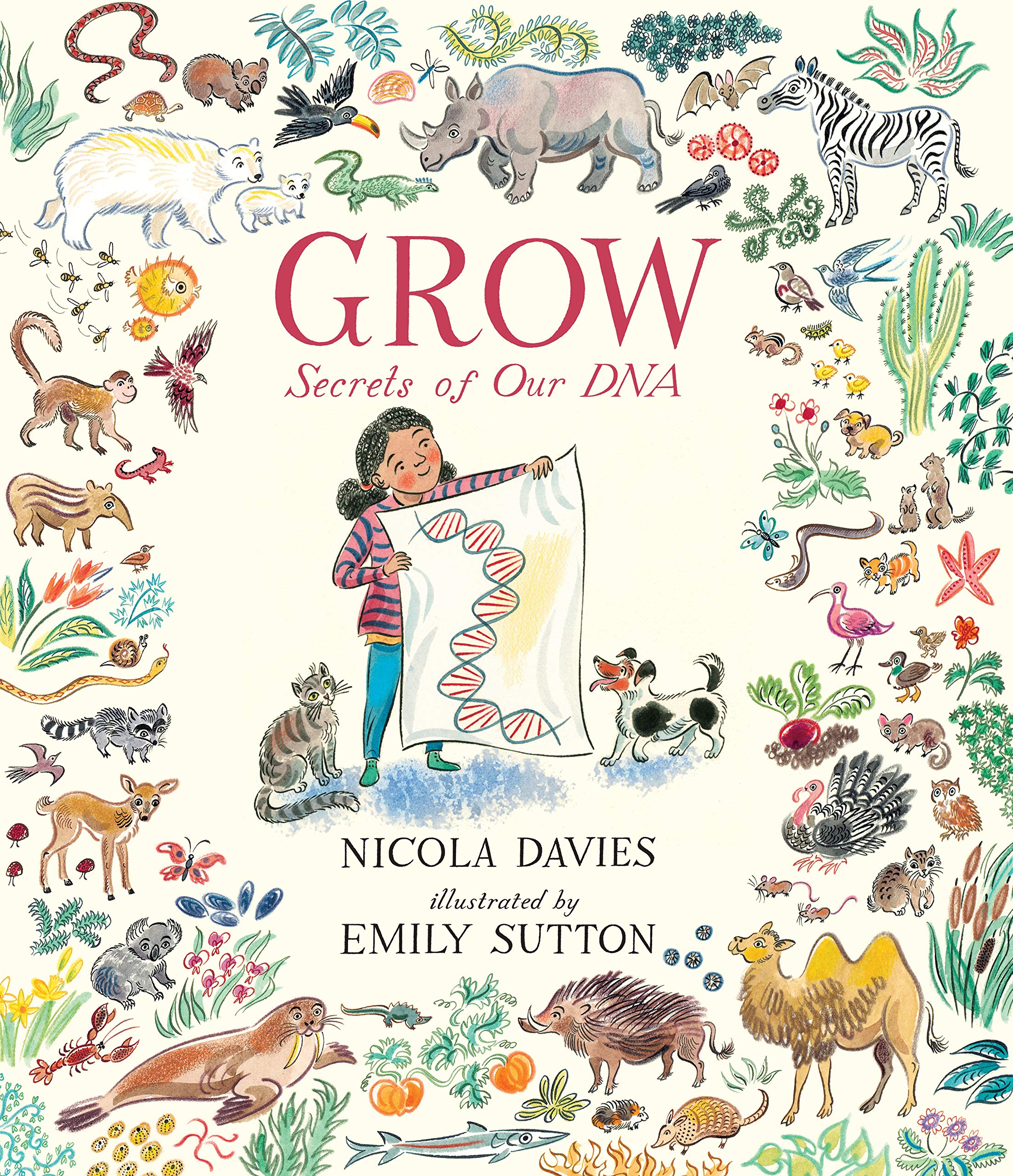
Grow: Secrets of Our DNA by Nicola Davies, illustrated by Emily Sutton

Published by Candlewick

Grow: Secrets of Our DNA: Davies, Nicola, Sutton, Emily: 9781536212723:  Amazon.com: Books

Summary:  All living things grow: some quickly, some slowly, some a little, and some a lot.  Humans grow from a tiny dot to an adult, following a set of instructions coded into DNA, the genetic code.  Humans’ genetic code is similar to some animals, like chimpanzees, less similar to other animals like dogs, and even less similar to plants.  But all forms of life are connected, and all connect back to earlier forms of life “because all life has always been written in one language”.  Includes an afterword called “How did you grow?”.  40 pages; grades K-5.

Pros:  Nicola Davies does a masterful job of explaining DNA and genetics in a way that allows me to confidently recommend this book for kids as young as kindergarteners.  The gorgeous illustrations showing all kinds of animal and plant life make it even more accessible for readers of all ages.

Cons:  I was surprised there were no resources for further research included at the end.

If you would like to buy this book on Amazon, click here.

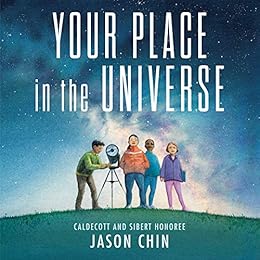
Your Place in the Universe by Jason Chin

Published by Neal Porter Books

Your Place in the Universe - Kindle edition by Chin, Jason. Children Kindle  eBooks @ Amazon.com.

Summary:  An eight-year-old is about five times as tall as this book…but only half as tall as an ostrich.  The ostrich is half as tall as the tallest land animal, the giraffe, but the giraffe is 20 times shorter than the tallest living thing, a redwood tree.  The journey continues outward: skyscrapers, mountains, outer space, all the way to the very edges of the universe.  It then comes back to Earth, and that group of eight-year-olds, who are capable of looking into the sky and imagining their place in the universe.  Includes additional information on Earth, the solar system, the universe, and making maps and models, as well as notes on the text and the illustrations, and a list of selected sources.  40 pages; ages 4-8.

Pros:  Although this sort of journey has been shown before (Cosmic View: The Universe in 40 Jumps or Powers of Ten), Jason Chin brings his own deft touch to it.  As always, Chin’s illustrations are amazing in their details, colors, and realistic renderings (I was particularly awed by the panoramic view of Mount Everest showing a juxtaposition with the tallest skyscrapers).  The simple comparisons make this accessible to early elementary kids, but the back matter makes it hefty enough for older readers.  Sure to be a contender for another Sibert award.

Cons:  I’m feeling pretty insignificant right now.

If you would like to buy this book on Amazon, click here.

If You Want to Visit a Sea Garden by Kay Weisman, illustrated by Roy Henry Vickers

Published by Groundwood Books

If You Want to Visit a Sea Garden - Kindle edition by Weisman, Kay,  Vickers, Roy Henry. Children Kindle eBooks @ Amazon.com.
If You Want to Visit a Sea Garden: Weisman, Kay, Vickers, Roy Henry:  9781554989706: Amazon.com: Books

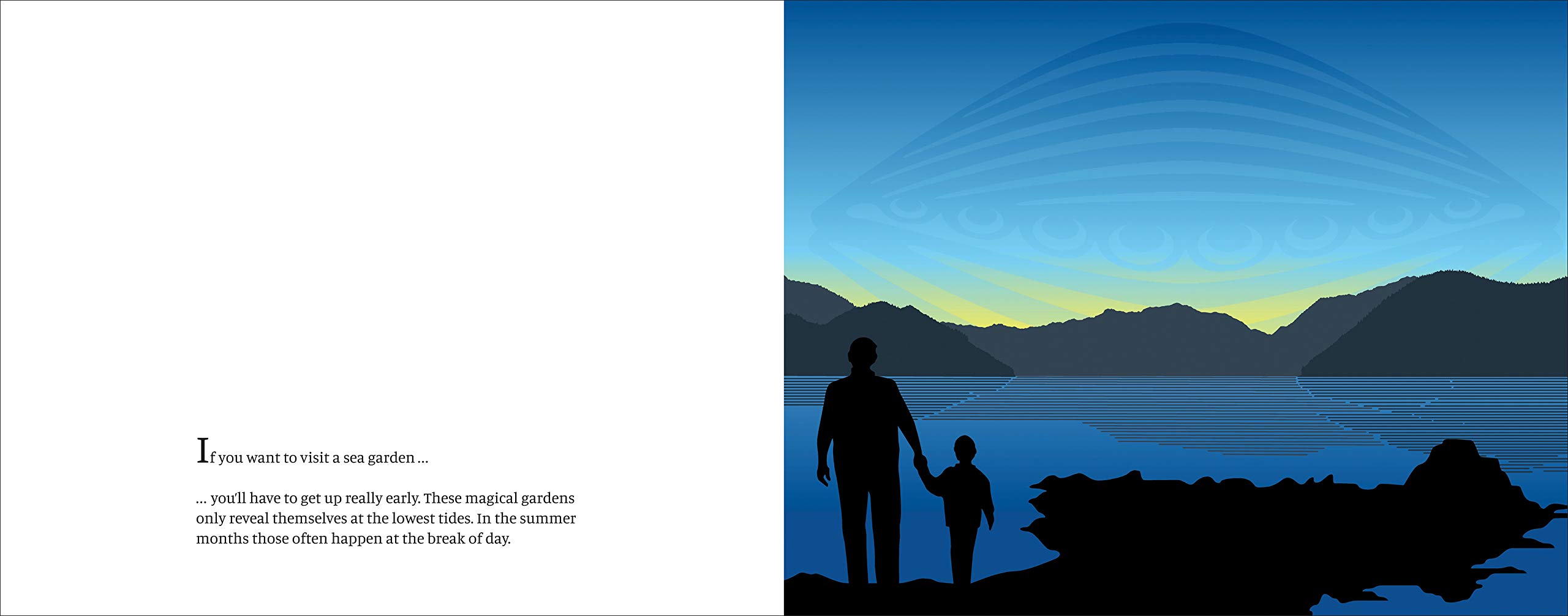
Summary:  A child and adult are seen in silhouette at the beach as the sun rises.  They’re there to visit a sea garden, a reef created by indigenous people for thousands of years by lining up boulders at the lowest tide line.  This creates a habitat for a variety of sea creatures, and the two see clams, whelks, sea stars, hermit crabs, and a wide variety of other creatures.  They join others digging for clams, planning to steam some and smoke others to eat later.  Before they leave, they do their part to tend to the sea garden, fixing a wall and clearing away driftwood and seaweed.  As the sun sets, they row away, heading back home.  Includes a page of information about sea gardens, including three photos.  32 pages; grades K-4.

Pros:  An interesting lesson on a method of sustainably harvesting seafood that has been done on the Pacific Northwest coast for over 3,000 years.  The illustrations are magnificent, with different vivid background colors showing the times of day throughout the story.  There were interesting faces and designs in the pictures that I wish were explained somewhere.

Cons:  I had trouble picturing what a sea garden looked like, and the photos at the end were so small that they still didn’t really clear it up for me.

If you would like to buy this book on Amazon, click here.

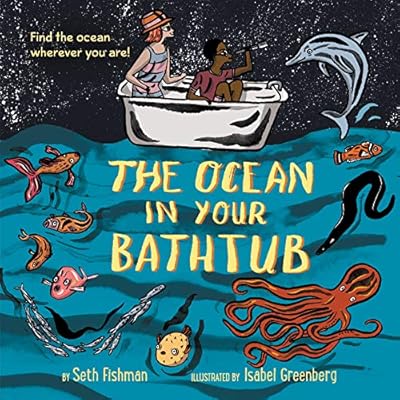
The Ocean In Your Bathtub by Seth Fishman, illustrated by Isabel Greenberg

Published by Greenwillow Books

The Ocean in Your Bathtub: Fishman, Seth, Greenberg, Isabel ...
The Ocean in Your Bathtub: STEM Activities with Seth Fishman ...

Summary:  Oceans cover 71 percent of the Earth, and contain 97 percent of Earth’s water.  Almost four of ten people live within 60 miles of an ocean.  Those are a few of the facts about oceans you’ll learn in this book, which is relevant even if you’re not one of those four out of ten.  The oceans affect our weather, drinking water, and food supply.  Plants in the ocean provide oxygen for the air we breathe.  And, of course, humans are doing an outstanding job of messing up the oceans with pollution and overfishing.  But even small deeds done to protect the oceans can have an impact.  Includes additional information on phytoplankton, the water cycle, aquifers, and what you can do to help the oceans.  40 pages; ages 4-8.

Pros:  A fun and accessible introduction to the ocean with interesting facts and lively illustrations.  I wasn’t familiar with this author-illustrator team, but it looks like they’ve written a couple of other interesting science books as well.

Cons:  Trying to cover such an enormous topic in a picture book is challenging, and there are some facts (“The ocean is NOT a major source of drinking water–it’s way too salty!”) that may leave kids wanting more of an explanation.  Some additional resources would have been helpful for this.

If you would like to buy this book on Amazon, click here.

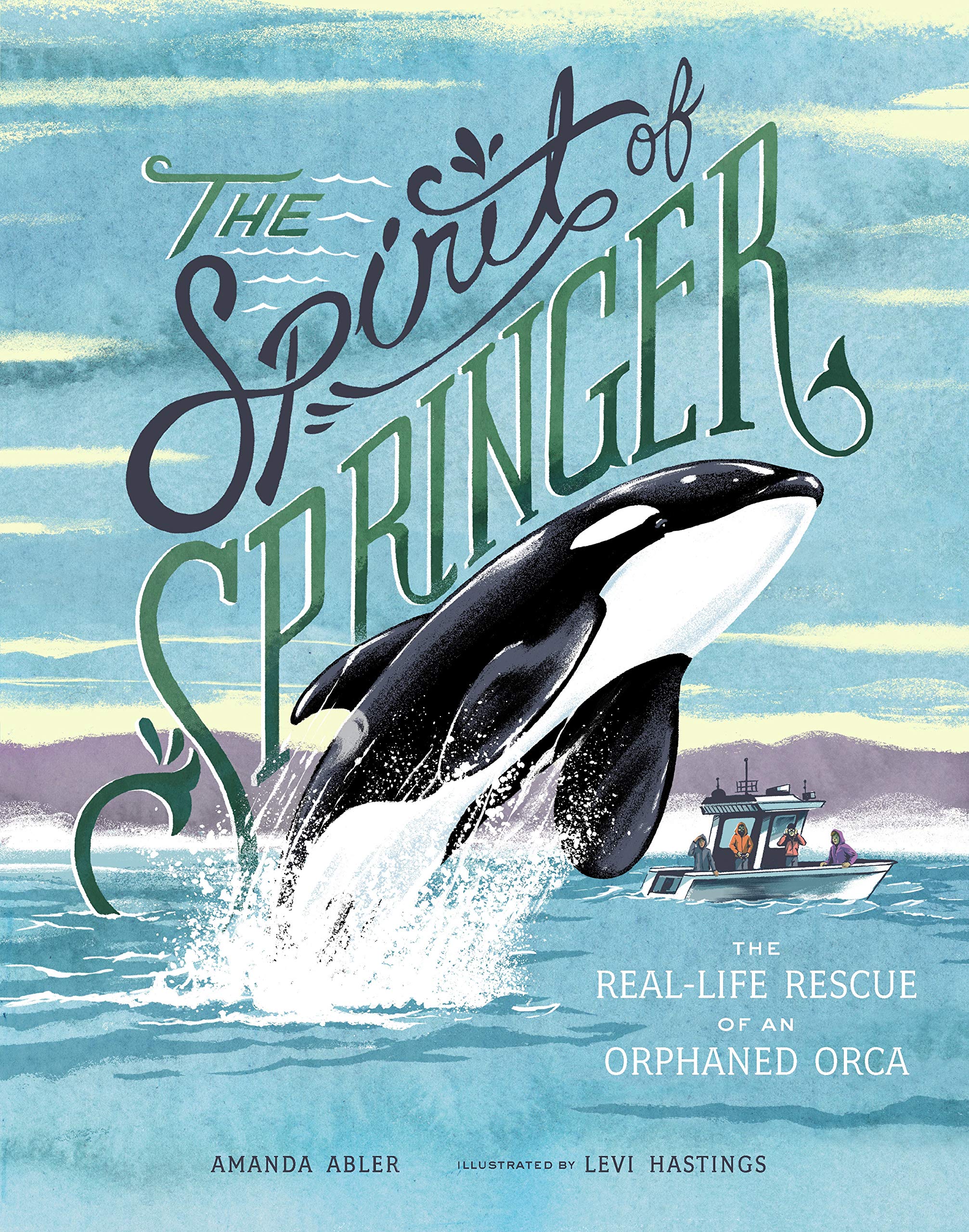
The Spirit of Springer: The Real-Life Rescue of an Orphaned Orca by Amanda Abler, illustrated by Levi Hastings

Published by Little Bigfoot

The Spirit of Springer: The Real-Life Rescue of an Orphaned Orca ...

Picture Books That Show the World Through a Child's Eyes - The New ...

Summary:  In January, 2002, an orca calf was discovered by herself near Seattle.  Scientists could tell from her dialect that she was from a pod that lives near Vancouver Island.  Using photos from that pod, they identified her as Springer, a two-year-old female.  Springer was too malnourished to be transported that distance, so scientists began a program of rehabilitation, trying to interact with her as little as possible so she could be reintroduced to her pod.  Six months later, she was healthy enough to travel, and made the trip to Dong Chong Bay in Canada, where she was welcomed by a group of First Nations people and two bald eagles.  It took awhile, but Springer eventually reconnected with her pod and was adopted by a female cousin.  Fourteen years later, in 2016, Springer was spotted again, this time with a calf of her own, whom scientists named Spirit.  48 pages; grades 2-5.

Pros:  Kids will fall in love with Springer and root for her to get back to her family.  They’ll also learn about the painstaking work scientists do to learn about orcas.  This would make a nice companion to A Whale of the Wild, the new book by Rosanne Parry.

Cons:  While I liked the illustrations, the predominantly blue, black, and white palette didn’t make for a very eye-catching cover.

If you would like to buy this book on Amazon, click here.


A Whale of the Wild by Rosanne Parry, illustrated by Lindsay Moore

Published by Greenwillow Books (Released September 1)

A Whale of the Wild: Parry, Rosanne, Moore, Lindsay: 9780062995926 ...

Summary:  Vega and her orca family live in the waters near land, taking care of each other and hunting for the salmon that sustains them.  Vega is learning to be a wayfinder, taught by her mother and grandmother in the matriarchal orca society.  When an earthquake and tsunami separate the family, Vega must keep herself and her younger brother Deneb safe.  They wind up in a much deeper part of the ocean, where they discover sights and creatures they have never seen before.  A harrowing journey back to their home reunites them with a couple of family members and gives them hope that they may find the rest of their kin some day.  Includes maps; facts about orcas; the real orcas who inspired the story; and additional information about salmon, the various habitats in the story, earthquakes and tsunamis, and how to help the orcas (not seen by me in the advanced review copy I got).  336 pages; grades 3-7.

Pros:  Another fascinating animal adventure by the author of A Wolf Called Wander, probably my top book club book in 2019.  Readers will learn a lot about the orcas and their ocean environment, as well as the threat humans pose to them.  I was sorry not to get to see Lindsay Moore’s illustrations (who is oddly not credited on the cover), which I’m sure are beautiful based on her work in Sea Bear.

Cons:  I found myself struggling a bit to get through this book, although it is beautifully written and has plenty of action.  I hope I’ll get to try it out on kids soon to see if they enjoy it as much as Wander

If you would like to buy this book on Amazon, click here.


Child of the Universe by Ray Jayawardhana, illustrated by Raul Colón

Published by Make Me a World

Child of the Universe: Jayawardhana, Ray, Colón, Raul ...

Child of the Universe: Jayawardhana, Ray, Colón, Raul ...

Summary:  As a girl is getting ready for bed, she and her father look out at the moon.  “The universe conspired to make you,” he tells her, then goes on to compare her to the beauty and majesty of the universe: her hair swirls about her face like the Milky Way, she lights up the room like the sun lights the moon, and the cosmos are reflected in her eyes.  He gives more concrete examples as well, like the fact that the iron and calcium in her blood and bones comes from stars that lived long ago.  On the last page, she gets tucked into bed, and looks out at the moon smiling back at her.  Includes an author’s note that tells of the strong connections to the cosmos that are part of Earth and humanity.  40 pages; ages 3-7.

Pros:  The gorgeous illustrations showing the girl traveling through the cosmos are worthy of Caldecott consideration.  Their brilliant, yet slightly muted colors fill every inch of each two-page spread.  Young scientists will be amazed to learn the science that connects them to the universe.

Cons:  If you’re going to use rhyming text, it has to be really, really good, and this isn’t quite there.  Jayawardhana, a dean at Cornell University who has researched planetary systems and the prospect for life on other planets, seems more comfortable writing his author’s note. 

If you would like to buy this book on Amazon, click here.

Cityscape: Where Science and Art Meet by April Pulley Sayre

Published by Greenwillow Books

Amazon.com: Cityscape: Where Science and Art Meet (9780062893314 ...

Summary:  “Rectangle. Right angle. Window. Wall. A windy canyon where shadows fall.”  The simple rhyming text is accompanied by several photos on each page showing urban landscapes.  Building, vehicles, and other structures focus on shapes, angles, functions, and art.  The last couple pages discuss how to find science, technology, engineering, math, and art in the city.  A list of 40 questions encourages readers to observe what they see in the city with an inquiring mind.  40 pages; ages 4-8.

Pros:  April Pulley Sayre works her usual magic with her combination of interesting photographs and brief rhyming text.  She moves in a different direction with this book, away from her usual nature topics, and into the city and human-built structures.  There’s a lot to absorb in both the book and the questions at the end, and kids will come away from this book observing their surroundings in a whole new way.

Cons:  Some of the topics seemed somewhat abstract.  On the other hand, this could make the book an interesting read for older kids as well.

If you would like to buy this book from Amazon, click here.