Sweet Dreamers by Isabelle Simler

Published by Eerdmans Books for Young Readers

Image result for sweet dreamers simler

Image result for sweet dreamers simler

Summary:  Twenty eight poems tell how different animals sleep: “Toes clinging to the ceiling/kite-fingers folded like a blanket/the bat dreams upside down/As the day shines, she slips into darkness.”  Each spread has a picture of the animal from a short distance on the page with the poem, and a close-up of the animal on the facing page. There are a few wordless spreads of nighttime landscapes interspersed among the poems.  The last poem is for the reader (or listener): “She clambers onto the whale/straddles the seahorse/clings to the elephant/swoops with the swallow./All night long, cuddling her koala/The child dreams beneath the moon.” 80 pages; ages 4-9.

Pros:  Nothing was lost in the translation of this book from the original French to English.  The poems are brief but expressive, and convey at least a fact or two about each animal.  The big and beautiful illustrations are digitally created, which is hard to believe. They look like scratchboard, with bright bits of color on dark backgrounds, perfect for the subject matter.

Cons:  Some additional information on the animals at the end would have added to the educational value.

If you would like to buy this book on Amazon, click here.

Nine Months: Before a Baby Is Born by Miranda Paul, illustrated by Jason Chin

Published by Neal Porter Books

Image result for nine months miranda paul amazon

Image result for nine months miranda paul

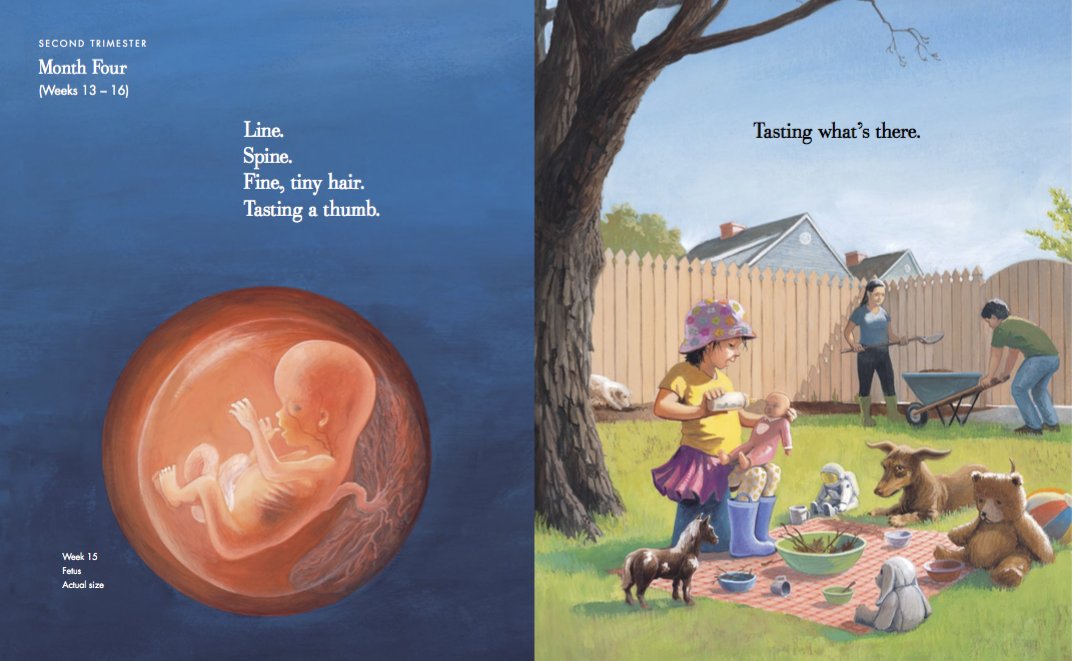
Summary:  On the right-hand pages of this book a family of a mother, father, and little girl prepare for a new baby.  The seasons change from winter to spring to summer to fall, as Mom’s belly slowly gets bigger. The left-hand pages show what’s going on with the new baby, starting from a fertilized egg and going all the way to the new baby in the hospital.  The big sister is part of the process, reading books about new babies, practicing giving a doll a bottle, watching the screen at the ultrasound, feeling the baby’s kicks, and finally, meeting her new little sister in the hospital. Includes more information on a baby’s development; the gestation periods of different animals; and some answers to what if questions that include information on twins, premature births, and miscarriages. 32 pages; ages 4-8.

Pros:  What an amazing resource for families expecting a new baby!  The simple rhyming text would make a quick read to a preschooler, but he or she will want to spend lots of time on Jason Chin’s awesome illustrations, many of which show the actual size of the developing fetus.  There’s just enough information for young kids without getting into too much birds-and-bees stuff.

Cons:  The whole process looks so easy, and the little girl seems 100% thrilled to be getting a younger sibling, which may not be entirely realistic.

If you would like to buy this book on Amazon, click here.

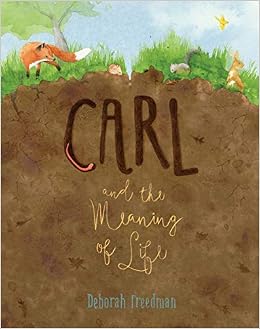
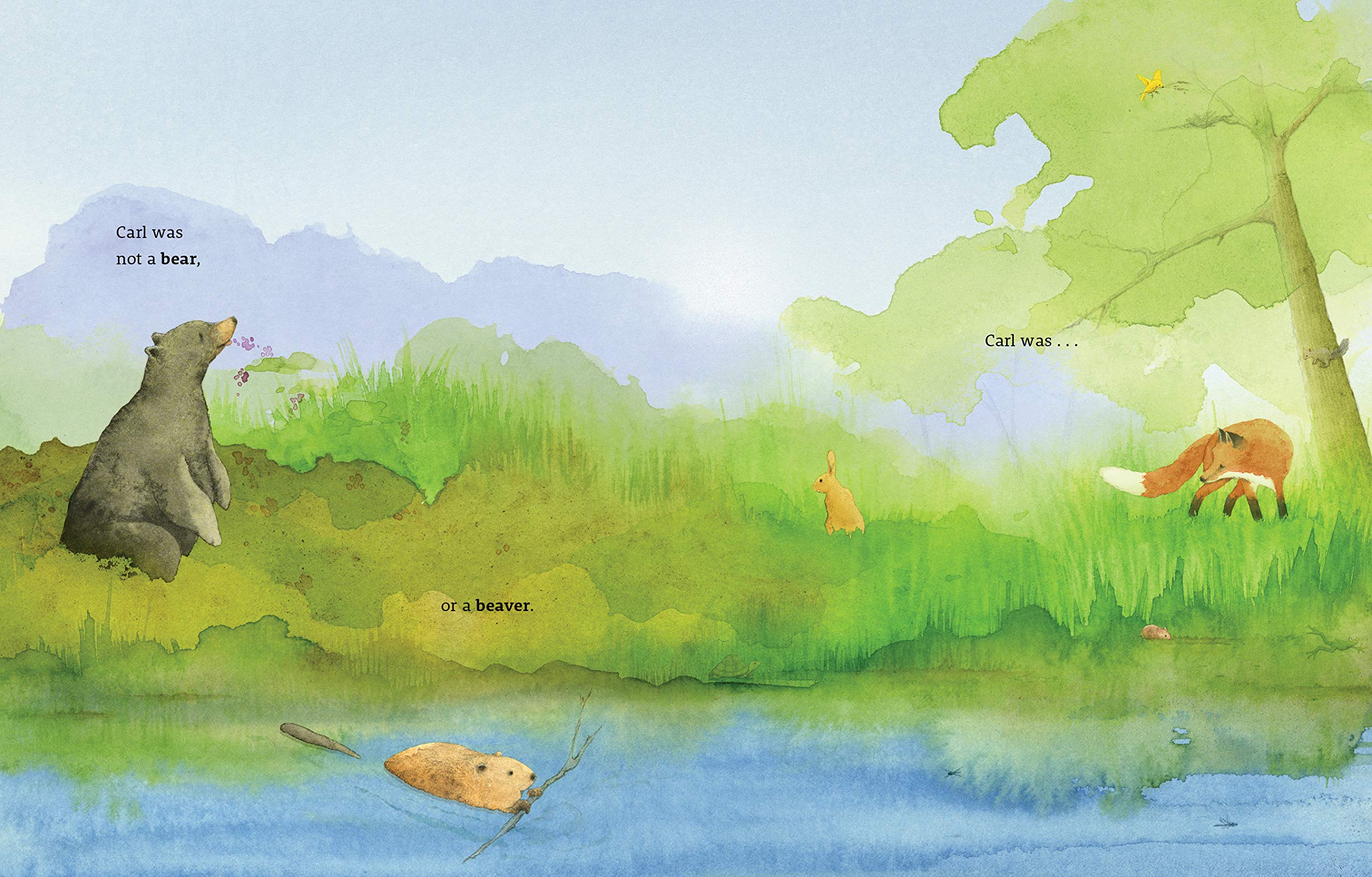
Carl and the Meaning of Life by Deborah Freedman

Published by Viking Books for Young Readers

Image result for carl and the meaning of life amazon

Image result for carl and the meaning of life freedman

Summary:  Carl is a busy earthworm, going about his wormy activities of eating, digesting, and pooping, when a field mouse asks him, “Why do you do that?”  The question stops Carl cold, and he goes off in search of an answer. He asks different animals, but no one can help him. In the meantime, the soil is getting hard and barren.  When the other animals start to leave in search of new homes, Carl realizes he has a job to do. He gets back to work, and soon the soil is fluffy once again, and the land has become habitable for animals to return.  Includes a brief author’s note about the important job of each animal, and ends with a question for the reader, “How do you help the earth?”  48 pages; ages 3-7.

Pros:  Carl is a cute, loveable protagonist–and it’s not often I say that about an annelid–who has important messages for young readers about taking care of the earth and being the best you can at what you do.

Cons:  A list of books and websites for further reading would have been a nice addition.

If you would like to buy this book on Amazon, click here.

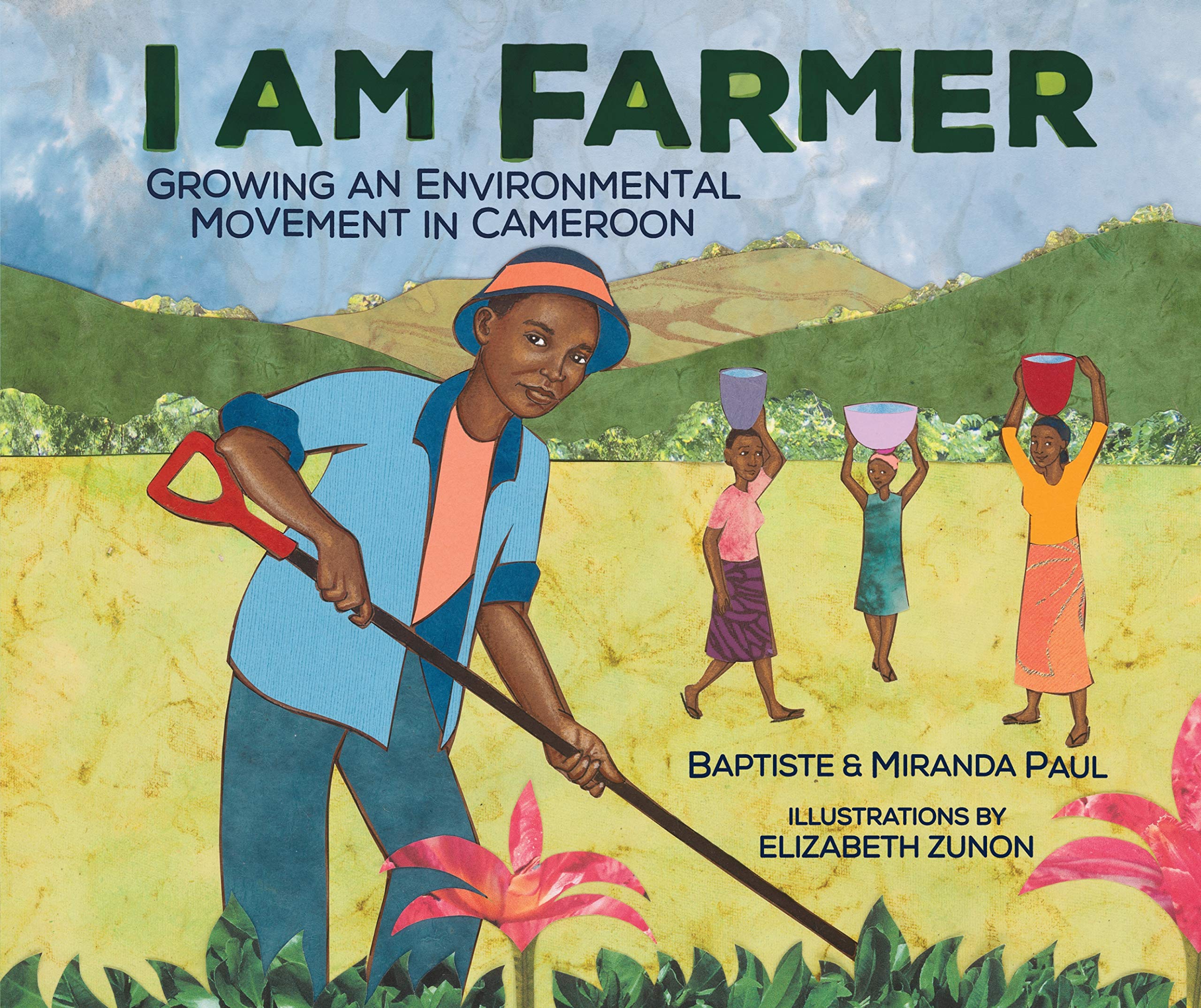
I Am Farmer: Growing an Environmental Movement in Cameroon by Baptiste and Miranda Paul, illustrated by Elizabeth Zunon

Published by Millbrook Press

Image result for i am farmer miranda paul amazon

Image result for i am farmer elizabeth zunon

Summary:  Growing up in Cameroon, Tantoh was sometimes laughed at for asking too many questions in school.  He loved nature, especially learning how to grow plants. His classmates gave him the nickname Farmer, meant to be an insult, but Tantoh embraced the title.  He purposely failed an exam that could have led to a well-paying office job so he could spend all his time outside growing crops. After studying agriculture in Cameroon and the U.S., Tantoh helped transform Cameroon by focusing on clean water and community gardens.  He founded the organization Save Your Future Association to build community, protect the environment, and promote education.  Includes an authors’ note with additional information about Farmer Tantoh, and photos and African proverbs on both the front and back endpapers.  32 pages; ages 7-11.

Pros:  As the authors write about Tantoh in their note: “His story is a reminder of many things–being true to your passion, using resources wisely, and never forgetting your roots.”  It’s an inspirational tale about one person making a big difference for many others.

Cons:  This is not likely to be a book most kids will pick up without some adult guidance.

If you would like to buy this book on Amazon, click here.

I wrote a book!

Remember the book A Wonderful Year by Nick Bruel?  Me neither.  It was the first book I reviewed on this blog on February 20, 2015, and I don’t think I’ve looked at it since.

Three days later I posted a review for The War That Saved My Life by Kimberly Brubaker Bradley, a book I still book talk many times a year and count among my favorite books of all times.

That’s the way it goes with reading.  Some books are just more memorable than others.

So when I realized that I’ve published almost 1,400 reviews, I decided it was time to do some weeding.  In a week or so, I’m going to take down the reviews from 2015 and 2016.  In preparation for this,  I’ve gone through all the books I’ve written about and picked out the ones I feel have stood the test of time.

I’ve compiled them into a book called Hit the Books: The Best of Kids Book A Day, 2015-2018.  There are about 150 books included; each entry has the summary I wrote on my blog and why it was included on the list.  They’re divided into eight sections: picture books, early readers, early chapter books, middle grade fiction, graphic novels, poetry, biography, and nonfiction.

I also put together ten lists of “Read-Alikes” from the books I’ve reviewed on the blog.  So if you have a fan of Diary of A Wimpy Kid or Raina Telgemeier, you can get some ideas for other books they might want to try.

Let me know if you find this book helpful.  Who knows, I may put together a second edition in another year or two!

If you would like to buy this book on Amazon, click here.

Seashells: More Than a Home by Melissa Stewart, illustrated by Sarah S. Brannen

Published by Charlesbridge

Image result for seashells more than a home amazon

Image result for seashells more than a home brannen

Summary:  How is a shell like an anchor?  A crowbar? A butterfly? The team who brought you Feathers: Not Just for Flying explains how shells serve different purposes for the animals who live inside them.  The pages are designed like pages from a scrapbook, with a paragraph of text accompanied by pictures that look like photographs or sketchbook drawings.  Two pages at the end give more information about five different kinds of shells. Also includes notes from the author and the illustrator, as well as resources for further research.  32 pages; grades K-4.

Pros:  This beautiful science book offers a good introduction to a lot of different types of shells with detailed illustrations that will help kids begin to learn how to identify them.

Cons:  Although I thought Feathers: Not Just for Flying was an equally attractive book, I’ve had a hard time generating any interest in it with kids.

If you would like to buy this book on Amazon, click here.

Butterflies in Room 6 by Caroline Arnold

Published by Charlesbridge

Image result for butterflies in room 6 amazon

Image result for butterflies in room 6 caroline arnold

Summary:  Mrs. Best’s kindergarten class, featured in Hatching Chicks in Room 6, is back, this time hatching butterflies.  The kids are shown observing eggs, caterpillars, chrysalises, and finally, full-grown painted lady butterflies.  They do more than observe, feeding the caterpillars, helping to move them to the cup where they’ll build their chrysalises, and getting to (gently) hold butterflies before releasing them.  Photos and text provide plenty of information about each step in the process. The camera captures kids’ expressions from concentrated attention to wonder to joy on the last page as their butterflies fly away.  Includes a page of questions; vocabulary; and lists of websites and books for more information. 40 pages; ages 4-8.

Pros:  I’d like to spend a few days hanging out in Mrs. Best’s room.  The kids look like they’re having a ball, and learning about science in the process.  There’s plenty of information about the butterfly’s life cycle; integrating it with a real class makes it accessible to young kids.

Cons:  You just know some kid is going to take the fact that larva poop is called frass and run with it.

If you would like to buy this book on Amazon, click here.


Daring Dozen: The Twelve Who Walked on the Moon by Suzanne Slade, illustrated by Alan Marks, with an afterword by Alan Bean, fourth man on the moon

Published by Charlesbridge

Image result for daring dozen

Image result for daring dozen

Summary:  Everyone knows the names Neil Armstrong and Buzz Aldrin, the first men to walk on the moon, but maybe not Gene Cernan and Jack Schmitt, the last men to do so.  In between were eight more who traveled to the moon between 1969 and 1972. This book has a few pages about each of the Apollo missions, 8 through 17, the astronauts who traveled on them, and what they accomplished on each trip.  The back matter includes an afterword by astronaut Alan Bean; a timeline to the moon from 1958-1972; additional information about the space vehicles used; and a page on each mission with photos, facts, and a summary paragraph.  48 pages; grades K-5.

Pros:  A fascinating look at the men who were well-known in their time, but tend to be forgotten today.  The author reminds readers of the courage it took, and the danger that accompanied all the missions.  She ends the timeline with the present, stating that lunar missions are currently being planned, and that kids may some day walk on the moon.

Cons:  There’s not much background given on the Apollo missions; page 1 begins with Apollo 11’s lunar module approaching the moon.

If you would like to buy this book on Amazon, click here.


Secret Engineer: How Emily Roebling Built the Brooklyn Bridge by Rachel Dougherty

Published by Roaring Brook Press
Image result for secret engineer amazon

Image result for secret engineer emily roebling

Summary:  Unlike many girls of her time, Emily Warren enjoyed studying math and science.  When she married Washington Roebling, she insisted on joining him on his travels through Europe as he sought ideas to build a bridge from Brooklyn to Manhattan.  Construction began in 1870, with caissons being sunk into the river bottom. Many workers got sick with “caisson fever” from working inside the hot, damp structure, and Washington was afflicted in 1872.  Unable to return to work, he began to rely on Emily to communicate his ideas to the construction workers at the bridge. Eventually, Emily taught herself bridge engineering and began to feel confident enough to add her own ideas.  A week before the opening of the Brooklyn Bridge in 1883, Emily assuaged people’s concerns about its stability by taking the first trip across in an open carriage. Crowds on both sides of the river celebrated the opening on May 24, “never even knowing about the contributions of an insistent woman named Emily Roebling.”  Includes additional information about Emily, a glossary, and a list of additional resources. Photos of the Brooklyn Bridge appear on the endpapers. 40 pages; grades 2-5.

Pros: An inspiring story of a little-known woman who educated herself to be able to play a key role in one of the great engineering feats of her day.

Cons:  I was curious about caisson fever and Washington’s fate, but there was no information about that.

If you would like to buy this book on Amazon, click here.

The Day the Universe Exploded My Head by Allan Wolf, illustrated by Anna Raff

Published by Candlewick

Image result for day the universe exploded my head

Image result for day the universe exploded my head

Summary:  These poems cover many aspects of astronomy and space travel, including the sun, moon, planets, meteors, black holes, eclipses, stars, rockets, astronauts, and Sputnik. The final piece, “The Day the Universe Exploded My Head” tells readers, “You can learn many facts about space from a book/But nothing’s as real as a firsthand look.”  This poem, like several of the others, is written for multiple voices, with different parts shown in different colors. Includes notes on the poems that give more information about each topic; a glossary of selected space terms; and internet resources.  56 pages; grades 2-6.

Pros:  It’s a fabulous collection of funny and informative poems that will teach kids a lot about space and astronomy.  I particularly liked the poems for multiple verses; they would be fun to do as a classroom performance.

Cons:  It would have been nice to see more information about the different forms of poetry, like the sonnet (or sunnet) that appears on page 1.

If you would like to buy this book on Amazon, click here.