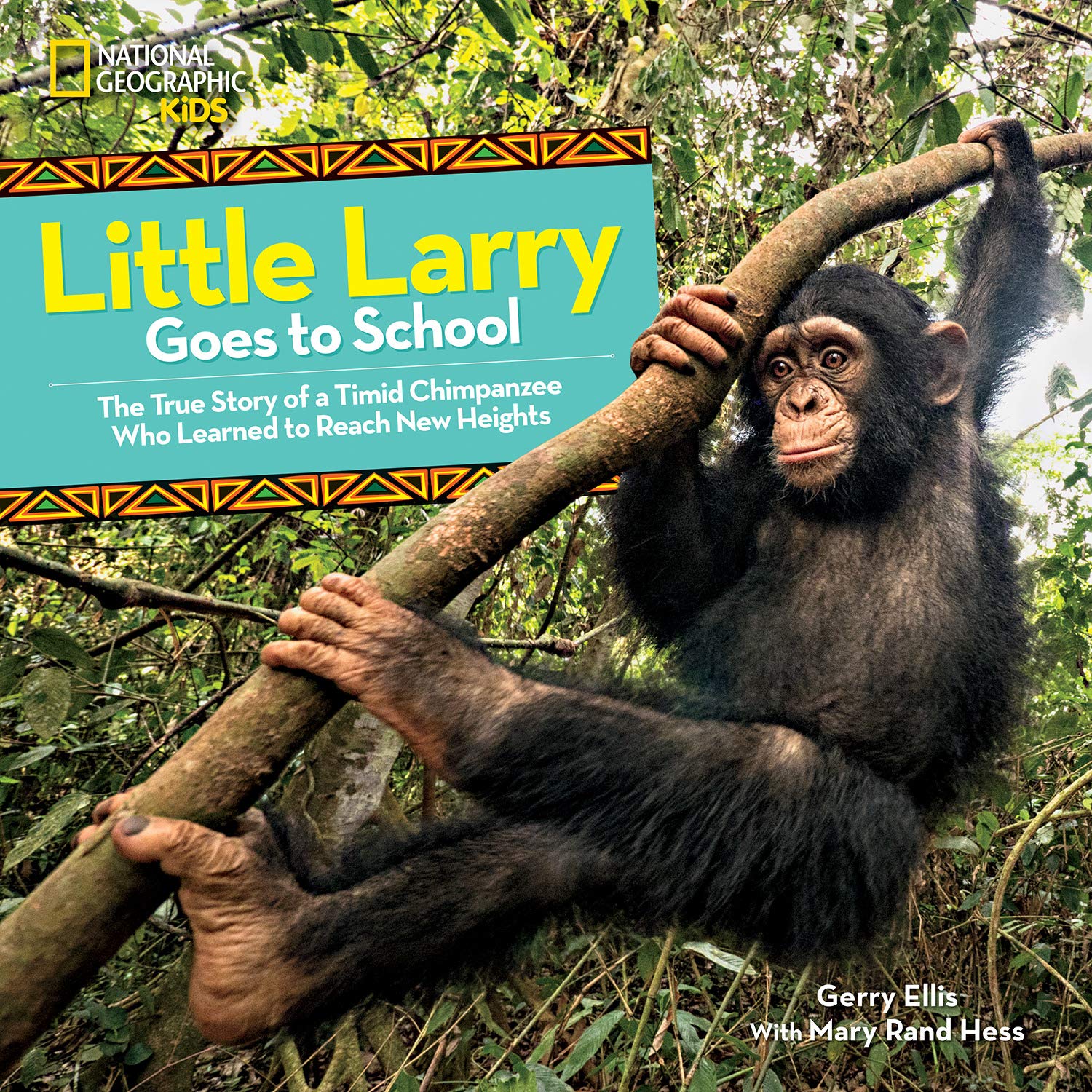
Little Larry Goes to School: The True Story of a Timid Chimpanzee Who Learned to Reach New Heights by Gerry Ellis with Mary Rand Hess

Published by National Geographic Children’s Books

Image result for little larry goes to school amazon

Image result for little larry goes to school mary rand hess

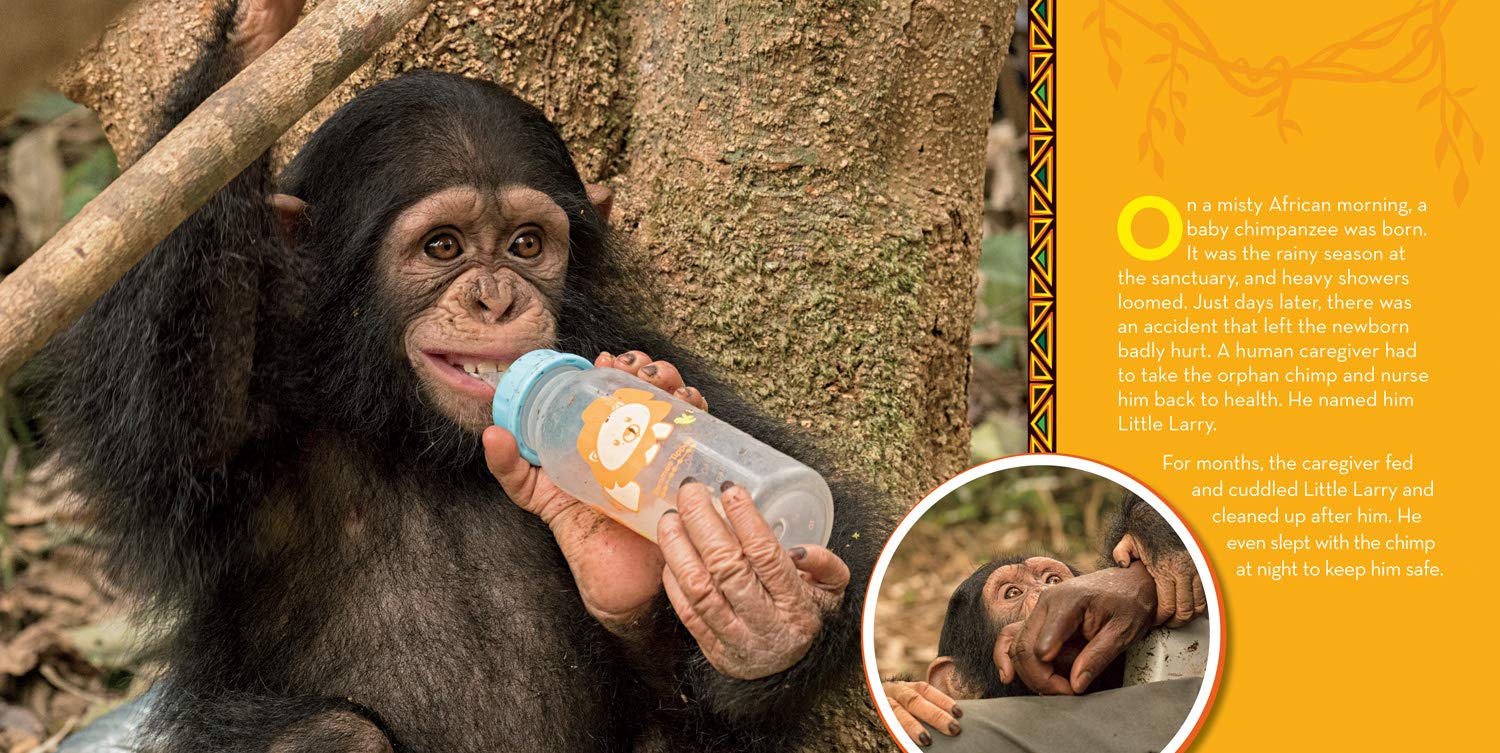
Summary:  Shortly after his birth, Little Larry was injured in an accident and rescued by humans.  His caregivers taught him some rudimentary chimpanzee skills, but he didn’t hang out with other chimps until he was eight months old.  He got along well with his playmates, but seemed to be afraid to climb trees. After months of watching the others climb, Larry slowly started to explore, first on vines close to the ground, then eventually high into the trees.  After graduating from his forest school, Larry was released into a chimpanzee sanctuary in Cameroon where he still lives today. Includes tips on speaking chimpanzee, sources of more information, additional facts; and an author’s note about the endangered status of chimpanzees.  32 pages; ages 4-8.

Pros:  Larry’s story is short and simple, but the photographs of him and his playmates are irresistible.  Facts about chimps’ diet, behavior, and communication are woven into the narrative, and the information at the end provides lots of other places to go for more research.

Cons:  There was very little information on Larry’s caregivers or the sanctuary where he lived.

If you would like to buy this book on Amazon, click here.

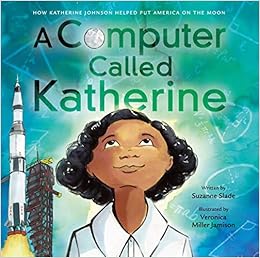
A Computer Called Katherine: How Katherine Johnson Helped Put America On the Moon by Suzanne Slade, illustrated by Veronica Miller Jamison

Published by Little, Brown Books for Young Readers

Image result for computer called katherine amazon

Image result for computer called suzanne slade

Summary:  Similar to last year’s Counting on Katherine, this picture book biography tells the story of Katherine Johnson’s life, beginning with her early fascination with math that eventually led her to a career at NASA.  Her brilliance was finally recognized there as she broke down the barriers that had kept women and blacks from the higher-level positions. This story focuses on her contributions to Apollo 11, the mission that included the first walk on the moon.  Katherine was instrumental in helping to calculate the flight plan that took the three astronauts to the moon and brought them safely back home again. Includes photos of Katherine and some of the documents she worked on at NASA, a time line, and author’s and illustrator’s notes.  40 pages; ages 4-8.

Pros:  Katherine Johnson’s story is brought to life in a way that is accessible for younger readers.  There’s an emphasis on her love of counting from an early age, and a fun incorporation of incorrect math facts (segregated schools seemed as wrong as 5+5=12; Katherine being excluded from NASA meetings was as wrong as 5×5=20).

Cons:  The story is light on dates and places, and there’s no list of further resources, so this wouldn’t be the best book for research or reports.

If you would like to buy this book on Amazon, click here.

Rocket to the Moon by Don Brown

Published by Harry N. Abrams

Image result for rocket to the moon brown amazon

Image result for rocket to the moon don brown

Summary:  Rodman Law, an early 20th-century stuntman, narrates the story of America’s space exploration.  Starting with a quick history of rockets, the narrative goes into more details with Werner von Braun, Robert Goddard, and the dawn of the U.S.-U.S.S.R. space race.  About half of the book is devoted to the Apollo missions, with the bulk of that describing Apollo 11 and the historic moonwalk by Neil Armstrong and Buzz Aldrin. It ends with Apollo 17, the final mission to reach the moon.  Includes a timeline, notes, and a lengthy bibliography. 136 pages; grades 3-7.

Pros:  Don’t be fooled by the graphic novel format, and Rodman Law’s light tone–there is lots of information here, and the extensive back matter provides plenty of additional research avenues.

Cons:  While this is billed as book 1 of a series called Big Ideas That Changed the World, I couldn’t find any information on any more upcoming books.

If you would like to buy this book on Amazon, click here.

Titanosaur: Discovering the World’s Largest Dinosaur by Dr. Jose Luis Carballido and Dr. Diego Pol, illustrated by Florencia Gigena

Published by Scholastic Press

Image result for titanosaur gigena amazon

Image result for titanosaur gigena

Summary:  When an Argentinian gaucho told museum staff that he had found a dinosaur bone much larger than the one they had on display, paleontologists Jose Luis Carballido and Diego Pol wanted to investigate.  They visited the ranch and found out the gaucho was right–he had discovered a dinosaur bone bigger than any previously discovered. The two paleontologists assembled a team and began excavating the fossils.  They eventually were able to estimate the size of the dinosaur, which would have weighed in at seventy tons. Over 100 bones were found, belonging to several dinosaurs.  The team had to work around the clock to uncover them all before cold weather set in, which could damage the fossils. When the titanosaur’s skeleton was finally assembled, it was 122 feet long and almost 26.5 feet tall, making it the largest ever found…for now.  40 pages; grades 1-4.

Pros:  Dinosaur enthusiasts will be blown away by this gigantic dinosaur, and the work it took to dig up and assemble.  The illustrations and photographs add a lot of information, and make a paleontology career look like a very fun adventure.

Cons:  Some back matter would have added a lot; for instance, I couldn’t find any dates for when the expedition took place or the name of the museum where the skeleton is now on display.

If you would like to buy this book on Amazon, click here.

The Frog Book by Steve Jenkins and Robin Page

Published by HMH Books for Young Readers

Image result for frog book jenkins amazon

Image result for frog book steve jenkins

Summary:  Similar in format to Steve Jenkins’ The Beetle Book, this book provides information on frogs’ diets, habitats, defenses, and reproduction.  There’s a page about extreme frogs (smallest, largest, most poisonous, etc.), and another on the endangered status of frogs around the world.  You can also learn the differences between a frog and a toad and a little bit about other amphibians. The last two pages have a table showing all the frogs in the book, with their body lengths, diets, and where in the world they can be found.  Includes lists of books and websites for further information. 40 pages; grades 1-5.

Pros:  There’s a wealth of information that would come in handy for any kind of frog research or report-writing.  The format is inviting, with beautiful cut paper illustrations, and small sections of text with the kinds of interesting facts kids love.

Cons:  I wasn’t a huge fan of the tiny font.  Also, a table of contents or list of the sections in the book would have been helpful.

If you would like to buy this book on Amazon, click here.

A Ray of Light: A Book of Science and Wonder by Walter Wick

Published by Scholastic Press

Image result for ray of light walter wick

Image result for ray of light walter wick

Summary:  As he did in his book A Drop of Water, Walter Wick gives a straightforward explanation about different aspects of light, all illustrated with his own photographs.  A variety of topics dealing with light are included, such as the color spectrum, iridescence, light waves, and incandescence. The text and photos present information in easy-to-understand formats, such as showing a ball attached to a rod vibrating at varying speeds in the water to demonstrate differences in wavelengths as a function of vibration speed.  There aren’t any activities or experiments, but several of the pages have information that would easily lend themselves to either one. The final two pages include notes on each topic, with extra details offered “for the benefit of the more advanced or curious readers”. 40 pages; grades 2-5.

Pros:  This visually appealing book will grab the attention of kids interested in STEM.  The clear explanations provide an excellent introduction to the topic, and the photographs lend themselves well to the text.

Cons:  There’s no table of contents, glossary, index, or list of additional resources.

If you would like to buy this book on Amazon, click here.

Hedy Lamarr’s Double Life: Hollywood Legend and Brilliant Inventor by Laurie Wallmark, illustrated by Katy Wu

Published by Sterling Children’s Books

Image result for hedy lamarr's double life amazonImage result for hedy lamarr's double life wu

Summary:  Most people know Hedy Lamarr as a film star, but she was also a dedicated inventor who spent her spare time coming up with ideas like a glow-in-the-dark dog collar and a flavor cube to turn plain water into soda.  Her biggest invention, working with composer George Antheil, was the “frequency hopping” guidance system, designed to prevent the enemy from jamming radio signals on torpedos. She and Antheil received a patent for their work in 1942, but unfortunately the system was never implemented by the Navy during the war.  Forty years later, the idea was declassified, and is used today to help keep cell phone calls and texts private. The two inventors never received recognition or money for their creation, but in 1997, they received the Pioneer Award from the Electronic Frontier Foundation. As Hedy commented, “It’s about time.” Includes a timeline, additional information about frequency hopping, a bibliography, a filmography of Lamarr’s works, and a reading list about other women in STEM.  48 pages; grades 2-5.

Pros:  Who knew Hedy Lamarr was a talented scientist and inventor as well as an actress?  This engaging biography includes information on her both her careers; the lively illustrations incorporate relevant quotes from Lamarr.  I was hoping to include a review of another book on this same topic, Hedy and Her Amazing Invention by Jan Wahl, published the same week, but no one in my library network has gotten a copy of this one.

Cons:  Some of the technical details may be a bit much for younger readers.

If you would like to buy this book on Amazon, click here.


Posted

Bloom Boom! by April Pulley Sayre

Published by Beach Lane Books

Image result for bloom boom amazon

Image result for bloom boom april pulley sayre

Summary:  “Every spring, across the land…Seeds sprout.  Stems pop out.  Bloom boom!” This book celebrates plants as they grow and blossom.  The large, close-up photos show all kinds of flowers, as well as leaves, bulbs, and an occasional animal (caterpillar, bee, lizard).  The phrase “Bloom boom!” is repeated as blossoming flowers are shown in a variety of habitats.  There are several pages of back matter, including information about flowers organized by habitat; additional resources; and thumbnail photos of each page in the book with further information about the plants and animals pictured.  40 pages; ages 4-8.

Pros:  April Pulley Sayre has produced another beautiful and informative science book for preschoolers on up.  Keep it in mind for a spring read-aloud.  The additional resources and information at the end make it a valuable resource for older kids.

Cons:  I found “Bloom boom” to be a little bit of a tongue-twister.

If you would like to buy this book on Amazon, click here.

Sea Bear: A Journey for Survival by Lindsay Moore

Published by Greenwillow Books

Image result for sea bear lindsay moore amazon

Summary:  A polar bear explains how she uses the sea ice to travel and to hunt.  As summer ends, the ice has thinned, and she spends more time swimming.  For much of the story, she is trying to reach land, which entails a long swim past other Arctic creatures like narwhals, walruses, and a whale.  Finally, after an exhausting three-day swim, she reaches land, where she will eat kelp and wait for the ice to thicken again so she can hunt seals.  Includes a page of information on sea ice, polar bears, and the implications of global warming; as well as a page describing some of the other animals shown in the book.  48 pages; ages 4-8.

Pros:  The lovely watercolor and ink illustrations perfectly capture the blues and whites of the Arctic, and the spare text introduces a lot of information about the polar bear.

Cons:  The global warming aspect makes it a sad story.

If you would like to buy this book on Amazon, click here.


Just Right: Searching for the Goldilocks Planet by Curtis Manley, illustrated by Jessica Lanan

Published by Roaring Brook Press

Image result for just right goldilocks planet manley amazon

Summary:  Are we alone in the universe?  Going back to ancient astronomers, this book quickly traces the history of what humans have learned about the place of Earth in the galaxy.  It then details how scientists are looking for a “just right” planet–not too big, not too small, not too hot, not too cold–that might support life.  Huge telescopes sitting on mountaintops or floating through space gather information on stars and the exoplanets around them. The illustrations show a girl and her family visiting a planetarium, then getting her her own telescope as she learns about the universe.  The last several pages speculate on what life on other planets might be like, and how we might communicate with those life forms. Includes a page of additional information; a bibliography; books and websites with additional information; and a timeline of space exploration on the front and back endpapers.  48 pages; grades 2-5.

Pros:  Packed with scientific information, the author does a great job of making a complicated topic accessible to elementary kids; the illustrations of the girl and her family help make it kid-friendly as well.

Cons:  Some of the information was a bit over my head…but readers will still find something interesting, even if they don’t understand it all.

If you would like to buy this book on Amazon, click here.