The Princess and the Warrior: A Tale of Two Volcanoes by Duncan Tonatiuh

Published by Abrams Books for Young Readers 
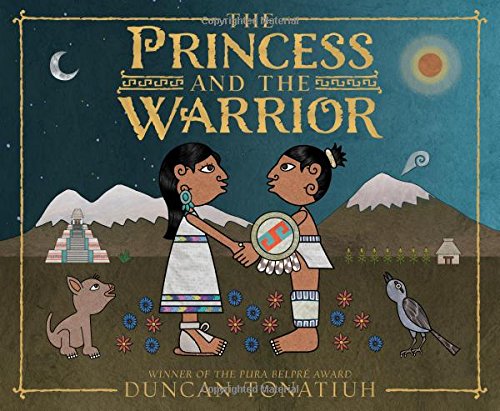
Summary:  Izta is a princess of the people, so when she falls in love, it isn’t with one of the wealthy suitors who travel from distant lands to court her.  The warrior Popoca can’t offer her riches, but he recognizes her kind heart and promises to always be faithful to her.  The king would prefer a more titled son-in-law, but he agrees to let the two marry if Popoca can defeat Jaguar Claw, a neighboring king who has caused trouble for years.  Popoca goes off to battle.  When Jaguar Claw realizes he is near defeat, he sends a messenger to tell Izta that her fiancé has been killed.  Grief-stricken, she drinks a potion that the messenger says will ease her sorrow.  Instead, it puts her into a deep sleep from which she never awakens.  When Popoca returns, he brings her outside to try to revive her, and there they stay, together, until they have turned into the two volcanoes, Iztaccihuatl and Popocatepetl.  An author’s note gives more history of this Aztec legend.  40 pages; grades 1-4.

Pros:  A captivating retelling of a Mexican legend that explains the existence of two volcanoes visible from Mexico City.  Award-winning author-illustrator Duncan Tonatiuh brings his distinctive style to the art done in the traditional Aztec style.

Cons:  Even with the glossary and pronunciation guide at the end, pronouncing the Aztec words is a challenge.

The Girl Who Drank the Moon by Kelly Barnhill

Published by Algonquin Young Readers 

Summary:  Each year, the youngest child in the Protectorate must be sacrificed to the witch to keep the people safe.  One year, the mother goes mad when her daughter is taken away.  Antain is just a boy when he witnesses this, but he never forgets it, nor can he forget what it was like to walk away, leaving the baby girl in the forest to die.  Little does he know that she is rescued by Xan, the witch who has rescued all the babies.  Usually Xan takes the children to another city to be adopted, but she accidentally feeds this one moonlight, filling her with magic, and decides to name her Luna and raise her herself.  And so the story goes, for almost 13 years, following Antain, Xan, Luna, a monster named Glerk, a tiny dragon named Fyrian, the madwoman, and the evil Sister Ignatia, until they all meet one fateful day in the forest.  The magic in Luna finally comes to fruition, and allows the power of love to overcome the power of evil.  386 pages; grades 4-7.

Pros:  Beautifully written and crafted, this is one of those books that weaves many different strands through the entire story until they all come together at the end.  Look for this as a Newbery consideration.

Cons:  While I admire and appreciate this book, the story never really grabbed me.  I had to assign myself nightly readings to get through it in a timely fashion.

Pablo Finds a Treasure by Andree Poulin, illustrated by Isabelle Malenfant

Published by Annick Press 

Summary:  Pablo and his sister Sofia spend their days hunting for treasure on Treasure Mountain, the local dump.  They’re joined by many other children who look for items that their parents can resell to buy a little food.  Sometimes they find old food, and eat it quickly before someone can steal it.  Their worst enemy is Filthy-Face, a man who bullies the children into handing over their treasures.  On this particular day, Pablo is having trouble finding anything; Sofia is doing better and scolds him for overlooking bits of plastic that can be recycled.  Just when he is ready to give up, Pablo finds a gold chain.  He and his sister excitedly make a list of all the things they’d like to buy with the chain until suddenly Filthy-Face looms in front of them.  He steals everything, and the two children have to run home empty-handed…until they arrive safely and Pablo reveals where he has hidden the gold chain.  32 pages; grades 1-4.

Pros:  An eye-opening look at poverty in an unnamed country.  The gray-toned illustrations match the sober subject.  This would make a good read-aloud to prompt further discussion or writing.

Cons:  It’s a pretty bleak story.

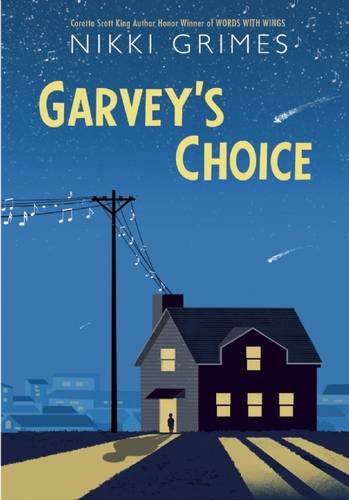
Garvey’s Choice by Nikki Grimes

Published by Wordsong 

Summary:  Garvey can’t seem to please his father, who wants a football-player son, not one who struggles with his weight and hates sports.  But Garvey’s good at chess, loves to read, and is interested in astronomy.  Encouraged by his best friend Joe, Garvey overcomes his fears and tries out for chorus, where his talents really start to emerge.  He discovers he has a strong tenor voice, and he even makes a new friend, Manny, a boy with albinism who shows Garvey how to ignore teasing and be himself.  When the first concert arrives, Garvey is shocked to see his father wiping away tears after his solo.  It turns out Dad was in a band way back when, and father and son finally find a connection through music.  A note at the end explains tanka, a Japanese form of poetry used to write this story.  120 pages; grades 4-7.

Pros:  A brief novel in verse that lingers long after the first page.  Garvey and his family are sympathetically portrayed, and readers will be rooting for him as he slowly finds his place in the world.

Cons:  At times, Joe and Manny’s advice seemed unrealistically wise beyond their years.

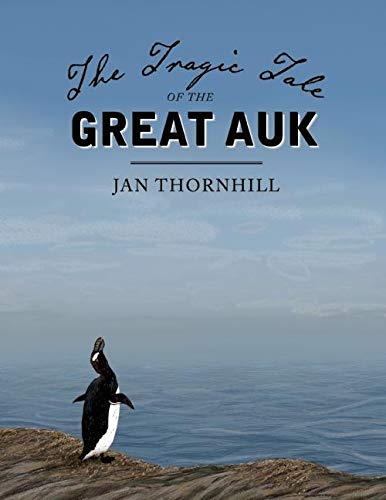
The Tragic Tale of the Great Auk by Jan Thornhill

Published by Groundwood Books

The Tragic Tale of the Great Auk: Thornhill, Jan: 9781554988655: Amazon.com:  Books

The Tragic Tale of the Great Auk: Thornhill, Jan: 9781554988655: Amazon.com:  Books

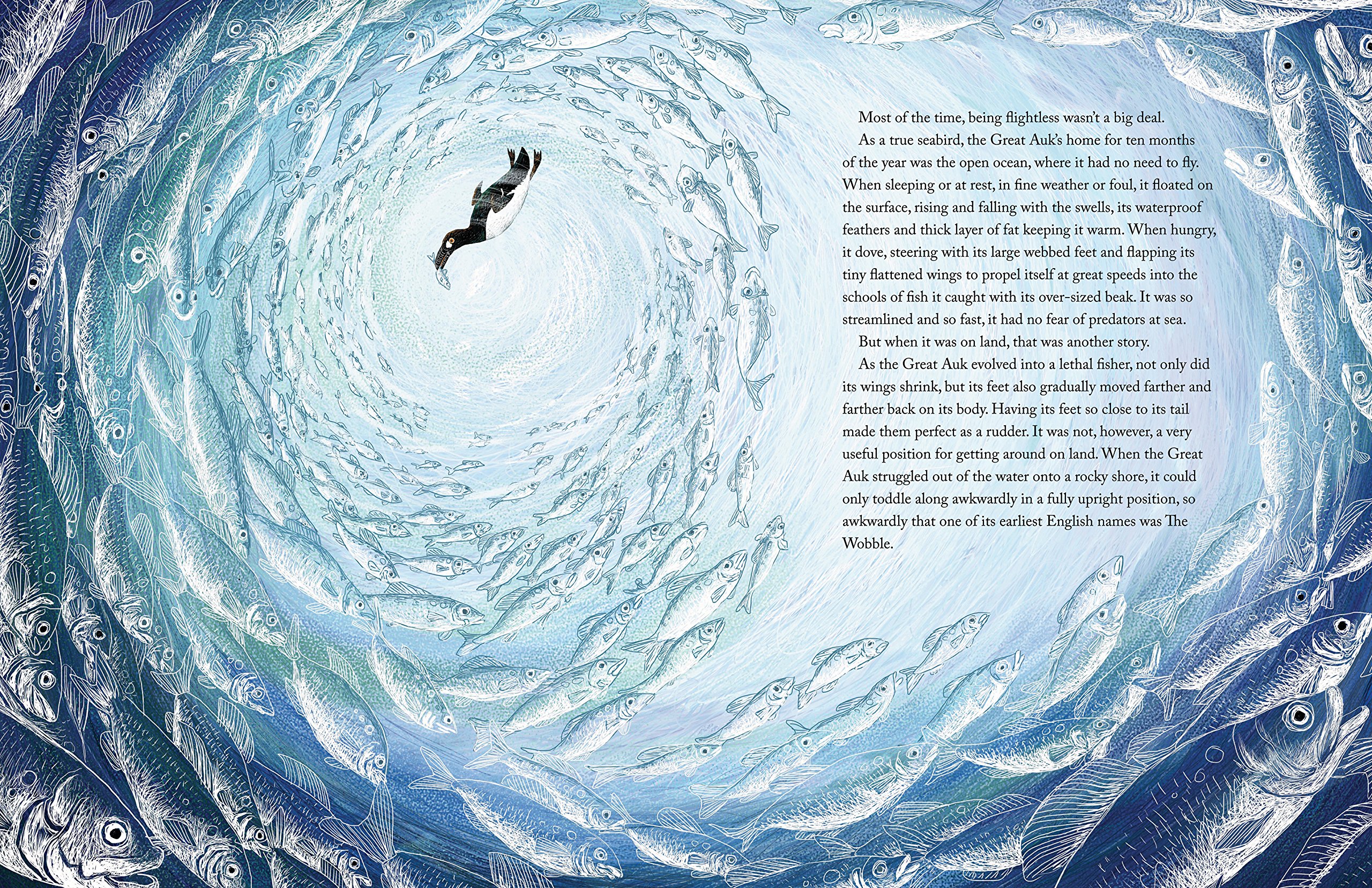
Summary:  For thousands of years, the Great Auk lived in northern seas.  It evolved to live in the water, only coming ashore to mate and lay a single egg once a year.  On land, it was slow and clumsy, but it nested in rocky places that were difficult for predators to reach.  Humans coexisted with the Great Auk for centuries.  The birds and their eggs were hunted, but not to excess.  When Europeans started traveling to North America, though, everything changed.  Ships’ crews were delighted to find fat, slow birds in great numbers to replenish their dwindling supplies of food during a long journey.  Eventually, the birds started dying off until entire colonies disappeared.  Later, birds and eggs were hunted by collectors, who would kill and stuff the birds for their displays.  In 1844, the last pair was killed by Icelandic hunters hired by a Danish collector.  This sad story ends on a few positive notes.  Funk Island, once home to many Great Auks is now a preserve for sea birds.  The decomposing bodies of the many Auks that were killed there turned into soil that covered the rocks, making the island hospitable to puffins.  The final page invites readers to join the ordinary people from around the world who are working to conserve other species before they, like the Great Auk, disappear.  44 pages; grades 2-6.

Pros:  Informational writing at its best; the Great Auk’s story is engagingly told and beautifully illustrated, touching on all kinds of topics from evolution to adaptation to conservation.  Readers will be horrified by the wasteful hunting of the birds, and hopefully inspired to help prevent other species’ extinctions.

Cons:  There’s a lot of text for a read-aloud.

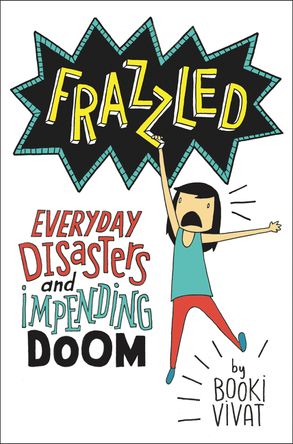
Frazzled: Everyday Disasters and Impending Doom by Booki Vivant

Published by HarperCollins 

Summary:  Abbie Wu is about to start middle school, and she is not excited about it.  To her, the middle is not a happy place, having spent her life stuck between an adorable younger sister and an overachieving older brother.  Not only that, but she is supposed to choose an elective, and she doesn’t know what her “thing” is.  Her best friends both have a “thing”—Maxine loves the theater and James is a genius at games.  Since Abbie can’t make up her mind about an elective, she gets stuck in study hall.  And in study hall, her stomach rumbles embarrassingly; school lunch is such a disaster that she’s starving by the afternoon.  Turns out she’s not the only one, and pretty soon she’s organized a snack exchange, first in study hall, then in the whole school.  It’s such a hit that Abbie thinks she has a “thing”…until the principal discovers what’s going on and shuts her down.  Fortunately, Abbie has a supportive, if somewhat eccentric, family, and they help her discover that it’s okay to fail occasionally, and she might just have a “thing” after all.  240 pages; grades 3-7.

Pros:  Reluctant readers will embrace Abbie, with her humorous observations on middle school and her book full of funny cartoon drawings.  A sure “thing” for Wimpy Kid and Dork Diary fans.

Cons;  While it’s still wildly popular, the whole irreverent middle school diary illustrated with cartoons “thing” is getting a bit old in this reviewer’s opinion.

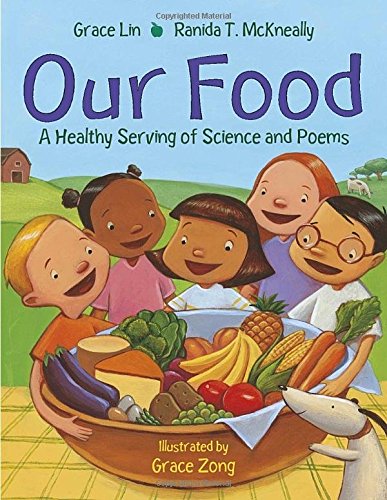
Our Food: A Healthy Serving of Science and Poems by Grace Lin and Ranida T. McKneally, illustrated by Grace Zong

Published by Charlesbridge 

Summary:  Each two-page spread includes a large, colorful illustration, a haiku poem, and a question such as “Why are so many vegetables green?” and “What makes a grain a grain?”  Each question is answered with several paragraphs of kid-friendly text.  Five food groups are covered: fruits, vegetables, dairy, protein foods, and grains.  The book supports the USDA recommendations for eating these different types of foods.  The last couple pages encourage eating a variety of healthy foods and explain a little more about the food groups.  Includes a glossary.  40 pages; grades K-3.

Pros:  A good basic introduction to food and nutrition.  The haikus and cheerful illustrations add fun touches.

Cons;  Food allergies receive a one-sentence mention at the bottom of the third-to-last page, and varieties on the USDA-recommended diet, such as vegetarianism or gluten-free, are not mentioned.  A list of additional resources could have addressed some of those topics.


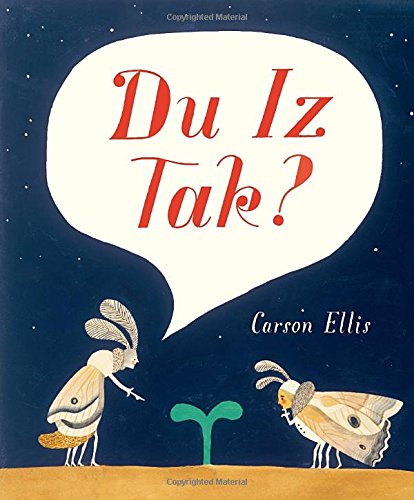
Du Iz Tak? by Carson Ellis

Published by Candlewick Press 

Summary:  The seasons come and go in a world populated by a variety of insects who, apparently, speak an insect language.  “Du iz tak?” seems to mean “What is that?”, and it’s a question one dragonfly asks another when it comes across a small green plant poking through the ground.  Other insects join the group, and as the plant grows, they create homes in its leaves.  A spider weaves a giant web on the top, which seems like a problem until the spider is carried off by a huge bird.  The plant eventually grows an enormous flower (“unk gladdenboot!”) which, over time, droops and scatters its seeds.  Through it all, a cocoon has been hanging from a nearby branch.  After the plant dies, a moth emerges and performs a nighttime dance with the seeds to a cricket’s fiddle music.  Winter passes, and in the spring all the seeds sprout, posing the question yet again, “Du iz tak?”  48 pages; ages 4-8.

Pros:  Wow!  An enormously creative, original take on the seasons.  The youngest readers will love poring over the pictures, examining the detailed changes from one page to the next.  Older kids will have fun trying to translate the language from context clues.  The Caldecott committee should put this one on its short list.

Cons:  Emerging readers may find the text confusing.

School of the Dead by Avi

Published by HarperCollins 

Summary:  “The first time Uncle Charlie came to live with us he was alive.  The second time he came, he was dead.”  So begins this ghost story about Tony, who grows close to his eccentric Uncle Charlie shortly before his death.  Before he dies, Uncle Charlie encourages Tony’s family to move to San Francisco so Tony can attend the Penda School, where Uncle Charlie was a student.  After his death, they do so, and immediately, Tony suspects there’s something strange about the school.  For starters, he keeps seeing Uncle Charlie.  Then there’s the mysterious blond boy in his class that other kids don’t seem to see.  As Tony hears more stories about ghosts and Penda students who have gone missing, he begins to suspect he may be in great danger.  The people around him may or may not be who they say they are, and it’s difficult for Tony to know just who he can trust.  The suspense builds to a heart-stopping climax at the school’s Halloween party, when Tony has to single-handedly battle the ghosts for the life of the school…and himself.  288 pages; grades 4-7.

Pros:  A suspenseful ghost story with plenty of plot twists and turns.  Plenty of creepily evil characters without being super scary.

Cons:  It was difficult to believe that a school in which students have disappeared regularly for decades hadn’t triggered some sort of investigation.

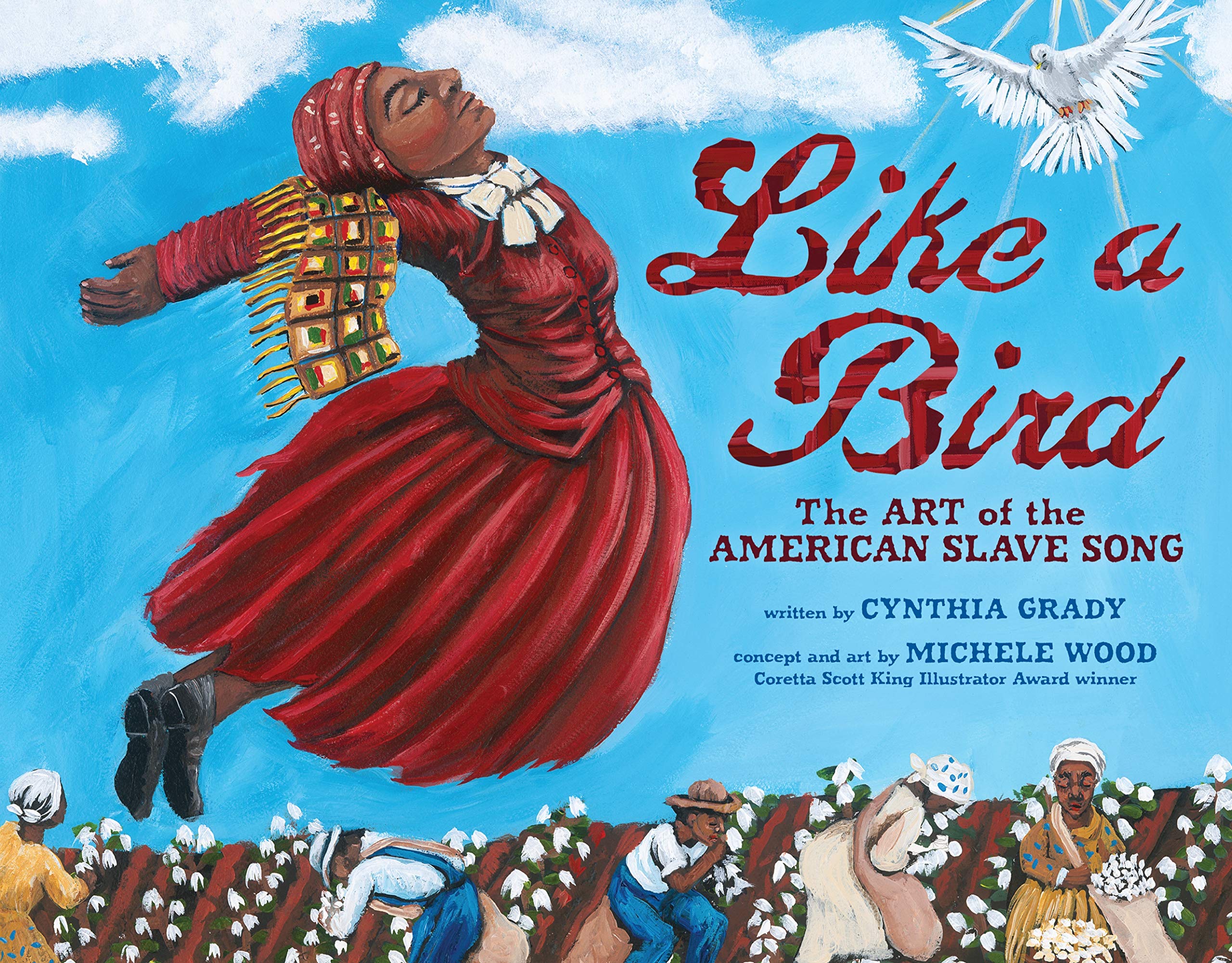
Like a Bird: The Art of the American Slave Song written by Cynthia Grady, concept and art by Michele Wood

Published by Millbrook Press

Like a Bird: The Art of the American Slave Song (Millbrook Picture Books):  Grady, Cynthia, Wood, Michele: 9781467785501: Amazon.com: Books

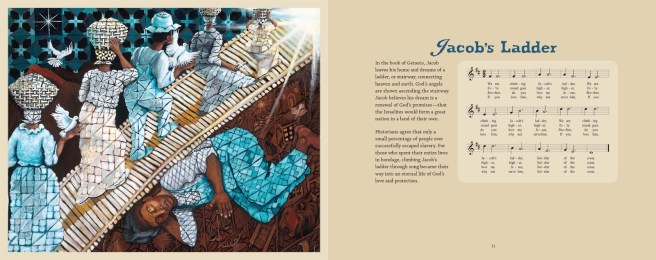
Summary:  Coretta Scott King Award winner Michele Wood has created beautiful paintings inspired by thirteen African American slave songs, such as “Jacob’s Ladder” and “Go Down, Moses”.  There is a one-page introduction that begins with the question, “What does a bird have to do with American slave songs?”  Each two page spread includes the song with music, a painting, and a paragraph or two of text giving some background about the song.  The bird motif in the title and introduction is carried out through the book, with a white dove appearing in every painting.  The last several pages include lyrics to all the songs, a glossary, bibliography, and a list of books and websites for additional reading.  40 pages; grades 3-6.

Pros:  This unique book would make an excellent addition to music and art libraries.  The beautiful paintings express both pain and hope, and contain interesting and symbolic details.  The words and music make the songs accessible to all readers.

Cons:  Listening to way too many “Wee Sing” cassettes in my children’s early years caused those versions to spring into my mind as soon as I saw many of these song titles.