Bomb (Graphic Novel): The Race to Build–and Steal–the World’s Most Dangerous Weapon by Steve Sheinkin, illustrated by Nick Bertozzi

Published by Roaring Brook Press

Summary:  Steve Sheinkin has turned his award-winning nonfiction book from 2012 into a graphic novel that tells the history of the Manhattan Project, including those who gave information to the Soviets that helped them develop an atomic bomb just a few years after the United States.  One of those was Harry Gold, whose interrogation by the FBI forms the structure for this book.  As the agents question him, Harry slowly reveals the story of the project in Los Alamos, with descriptions of the various people involved like Robert Oppenheimer, Leslie Groves, Richard Feynman, and Klaus Fuchs.  The book ends with a showdown between Oppenheinmer and President Harry Truman, as each realizes the terrible power he has unleashed on the world. As Steve Sheinkin concludes in his author’s note, “How does this story end? We don’t know–because it’s still going on.”  256 pages; grades 5-12.

Pros:  I loved the original Bomb, and this graphic novel does an amazing job of telling many aspects of the story in a necessarily condensed format.  The excellent artwork helps to distinguish the many characters in the story.  It’s an important historical narrative, and the graphic format will make it accessible to many more readers.

Cons:  I missed the depth of the original book in telling about many of the characters and events.

The Kindest Red: A Story of Hijab and Friendship by Ibtihaj Muhammad and S. K. Ali, illustrated by Hatem Aly

Published by Little, Brown Books for Young Readers

Summary:  In this follow-up to The Proudest Blue, Faizah is happy to be heading to school in the red dress that has been worn by both Mama and her older sister Asiya.  Her teacher has the class brainstorm about what kind of world they want to live in, and the kids put their ideas into practice on the playground, helping and including each other in their games.  After recess, the class lines up for picture day, Faizah feeling great in her new dress.  But when her classmates’ siblings come to pick them up, she notices that many of them are dressed alike, unlike her and Asiya.  Her best friend Sophie saves the day, taking off her red sash and wrapping it around Faizah’s head just like Asiya’s hijab.  Includes an author’s note about her experiences she used to write this book and a photo of her with her older sister and brother.  40 pages; ages 4-8.

Pros:  I was excited to see this book, because I have several girls in my school who wear hijab, and they love The Proudest Blue.  Two of them have checked it out a total of five times in the last year.  I’m sure they’ll enjoy this new story with its focus on kindness, friendship, and family.

Cons:  I couldn’t quite figure out why all the siblings were dressed alike.  Were they also being photographed in family groups?

Very Good Hats by Emma Straub, illustrated by Blanca Gómez

Published by Rocky Pond Books

Summary:  You may think you know what a hat is, but you are probably limiting yourself.  Acorn caps (as well as raspberries, chewed-up gum, tortellini, and doll shoes) work well if you’re a finger, and a pudding cap will do just fine if you’re a stuffed bear.  Humans can wear their pets as hats, or books (if they have good posture) or bubbles in the bathtub.  Some jobs come with a hat, like cowboy, chef, and pirate.  Hats are everywhere!  Because anything can be a hat if you believe it is.  32 pages; ages 3-6.

Pros:  A book filled with quirky fun, both the text and the illustrations, and one that is sure to inspire creativity in making hats and thinking of what non-human objects could use for hats.  Also, you will get to say the word “haberdashery.”

Cons:  I try so hard to discourage kids from putting their library books on their heads, and then this book comes along.

Courage in Her Cleats: The Story of Soccer Star Abby Wambach by Kim Chaffee, illustrated by Alexandra Badiu

Published by Page Street Kids

Summary:  As the youngest of seven children, Abby Wambach learned to be tough, especially on the soccer field.  After a successful high school career that ended with a crushing state championship loss, Abby played at the University of Florida where she was recruited for the U.S. Women’s National Soccer Team.  She toughened up even more with a personal trainer to become part of the team that won the gold medal at the 2004 Olympics.  She was on track to win another medal when she broke her leg shortly before the 2008 Olympics, but her encouragement from the sidelines helped her team win gold again.  After a year of rehab, she was back, scoring her 100th career goal in 2009.  Includes additional information about Abby’s childhood and her post-2009 soccer career, a list of soccer terms with definitions, and a bibliography.  32 pages; grades K-4.

Pros:  A lively introduction to Abby Wambach’s life with colorful illustrations and an eye-catching cover that will grab the interest of sports fans.

Cons:  I wish there had been some information on Abby’s activism on behalf of the LGBTQ+ community and women in sports.

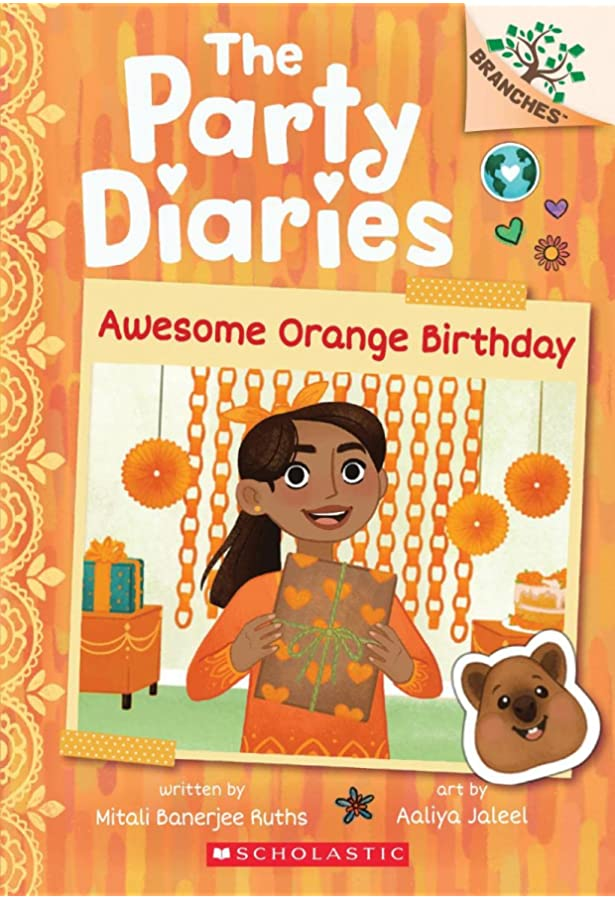
Awesome Orange Birthday (Party Diaries, book 1) by Mitali Banerjee Ruths, illustrated by Aaliya Jaleel

Published by Scholastic

Summary:  After Priya posts pictures of the party she organized for her little brother, Layla Aunty asks her to take charge of her upcoming birthday party.  She offers to pay Priya, but Priya asks for a donation to help quokkas instead (you’ll learn more about this endangered Australian animal if you read the book).  Priya gets to work, starting a party journal to help her stay organized.  Layla Aunty’s favorite color is orange, so that becomes the party’s theme.  Priya enlists the help of her best friend and Layla Aunty’s friends (including Prya’s mom) to make decorations, food, invitations, and a special present.  It’s a busy time, but everything goes off without a hitch, and Layla Aunty declares it her favorite birthday, making a generous donation to the quokkas.  After pictures are posted, Layla gets her second job, which is undoubtedly the subject of book 2, Starry Henna Night, due out in May.  80 pages; grades 1-3.  

Pros:  This is a typical Scholastic Branches series (and you know I mean that as a compliment) with a strong female entrepreneur as the main character and an appealing diary format filled with colored illustrations and cartoon bubbles.

Cons:  I kept waiting for something to go wrong–you know, conflict–but everything went perfectly, making this feel a bit more like a party-planning manual than a novel.

Holding Her Own: The Exceptional Life of Jackie Ormes by Traci N. Todd, illustrated by Shannon Wright

Published by Orchard Books

Summary:  Zelda Jackson was an artist, poet, and storyteller who dreamed of working for the Black newspaper, the Pittsburgh Courier.  She got her break writing a story about boxing that was published using her childhood nickname, Jackie.  Once she was an established columnist, she tried her hand at art, creating a comic strip character named Torchy Brown, a young woman who moved from her home in Mississippi to New York City.  After marriage and a move to Chicago, Jackie worked for the Chicago Defender, creating a new comic called Patty-Jo ‘n’ Ginger, which she used to comment on civil rights and other issues important to Black people.  Jackie became a community activist, using the money she made from her comics to fund causes she believed in, and drawing the attention of the FBI, who spied on her for a decade.  After retiring Patty-Jo, Jackie gave up comics, pursuing other forms of art until her death in 1985.  Includes notes from the author and artist, photos, and a bibliography.  48 pages; grades 2-5.

Pros:  This fascinating biography with striking comic-style artwork will inspire graphic novel fans who may want to try creating comics of their own and shows them how comics can be used for both fun and communicating a more serious message.

Cons:  I wish there had been a bit more information on Jackie’s post-comics art career.

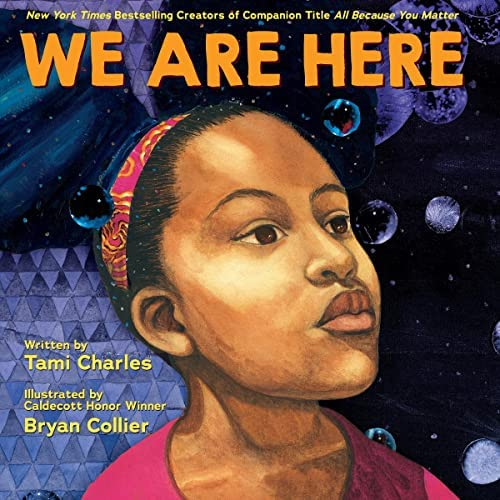
We Are Here by Tami Charles, illustrated by Bryan Collier

Published by Orchard Books

Summary:  The team behind All Because You Matter has created a new book celebrating Black contributions around the world to music, food, fashion, and science.  Written for a daughter that she never met (as explained in the author’s note), the free verse poem and illustrations feature a girl as she learns about the ways Black people have shaped the world throughout human history.  There are references to the pandemic and Black Lives Matter protests in both the text and the illustrations, which concludes, “You are brilliant, extraordinary, far-beyond-ordinary, the very best of who we are.” Includes additional information about some of the people and concepts referenced in the text, as well as notes from the author and illustrator.  40 pages; grades 1-5.

Pros:  An empowering picture book filled with beautiful words and pictures that may inspire readers to delve deeper into the history of Black people all over the world.  

Cons:  The writing is pretty abstract, so, while this is recommended as a picture book for preschool and primary grades, I think older kids would get more from it.

Black History book list

I’ve just updated my Black History book list, adding over 20 books from the past year. It’s a very long list at this point, but I can’t bring myself to take any of the books off of it. You can access it by clicking on the link or by going to my home page, moving the cursor over Book Lists, then clicking on Black History from the menu.

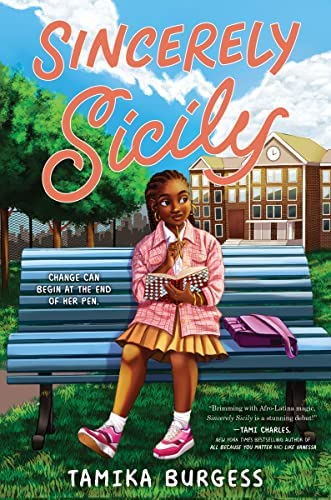
Sincerely Sicily by Tamika Burgess

Published by HarperCollins

Summary:  Sicily is dismayed to learn she’ll be starting sixth grade at the new middle school, leaving her three best friends behind.  School turns out okay, as Sicily reconnects with an old friend from kindergarten, whose cute seventh-grade cousin Michael is living with the family.  Things hit a snag, though, when Sicily’s class is assigned a project on their family’s heritage, and some of her classmates question how she can be both Black and Latinx (Panamanian).  Sicily begins to explore her culture through research, conversations with family members, and writing, something she has always felt passionate about.  She has a chance to write for a new school magazine, but the mean girl editor discourages her.  With inspiration from both her late grandfather’s journals and her new friend Michael, Sicily finally decides to persevere with her writing and produces something she can truly be proud of.  Includes a glossary and author’s note.  304 pages; grades 4-7.

Pros:  Sicily is a smart and sensitive narrator whose passion for writing and curiosity about her culture will educate and inspire readers.  Subplots about a fight with her grandmother over her hair and a ruined dress she tries to keep a secret from her mom add to the authenticity of the story.

Cons:  Sometimes the story felt a little too much like a vehicle for educating readers about Black Panamanian culture.

An American Story by Kwame Alexander, illustrated by Dare Coulter

Published by Little, Brown Books for Young Readers

Summary:  “How do you tell a story that starts in Africa and ends in horror?”  Kwame Alexander was moved to write this poem after he realized his daughter’s fourth-grade teacher wasn’t teaching students about slavery, because she was anxious and hadn’t been trained in how to teach that piece of the American story.  With distinctive illustrations that combine sculptures and paintings, the book portrays life in Africa, people being captured, the Middle Passage, and the horrors of slavery once they arrived in America.  The narrative is interspersed with pictures of a class learning from a teacher who is somewhat hesitant to teach the story, but who is encouraged by her students to tell them the truth.  How do you tell the story? “You do it/by being brave enough/to lift your voice,/by holding/history/in one hand/and clenching/hope/in the other.”  56 pages; grades 3-7.

Pros:  I have been sharing Kwame Alexander’s The Undefeated with fourth and fifth graders this week, and I think this book is even more powerful.  I know I can feel uncomfortable talking to elementary students about racism and slavery, but they are ready to hear about it, and this is an important book for making sure that happens.  The illustrations are equally powerful and mark my first Caldecott prediction for 2024.

Cons:  I saw recommendations in several places for ages 4-8, but I think it’s more appropriate for older elementary kids.