Bridge to the Wild: Behind the Scenes at the Zoo by Caitlin O’Connell, with photographs by Caitlin O’Connell and Timothy Rodwell

Published by HMH Books for Young Readers
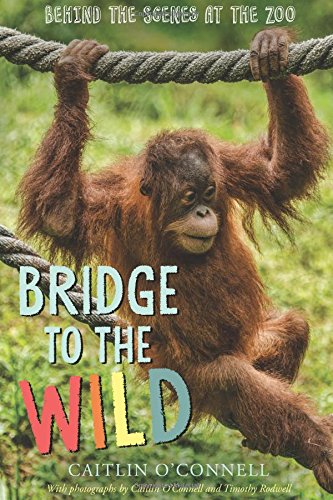
 

Summary:  Caitlin O’Connell, elephant scientist and science writer, expands her horizons here to many other zoo animals.  Touring Zoo Atlanta in Atlanta, Georgia, she gives readers a behind-the-scenes look at how zoo staff study animal behavior.  Readers will learn how panda mothers interact with their babies, how hierarchies work with various social animals like elephants and gorillas, and how zoo staff handle deadly poisonous snakes.  Much of what is learned about animals in captivity can be applied to helping species survive in the wild.  The last chapter describes ways humans have been able to help endangered animals such as Brazil’s lion tamarin.  Includes extensive bibliography, source notes, and index.  208 pages, grades 5-7.

Pros:  Animal lovers will learn a lot from this book, and come away with a new appreciation for zoos and the people who work there.  Excellent photographs illustrate almost every page.  Chapters could be read in isolation by those interested in a specific animal.

Cons:  At 208 pages, it will take a pretty dedicated young zoologist to get through the whole book.

Lucy & Andy Neanderthal by Jeffrey Brown

Published by Crown Books 

Summary:  Siblings Lucy and Andy, as well as their friends and family, are Neanderthals, which means…what?  Two modern scientists appear at the end of each chapter to fill the reader in on how Neanderthals hunted, created tools, communicated, made clothes, and more.  There are pertinent comments throughout the story which is a humorous slice-of-life look at several days with the Neanderthals.  The family prepares  for a big mammoth hunt, goes on the hunt, then turns the dead mammoth into meat and clothes.  At the end, the Neanderthals meet up with some humans, who seem to be fabulous new neighbors until Andy overhears them plotting to take over the Neanderthals’ cave.  This sets up for book 2 which is previewed on the final few pages.  There’s a section at the end with still more Neanderthal information, and a note from the author in which he claims to have read almost 100 books to prepare for the creation of this graphic novel.  224 pages; grades 2-6.

Pros:  Far more educational than what I was expecting from the author of Jedi Academy, but don’t worry, there is plenty of fun mixed in as well.  This one is guaranteed to fly off the library shelves, and readers will be laughing too much to realize they’re learning, too.

Cons:  I prefer some color in my graphic novels.

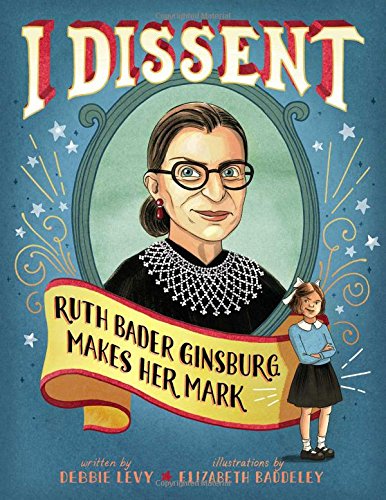
I Dissent: Ruth Bader Ginsburg Makes Her Mark by Debbie Levy, illustrated by Elizabeth Baddeley

Published by Simon and Schuster 

Summary:  Growing up in the 1940’s, Ruth Bader noticed many prejudices and injustices.  There were hotels and restaurants that banned her family because they were Jewish.  Girls weren’t expected or encouraged to do many of the things boys could do.  Even as a left-handed person, Ruth faced discrimination, getting a “D” in penmanship when she was forced to write with her right hand.  Ruth’s mother took her to the library and encouraged her to get an education; although she died the day before Ruth’s high school graduation, Ruth persisted and went to college and law school.  Overcoming the difficulties of being hired as a female lawyer, she eventually became a law professor, then a judge.  In 1993, Ruth Bader Ginsburg was appointed to the Supreme Court.  Throughout her career, up to the present day, she has fought for the rights of those who experience discrimination.  Now the oldest member of the Supreme Court, there are those who think it’s time for her to retire.  Ruth Bader Ginsburg dissents.  Includes an extensive author’s note with additional biographical information, notes on the Supreme Court cases mentioned in the text, and a bibliography.  40 pages; grades 1-4.

Pros:  The first picture book about this woman who continues to inspire.  Building Ruth’s story around her experiences with discrimination and passion for justice gives the story a good focus.  The illustrations add a bit of humor and incorporate some of the text into the pictures.

Cons;  Those whose politics don’t match Ginsburg’s may disagree with the way some of the Court cases are described.

I

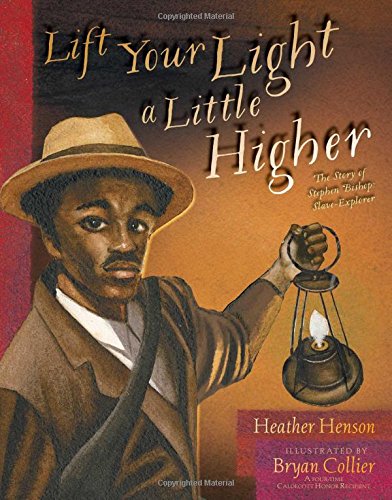
Lift Your Light a Little Higher by Heather Henson, illustrated by Bryan Collier

Published by Atheneum


Summary:  Stephen Bishop invites you to join him on a tour of Kentucky’s Mammoth Cave.  Born a slave, Bishop was trained as a tour guide for this huge cave system (the longest in the world) that was on his master’s plantation.  Although other slaves also guided visitors, Stephen became the most famous.  He discovered new animals and forged new paths through the caves.  He shows visitors his name on the cave wall, written along with his wife’s and many other visitors’, with the smoke from a candle tied to a long stick.  Little is known of Stephen Bishop’s life, which ended at the age of 37.  He is buried not far from the entrance to Mammoth Cave.  Author’s and illustrator’s notes at the end give more information about Bishop and how this book was created.  32 pages; grades 1-4.

Pros:  The lyrical text and beautiful illustrations by Bryan Collier bring this little-known man to life, along with the caves he loved and studied for many years.  Since so little is known about him, this isn’t really a biography, but more an imagined meditation on slavery, race, and life.

Cons:  Read the author’s note first, or the story will be hard to understand.

Click Here to Start by Denis Markell

Published by Delacorte Press 

Summary:  During 12-year-old Ted’s final visit with his somewhat mysterious great uncle, Uncle Ted extracts a promise from young Ted to not give up and keep looking for answers.  Shortly afterward, his great uncle dies, and Ted inherits his apartment and all its contents.  He and his friend Caleb are psyched to dig into the mess, but disappointed when Ted’s father invites his boss’s daughter, Isabel, to join them.  Isabel turns out to be a brain, which is helpful as the three are drawn deeper and deeper into a search for lost treasure.  Ted is an expert an online escape-the-room games, and it turns out his great uncle created a hunt perfectly honed to his skills.  The only problem is there’s at least one bad guy racing to find the same treasure, and it’s hard to tell who he is.  With plot twists on practically every page, the three kids finally end up victorious, with a few ends left loose to pave the way for a sequel.  320 pages; grades 5-8.

Pros: Fast-paced and funny, this is sure to engage reluctant readers with its non-stop action and humorous dialogue.

Cons:  Plan on suspending your disbelief by chapter two and keeping it suspended up until the last page.  The solution to this puzzle is way beyond the capabilities of any mortal mind, and there are a few too many coincidences to be believable.  Don’t think too much…just enjoy the ride.

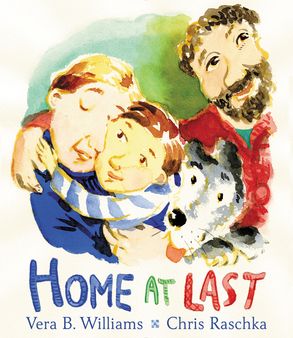
Home at Last by Vera B. Williams, illustrated by Chris Raschka

Published by Greenwillow Books 

Summary:  Lester is finally going home with his new parents, Daddy Albert and Daddy Rich, after waiting a year for his adoption to become final.  Even though he’s spent a lot of time with his two dads and their dog Wincka, it still feels weird to him to be in a new home.  Although his parents encourage him to unpack, he insists on keeping his suitcase full of action figures right next to his bed in case he needs their protection.  And every night, he goes into his parents’ bedroom and stands at the foot of the bed until they wake up and take him back to his own bed.  This becomes more and more of a problem for everyone, until finally Wincka figures out what to do.  After many years of sleeping at the foot of Albert and Rich’s bed, he realizes he has a new job, and moves in with Lester.  This gives Lester the security he’s been looking for, and at last he is ready to begin his new life.  40 pages; ages 4-8.

Pros:  A moving story of love and family, written by Caldecott honoree Vera B. Williams, and illustrated by Caldecott medalist Chris Raschka.  Raschka has included a note at the end on how he and Williams worked together to create this final book before Williams’ death last October.

Cons:  Due to its length and somewhat rambling nature, it’s a story best suited for one-on-one sharing.

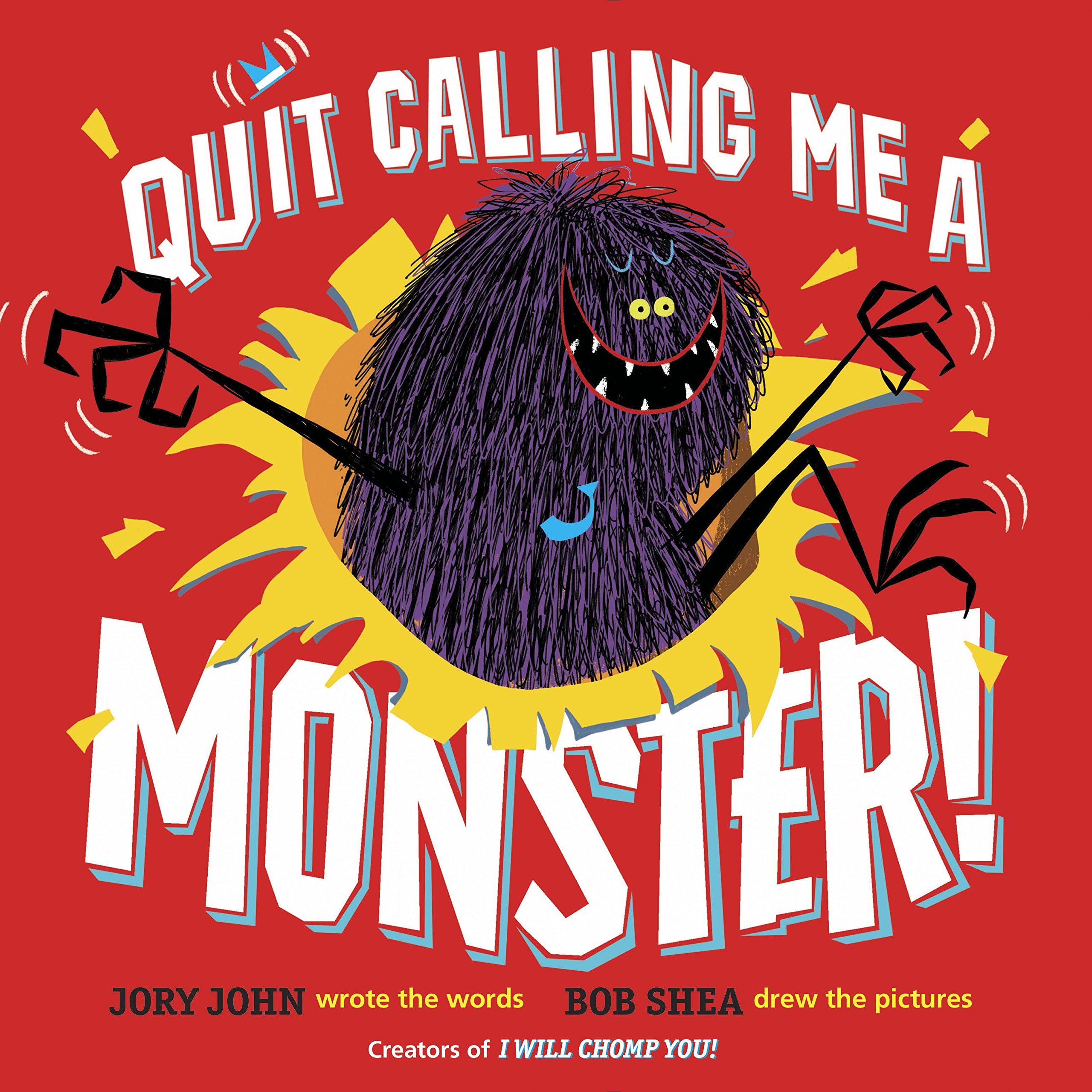
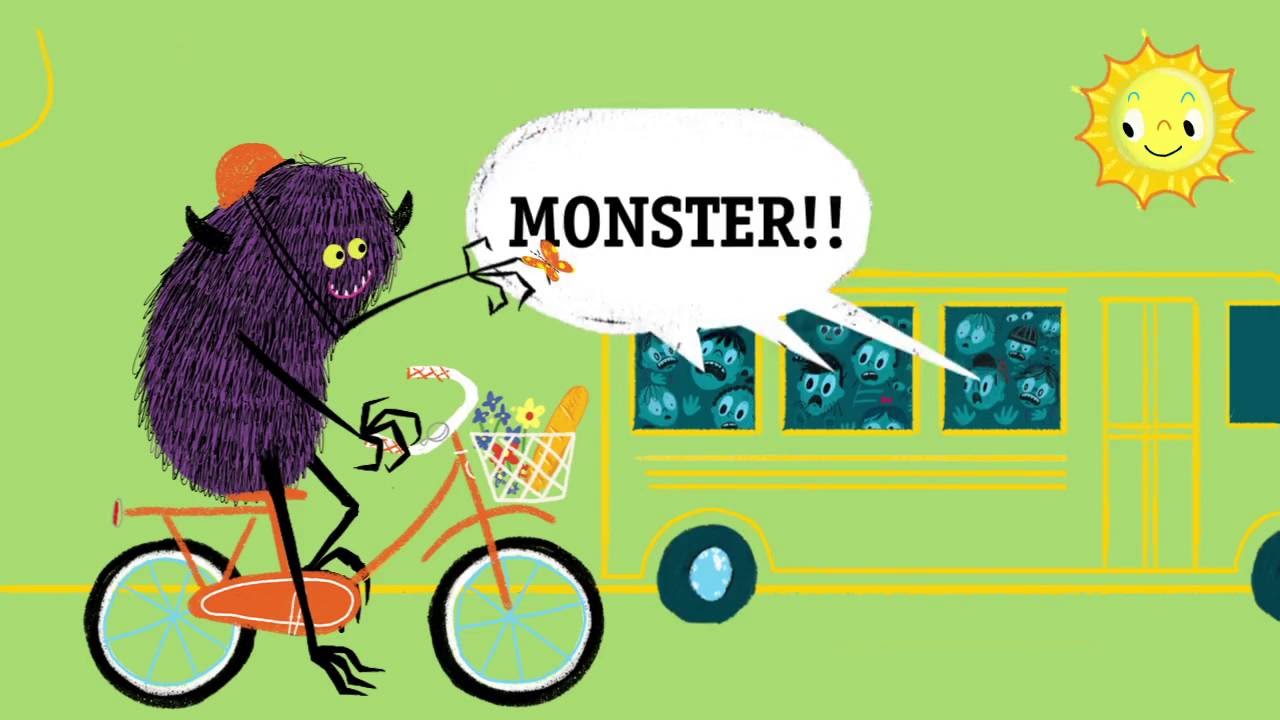
Quit Calling Me a Monster! by Jory John, illustrated by Bob Shea

Published by Random House Books for Young Readers

Quit Calling Me a Monster!: John, Jory, Shea, Bob: 9780385389907: Amazon.com:  Books

Summary:  He’s sick and tired of being called a monster.  Okay, so maybe he does have horns, claws, and fangs.  And perhaps his feet clomp louder than most, his hair is wild, and he likes to roar, cackle, and howl at the moon.  But do people really need to scream and run away from him when he’s innocently walking around, buying groceries, or trying to catch some sleep under your bed or in your closet?  His parents were monsters, and he’s a monster, too.  He can’t help it.  And for the record, his name is Floyd.  Floyd Peterson.  The penultimate page has an exchange he appreciates:  “Daddy, I think there’s a monster in my closet!”  “No, son, it’s just Floyd Peterson.”  “Oh…okay.  Good night.”  Much better.  40 pages; ages 3-7.

Pros:  So many possibilities.  Persuasive writing mentor text.  Empathy for differences.  Or simply a really fun read-aloud that will make kids laugh out loud.

Cons:  Is it just me, or does the monster look like a hairy version of one of those dancing raisins from 1980’s commercials?

Fairy World: Enter the Magical and Mysterious Realm by Stella A. Caldwell, illustrated by Ryan Forshaw

Published by Barron’s 

Summary:  Stella Caldwell presents herself as an expert on fairies who has traveled extensively to study these magical creatures.  Her definition of “fairy” extends to a variety of creatures including pixies, boggarts, elves, and many others.  She has included several “case studies”, relating stories in which she was called upon to investigate a human interaction with a fairy.  The oversized book is set up almost like a scrapbook, lavishly illustrated with labeled pictures of items associated with magical folk, such as wings and flowers.  There’s more than a hint of danger in associating with these creatures; many will help humans but can play tricks or worse if the people aren’t properly grateful.  The final two pages tell of fairies stealing children and replacing them with changelings who can eventually be trained to fit in to the human world.  80 pages; grades 4-7.

Pros:  Fantasy fans will want to spend lots of time poring over this book.  There is so much information, presented in a variety of ways, as well as gorgeous artwork.  In each chapter, there’s at least one wordless two-page spread illustration, suitable for framing.

Cons:  Definitely for older kids…the fairies here are far more “Spiderwick Chronicles” than “Rainbow Magic”.

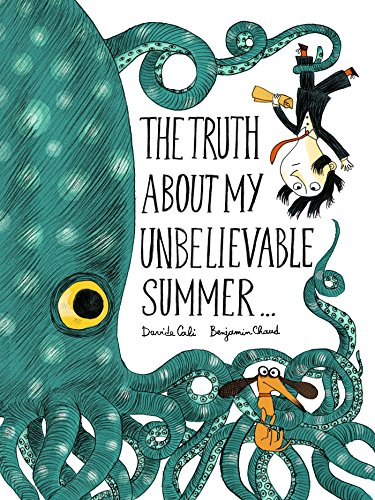
The Truth About My Unbelievable Summer by Davide Cali, illustrated by Benjamin Chaude

Published by Chronicle Books


Summary:  When a boy’s teacher asks him, “So what did you do this summer?”, he spins an increasingly fantastic tale.  It starts with him finding a message in a bottle which turns out to be a treasure map.  He ends up on a pirate ship, in a submarine, scaling the Great Wall of China, being chased by mummies in Egypt, and much, much more.  He concludes the story by saying to his teacher, “So you probably don’t believe me…right?”  The next page shows his teacher busily drawing something at her desk, with the caption, “Three months earlier…”, and then [spoiler alert] tossing a bottle with a paper inside toward the boy at the beach. 44 pages; grades K-3.

Pros:  A fun story that could inspire kids to come up with their own tall tales.  The pictures are crowded with action.  Readers will laugh at the final plot twist.

Cons:  The small size of the book and the unappealing appearance of the protagonist turned me off from reading this for quite a while.

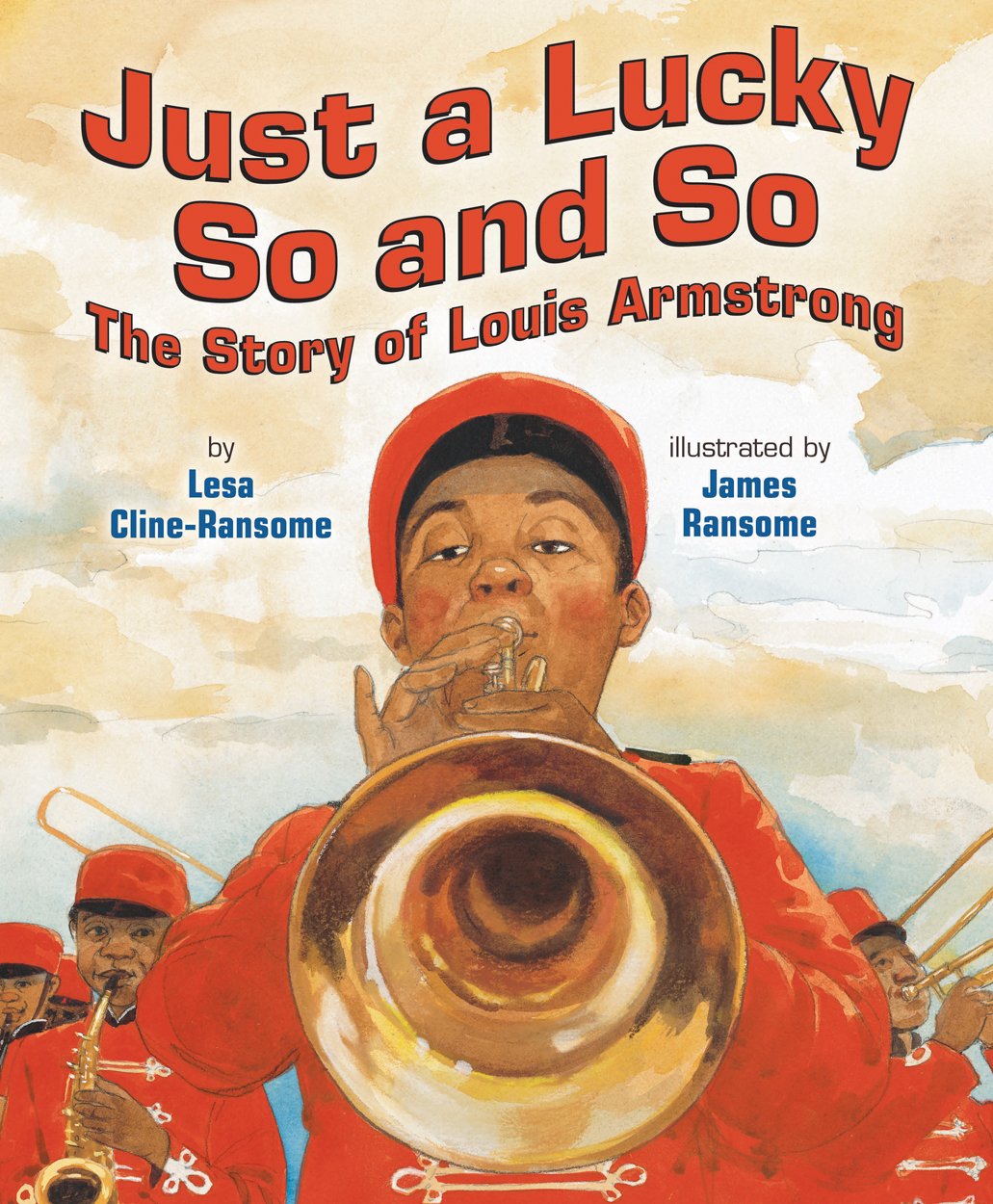
Just a Lucky So-and-So: The Story of Louis Armstrong by Lesa Cline-Ransome, illustrated by James Ransome

Published by Holiday House 

Summary:  Louis Armstrong considered himself to have led a lucky life, but his early days weren’t always so auspicious.  Born in The Battlefield, a tough part of New Orleans, young Louis started working at an early age to help his single mother.  He was surrounded by music, and a pawnshop cornet allowed him to begin to make his own tunes.  After shooting off a gun on New Year’s Eve, Louis was sent to reform school, where he worked his way up to bandleader.  After his stint there, he returned to his old neighborhood and pursued his career in earnest.  The book ends with him newly arrived in Chicago, being cheered on by the crowd to come forward and blow his horn.  A full-page author’s note gives more information on Armstrong’s life, and another page has resources for further research, including places to visit.  40 pages; grades 1-4.

Pros:  The large, full-color illustrations nicely complement the somewhat spare lyrical text.  The end matter gives plenty of material for researchers.

Cons:  The large number of people and places in a relatively short story was a little confusing.  Also, the quotes from Armstrong throughout the text aren’t cited.