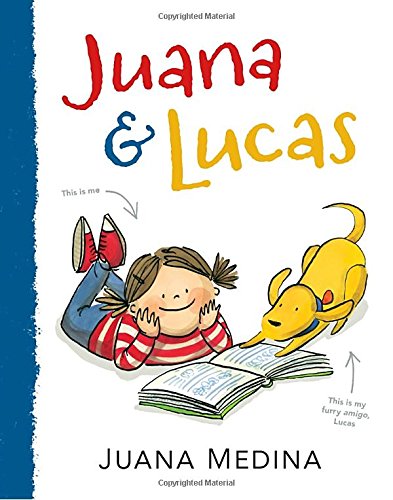
Juana & Lucas by Juana Medina

Published by Candlewick 

Summary:  Juana lives in Bogota, Colombia with her mother, Mami, and her dog Lucas.  She loves soccer, her best friend Juli, and Astroman.  She does not love learning “the English” at school.  It’s hard, and there doesn’t seem to be much point to it.  But then her beloved grandparents tell her they want to take her to Spaceworld in Orlando, Florida, where Juana will get to meet Astroman.  Her grandfather tells her that at Spaceworld, everyone speaks English, and Mami tells her that if her grades don’t improve, there will be no Spaceworld.  That’s all the inspiration she needs, and before long, the family has an amazing trip, and Juana gets to tell Astroman her whole life story.  96 pages; grades 2-4.

Pros:  Fans of Judy Moody and Junie B. Jones will enjoy the spunky Juana and her affectionate dog.  The Colombian setting and frequent Spanish words give this a nice international flavor.  Lots of colorful, cartoony illustrations throughout.

Cons:  It would have been nice to have a Spanish to English translation guide for all the Spanish words in the text.

Pedro, First Grade Hero by Fran Manushkin, illustrated by Tammie Lyon

Published by Picture Window Books 

Summary:  Katie Woo’s friend Pedro has his own new series.  This collection contains four stories, which are also available as individual books.  Pedro collects bugs, tries out for soccer goalie, starts a mystery club with his friends, and runs for first grade class president.  Katie is a pretty prominent character in every story, along with several of their classmates.  The last four pages, “Joke Around With Pedro”, contain jokes in keeping with the themes of the four stories.  96 pages; grades K-2.

Pros:  A great choice for newly independent readers, this feels like a chapter book, but reads like an easy reader, with just a few sentences of text on each page.  There are plenty of cheerful illustrations, and an ethnically diverse cast of kid characters.

Cons:  First graders Pedro and Katie are way more civil in their presidential election than some other politicians we know.

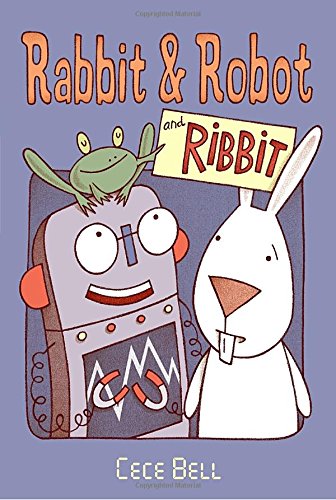
Rabbit & Robot and Ribbit by Cece Bell

Published by Candlewick Press 
Summary:  When Rabbit goes to visit Robot, he’s dismayed to find that Robot has another friend over, a frog named Ribbit.  Ribbit’s vocabulary is limited to a single word, “Ribbit”, which Robot is able to understand using his frog translation software.  Rabbit starts feeling jealous, and pretty soon Rabbit’s and Ribbit’s emotions are running so high that Robot overheats himself trying to interpret them all.  When Robot collapses, Rabbit and Ribbit have to work together to learn how to revive him.  In the end, the three friends discover that three isn’t really a crowd and learn to play together.  48 pages; grades K-3.

Pros:  The sequel to Rabbit and Robot: The Sleepover, this long easy reader/short chapter book with cartoon illustrations and silly dialogue is just right for emerging independent readers.

Cons:  Let’s hope Cece Bell doesn’t wait another 2 ½ years before writing another Rabbit and Robot book.

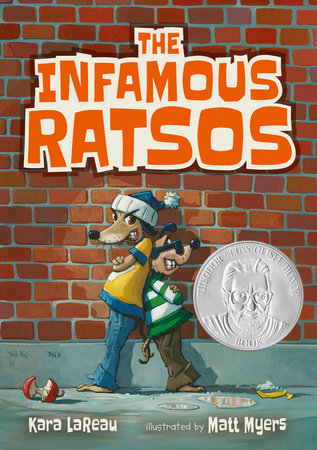
The Infamous Ratsos by Kara LaReau, illustrated by Matt Myers

Published by Candlewick Press 

Summary:  Louie and Ralphie Ratso live with their father, Big Lou, who is one tough rat.  Their mother has been gone for a while, but they all try not to think about that.  Instead they focus on being tough.  For the boys, that means thinking up bullying schemes to torture their neighbors and classmates.  Trouble is, their plans keep backfiring to make them look like the good guys.  When they steal a hat from a boy in their class, it turns out he stole the hat to begin with.  He gets punished, while the Ratsos get praised by their teacher.  A plan to pile up snow in front of their neighbor’s store goes awry when the boys take a wrong turn and end up clearing his sidewalks.  As the final insult, the boys’ teacher sends home a note, letting their father know what upstanding citizens they are.  To their amazement, their tough-as-nails dad breaks down in tears and tells them how proud their mother would be of them.  From then on, the Ratsos go from trying to be infamous to being famous…for their good deeds.  64 pages; grades 1-4.

Pros:  What could have been a sappy, moralistic tale is actually very funny, with a lesson snuck in pretty surreptitiously.  Plenty of illustrations and large text make this a good choice for those just moving in to chapter books.

Cons:  If your young reader doesn’t get the concept of “irony” when reading about the Ratsos’ antics, you may be in for a long school year.

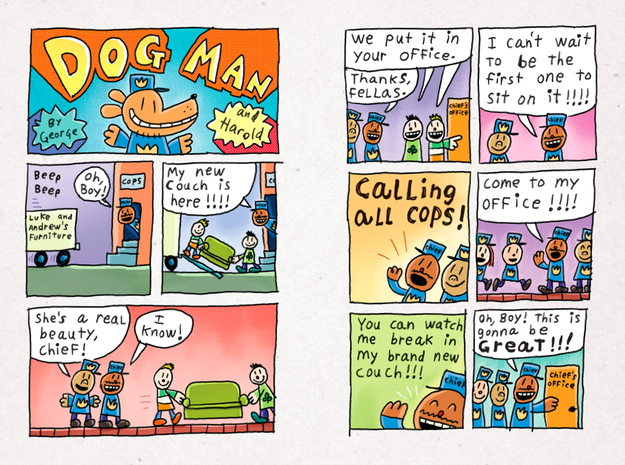
Dog Man by Dav Pilkey

Published by Graphix


Summary:  George and Harold, creators of Captain Underpants, revisit a character they came up with in first grade.  Police officer Knight has a strong body but a weak brain; his canine companion Greg has a brilliant mind, but isn’t very big or powerful.  An accident results in Greg’s head being stitched on to Officer Knight’s body, creating superhero Dog Man.  Dog Man has four adventures in this comic book, all of them involving his nemesis, Petey the Cat.  The pictures and text channel a talented first grader, complete with occasional crossed-out words and grammatical errors.  “Extra cheesy Flip-o-ramas” are inserted throughout the text to create some “animation”.  The last few pages have instructions on how to draw some of the characters, and there is a preview of Dog Man 2: Unleashed, available January 2017.  240 pages; grades 2-4.

Pros:  Once again, Dav Pilkey has his finger firmly on the pulse of an 8-year-old.  Reluctant readers everywhere, as well as non-reluctant ones, will enthusiastically embrace Dog Man and his adventures.

Cons:  I fear that by reviewing Inspector Flytrap and Dog Man in the same week, I may have irrevocably labeled myself “literary lightweight”.

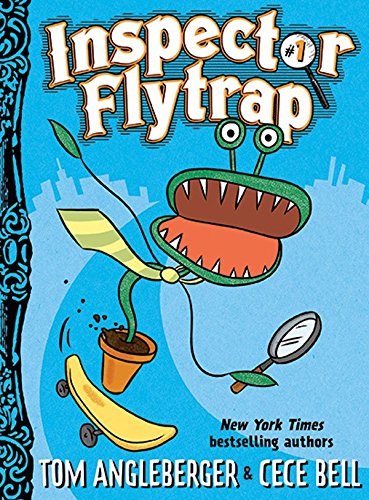
Inspector Flytrap by Tom Angleberger and Cece Bell

Published by Amulet Books 

Summary:  In a literary first, a Venus flytrap with dreams of becoming a detective pairs up with a goat named Nina, who pushes Flytrap around on a skateboard and eats everything in sight.  The opening book in the series has the two of them solving three mysteries.  In the first, an art museum hires the pair to identify a mysterious orange blob on a famous painting (hint: it involves a sneeze on the part of the artist); next, they figure out how a giant stinky shoe got on top of a cookie store; finally, they solve the mystery of a missing rose, which leads to a surprise romance for both Flytrap and Nina.  All stories are generously sprinkled with Bell’s black, white, and green illustrations.  112 pages; grades 2-4.

Pros:  Quirky author Angleberger (Origami Yoda) and his Newbery honoree wife Cece Bell (El Deafo) team up for a wild, crazy, and hilarious new mystery series.  Readers will be as helpless as a bug in a Venus flytrap to resist the second installment, Inspector Flytrap in the President’s Mane is Missing, released the same day as this one.

Cons:  Nina the goat is pretty annoying.

The Big Move (Commander in Cheese series) by Lindsey Leavitt, illustrated by A. G. Ford

Published by Random House 

Summary:  Excitement is building in the White House as a new President is about to be inaugurated.  Mouse siblings (and White House residents) Ava and Dean are particularly excited because the new Commander in Chief has two children of her own.  The mice hope to add a Lego to the collection of White House treasures that generations of mice have maintained in tunnels around the house.  They see their chance to explore the kids’ rooms when everyone else is distracted by the inauguration ceremony, but plans go awry.  First, they get locked into a room with no tunnels, then the kids come back and discover them, resulting in a “Code Brown” that brings in Secret Service agents to try to get rid of the “vermin”.  There’s a happy ending for all, both human and rodent, and a promise of further interactions and adventures between the mice and their new human friends.  Back matter includes pictures of all the U.S. Presidents, fun facts about Inauguration Day, a floor plan of the part of the White House in the story, and a preview of book #2.  112 pages; grades 1-3.

Pros:  As a kid, I would have loved imagining being a mouse in the White House.  Ava and Dean are likeable characters, and readers will effortlessly learn a few facts about the presidency while enjoying the mice’s adventures.

Cons:  The plot is fairly predictable and the characters are pretty one-dimensional.

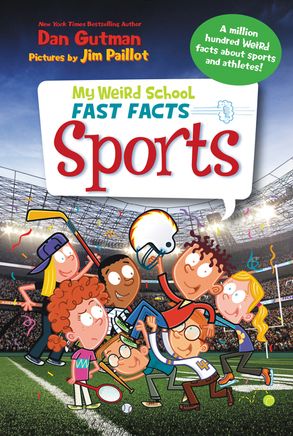
Sports (My Weird School Fast Facts) by Dan Gutman

Published by HarperCollins 

Summary: A.J. and Andrea, two of the wisecracking, squabbling kids from the My Weird School series, offer weird and interesting facts about a variety of sports. In addition to more well-known information, such as how different sports were invented, there are tidbits that will appeal specifically to elementary boys (some early hockey pucks were made of frozen cow poop) and some that are just bizarre (a hockey puck once hit a player in the chest, where he had a pack of matches, and his uniform caught on fire). Chapters include baseball, football, soccer, basketball, hockey, golf, car racing, the Olympics, and a couple chapters of miscellaneous facts. Includes lots of black-and-white illustrations by My Weird School illustrator Jim Paillot, as well as some photos. Look for a similar book with geography facts, and undoubtedly more on the way. 175 pages; grades 1-4.

Pros: Perfect for reluctant readers, this new series combines popular topics, interesting facts, and plenty of the humor that has made this series a favorite.

Cons: To my mind, the fast-fact format got a little old in the last few chapters. It wouldn’t have been a great loss to edit out the miscellaneous stuff.

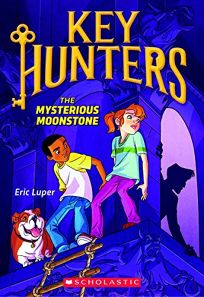
The Mysterious Moonstone (Key Hunters series) by Eric Luper

Published by Scholastic 

Summary:  Cleo and Evan miss their favorite school librarian, Mrs. Hilliard.  After she mysteriously disappeared, the strange Ms. Crowley took over.  One day, Ms. Crowley is acting odder than ever.  The two kids follow her, and discover a secret underground library.  They find a note from Mrs. Hilliard telling them she’s trapped in a book, and they need to solve the mysteries in the other books to free her and avoid getting stuck themselves.  Entering one of the books, they find themselves in 19th century London, where they help a teenage Sherlock Holmes-like detective figure out who stole a diamond from a wealthy family.  Ms. Crowley makes an appearance in this mystery, and after it’s solved, the three of them return to their school.  More mysteries await, however, as they work to free Mrs. Hilliard.  128 pages; grades 2-4.

Pros:  The mystery was surprisingly good, with a cast of suspicious characters and a bumbling, yet charming detective.   The story-within-the-story structure is a fun way to move the series along.

Cons:  The beginning was a little slow.

The Gold Medal Mess (MVP) by David A. Kelly

Published by Random House 

Summary:  Nico, Kat, Max, Luke, and Alex can’t wait for their school’s upcoming Olympics.  So they’re worried when they find a note threatening to sabotage the games.  Their principal doesn’t seem too concerned, but when the events begin, a series of mishaps confirms the kids’ suspicions that someone is out to ruin the fun.  The kids decide to take matters into their own hands and figure out who is behind the evil plot.  128 pages; grades 1-4.

Pros:  The first in a new sports-themed series, this will be welcomed by fans of A to Z Mysteries and David A. Kelly’s other series, Ballpark Mysteries.

Cons:  Five detectives is a little unwieldy and doesn’t allow for much character development in such a short story.