March of the Mini Beasts (The Data Set #1) by Ada Hopper, illustrated by Sam Ricks

Published by Little Simon 

Summary:  Gabe, Laura, and Cesar call themselves The Data Set because they collect enough data—random information—to stump even their teachers.  One day they’re on a mission to sell enough candy bars in their neighborhood to fund their science club’s field trip.  Knocking on doors, they eventually get to a strange-looking house that turns out to be inhabited by Dr. Bunsen, a kindly mad scientist.  He introduces them to his growth ray machine, which turns out to not only cause their little plastic animals to grow, but also brings them to life.  The animals start out as mini pets that fit into a terrarium, but rapidly begin to grow to full size.  The kids must put their heads together to figure out how to find a safe home for their new pets.  The zoo animals prove to be manageable, but the fast-growing stegosaurus presents a problem to be solved in book #2.  128 pages; grades 1-3.

Pros:  This face-paced humorous adventure is a perfect first chapter book, with a large font and plenty of illustrations on just about every page.

Cons:  The Data Set didn’t seem all that brainy…everyone gasped with amazement when Cesar came up with the idea to take the growing wild animals to the zoo.

Danger! Tiger Crossing (Fantastic Frame series) by Lin Oliver, illustrated by Samantha Kallis

Published by Grosset and Dunlap 

Summary:  Tiger’s exploring his new neighborhood when he sees an orange pig in a hat and tie.  Pursuing this unusual neighbor, he meets a girl named Luna, and the two of them trace Chives the Pig to an old haunted-looking house.  Boldly making their way inside, they meet ancient Viola Dots, who hasn’t left her house in 50 years, ever since her son David disappeared into a picture frame, and Chives popped out in his place.  Upon close examination of the frame, Tiger discovers a clock, which he sets back an hour.  Almost immediately, the picture opens up, and he and Luna are sucked inside.  There they meet David, who is still 13, and have to outrun the hungry tiger that was in the painting.  They manage to find their way back, but David is left behind once again, leaving the reader ready for book #2, Splat! Another Messy Sunday, now available at a library or bookstore near you.  Back matter includes information about the painting the kids go into, Surprised! By Henri Rousseau. 128 pages; grades 2-4.

Pros:  A reasonably exciting adventure for early chapter book readers, with lots of illustrations, black and white for the times outside of the picture and color inside of it.

Cons:  It didn’t seem realistic that 50 years had gone by since David disappeared.  Viola Dots would have to be closing in on 90, yet looked and acted about 60.

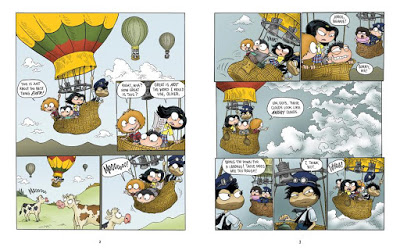
Poptropica: Mystery of the Map by Jack Chabert, illustrated by Kory Merritt

Summary: A hot-air balloon ride gone wrong lands Oliver, Mya, and Jorge on a mysterious island inhabited by dodo birds and Vikings. The dodos are entertaining and companionable, the Vikings, not so much. Not only are Erik the Red and his band after the kids, but Octavian, the balloon’s pilot, wants the magic map they took from him. After a daring prison break and a series of exciting chase scenes, the three children manage to outwit them all and sail off in a Viking vessel. The trip home promises an exciting sequel. 112 pages; grades 1-4.

Pros: This graphic novel is based on the Poptropica website, a gaming site co-founded by Diary of a Wimpy Kid creator Jeff Kinney. All the kid-friendly elements are in place to make this a surefire hit with even reluctant elementary readers.

Cons: Is it really okay to have a positive Jeff Kinney blurb on the front cover a book based on a website he helped create?

Weekends with Max and His Dad by Linda Urban, illustrated by Katie Kath

Published by HMH Books for Young Readers

Summary:  Max’s parents have recently separated, and now Max spends every weekend with his dad at his new apartment.  At first, the new place feels unfamiliar, and Max’s dad isn’t always tuned in to what Max likes in terms of room decor or activities.  But Dad is a good listener, and eventually he gets things right.  He takes Max on adventures to explore his new city, but again, he lets Max take the lead in terms of pace and direction.  As the weeks go by, Max gets to know the neighbors, and to feel comfortable enough to invite his best friend for a sleepover.  By the final page, Max has realized he now has two homes, and that he feels happy and safe in each one.  160 pages; grades 1-4.

Pros:  Max and his dad are likeable, yet realistic characters.  I loved how Dad kept pretending he wasn’t sick the weekend of the sleepover…so like a parent to keep soldiering along, even when you can barely stay awake!  The gradual pace of Max’s adjustment felt natural.  Both parents and children of divorce would benefit from reading this book.

Cons:  160 pages is a bit long for those readers just transitioning to chapter books.  The book is divided into three parts, so some may want to just try part 1 before deciding whether or not to tackle the whole thing.

Waylon! One Awesome Thing by Sara Pennypacker, illustrated by Marla Frazee

Published by Disney Hyperion


Summary: Waylon’s finding fourth grade tough, both at school and at home. In school, Arlo Brody, the kid everyone wants to be like, has decided that the boys should be divided into two teams. Waylon just wants to be friends with all the kids, but Arlo says the teams are at war. A new boy, Baxter, who might be a criminal, seems to want to hang out with Waylon. Meanwhile, Neon (Waylon’s 14-year-old sister formerly known as Charlotte) has taken to wearing all black and locking herself into her room. Waylon’s passion is science, but even his best ideas can’t help him figure out the people around him. When he learns the word isthmus in geography class, he decides that’s what he has to be—the bridge between friends and family members who seem to be living in two different countries. A happy almost-ending is in store for everyone—until the final end raises a big question that will surely need a sequel to resolve. 208 pages; grades 1-4.

Pros: Clementine’s classmate gets a story of his own, with the Sara Pennypacker-Marla Frazee team produces a book every bit as winning as their first series.

Cons: See pages 12 and 13 for some pretty egregious typos.

Fluffy Strikes Back by Ashley Spires

Published by Kids Can Press 

Summary: Fluffy is the lead cat of P.U.R.S.T. (Pets of the Universe Ready for Space Travel). Although he used to work out in the field, he now spends his days behind a desk five stories underground, protecting the humans and pets of the world from aliens. But one day, those aliens (insects) invade P.U.R.S.T. headquarters, and Fluffy has to spring back into action to defeat them. It’s a tough job, but with the help of his right-hand cat and chief engineer guinea pig (hamster?), Fluffy is able to get the job done. 72 pages; grades 1-4.

Pros: A fun beginning graphic novel; not too much text, but plenty of cat action.

Cons: A bit of bathroom—or rather, litter box–humor.


My Life in Pictures written and illustrated by Deborah Zemke

Published by Penguin Young Readers Group


Summary:  Bea Garcia likes to draw pictures of everything in her life.  She keeps her drawings in a book she calls—you guessed it—My Life in Pictures.  She has pictures of her mom and dad, pictures of her little brother Pablo, a.k.a. The Big Pest, and pictures of her best friend Yvonne, who, sadly, has just moved to Australia.  Yvonne’s house next door is empty, but not for long.  Pretty soon a new family moves in with a boy just Bea’s age—or is he really a monster?  Bert, a.k.a. Burp, ends up in Bea’s class, and she’s pretty sure nothing can be worse than the first day of school…until she gets to the second day.  Just when it seems like disaster is about to strike, Bea’s book of pictures winds up saving the day.  134 pages; ages 6-9.

Pros:  Bea is a likeable character with realistic-sounding problems and a spunky attitude to handle them.  The heavily illustrated text will make this a good choice for readers transitioning to longer chapter books.

Cons:  I was a bit disturbed that Bea’s teacher showed her artwork to the whole class without first asking her permission.

The Great Pet Escape by Victoria Jamieson

Published by Henry Holt and Company 

Summary:  GW (real name, George Washington) has been stuck in his hamster cage for three months, two weeks, and one day.  He and his friends, Barry the bunny and Biter the ferocious guinea pig used to be the Furry Fiends until they were captured and turned into classroom pets.  As the story opens, GW has just figure out a way to unlock the cage.  At the end of the school day, he makes his break and goes off in search of his companions.  To his dismay, Barry seems pretty happy in first grade, and Biter has completely gone over to the dark side of kindergarten, calling herself Sunflower and practicing yoga to handle her anger issues.  GW finally convinces them to return to their previous life, but their plans are interrupted by Harriet, the fourth grade mouse, leading an army that includes the fifth grade snake and ten more mice (or wait, is it nine and a well-fed snake?).  War breaks out in the halls and cafeteria of the school, and a single food fight could change the course of class pet history forever.  64 pages; ages 6-10.

Pros:  Victoria Jamieson is a genius. Roller Girl was a Newbery winner and one of my favorite graphic novels of 2015.  Now she’s gone in a totally new direction with a hilarious new graphic.  Unlike some “humorous” kids’ books that just seem silly, this one had me laughing out loud on every page.

Cons:  I can’t decide which sequel I want to see first…Roller Girl 2 or another installment of Pets on the Loose.

Pugs of the Frozen North by Philip Reeve, illustrated by Sarah McIntyre

Published by Random House 

Summary:  When Shen’s boat crushed by frozen waves in a sudden ice storm, he’s left on his own with part of the ship’s cargo—66 pugs.  They manage to cross the ice to the nearest village, where they meet Sika and her family. Sika tells Shen that it’s True Winter, an event that only happens once in a lifetime.  True Winter means the Snowfather can be reached at the North Pole, and there will be a sled race to get to him.  Whoever gets there first will be granted a wish.  Sika wants to go to see if she can save her dying grandfather; she has a sled, but no dogs.  Turns out sixty six pugs can do the work of a dog sled team, so off they all go, racing against a group of formidable opponents.  Undeterred by yetis, snowbots, and cheating competitors, the kids and their pugs prove that they are contenders.  224 pages; ages 7-10.

Pros: Don’t be put off by the goofy cover; this is a good adventure story with original characters and loveable characters. The humor is accentuated with silly illustrations on every page.

Cons: There’s no getting around it, those pugs are pretty ugly.

Oona Finds an Egg (Oodlethunks Book 1) by Adele Griffin illustrated by Mike Wu

Published by Scholastic 

Book trailer: https://www.youtube.com/watch?v=dVhK8kZN5w0

Summary:  Oona lives in a cave with her high-powered mother (she’s trying to market the newly-invented wheel), her father (he’s a laid-back hunter-gatherer who likes to cook), and younger brother, Bonk.  When Oona discovers a large egg, she hopes it will hatch into something that Bonk’s not allergic to. And that it won’t be interested in eating her and her family.  When she and Bonk have a fight, the egg mysteriously disappears, and Oona is heartbroken.  Using her wits and ingenuity, she figures out what happened and tracks down her unhatched pet just as the egg is starting to rock and crack a bit.  It breaks open, and out steps a baby…well, I can’t give everything away.  Book #2 comes out in September.  160 pages; grades 2-4.

Pros:  The Oodlethunks are a modern Stone-Age family, and 21st century kids will chuckle over the up-to-date reinventions of prehistoric life.  The author’s note at the end separates fact from fiction, explaining that much of the Oodlethunks’ village is based on ancient Colorado.  Fun illustrations.

Cons:  The geologic ages are a bit mixed up.