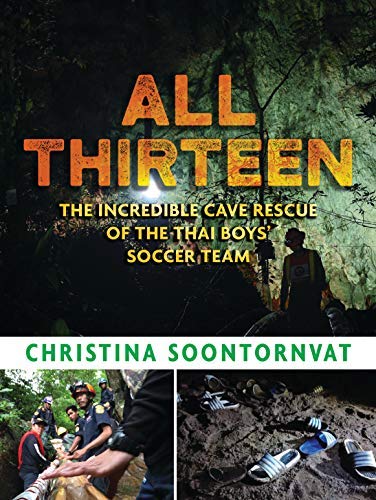
All Thirteen: The Incredible Cave Rescue of the Thai Boys’ Soccer Team by Christina Soontornvat

Published by Candlewick Press (released October 30)

All Thirteen: The Incredible Cave Rescue of the Thai Boys' Soccer ...

Summary:  In the summer of 2018, the entire world watched as rescue teams struggled to save the twelve members of the Wild Boars soccer team and their coach who were stuck inside the flooded Tham Luang Nang Non cave in Thailand.  This book tells the story from the beginning, when this close-knit group of boys ranging in age from 11 to 16, and their 25-year-old coach decided to take a trip to the cave one day after practice.  After the cave unexpectedly flooded, an international team of cavers and divers were called in to figure out the best rescue strategy: pump out the water, drill into the side of the cave, or dive and swim the team out.  In the end, the dive and swim strategy was used, and as the story unfolds, the reader finds out it was nothing short of a miracle that all thirteen were rescued (although a Thai Navy SEAL died delivering oxygen tanks a couple days before the rescue procedure began).  Sidebars give more information about Thailand, caves, and Buddhism (the coach spent much of his life in Buddhist monasteries, and his teachings on meditation helped everyone stay calm inside the cave).  Includes an author’s note that tells of her connection to the story (she was visiting family in Thailand during the rescue); extensive source notes, a bibliography, and an index.  288 pages; grades 4-8.

Pros:  I didn’t think anything could compel me to read a 288-page book on my phone, but once I started reading this story, I couldn’t stop.  The boys and especially their coach are likeable from page 1, and the rescuers endure hunger, sleep deprivation, and what sounded like a really disgusting foot fungus condition to accomplish something that seemed impossible from beginning to end.  The numerous photos draw the reader in, and the sidebars add to the content, and remind me that I’d really like to visit Thailand someday.

Cons:  This book appears to be retailing for almost $25.00.

If you would like to buy this book on Amazon, click here.

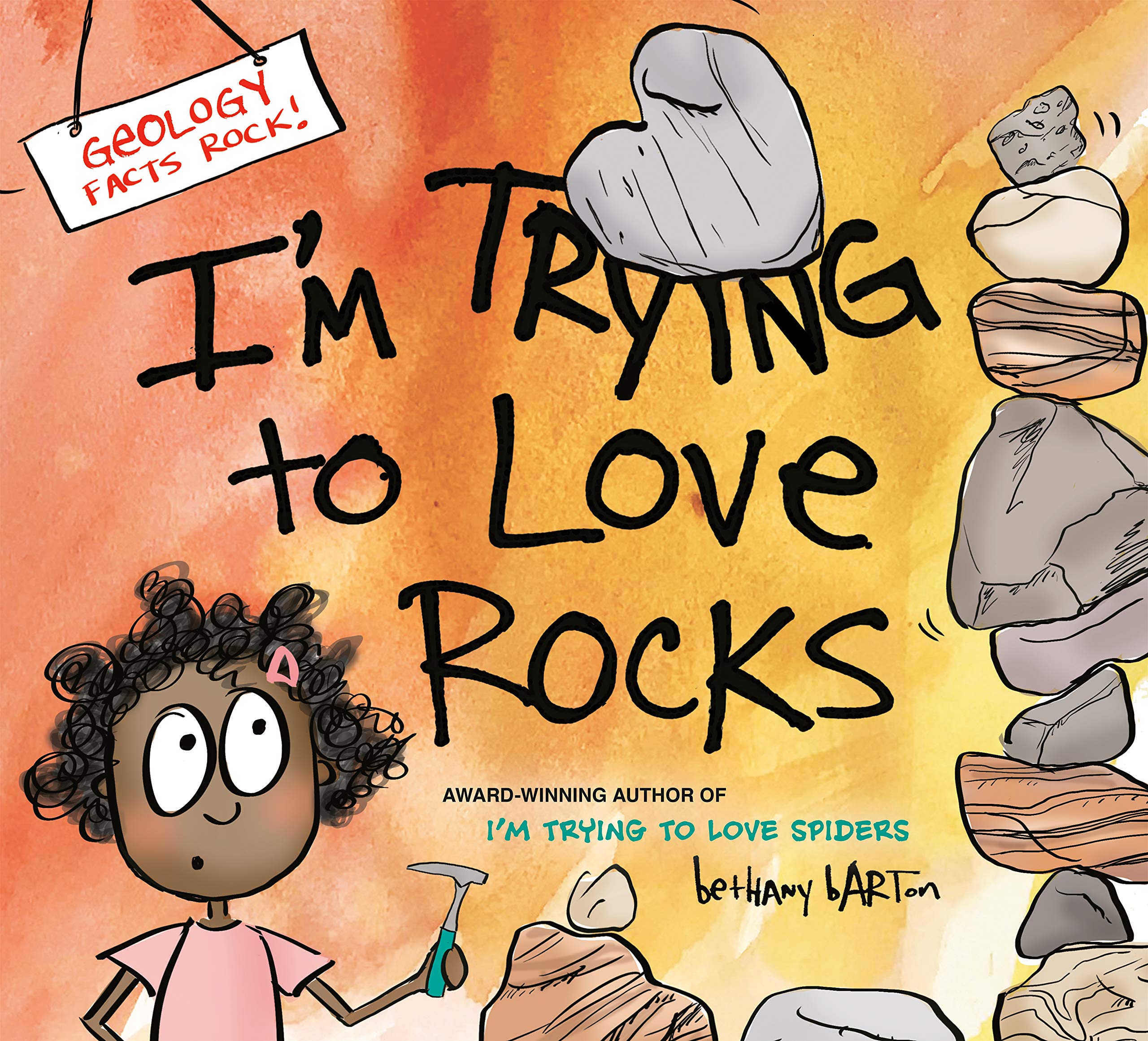
I’m Trying to Love Rocks by Bethany Barton

Published by Viking Books for Young Readers

I'm Trying to Love Rocks: Barton, Bethany: 9780451480958: Amazon ...

I'm Trying to Love Rocks by Barton, Bethany - Amazon.ae

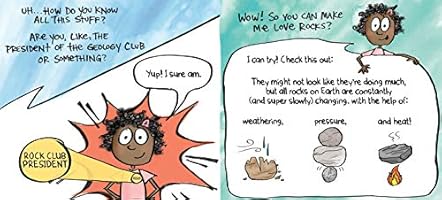
Summary:  The author of three other I’m Trying to Love… books makes seemingly dull, boring rocks come alive with a spirited girl narrator who corrects the off-the-page speaker by showing how rocks tell interesting stories.  She identifies the three types of rocks, explaining how each kind is formed, and goes on to show examples of work geologists do that kids will relate to.  She makes a brief plug for scientists in general, “Science isn’t about having the answers–it’s about asking questions.”  A careful examination of the end papers indicates that her mission has been accomplished: the front papers show a bunch of rocks, each one labeled “rock”, while the end ones have each rock correctly labeled.  40 pages; ages 4-8.

Pros:  Another lively, informative entry in this series, with plenty of humor, bright cartoon-style illustrations and comic bubble dialogue. This would make a perfect introduction to a unit on rocks for preschool and primary grades.

Cons:  No back matter. 

If you would like to buy this book on Amazon, click here.

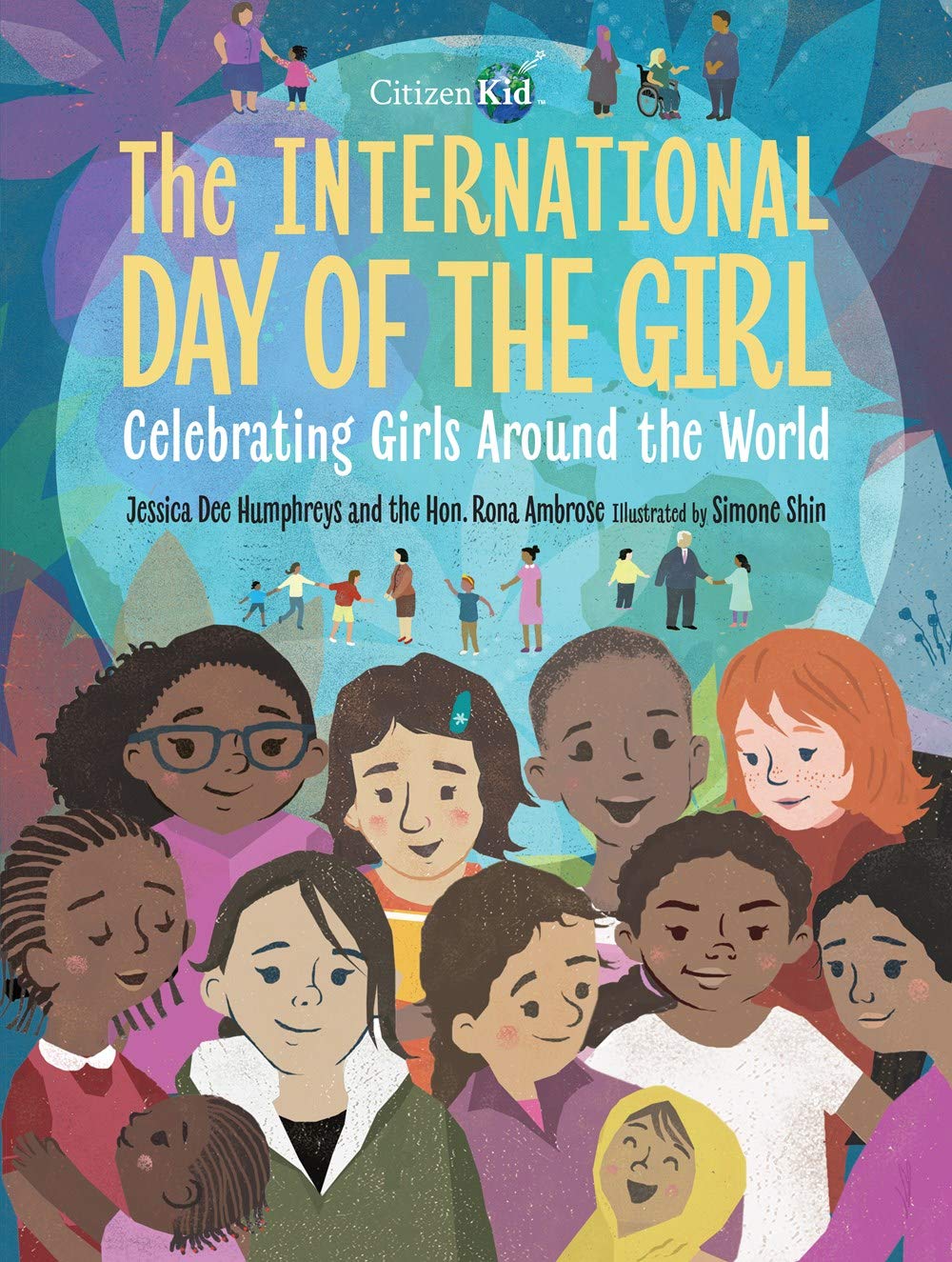
The International Day of the Girl: Celebrating Girls Around the World by Jessica Dee Humphries and the Hon. Rona Ambrose, illustrated by Simone Shin

Published by Kids Can Press (Released September 1)

The International Day of the Girl: Celebrating Girls Around the ...

Summary:  In 2011, the United Nations declared that October 11 would be an annual day of recognition for girls around the world–the International Day of the Girl.  This book tells the stories of nine (fictional) girls from all over the world who experienced gender inequality, and took action to remedy it.  Each one is introduced by name and a personality trait (“This is Abuya.  She is creative”), then tells a brief version of her story, including a sidebar about the more global issue it connects to.  For instance, in Kenya,  Abuya overheard her older sister asking to stay home from school because there was no girls’ bathroom.  Assisted by her father, Abuya used her carpentry skills to build an outhouse.  The sidebar describes the issue of providing safe bathroom facilities so girls are able to get an education.  An illustration accompanies each story.  Includes a timeline of events leading to the creation of the International Day of the Girl and further information about each of the issues facing girls addressed in the book.  32 pages; grades 2-6.

Pros:  This was the first I had heard of the International Day of the Girl, and this introduction explains many of the issues affecting girls around the world in a way that readers will understand and connect with.  The introduction uses the metaphor of a garden that’s been divided into two halves, with one half receiving all the nurturing and attention.  The colorful illustrations continue that metaphor, and the last page encourages kids to “be the world’s gardener”.  Another excellent entry in the CitizenKid series.

Cons:  A map showing where the different girls live around the world and some additional resources would have been useful additions.

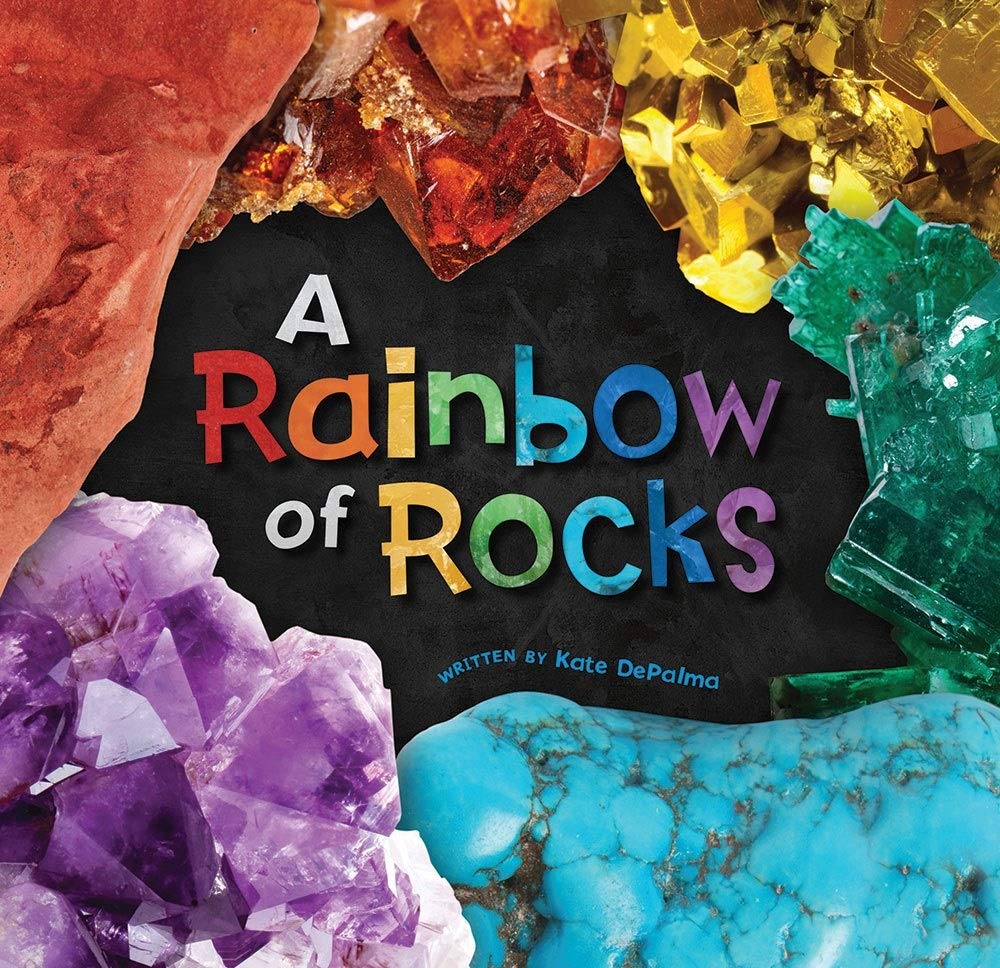
A Rainbow of Rocks by Kate DePalma

Published by Barefoot Books

A Rainbow of Rocks: DePalma, Kate: 9781782859925: Amazon.com: Books

Summary:  Each page features two rocks of the same color on a black background with rhyming text to identify them (“Pyrite cubes reflect the light. Calcite is glassy–edged with white.”).  After going through red, orange, yellow, green, blue, purple, black, and rainbow-colored, the author concludes, “Rocks in every shape and hue. Each one’s different, just like you!”  The final three pages contain five questions about rocks and minerals with fairly in-depth answers.  24 pages; ages 3-7.

Pros:  The photos of are gorgeous, and the back matter provides a good introduction to rocks and minerals.

Cons:  There feels like a disconnect between the rhyming text, which seems most appropriate for preschoolers, and the back matter, which would work for kids up to age 10 or so.

If you would like to buy this book on Amazon, click here.

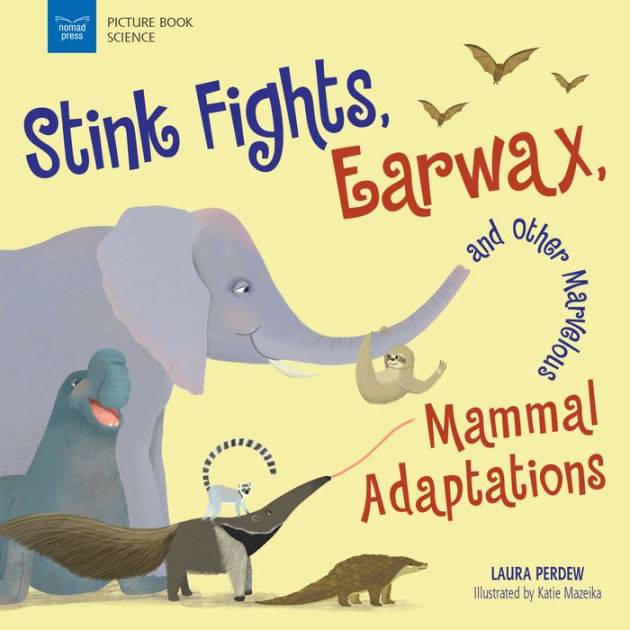
Stink Fights, Earwax, and Other Marvelous Mammal Adaptations by Laura Perdew, illustrated by Katie Mazeika

Published by Nomad Press (released August 13)

Stink Fights, Earwax, and Other Marvelous Mammal Adaptations by ...

Stink Fights, Earwax, and Other Marvelous Mammal Adaptations ...

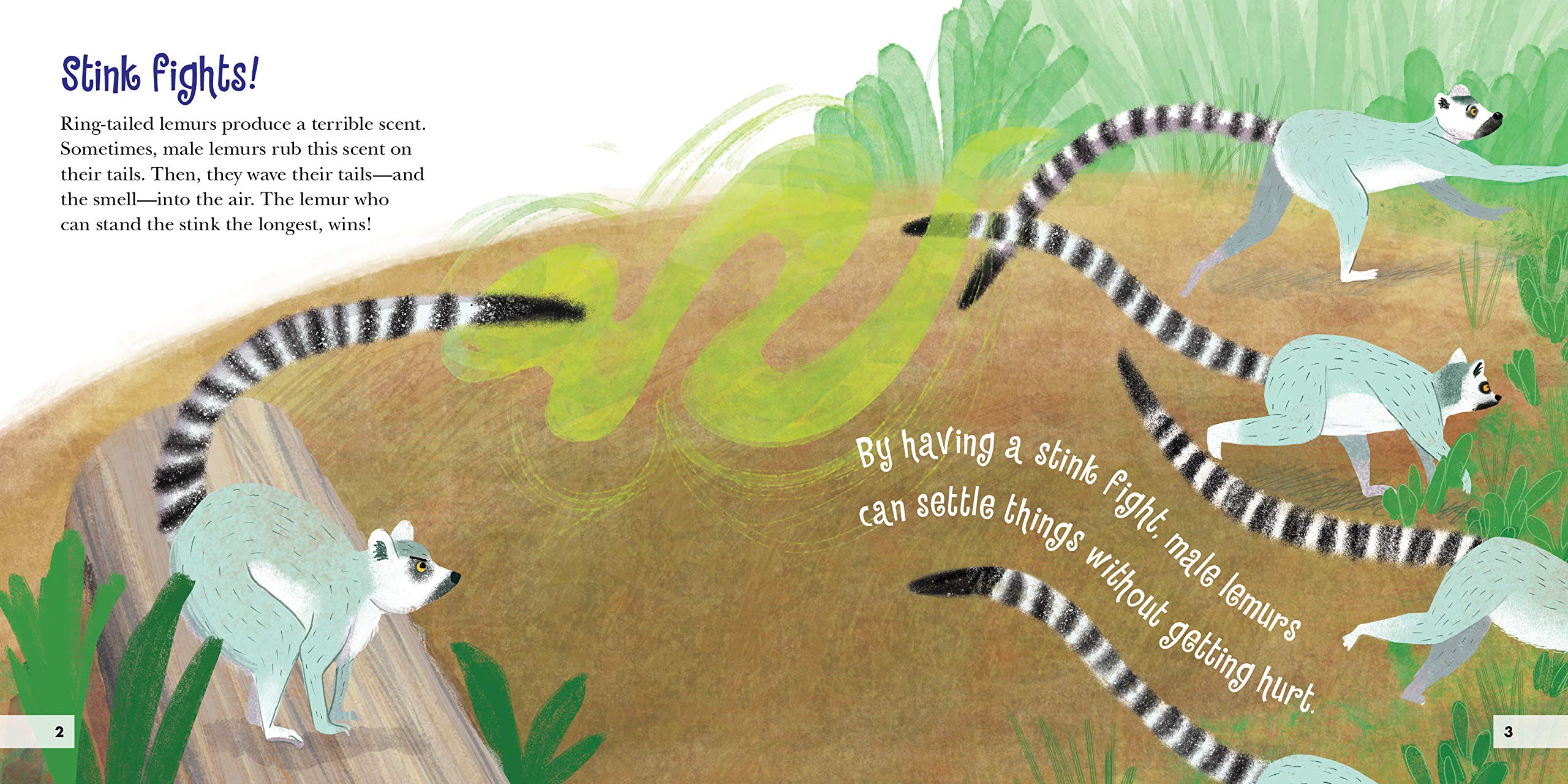
Summary:  Beginning with four haiku about adaptation, the author then moves to a one-page explanation of what animal adaptation is.  From there, it’s a look at individual animals who have interesting adaptations:  ring-tailed lemurs’ stink fights and whales’ earwax from the title, as well as elephants’ ears, star-nosed moles’ noses, giant anteaters’ tongues, and more.  Each two-page spread includes an illustration and a few sentences describing the adaptation and how it helps that animal.  Includes an activity to explore how humans adapt; a page called “Connections” which is a list of fun facts about mammals; and a glossary.  32 pages; ages 4-8.

Pros:  A fun introduction to animal adaptation (specifically mammals) with playful illustrations and facts that are sure to pique the interest of young readers.

Cons:  There’s not a lot of information or additional resources; some facts, like “Elephants have an excellent sense of smell” don’t get any additional explanation.

If you would like to buy this book on Amazon, click on.

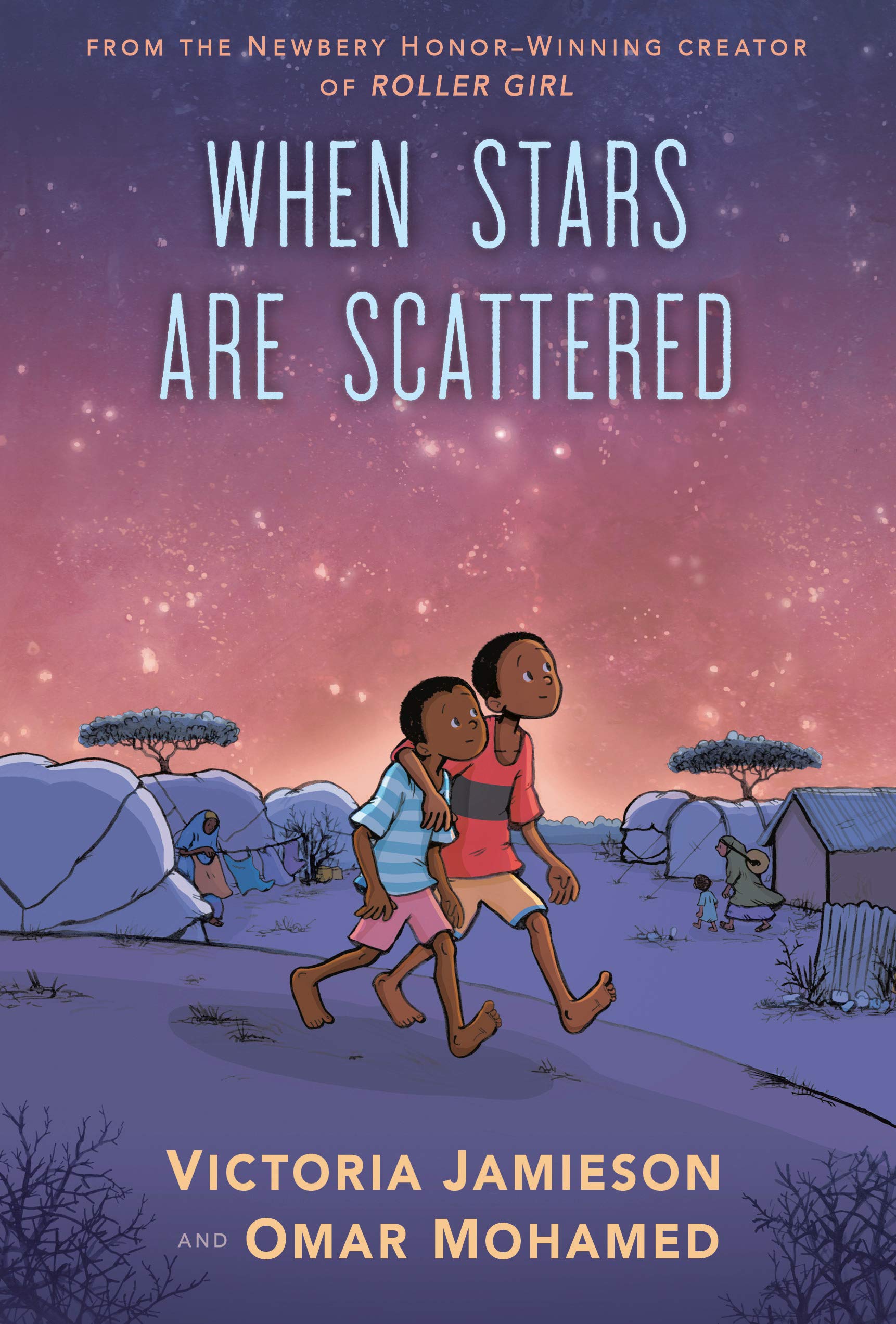
When Stars Are Scattered by Victoria Jamieson and Omar Mohamed

Published by Dial Books

When Stars Are Scattered: Jamieson, Victoria, Mohamed, Omar ...

When Stars Are Scattered on Apple Books

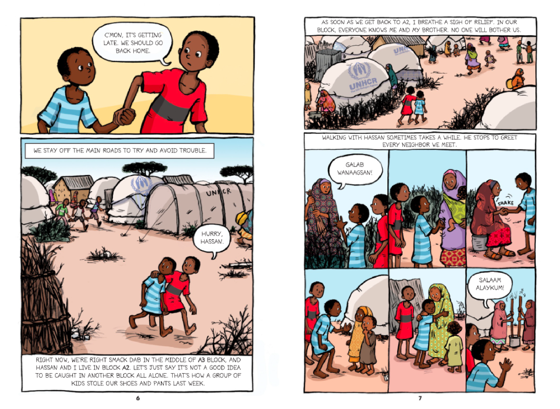
Summary:  Omar and his younger brother Hassan have spent a good portion of their lives in a refugee camp in Kenya.  Originally from Somalia, they have been refugees since their father was killed and their mother disappeared during the civil war there.  An older woman named Fatuma lives in a nearby tent and acts as a foster mother to the boys.  Every day in camp is pretty much the same.  Omar wishes he could go to school, but feels that he must stay at home with Hassan, who is nonverbal and has seizures.  The book covers many of the years the boys are in the camp, starting when they are young, and continuing as Omar finally decides to go to school, where he is able to stay until he graduates high school; and their excruciating wait for resettlement, which finally ends when they get permission to move to the United States in 2009.  An afterword tells what happened to the two after they moved to the U.S.; there are also authors’ notes by both authors telling how they came to create this book.  264 pages; grades 4-8.

Pros:  This may be my favorite book of the year so far.  I love Victoria Jamieson’s work, and her artwork is as engaging as it was in Roller Girl and All’s Faire in Middle School.  The story is compelling, and readers will experience the boredom of the refugee camp, as well as the seesawing between hope and despair.  Victoria Jamieson has so many fans, and having her name on this book will make this important story accessible to kids who might not otherwise read it.  I’d love to see it considered for the Newbery or other awards.

Cons:  The story is very different from the lighthearted middle-grade fare of Jamieson’s other works.  While there’s nothing in here that’s inappropriate for fourth and fifth graders, kids who pick it up expecting more of the same may need a little guidance.

If you would like to buy this book on Amazon, click here.

111 Trees: How One Village Celebrates the Birth of Every Girl by Rina Singh, illustrated by Marianne Ferrer (CitizenKid series)

Published by Kids Can Press (Released October 6)

111 Trees: How One Village Celebrates the Birth of Every Girl by ...

Summary:  Growing up in India, Sundar Paliwal watched his mother as she spent hours fetching water, cried over her hungry children, and ultimately died of a snakebite when he was still a child.  As an adult, he worked in a marble factory and witnessed the environmental devastation this work caused.  When his oldest daughter died, he planted trees in her memory.  This gave him the idea to plant 111 trees to honor any girl born in his village.  There were celebrations whenever a boy was born, and Sundar believed that girls should be celebrated as well.  After winning an election to be head of the village, Sundar put his many ideas into practice, and today, there is plenty of food and water, and girls go to school with boys until they are 18.  He continues to plant 111 trees any time a girl is born.  Includes five pages of back matter with additional information, photos, and ways kids can help Sundar’s work.  36 pages; grades K-5.

Pros:  I’m a huge fan of the CitizenKid books and review them whenever I can (look for another one coming soon).  Like others in the series, this one profiles a real person who has made a difference in a part of the world American kids may not know much about.  It also empowers kids to see how an ordinary person can do extraordinary things in their community, and gives them ways that kids can contribute.

Cons:  I’d like to see a world map in all the CitizenKid books showing where the story takes place.

If you would like to buy this book on Amazon, click here.

Bright Dreams: The Brilliant Ideas of Nikola Tesla by Tracy Dockray

Published by Capstone Editions (released August 1)

Bright Dreams: The Brilliant Ideas of Nikola Tesla by Tracy ...

Bright Dreams: The Brilliant Ideas of Nikola Tesla by Tracy ...

Summary:  Growing up in the 19th-century Austrian empire, Nikola Tesla was fascinated by electricity and dreamed of studying engineering.  Although his father wanted him to become a priest, Nikola eventually got his way.  He was so focused on his questions about electricity, though, that he flunked out of engineering school.  Tesla eventually emigrated to America, where he worked with both Thomas Edison and George Westinghouse to develop his ideas about AC (alternating current) electricity.  In spite of his brilliance, Nikola lacked the social and business skills to make his inventions a success, and died a poor man at the age of 86.  His life and ideas have experienced a revival in recent years, including the naming of the Tesla car.  Includes a timeline, bibliography, and additional sources of information.  32 pages; grades 2-5.

Pros:  This is a good introduction to Nikola Tesla’s life, and would serve as a good starting point for research for elementary kids.  Plenty of sidebars help explain some of the more technical aspects of Tesla’s work.  

Cons:  Thomas Edison sounds like a pretty terrible person.

If you would like to pre-order this book on Amazon, click here.

If You Take Away the Otter by Susannah Buhrman-Deever, illustrated by Matthew Trueman

Published by Candlewick (Released May 26)

If You Take Away the Otter: Susannah Buhrman-Deever, Matthew ...

If You Take Away the Otter: Susannah Buhrman-Deever, Matthew ...

Summary:  Kelp forests, like any habitat, are home to a web of living creatures that keep the whole ecosystem in balance.  Otters do their part by eating the fish, shellfish, and sea urchins that live in these forests.  But a demand for the otters’ fur, beginning in the eighteenth century, reduced the otter population on the Pacific coast from between 150,00 and 300,000 to fewer than 2,000.  Without the otters, sea urchins flourished, eating the base of the kelp and eventually destroying the forests.  In 1911, laws were passed to stop the fur trade, and the otters slowly began to return.  As the otter population went up, the sea urchins’ went down, until balance was restored once again.  Includes additional information about kelp forests, sea otters, and people; a bibliography; and a list of additional resources.  32 pages; grades 1-4.

Pros:  Another book that shows the importance of maintaining the balance of an ecosystem, how humans often mess that up, and how laws and other regulations can help to restore it.  The text is simple enough for primary grades without being condescending, the watercolor illustrations of the kelp forest world are beautiful, and the sea otters are adorable.

Cons:  There’s a little too much anthropomorphized good-versus-evil in the world of the kelp forest, with the sea otters being described as “the kings of these forests” without any evidence to back that claim.  Meanwhile, the sea urchins, who were really just doing their thing, are portrayed as “an army”.  It doesn’t help that they look a bit like a well-known virus. 

Links to COVID-19 Resources – Copyright Clearance Center     40 Animal Species that Outlive the Rest

Is there a resemblance, or am I just starting to see coronavirus everywhere?

If you would like to buy this book on Amazon, click here.


Jefferson Measures a Moose by Mara Rockliff, illustrated by S. D. Schindler

Published by Candlewick (Released August 4)

Jefferson Measures a Moose: Mara Rockliff, S. D. Schindler ...

Jefferson Measures a Moose: Mara Rockliff, S. D. Schindler ...

Summary:  Thomas Jefferson loved numbers and was always measuring, observing, and jotting down all things quantitative.  So when he read a book by a French naturalist named Buffon, claiming that America was a terrible place populated with weak and puny animals, Jefferson was determined to set the record straight.  He wrote a book of his own, filled with measurements of different American animals.  But when he presented this book to Buffon in person, the Frenchman was unimpressed.  Jefferson was living in France at the time, so he put his friend James Madison to work back home measuring moles and weighing weasels.  He even got a friend from New Hampshire to ship him a dead moose (which arrived in France a bit worse for the wear).  Buffon died before printing a retraction, but Jefferson continued his work to prove to Europeans that Americans and their animals were healthy and robust.  Includes an afterword with additional information; some examples of Jefferson’s numbers; and lists of both primary and secondary sources.  48 pages; grades 2-5.

Pros:  As she did in Mesmerized: How Ben Franklin Solved a Mystery That Baffled All of France, Mara Rockliff has written a fun, well-researched, and informative picture book in which a Founding Father takes on a Frenchman and blinds him with science.  The excellent back matter makes this a great starting point for research.

Cons:  While the illustrations were fun and perfectly adequate, I preferred the more distinctive ones in Mesmerized done by Iacopo Bruno, who also illustrated Rockliff’s Anything But Ordinary Addie.

If you would like to buy this book on Amazon, click here.