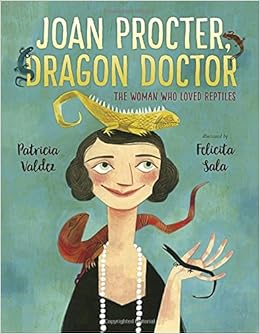
Joan Procter, Dragon Doctor: The Woman Who Loved Reptiles by Patricia Valdez, illustrated by Felicita Sala

Published by Knopf Books for Young Readers

Image result for joan procter dragon doctor amazon

Image result for joan procter dragon doctor

Summary:  From the time she was a young girl, Joan Procter loved reptiles.  Instead of a doll, she carried around her favorite lizard, and she got a pet crocodile for her 16th birthday.  She started hanging out with the curator of reptiles and fish at the Natural History Museum when she was still in high school. He was impressed enough to hire Joan as his assistant, and she eventually took over his job when he retired.  From there, she went to work at the London Zoo, designing a new reptile house. The most amazing part of her new creation was the exhibit featuring Komodo dragons, a fabled but little-known animal from Indonesia.  People assumed they were ferocious, but Joan soon learned they were quite gentle, and one of them, Sumbawa, became something of a pet to her. He often accompanied her around the zoo, at children’s tea parties she held there, and even at a scientific presentation at the Zoological Society in London.  An author’s note gives more biographical information, including the sad fact that Joan was sickly much of her life and died at the age of 34. 40 pages; grades K-4.

Pros:  Kids will warm up right away to Joan and her love of animals; they’ll also be inspired by her groundbreaking work as a woman scientist.  The illustrations are beautiful, especially the ones of the reptiles.  And who doesn’t love a Komodo dragon?

Cons:  Hopefully no reader will be inspired to bring a baby crocodile to math class, like Joan did.

If you would like to buy this book on Amazon, click here.

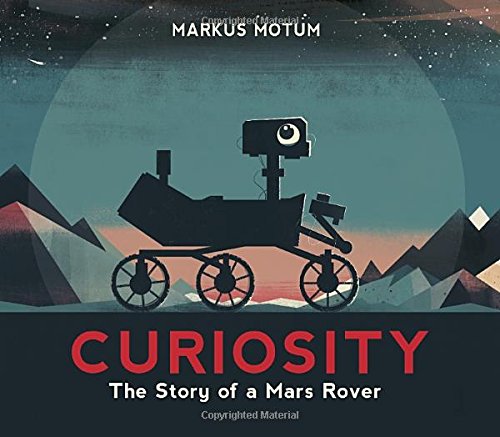
Curiosity: The Story of a Mars Rover by Markus Motum

Published by Candlewick

Image result for curiosity mars rover motum amazon

Summary:  In a first-person narration, the Mars rover Curiosity tells her story, beginning before she was built, when scientists at NASA started designing probes to learn more about Mars.  Curiosity (she was named by a sixth grader from Kansas) was to be larger and more advanced than any of the previous probes.  Labeled illustrations show the processes of designing and building her in Los Angeles, then flying her to Florida, where she was launched on November 26, 2011.  After 253 days of space travel and a somewhat precarious landing, Curiosity began the work of exploring Mars that she continues today.  Includes additional information about Mars rovers, a timeline, and a glossary.  56 pages; grades 2-6.

Pros:  The personification of the rover makes it accessible for elementary school kids; the text, illustrations, and labeled diagrams provide a lot of information.

Cons:  Two design issues: the book is so large it feels a bit unwieldy, and some of the black-on-blue or blue-on-black type/background combinations are difficult to read.

If you would like to buy this book on Amazon, click here.

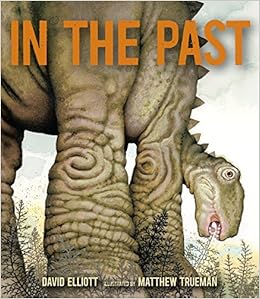
In the Past by David Elliott, illustrated by Matthew Trueman

Published by Candlewick

Image result for in the past elliott amazon

Image result for in the past matthew trueman david elliott

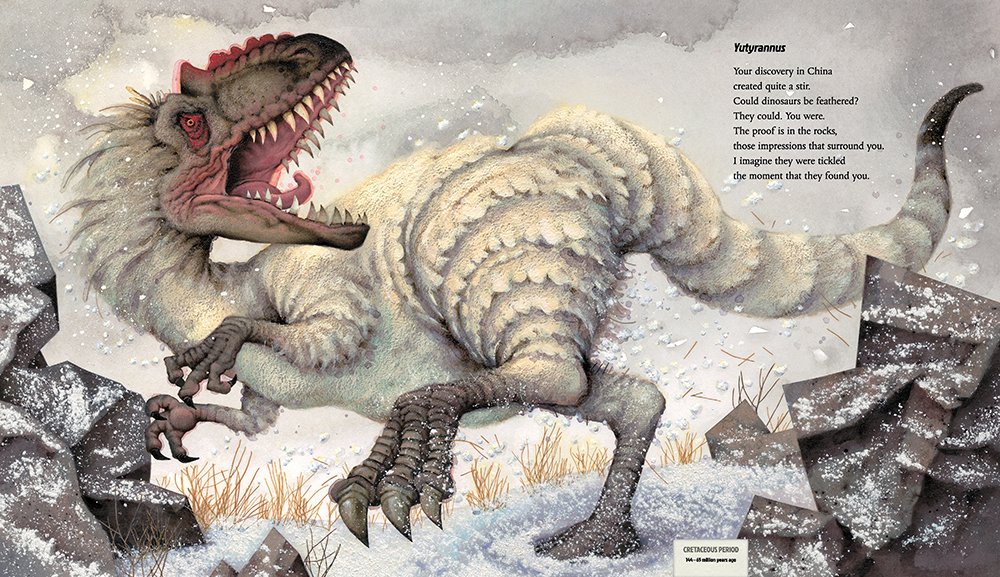
Summary:  Twenty poems are illustrated with oversized paintings of a variety of prehistoric creatures from the trilobite (“So many of you./So long ago./So much above you./Little below.”) to Tyrannosaurus Rex.  (You thought/(if you could think)/you’d live forever./The great T. rex/would never die!/But even kings/are vanquished/when stars fall/from the sky.”).  Early mammals like the smilodon (a.k.a. Saber-tooth tiger) and mammoth are included.  Each illustration is labeled with the geological period when that animal lived.  Back matter includes a note from the author and information about the animals that inspired the poems. 48 pages; ages 3-8.

Pros:  Dinosaur fans will love the giant (and appropriately ferocious) illustrations as well as the brief, funny poems.

Cons:  Additional scientific information on each page would have made some of the poems more understandable.

If you would like to buy this book on Amazon, click here.

The Girl Who Drew Butterflies: How Maria Merian’s Art Changed Science by Joyce Sidman

Published by HMH Books for Young Readers
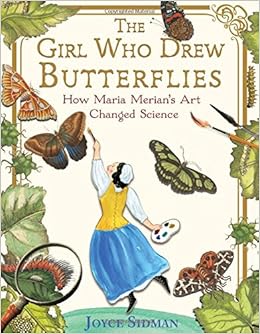
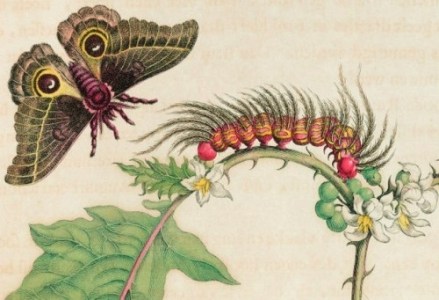
Image result for girl who drew butterflies amazon

Image result for maria merian paintings

Summary:  Maria Merian faced some tough obstacles to studying science in the 17th century, not the least of which was the risk of being painfully executed for practicing witchcraft.  Fortunately, she had a supportive family who was pretty tolerant of her obsession with insects.  Her father was a printer and engraver; after he died, she had an artist stepfather.  Both included her in the family business, and Maria used her artistic skills to capture what she observed in nature.  She set about disproving the theory of spontaneous generation by studying the life cycles of as many moths and butterflies as she could.  As an adult she produced books of her subjects, usually in their natural habitats, making connections between plants and animals that few of her contemporaries observed.  In her 50’s, she traveled with her daughter to Suriname, where she was among the first European naturalists.  Her final masterpiece, an illustrated guide to the insects and plants she observed there, was well-received throughout Europe and influenced John James Audubon and other naturalists more than a century later.  Includes an author’s note, timeline, bibliography, and index.  160 pages; grades 5-8.

Pros:  A fascinating biography of a woman who was many centuries ahead of her time, balancing family and running a household with her art and science careers.  Her paintings and engravings throughout the book are almost unbelievably detailed and realistic.  Newbery poet Joyce Sidman named each chapter for a stage of a butterfly’s life and wrote an appropriate poem for each.

Cons:  While the book seems like it could appeal to third and fourth graders (only 120 pages of text and lots of pictures), the subject matter makes it more appropriate for grades 5-8.

If you would like to buy this book on Amazon, click here.
 

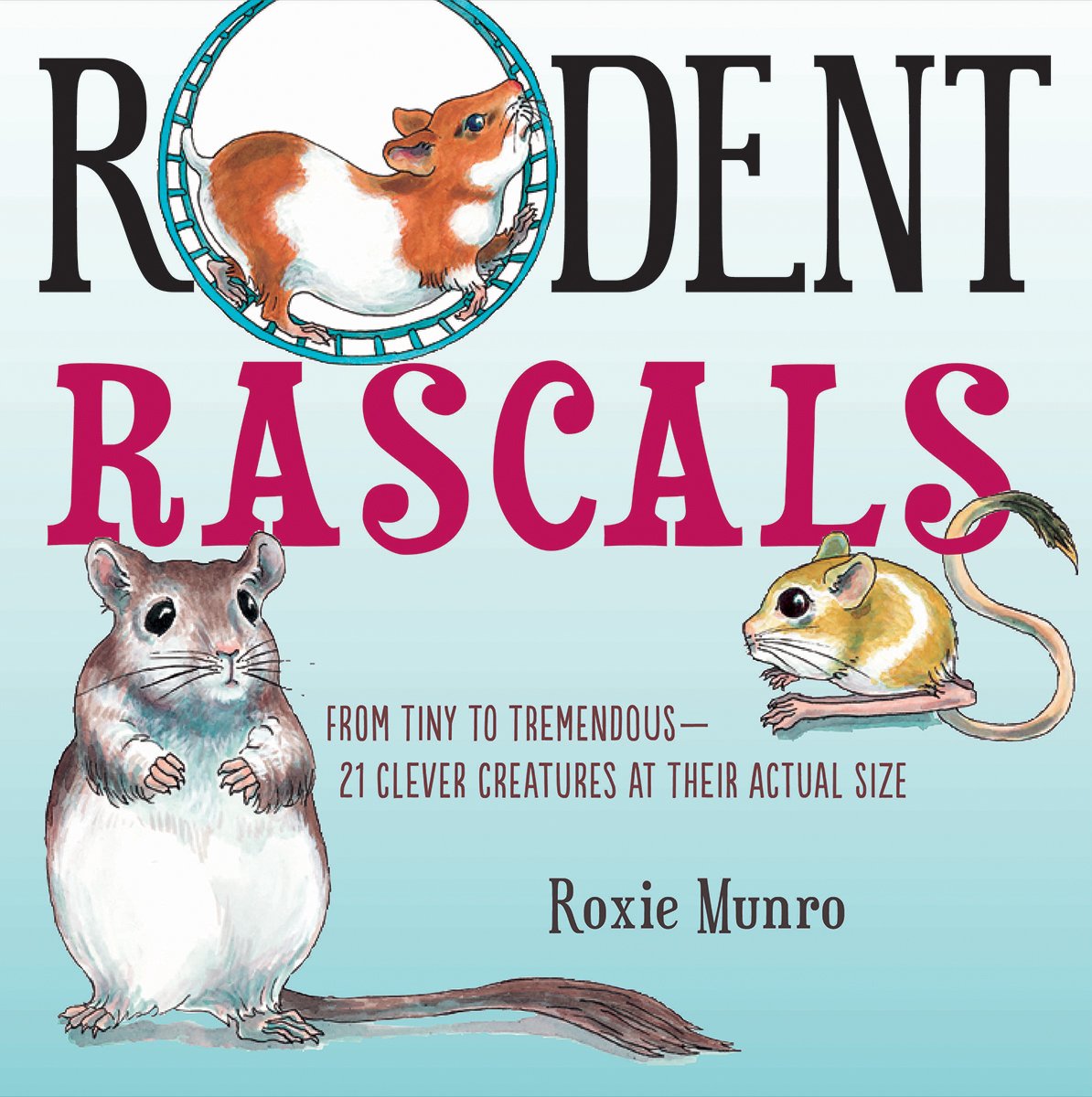
Rodent Rascals: From Tiny to Tremendous–21 Clever Creatures At Their Actual Size by Roxie Munro

Published by Holiday House

Image result for rodent rascals amazon

Summary:  Rats! A book about rodents? Yes, and there are rats…and lots of other rodents from the two-inch pygmy jerboa to the 150-pound capybary. Each animal is portrayed in actual size (or as much of it as can fit on a page) with a paragraph of text providing some interesting facts about it. An introductory page explains what makes an animal a rodent; two pages at the end provide researchers with the size, habitat, and scientific name of each creature. Includes a glossary, index, and additional resources. 40 pages; grades K-4.

Pros: Animal lovers as well as rodent-phobes (I just made up that word, but I kind of am one) will learn quite a bit and enjoy the large ink and acrylic illustrations.

Cons:  Is it accurate to have guinea pigs in this book? Back in the days when I was a guinea pig owner (technically, my children were the owners, but you know how that goes), I was told guinea pigs aren’t rodents.  There seems to be some controversy about this, and guinea pigs may be leaving the world of rodents for their own order, as rabbits did before them.

If you’d like to buy this book on Amazon, click here.
 

A Chip Off the Old Block by Jody Jensen Shaffer, illustrated by Daniel Miyares

Published by Nancy Paulsen Books

Image result for chip off old block miyares amazon

Image result for chip off old block miyares

Summary:  Rocky is little, but he dreams of doing great things like his Aunt Etna the volcano or his Uncle Gibraltar, who rules over huge ships and oceans.  His parents tell him he’s just a pebble, “a chip off the old block”, as his dad likes to say, but Rocky feels like a boulder inside.  Traveling by truck, eagle flight, and car, he visits the Grand Canyon, Devil’s Tower, and Mt. Rushmore.  At Mt. Rushmore, he learns that the destination has closed because Abraham Lincoln’s nose is cracked.  Rocky travels down Lincoln’s face, and realizes he fits perfectly into the crack.  All is well, and Rocky feels like he is no longer taken for granite.  Includes information about the three types of rocks and identifies the famous rocks in the story, along with each one’s type.  32 pages; grades K-3.

Pros:  A fun introduction to rocks and some famous geological sites around the world.

Cons:  The ending felt a little forced.

If you would like to buy this book on Amazon, click here.
All That Trash: The Story of the 1987 Garbage Barge and Our Problem With Stuff by Meghan McCarthy

Published by Simon and Schuster

Image result for all that trash meghan mccarthy amazon

Image result for all that trash meghan mccarthy amazon

Summary:  In 1987, Lowell Harrelson had the brilliant idea to make electricity from the methane gas released by decomposing garbage.  He rented a barge, hired two tugboat drivers, and loaded over 3,000 tons of garbage to be hauled from New York to North Carolina.  When the (incorrect) rumor got out that there was medical waste on the barge, officials in North Carolina refused to let the trash into the state. Thus began a saga that continued for five months and over 6,000 miles as one state after another (and a few countries) refused the barge entry.  Unbelievably, the trash ended up back in New York, where sanitation workers burned it. The news media picked up the story and ran with it, raising awareness about the problem of overflowing landfills and giving momentum to the recycling movement. Includes additional facts about the barge, garbage, and recycling, as well as a very complete bibliography.  48 pages; grades 2-5.

Pros:  Meghan McCarthy has a knack for finding obscure stories and bringing them to life, making them relevant to today’s readers.  Her bug-eyed portraits and cartoon bubbles make this entertaining and highly readable, while the text imparts plenty of information.

Cons:  Five months hauling a barge with 3,000 tons of garbage.  Eww.

If you would like to buy this book on Amazon, click here.
Thank You, Earth: A Love Letter to Our Planet by April Pulley Sayre

Published by Greenwillow Books

Image result for thank earth sayre amazon

Summary:  April Pulley Sayre writes a thank you note to planet Earth with poetry and photographs.  She looks at the materials that make up Earth (air, rocks, water), the shapes (curves, lines, and patterns), and living things (plants, animals).  Every part of earth is celebrated, even storms and things that sting, with a conclusion of “Thank you for beginnings, for endings, for lifetimes. Thank you for being our home.”  Back matter includes two pages of suggestions on how kids can turn their thank you’s into action for the earth, including a list of resources and organizations.  40 pages; ages 4-8.

Pros:  As always, Sayre’s nature photography is up close and gorgeous.  This would be a perfect book to share with young kids on Earth Day, maybe with some follow-up action.

Cons:  The poem seemed a little clunky to me.

If you would like to buy this book from Amazon, click here.

The Monarchs Are Missing: A Butterfly Mystery by Rebecca E. Hirsch

Published by Millbrook Press

Image result for monarchs missing hirsch amazon

Summary:  The monarchs are missing?  Some of them are, anyway.  In the last two decades, the monarch butterfly population has steeply declined.  How can we even know how many monarchs there are?  The answer to that goes back to the 1960’s when scientists first discovered the areas in Mexico where monarchs spend the winter.  Since then, they’ve taken annual measurements of the area the butterflies inhabit to get a rough estimate of the population.  There’s no agreement in the scientific community about why there are so many fewer monarchs today, but some theories include climate change, new pesticides, and agricultural methods that have impacted milkweed, the butterflies’ main food source.  Kids can help by planting milkweed and other wildflowers that provide nectar for the monarchs during their migration south.  Includes an author’s note, glossary, 3 books for further reading, an index, instructions for planting a butterfly garden, and several websites to help kids become citizen scientists.  56 pages; grades 3-7.

Pros:  A fascinating look at science at work, with plenty of photos and kid-friendly ideas for making a difference.

Cons:  The introduction profiled two kids catching and tagging butterflies; it would have been interesting to read more about kids acting as citizen scientists.

If you would like to buy this book from Amazon, click here.

The Bee Book by Charlotte Milner

Published by DK Children

Image result for bee book milner amazon

Image result for bee book milner

Summary:  What’s the buzz about bees?  This book seeks to answer this and quite a few more questions like “Where does honey come from?”, “What would we do without bees?”, and “What can you do to help?”.  Turns out the whole “busy as a bee” thing is real; you might appreciate that spoonful of honey more when you know it’s the lifetime’s work of 12 honeybees (a jar of honey represents 55,000 miles of flying).  Why should humans be concerned about the disappearance of bees?  One-third of our food comes from crops pollinated by animals.  Scientists are working to develop a robot bee, but it’s not quite the same, is it?  Activities at the end include making a bee hotel and planting a garden to help bees in their pollination efforts.  48 pages; grades K-5.

Pros:  Interesting information combined with lots of graphics make this an appealing choice to learn more about all kinds bees, with a focus on honeybees.

Cons:  The whole bee situation is a lot more serious than I realized.

If you would like to buy this book from Amazon, click here.