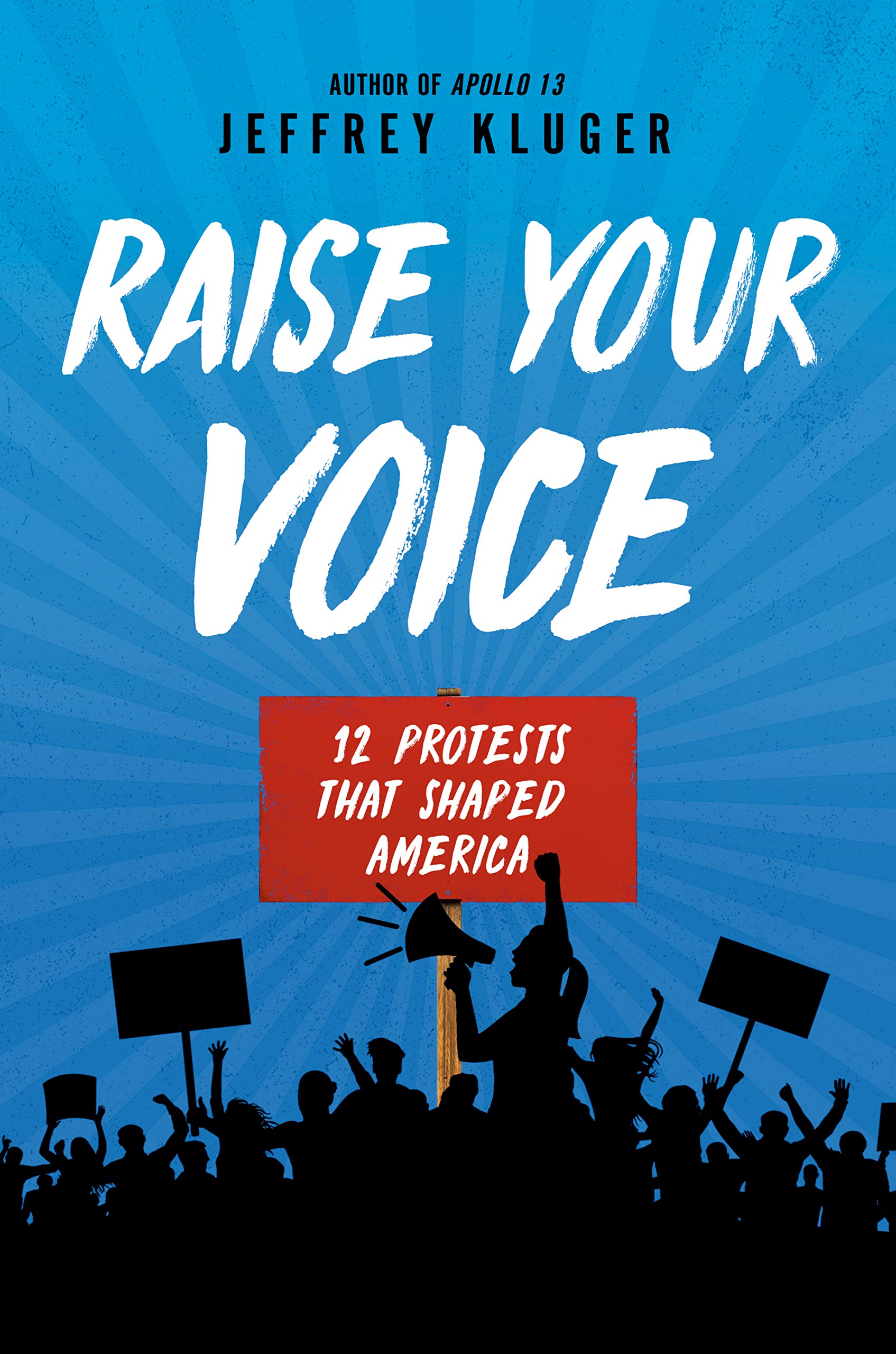
Raise Your Voice: 12 Protests That Shaped America by Jeffrey Kluger

Published by Philomel Books

Raise Your Voice: 12 Protests That Shaped America: Kluger, Jeffrey ...

Summary:  From the Boston Tea Party to the Dakota Access Uprising and the Women’s March, these twelve chapters cover protests organized by ordinary people that have stood up to the established order and helped effect change.  Other than the Tea Party and the Seneca Falls Convention, the rest are from the 20th and 21st century, including the Triangle Shirtwaist Factory Fire, the Montgomery Bus Boycott, the March on Washington, the 1968 Democratic Convention, the Stonewall Uprising, Earth Day, the March Against Nuclear Weapons, and ACT UP.  Each chapter begins with a photo, then gives some background before launching into the people and places of each protest, and the outcomes they did or didn’t achieve.  There are no source notes, but there’s a “Note on Sources” at the end that gives a good introduction to different types of sources and research; there is also an extensive index.  224 pages; grades 6 and up.

Pros:  Seeing as we seem to be living through chapter 13 of this book, readers may find a lot to connect with and inspire them.  It was encouraging to read about the impact these protests made.  The narratives are engagingly written; each one could be used as a stand-alone research source.  

Cons:  The small font and lack of photos made this not very visually appealing.  Also, in the heads-up category, protesters do use salty language, which is represented as “f—” or other fill-in-the-blank forms.  And there’s no getting around the need to describe the pussy hats of the Women’s March, but it’s pretty sanitized.

If you would like to buy this book on Amazon, click here.

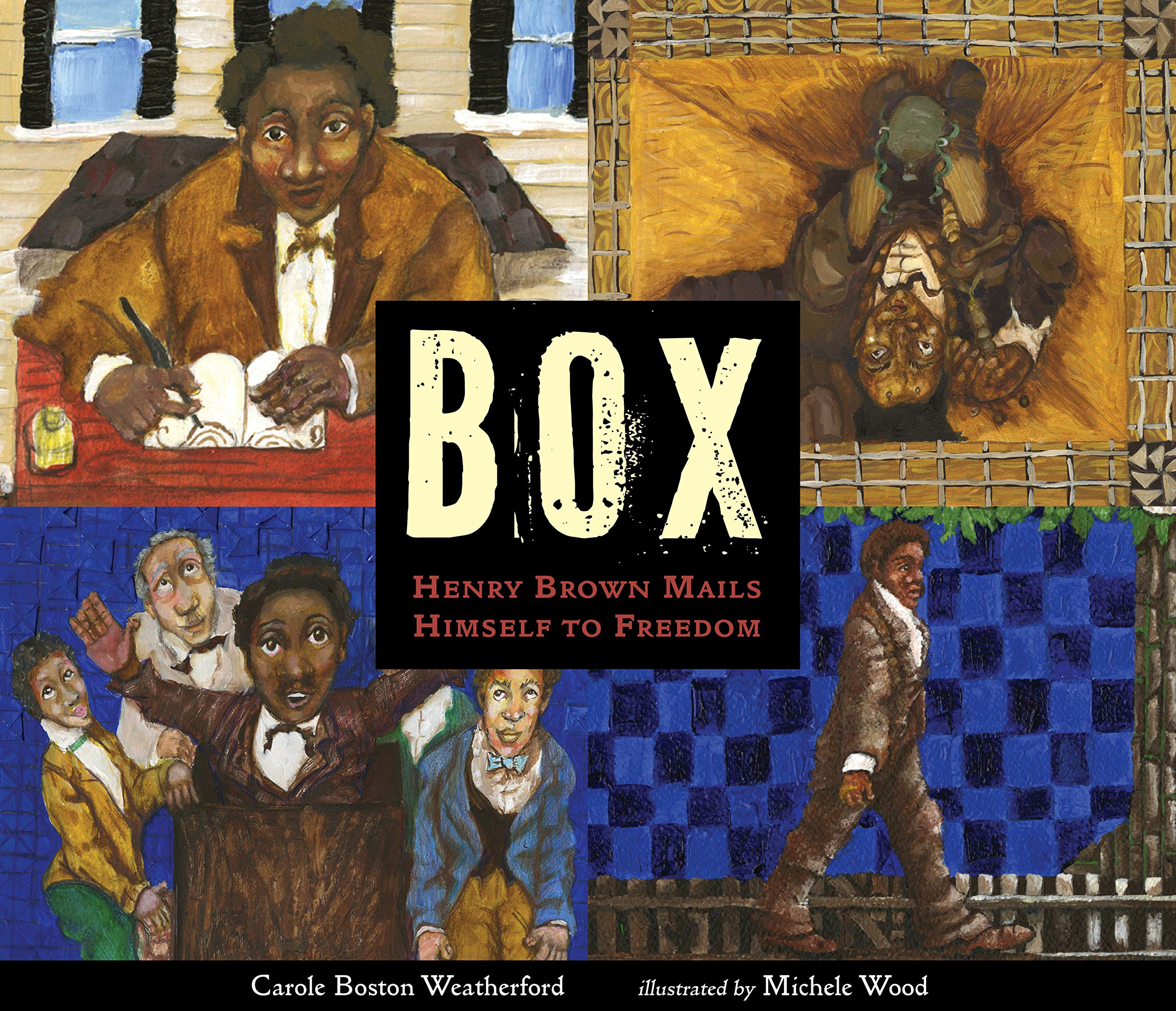
Box: Henry Brown Mails Himself to Freedom by Carole Boston Weatherford, illustrated by Michele Wood

Published by Candlewick

BOX: Henry Brown Mails Himself to Freedom: Weatherford, Carole ...

BOX: Henry Brown Mails Himself to Freedom: Weatherford, Carole ...

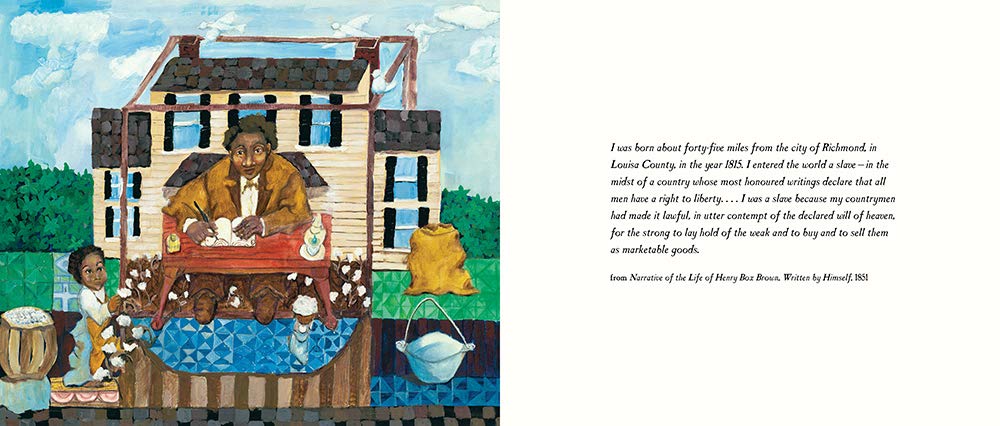
Summary:  Henry Brown’s story has been told before, probably most famously (for kids) in the Caldecott Award winning Henry’s Freedom Box by Ellen Levine. Here, the narrative is in the form of a series of six-line poems.  They focus not only on Henry’s story, but on other aspects of slavery, including Nat Turner’s rebellion and the division of families, both Henry’s family of origin and later, his forced separation from his wife and children.  His harrowing escape in a sealed box traveling for two days from Virginia to Philadelphia is described, as well as the almost fifty years he lived afterward.  Brown published his story, The Narrative of the Life of Henry Box Brown, and created a moving panorama that he exhibited in both the U.S. and England, remaining overseas with his wife and daughter for almost 25 years.  Includes a timeline of both Henry Brown’s life and other significant events that occurred during his lifetime, a bibliography, and an illustrator’s note.  40 pages; grades 4-8.

Pros:  This would make an excellent companion to Henry’s Freedom Box, giving older students a chance to delve into Brown’s life a little deeper.  The first-person poems are enhanced by the mixed media folk art illustrations.  It would be an interesting twist in children’s literature history if this book received a Caldecott medal or honor next year.

Cons:  Due to the nature of poetry, readers have to make a fair number of inferences to understand the details of Henry Brown’s life.  An introductory note would have maybe made this a little simpler, as would reading this in conjunction with Ellen Levine’s book.

If you would like to buy this book on Amazon, click here.

Stamped: Racism, Antiracism, and You: A Remix of the National Book Award Winning Stamped from the Beginning by Jason Reynolds and Ibram X. Kendi

Published by Little Brown Books for Young Readers

Amazon.com: Stamped: Racism, Antiracism, and You: A Remix of the ...

Summary: In this “remix” of Ibram Kendi’s award-winning book Stamped from the Beginning, Jason Reynolds tells the history of racism in America, going back to the fifteenth century and continuing to (almost) the present day.  Focusing on people such as Cotton Mather, Thomas Jefferson, William Jennings Bryan, and Angela Davis, Reynolds explores their lives and beliefs in the context of racism vs. assimilation vs. antiracism.  Starting off with the statement (revisited many times) that “this is not a history book”, the book is written in a tone designed to appeal to young readers.  Includes an afterword, acknowledgements from both Jason Reynolds and Ibram X. Kendi, a lengthy reading list, and extensive source notes.  320 pages; grades 6-12.

Pros:  Jason Reynolds’ book could not have been more timely, and will undoubtedly find its way into the curriculum of many a school district in the coming year.  As he has proven in his fiction writing, his writing style is extremely engaging for young adults, who may be relieved to hear this isn’t a history book and will enjoy reading it for their own edification.  The content will reveal to them–and to adults as well–what has traditionally been left out of the telling of America’s past, and will give them an antiracist lens with which to view the present.

Cons:  Covering 600 years of history in a book of this length is a daunting task, and readers may struggle to keep all the names, places, events, and belief systems straight as they quickly travel through the centuries.

If you would like to buy this book on Amazon, click here.

Close Calls: How Eleven U.S. Presidents Escaped from the Brink of Death by Michael P. Spradlin

Published by Bloomsbury Children’s Books

Close Calls: How Eleven US Presidents Escaped from the Brink of ...

Summary:  These stories relate how eleven United States presidents narrowly escaped death, either before their administration or during it.  Quite a few are war stories, including George Washington in the American Revolution, and John F. Kennedy, Dwight D. Eisenhower, George H. W. Bush, and Gerald Ford in World War II.  A few were assassination attempts on sitting presidents: Andrew Jackson, Theodore Roosevelt, Harry Truman, and Ronald Reagan.  The story of Abraham Lincoln is how rumors of assassination were thwarted while Lincoln traveled to Washington, D.C. after he was elected president.  Each story includes at least one sidebar with information on a topic related to the main narrative.  Includes a list of sources and an index.  128 pages; grades 4-8.

Pros:  These exciting survival stories with some name recognition of at least the most famous presidents will surely entice some reluctant readers to sample some nonfiction.  Each chapter is relatively short with plenty of action.

Cons:  Not a single photo, and some of the stories (Kennedy, Carter, Reagan) have no dates.

If you would like to buy this book on Amazon, click here.

All of a Sudden and Forever: Help and Healing After the Oklahoma City Bombing by Chris Barton, illustrated by Nicole Xu

Published by Carolrhoda Books

All of a Sudden and Forever: Help and Healing after the Oklahoma ...

Q&A with Chris Barton – BookPeople

Summary:  “Sometimes bad things happen, and you have to tell everyone.  Sometimes terrible things happen and everybody knows.  One April morning in 1995, one of those terrible things happened in Oklahoma City.”  How do you tell the story of the Oklahoma City bombing to a picture book audience?  Answer: in a straightforward manner, with an emphasis on different losses and emotions different people experienced (“Some lost friends, neighbors….Some who survived had bodies broken in ways large and small….Some who rushed into help saw horrible things they would never forget”).  But also with an emphasis on healing, helping (and getting help), and moving on.  At the center of this part of the story is the Survivor Tree, an elm that survived the bombing and flourished in the years afterward, providing seedlings that have been planted far and wide.  Those seedlings have grown into trees and produced seedlings of their own, making the spread of trees an apt metaphor for the spread of help and comfort that has come from the survivors of this tragedy.  Includes author’s and illustrator’s notes; a list of people interviewed for the book, along with their connections to the bombing; and a list of recommended resources.  40 pages; grades 2-6.

Pros:  The Oklahoma City bombing doesn’t seem that long ago…until I look at my 25-year-old daughter who was born seven weeks afterward.  This book does an admirable job of introducing kids to the event, which they may never have heard of.  The illustrations are appropriately subdued; the faceless people in the pictures and the emphasis on grief and healing also make this a story to be read in conjunction with other difficult situations.

Cons:  Readers looking for a lot of information on the actual bombing will need to pursue some of the resources at the end.

If you would like to buy this book on Amazon, click here.

Sharuko: El Arqueólogo Peruano Julio C. Tello/Peruvian Archaeologist Julio C. Tello by Monica Brown, illustrated by Elisa Chavarri

Published by Children’s Book Press (Released August 18)

Sharuko: El Arqueólogo Peruano Julio C. Tello / Peruvian ...

Summary:  Born in Peru in 1880, Julio Tello grew up in an indigenous community, speaking Quecha, the language of the Inca Empire.  His adventurous nature earned him the Quecha nickname Sharuko, meaning “brave”.  He and his brother discovered bones, pottery, and even some human skulls as they explored the foothills of the Andes.  At 12, he went to live with his aunt and study in Lima, eventually graduating from medical school.  After getting a degree in anthropology and archaeology from Harvard, he worked as an archaeologist at the Museum of Natural History in Lima.  His archaeological discoveries showed that indigenous cultures had existed in Peru more than 3,000 years ago, refuting the theories that these cultures originated in Mexico or Central America.  He became director of the new Museum of Anthropology, where he was able to share his discoveries with Peruvians, transforming their understanding of their history.  Includes maps; an afterword, illustrator’s note, and list of sources.  40 pages; grades 2-6.

Pros:  Written in both Spanish and English, this story shines a light on Peruvian history and a man who single-handedly helped rewrite it.  The colorful illustrations feature some of the art and artifacts Tello helped discover.

Cons:  Readers will need some background knowledge to appreciate the story; although the format is a picture book, this will probably appeal more to older elementary and even middle school kids.

If you would like to buy this book on Amazon, click here.

All Thirteen: The Incredible Cave Rescue of the Thai Boys’ Soccer Team by Christina Soontornvat

Published by Candlewick Press (released October 30)

All Thirteen: The Incredible Cave Rescue of the Thai Boys' Soccer ...

Summary:  In the summer of 2018, the entire world watched as rescue teams struggled to save the twelve members of the Wild Boars soccer team and their coach who were stuck inside the flooded Tham Luang Nang Non cave in Thailand.  This book tells the story from the beginning, when this close-knit group of boys ranging in age from 11 to 16, and their 25-year-old coach decided to take a trip to the cave one day after practice.  After the cave unexpectedly flooded, an international team of cavers and divers were called in to figure out the best rescue strategy: pump out the water, drill into the side of the cave, or dive and swim the team out.  In the end, the dive and swim strategy was used, and as the story unfolds, the reader finds out it was nothing short of a miracle that all thirteen were rescued (although a Thai Navy SEAL died delivering oxygen tanks a couple days before the rescue procedure began).  Sidebars give more information about Thailand, caves, and Buddhism (the coach spent much of his life in Buddhist monasteries, and his teachings on meditation helped everyone stay calm inside the cave).  Includes an author’s note that tells of her connection to the story (she was visiting family in Thailand during the rescue); extensive source notes, a bibliography, and an index.  288 pages; grades 4-8.

Pros:  I didn’t think anything could compel me to read a 288-page book on my phone, but once I started reading this story, I couldn’t stop.  The boys and especially their coach are likeable from page 1, and the rescuers endure hunger, sleep deprivation, and what sounded like a really disgusting foot fungus condition to accomplish something that seemed impossible from beginning to end.  The numerous photos draw the reader in, and the sidebars add to the content, and remind me that I’d really like to visit Thailand someday.

Cons:  This book appears to be retailing for almost $25.00.

If you would like to buy this book on Amazon, click here.

The International Day of the Girl: Celebrating Girls Around the World by Jessica Dee Humphries and the Hon. Rona Ambrose, illustrated by Simone Shin

Published by Kids Can Press (Released September 1)

The International Day of the Girl: Celebrating Girls Around the ...

Summary:  In 2011, the United Nations declared that October 11 would be an annual day of recognition for girls around the world–the International Day of the Girl.  This book tells the stories of nine (fictional) girls from all over the world who experienced gender inequality, and took action to remedy it.  Each one is introduced by name and a personality trait (“This is Abuya.  She is creative”), then tells a brief version of her story, including a sidebar about the more global issue it connects to.  For instance, in Kenya,  Abuya overheard her older sister asking to stay home from school because there was no girls’ bathroom.  Assisted by her father, Abuya used her carpentry skills to build an outhouse.  The sidebar describes the issue of providing safe bathroom facilities so girls are able to get an education.  An illustration accompanies each story.  Includes a timeline of events leading to the creation of the International Day of the Girl and further information about each of the issues facing girls addressed in the book.  32 pages; grades 2-6.

Pros:  This was the first I had heard of the International Day of the Girl, and this introduction explains many of the issues affecting girls around the world in a way that readers will understand and connect with.  The introduction uses the metaphor of a garden that’s been divided into two halves, with one half receiving all the nurturing and attention.  The colorful illustrations continue that metaphor, and the last page encourages kids to “be the world’s gardener”.  Another excellent entry in the CitizenKid series.

Cons:  A map showing where the different girls live around the world and some additional resources would have been useful additions.

111 Trees: How One Village Celebrates the Birth of Every Girl by Rina Singh, illustrated by Marianne Ferrer (CitizenKid series)

Published by Kids Can Press (Released October 6)

111 Trees: How One Village Celebrates the Birth of Every Girl by ...

Summary:  Growing up in India, Sundar Paliwal watched his mother as she spent hours fetching water, cried over her hungry children, and ultimately died of a snakebite when he was still a child.  As an adult, he worked in a marble factory and witnessed the environmental devastation this work caused.  When his oldest daughter died, he planted trees in her memory.  This gave him the idea to plant 111 trees to honor any girl born in his village.  There were celebrations whenever a boy was born, and Sundar believed that girls should be celebrated as well.  After winning an election to be head of the village, Sundar put his many ideas into practice, and today, there is plenty of food and water, and girls go to school with boys until they are 18.  He continues to plant 111 trees any time a girl is born.  Includes five pages of back matter with additional information, photos, and ways kids can help Sundar’s work.  36 pages; grades K-5.

Pros:  I’m a huge fan of the CitizenKid books and review them whenever I can (look for another one coming soon).  Like others in the series, this one profiles a real person who has made a difference in a part of the world American kids may not know much about.  It also empowers kids to see how an ordinary person can do extraordinary things in their community, and gives them ways that kids can contribute.

Cons:  I’d like to see a world map in all the CitizenKid books showing where the story takes place.

If you would like to buy this book on Amazon, click here.

Dictionary for a Better World: Poems, Quotes, and Anecdotes from A to Z by Irene Latham and Charles Waters, illustrated by Mehrdokht Amini

Published by Carolrhoda Books

Dictionary for a Better World: Poems, Quotes, and Anecdotes from A ...

The Art of Dictionary for a Better World

Summary:  From “acceptance” and “ally” to “yes” and “zest”, Latham and Waters take readers through an alphabet of words designed to make them think about how to make the world a better place.  Each page features a poem about the word, a personal anecdote written by one of the authors, an appropriate quote, and a definition of the poetic form used. There’s also a “Try It!” suggestion for an activity that focuses on the concept.  Includes a note from the authors; materials referenced in the quotes; additional recommended books; poetry resources; and an index of poetic forms.  120 pages; grades 3-7.

Pros:  The team that brought you Can I Touch Your Hair? has created a beautifully illustrated book that could be used to teach poetry or to begin a discussion on any of the words.  The anecdotes and “Try It!” suggestions could lead to some writing activities.  

Cons:  I wasn’t super excited to read a book entitled Dictionary for a Better World; seems like the authors or editors could have thought of a title with a little more zing.

If you would like to buy this book on Amazon, click here.